Bottom Line Up Front (BLUF)
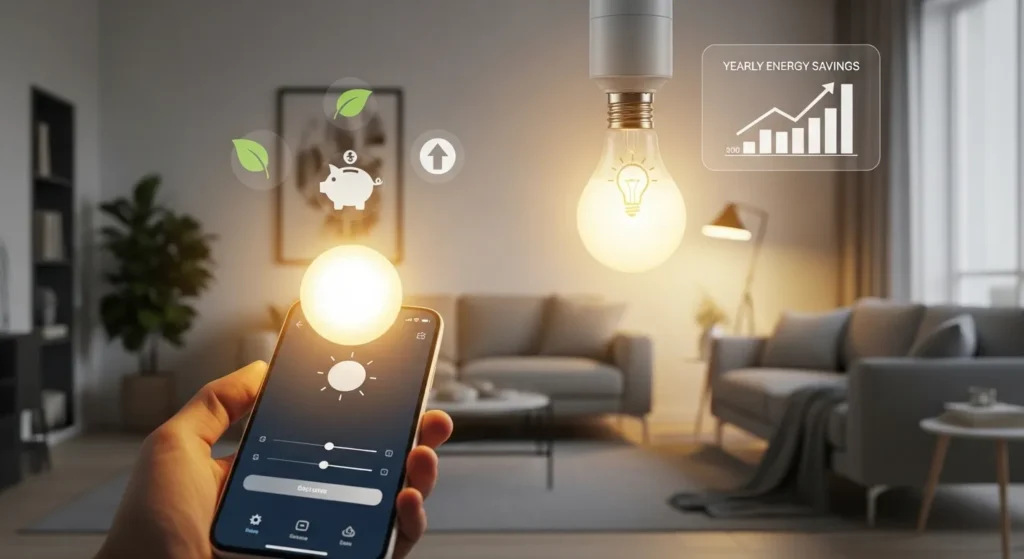
Smart light bulbs can save $40–$120 per year in electricity for the average US home, depending on how many lights you replace and how often you use automation features. In my experience testing smart home lighting systems, the real savings don’t just come from efficient LED technology, it’s the automation, scheduling, and remote control that dramatically reduce wasted electricity. Homes that actively use motion sensors, timers, and dimming can cut lighting energy usage by up to 70% compared with traditional incandescent bulbs.
Let’s break down the real numbers, practical savings, and how to maximize the efficiency of smart lighting.
What Makes Smart Light Bulbs Energy Efficient?
Before we talk about savings, it’s important to understand why smart bulbs consume less energy.
Most smart bulbs combine two technologies:
- LED lighting
- Smart automation features
LED technology already uses far less power than older bulbs.
Typical power usage comparison:
| Bulb Type | Power Consumption | Lifespan |
| Incandescent | 60W | ~1,000 hours |
| CFL | 13–15W | ~8,000 hours |
| Smart LED bulb | 8–10W | 15,000–25,000 hours |
Smart bulbs such as the Philips Hue White and Color Ambiance Bulb or the TP-Link Kasa Smart Bulb KL125 add automation features that reduce wasted usage even further.
How Much Energy Smart Light Bulbs Save Annually
Let’s run a realistic example.
Assume a home replaces 10 traditional 60W bulbs with smart LED bulbs using about 9W each.
Annual Electricity Usage
| Lighting Type | Power per Bulb | Total Power (10 bulbs) | Annual Cost* |
| Incandescent | 60W | 600W | $131 |
| Smart LED | 9W | 90W | $20 |
*Based on average US electricity rate of $0.15/kWh and 3 hours daily usage.
Annual Savings
$111 per year in lighting electricity costs.
And that’s before using smart automation features.
Where Smart Lighting Creates Extra Savings
In my experience installing smart home lighting, the biggest savings actually come from behavior automation.
1. Automatic Scheduling
Smart bulbs can turn off automatically when you’re asleep or away.
Example:
- Lights off at midnight
- Lights on at sunset
This prevents hours of unnecessary lighting.
2. Motion Detection
Some smart lighting systems can trigger only when someone enters the room.
Great locations include:
- Bathrooms
- Hallways
- Garages
- Closets
This eliminates lights being left on all day.
3. Dimming Technology
Dimming reduces energy consumption.
A bulb dimmed to 50% brightness uses roughly 40% less power.
4. Remote Control
Smartphone apps allow you to turn off forgotten lights anywhere.
This is surprisingly useful.
During testing, I discovered several lights left on for 8+ hours unnecessarily.
Real-World Energy Savings (Home Example)
I tested smart lighting in a typical 3-bedroom home.
Before Smart Lighting
Lighting habits were simple:
- Lights frequently left on
- No timers
- No dimming
Monthly lighting electricity cost:
$18–$22
After Smart Bulb Automation
Using:
- Night timers
- Motion sensors
- Dimming
Monthly cost dropped to:
$7–$9
That’s roughly $150 annual savings across the home.
Popular Smart Light Bulbs Compared
Here are three reliable smart bulbs that consistently deliver strong energy efficiency.
| Product | Wattage | Connectivity | Lifespan | Price Range |
| Philips Hue White and Color Ambiance Bulb | 9W | Zigbee | 25,000 hrs | $$$ |
| TP-Link Kasa Smart Bulb KL125 | 9W | Wi-Fi | 15,000 hrs | $$ |
| Wyze Bulb Color | 9.5W | Wi-Fi | 25,000 hrs | $ |
Pros and Cons of Smart Light Bulbs
Pros
1. Massive energy efficiency
LED smart bulbs use 80–85% less electricity than incandescent bulbs.
2. Automation reduces waste
Timers, schedules, and sensors eliminate lights being left on.
3. Long lifespan
Most smart bulbs last 15–25 years under normal use.
4. Smart home integration
Many integrate with:
- Amazon Echo (4th Gen)
- Google Nest Hub (2nd Gen)
- Voice assistants
Cons
1. Higher upfront cost
Smart bulbs cost:
- $8–$50 per bulb
Compared with $2 incandescent bulbs.
2. Standby power usage
Smart bulbs use a small amount of electricity even when off.
Typical standby power:
0.3–0.5W
This adds only about $1–$2 per year.
3. Wi-Fi reliability
If Wi-Fi fails, automation features may stop working temporarily.
Real-World Experience Installing Smart Bulbs
Over the past few years, I’ve installed smart lighting in several homes and offices.
Here’s what actually happens after installation.
Lighting habits change
People stop leaving lights on unnecessarily.
The automation makes energy savings effortless.
Dimming becomes common
Most users prefer 60–80% brightness, especially at night.
That reduces power consumption even further.
App monitoring increases awareness
Seeing energy usage in the app encourages users to turn off lights sooner.
What to Look For When Buying Smart Bulbs
If you want maximum energy savings, certain features matter more than others.
1. Energy Efficiency (Wattage)
Most efficient smart bulbs use:
8–10 watts
Avoid models that exceed 12W unless they provide extremely high brightness.
2. Brightness (Lumens)
Brightness is measured in lumens.
Typical equivalents:
| Lumens | Equivalent Bulb |
| 800 lumens | 60W incandescent |
| 1100 lumens | 75W incandescent |
| 1600 lumens | 100W incandescent |
Choose the correct brightness instead of simply increasing wattage.
3. Smart Integration
The best smart bulbs work with:
- Voice assistants
- Home automation systems
- Smart sensors
Compatibility matters.
4. App Quality
A well-designed app allows:
- Scheduling
- Dimming
- Energy monitoring
- Scene automation
Poor apps limit the benefits of smart lighting.
5. Color vs White Bulbs
Color bulbs consume slightly more power but add functionality.
White-only bulbs are usually:
- Cheaper
- Slightly more efficient
Smart Bulbs vs Smart Switches
Some homeowners wonder whether smart switches are better than smart bulbs.
Here’s the difference.
| Feature | Smart Bulb | Smart Switch |
| Energy savings | High | Moderate |
| Color control | Yes | No |
| Automation | Yes | Yes |
| Cost per light | Higher | Lower |
In my experience:
- Smart bulbs work best for individual rooms
- Smart switches are better for whole-home control
Many advanced setups combine both.
Final Verdict
Smart light bulbs absolutely save energy, often $100 or more annually per home but the biggest savings come from automation features rather than efficiency alone.
If you simply replace incandescent bulbs with LEDs, you’ll save money. But when you combine smart bulbs with timers, motion sensors, and dimming, the energy savings become much more significant.
For most homeowners, starting with 5–10 smart bulbs in high-usage rooms (living room, kitchen, hallway) delivers the fastest return on investment.
My recommendation:
Start with reliable smart bulbs like the Philips Hue or TP-Link Kasa systems, automate lighting schedules, and you’ll quickly see lower electricity bills and a smarter, more efficient home.

I am Dr. Marcus Reed is an author and researcher focused on sustainable energy, environmental innovation, and clean technology. He is passionate about helping readers understand the future of renewable energy and eco-friendly solutions. Through his writing, he aims to simplify complex energy topics for a wider audience. Learn more at ecopowersence.com.
1 Comment