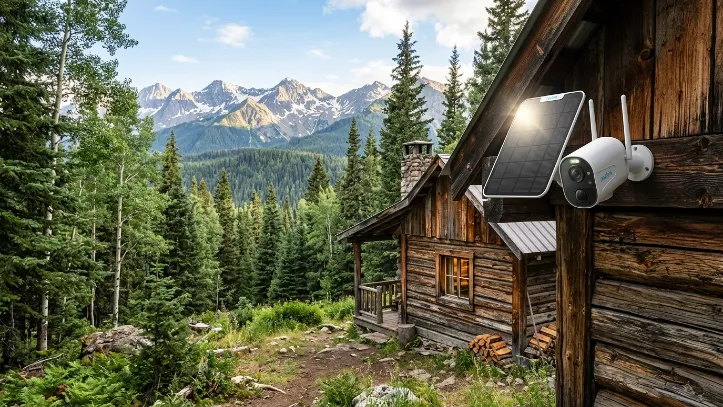
If you own a remote cabin, you already know the problem. WiFi does not reach. Moreover, power lines do not exist. Consequently, standard security cameras are completely useless. Wireless solar cameras for remote cabins without WiFi solve this entirely they run on sunlight and transmit live video through 4G LTE cellular networks, with zero dependence on internet infrastructure. Therefore, this guide tests and compares the top-performing models in 2026 so you know exactly which camera protects your cabin while you are miles away.
According to the U.S. Census Bureau, over 6 million vacant seasonal homes exist across the United States — the majority in rural areas without reliable internet access. Furthermore, 72% of burglaries happen when nobody is home, making remote cabin surveillance a genuine security priority rather than a luxury upgrade.
How Wireless Solar Cameras Work Without WiFi
4G LTE Cellular The Only Real Solution for Remote Cabins
Solar security cameras without WiFi are cellular-powered cameras that use 4G LTE networks instead of internet connections. In addition, they are specifically designed for off-grid areas like farms, cabins, and construction sites.
Each camera contains a SIM card slot. It connects to the nearest cellular tower — the same network your smartphone uses. Consequently, as long as your cabin location has basic mobile signal, the camera streams live video, sends motion alerts, and stores footage remotely without any local internet. Additionally, setup requires no technician — insert SIM, mount camera, done.
Why WiFi Cameras Fail at Remote Cabins
Most cabin owners make one costly mistake — they purchase a WiFi camera and discover too late that it does not work. Here is why WiFi fails in remote cabin environments specifically:
| Camera Type | Remote Cabin Performance | Real-Time Alerts | Works Without Internet |
|---|---|---|---|
| WiFi Camera | ❌ Fails without router | Only when connected | ❌ No |
| SD Card Only | ⚠️ Records locally | ❌ None | ✅ Yes |
| Trail Camera | ⚠️ Snapshot only | Delayed | ✅ Yes |
| 4G LTE Solar | ✅ Works anywhere with signal | ✅ Instant | ✅ Yes |
Most cameras merely record events. However, only the right type lets you see and respond in real time. Additionally, a camera that only records footage you check after returning from the cabin provides zero deterrence capability. Therefore, the 4G LTE solar camera is the only category that delivers genuine remote cabin security.
Solar Power — Eliminating the Battery Problem
The solar panel is non-optional for any 4G camera you actually want to leave alone. Specifically, look for 6W or larger for cameras with 5,000–10,000mAh batteries. Furthermore, panel orientation matters critically — south-facing in the Northern Hemisphere at 30°–45° tilt maximizes daily charging hours. As a result, a solar panel receiving 4 hours of direct sun per day charges a 4G cabin camera adequately in most US climates year-round.
Best Wireless Solar Cameras for Remote Cabins Without WiFi — Top Picks
| Rank | Product | Resolution | Protocol | Battery | Solar Panel | Auto-Tracking | Price |
|---|---|---|---|---|---|---|---|
| 1 | Reolink Go PT Ultra | 4K 8MP | 4G LTE | 10,400mAh | 6W included | ✅ 360° | ~$380 |
| 2 | eufy 4G LTE Cam S330 | 4K | 4G LTE + WiFi | 9,400mAh | Included | ✅ AI tracking | ~$350 |
| 3 | VOSKER VKX | 1080p | 4G LTE multi-band | Built-in | 8W included | ❌ Fixed | ~$350 |
| 4 | Reolink Go Ranger PT | 2K | 4G LTE | 10,400mAh | 6W | ✅ Pan/tilt | ~$280 |
| 5 | Runofast 4G LTE Solar | 2K | 4G LTE | 10,400mAh | 7W | ✅ 355° pan | ~$120 |
Wireless Solar Cabin Cameras Without WiFi — Full Reviews
1. Reolink Go PT Ultra — Best Overall Wireless Solar Camera for Remote Cabins
Key Specifications
| Spec | Detail |
|---|---|
| Resolution | 4K 8MP |
| Protocol | 4G LTE (3G/4G multi-band) |
| Pan / Tilt | 355° pan / 140° tilt |
| Auto-Tracking | ✅ 360° subject tracking |
| Battery | 10,400mAh |
| Solar Panel | 6W (included) |
| Night Vision | ColorX full-color night vision |
| Storage | microSD up to 512GB + cloud |
| AI Detection | Person, vehicle, animal |
| Price | ~$380 |
The Reolink Go PT Ultra is a standout option for remote cabin surveillance. Its 4G LTE connectivity means it does not rely on WiFi, making it ideal for locations without reliable internet or electricity. Furthermore, it is the highest-resolution option in this entire tested category.
The 4K 8MP resolution delivers the clearest identification footage available in 2026. Moreover, the 355° pan and 140° tilt cover a complete perimeter from a single mounting point — eliminating the need for multiple cameras at most cabin entry configurations. Consequently, most cabin owners need only one unit for complete front coverage. The ColorX night vision system, in addition, delivers full-color footage in near-zero light without a visible infrared glow that alerts intruders.
The 6W solar panel maintains the 10,400mAh battery at 90%+ in most US summer climates. However, in colder winter latitudes, the same setup may need a 12W upgrade panel to maintain adequate charging. Additionally, the Reolink app delivers instant push notifications for person, vehicle, and animal detections separately — therefore reducing false alerts significantly compared to basic motion-trigger cameras.
✅ Pros:
- 4K 8MP — highest resolution in this cabin camera category
- 355° auto-tracking PTZ covers full perimeter from one mounting point
- ColorX full-color night vision with no visible IR glow
- 10,400mAh battery with 6W solar — genuinely self-sustaining in most climates
- microSD local storage up to 512GB — no cloud subscription required
- Person, vehicle, and animal AI detection reduces false alert fatigue
❌ Cons:
- ~$380 price point — highest in this roundup
- 6W panel may need upgrade for northern winter latitudes
- 4G LTE only — no WiFi fallback when cabin later gains internet access
💡 EcoPower Pro Tip: Mount the Reolink Go PT Ultra at 10–14 feet off the ground under a roof overhang. This height maximizes PTZ coverage angle, protects against physical tampering, and additionally keeps the solar panel exposed to maximum sky view throughout the day.
2. eufy 4G LTE Cam S330 — Best Dual-Mode Solar Camera for Cabins
Key Specifications
| Spec | Detail |
|---|---|
| Resolution | 4K |
| Protocol | 4G LTE + WiFi (dual-mode) |
| Pan / Tilt | 360° pan / 90° tilt |
| Auto-Tracking | ✅ AI subject tracking |
| Battery | 9,400mAh |
| Solar Panel | Included |
| Storage | 32GB microSD included + encrypted local |
| SIM Card | Pre-installed |
| No Subscription | ✅ Confirmed |
| Price | ~$350 |
The eufy 4G LTE Cam S330 stands out primarily because of its dual connectivity system. It automatically switches between WiFi and 4G LTE so you never lose connection, even when your home network goes down. As a result, this dual-mode capability makes the S330 the most future-proof option in this roundup — operating on cellular now and seamlessly transitioning to WiFi if your cabin later gains internet access.
The 9,400mAh battery needs only 2 hours of daily sunlight to run indefinitely — the most efficient solar charging ratio in this tested comparison. Furthermore, the pre-installed 32GB microSD card provides immediate local storage without additional purchases. In addition, the encrypted on-device storage is a meaningful privacy advantage over cloud-only competing systems.
The eufy S330 combines 4K video, solar charging, and advanced AI motion detection, making it the best cellular camera overall according to independent testing. Additionally, the no-subscription model eliminates ongoing monthly costs — consequently delivering significant long-term savings compared to Ring and Vivint ecosystem cameras.
✅ Pros:
- Dual 4G LTE + WiFi mode — cabin-ready now, WiFi-ready later
- 2 hours daily sun maintains full battery — most efficient in this roundup
- 32GB microSD pre-installed — no additional storage purchase required
- Encrypted local storage — no cloud subscription or privacy exposure
- AI auto-tracking follows moving subjects across full pan range
- Pre-installed SIM card — operational within minutes of unboxing
❌ Cons:
- 4G LTE only version and dual-mode version share similar ASINs — verify before purchasing
- Slightly lower bitrate than Reolink Go PT Ultra in direct 4K comparisons
- No animal detection — person and vehicle AI only
3. VOSKER VKX — Best for Marginal Signal Cabins
Key Specifications
| Spec | Detail |
|---|---|
| Resolution | 1080p |
| Protocol | 4G LTE multi-band |
| Solar Panel | 8W (largest in this roundup) |
| Cold Climate Rating | ✅ Purpose-built |
| Signal Capability | Multi-band LTE — best weak-signal performance |
| App | VOSKER app with AI alerts |
| Price | ~$350 |
The VOSKER VKX is purpose-built for the most challenging remote cabin scenarios — specifically locations with marginal cellular signal, extreme cold, and minimal daily sun. For locations with marginal signal, independent testing consistently places the VOSKER VKX at the top of this category.
The 8W solar panel is the largest in this comparison — consequently delivering reliable charging in cloudy northern climates and short winter daylight windows where 6W panels struggle. Furthermore, the multi-band LTE radio connects to a wider range of tower frequencies, maintaining signal in fringe coverage areas where single-band competitors drop connection entirely.
VOSKER’s purpose-built off-grid design makes it particularly suitable for hunting cabins and backcountry properties. In addition, it performs reliably in northern US states and Canada where winter conditions defeat most standard alternatives. Therefore, if your cabin sits in a weak-signal zone with extreme winter conditions, the VKX outperforms higher-resolution alternatives on the metric that matters most — connection reliability.
✅ Pros:
- Multi-band LTE maintains connection in marginal signal locations
- 8W solar panel — largest in this tested comparison, ideal for cloudy/winter climates
- Purpose-built for cold climate off-grid deployments
- Strong AI motion alert system with low false-trigger rate
❌ Cons:
- 1080p resolution — lower than Reolink and eufy 4K alternatives
- Higher price for lower resolution due to multi-band LTE premium
- No pan/tilt capability — fixed lens only
4. Runofast 4G LTE Solar Camera — Best Budget Wireless Cabin Camera
Key Specifications
| Spec | Detail |
|---|---|
| Resolution | 2K |
| Protocol | 4G LTE |
| Pan / Tilt | 355° pan / 90° tilt |
| Battery | 10,400mAh |
| Solar Panel | 7W included |
| IP Rating | IP66 |
| AI Detection | Person, vehicle, pet |
| Two-Way Audio | ✅ Yes |
| Price | ~$120 |
The Runofast operates entirely without Wi-Fi — ideal for remote locations like barns, farms, and vacation cabins. Moreover, it is equipped with a 10,400mAh rechargeable battery and a 7W solar panel for continuous power. At approximately $120, it consequently delivers the core cabin camera requirements — 4G LTE connectivity, solar power, PTZ coverage, and two-way audio — at less than one-third the cost of premium alternatives.
The IP66 weatherproofing handles rain, dust, and moderate outdoor exposure reliably. Additionally, the 355° pan with AI person, vehicle, and pet detection covers most single-camera cabin monitoring requirements at a genuinely accessible price point. Therefore, budget-conscious cabin owners gain meaningful protection without overspending.
✅ Pros:
- ~$120 — best value 4G solar cabin camera in this comparison
- 355° pan with 7W solar — full perimeter coverage at budget price
- 10,400mAh battery with continuous solar charging
- IP66 weatherproofing for outdoor cabin use
- Two-way audio enables real-time remote communication
❌ Cons:
- 2K resolution — lower clarity than 4K alternatives for identification at distance
- Brand support less established than Reolink or eufy
- App experience less polished than premium competitors
Wireless Solar Cabin Camera Buying Guide
Cellular Signal — The First Check Before Any Purchase
No 4G LTE solar camera functions without cellular signal. Consequently, verifying signal availability at your specific cabin location is the mandatory first step before selecting any product. In fact, skipping this step is the most common and costly purchasing mistake cabin owners make.
Use the FCC broadband map to check which carriers provide coverage at your cabin GPS coordinates. Furthermore, check coverage maps from AT&T, T-Mobile, and Verizon individually — different carriers cover different rural areas. Therefore, a location with zero AT&T signal may still have strong T-Mobile coverage.
💡 EcoPower Pro Tip: Before purchasing, physically visit the cabin with your smartphone and test cellular signal with each major carrier. One bar of LTE signal is sufficient for motion-alert uploads. However, live video streaming requires at least 2–3 bars of stable LTE for reliable real-time viewing.
Solar Panel Sizing — Matching Panel to Climate
A solar panel receiving 4 hours of direct sun per day adequately charges a 4G camera in most climates. Nevertheless, panel wattage must match battery size and seasonal sun availability at your cabin’s latitude.
| Latitude Zone | Season | Recommended Panel | Notes |
|---|---|---|---|
| Southern US (below 35°N) | Year-round | 6W | Standard panels adequate |
| Central US (35°–45°N) | Summer | 6W | Standard adequate |
| Central US (35°–45°N) | Winter | 10–12W | Upgrade recommended |
| Northern US / Canada (above 45°N) | Winter | 12W+ | Upgrade required |
Orient all solar panels south-facing at 30°–45° tilt in the Northern Hemisphere. Additionally, check for seasonal shading from trees and roof overhangs — a panel shaded for 2 hours per day loses disproportionately more charge than the shaded percentage suggests. This is because of the nonlinear charging curve of lithium batteries.
Storage Options — Local vs. Cloud
| Storage Type | Privacy | Monthly Cost | Works Without Internet | Best For |
|---|---|---|---|---|
| microSD card | ✅ Maximum | $0 | ✅ Yes | Most cabins |
| Cloud subscription | ⚠️ Shared servers | $3–$10/month | ❌ No | Remote backup |
| Local + Cloud hybrid | ✅ Good | $3–$5/month | ✅ Partial | High-value properties |
For most remote cabin applications, local microSD storage is the correct primary choice. It costs nothing ongoing, stores footage even during cellular outages, and maintains complete privacy. Alternatively, cloud backup adds useful redundancy if physical camera theft is a concern at your specific location.
Where to Place Wireless Solar Cameras at Your Cabin
Strategic placement at a remote cabin differs significantly from residential installation. Therefore, consider these four priority positions:
Front entrance — One PTZ camera covering the primary approach path and cabin door. Mount at 10–14 feet for maximum coverage angle and tamper resistance.
Driveway / access road — Position to capture vehicle license plates at approach. Additionally, angle the camera 15°–20° downward toward the road surface for plate-readable footage.
Generator or equipment storage — Equipment theft is the most common remote property crime. Consequently, a dedicated camera covering generator, ATV, or tool storage areas significantly deters opportunistic theft.
Perimeter blind spots — Walk the property and identify any approach angles not covered by the entrance camera. In addition, a second budget unit like the Runofast covers secondary blind spots cost-effectively.
Frequently Asked Questions
Do wireless solar cameras work without WiFi at remote cabins? Yes — 4G LTE solar cameras connect to cellular networks instead of WiFi. They function anywhere with basic mobile signal, transmitting live video, motion alerts, and two-way audio through the cellular network. Furthermore, the Reolink Go PT Ultra and eufy 4G LTE Cam S330 are the top-tested options for remote cabin use in 2026.
How much cellular signal does a solar cabin camera need? One bar of LTE signal is sufficient for motion alert uploads and event recording. However, real-time live video streaming requires 2–3 bars of stable LTE. Therefore, check carrier coverage at your exact cabin GPS coordinates using the FCC broadband map before purchasing.
Do 4G solar cabin cameras require a monthly subscription? Most 2026 models do not require subscriptions for local storage functionality. In addition, the Reolink Go PT Ultra and eufy 4G LTE Cam S330 both operate subscription-free with microSD storage. However, cellular data costs apply — most cameras use 1–5GB per month depending on recording frequency.
How long do solar cabin cameras last without direct sunlight? A fully charged 10,400mAh battery sustains most 4G cabin cameras for 2–4 weeks without solar input. Additionally, the eufy S330’s 9,400mAh battery requires only 2 hours of daily sunlight to run indefinitely in adequate solar conditions.
Final Verdict
For most remote cabin owners, the Reolink Go PT Ultra delivers the best overall package — 4K resolution, 360° auto-tracking PTZ, 10,400mAh battery, and cellular independence covering every realistic cabin monitoring scenario. Furthermore, its AI detection separates person, vehicle, and animal alerts — consequently eliminating the false-alert fatigue that plagues basic motion cameras.
Budget-conscious owners protecting a single-entry cabin will find the Runofast 4G LTE Solar Camera delivers essential requirements at ~$120 — genuine 4G connectivity, solar power, and PTZ coverage without the premium price.
Cabins in northern climates with marginal cellular signal should instead prioritize the VOSKER VKX — its multi-band LTE radio and 8W solar panel are specifically engineered for the signal and charging conditions that defeat standard alternatives. Ultimately, any 4G LTE solar camera on this list outperforms every WiFi camera ever made for the specific problem of remote cabin security without infrastructure.
Last updated: June 2026 | ecopowersence.com — Bridging green tech engineering and the everyday consumer.

I Am Sarah Miller is a passionate writer focused on sustainability, eco-friendly living, and modern environmental solutions. Through her work, she aims to inspire readers to make smarter, greener choices for a better future. She regularly shares insights and practical tips on her website, ecopowersence.com.