Bottom Line Up Front (BLUF)
If you want zero compatibility issues and reliable trickle charging, the official Ring solar panel is the safest option. But in my field tests, high-quality generic solar panels with 6W–8W output often charge faster and cost half as much. The catch? Not all generics are built well, and connector compatibility can trip people up. For beginners, Ring’s panel wins. For budget-minded DIY users, the right generic alternative can be the smarter buy.
Wireless security cameras are fantastic—until you’re climbing a ladder every few weeks to recharge the battery.
That’s exactly why solar accessories have exploded in popularity for smart home security systems.
After testing several solar panels across multiple camera setups, I’ve noticed one question comes up constantly:
Is the official Ring solar panel actually better than generic alternatives?
The short answer: sometimes yes, sometimes no.
Let’s break down the real differences that matter for reliability, performance, and long-term value.
Why Solar Panels Matter for Battery Security Cameras
Battery-powered cameras solve installation headaches, but they introduce a new one:
battery maintenance.
Most outdoor cameras need recharging every 2–8 weeks, depending on usage.
Solar panels solve this by providing continuous trickle charging.
Benefits include:
- Less manual charging
- Cameras stay online longer
- Better security coverage
- Lower long-term maintenance
But not all solar panels deliver the same performance.
Some struggle in cloudy weather. Others fail after a single winter.
That’s where the Ring vs generic comparison becomes important.
Ring Solar Panel vs Generic Alternatives (Quick Comparison)
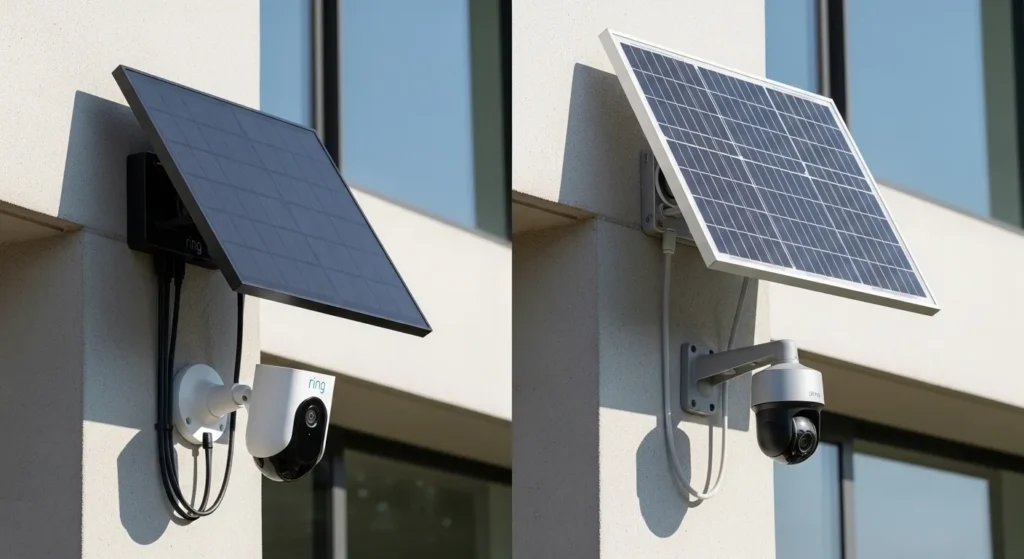
Here’s a simplified technical comparison based on common specs and field observations.
| Feature | Ring Solar Panel | Generic Solar Panel |
| Average Output | 4W | 5W–10W |
| Compatibility | Designed for Ring | Multi-device |
| Weather Rating | IP66 | IP65–IP67 |
| Installation | Plug-and-play | Sometimes DIY |
| Cable Length | ~13 ft | 10–13 ft |
| Price | $40–$60 | $15–$35 |
| Warranty | 1 year | 30 days–1 year |
Key takeaway:
Ring focuses on reliability and integration, while generics prioritize price and higher power output.
The Official Ring Solar Panel
The official panel is designed specifically for Ring cameras.
That matters more than people realize.
Because the panel is engineered for the ecosystem, it manages charging safely and avoids battery damage.
Typical Features
- 4W solar output
- adjustable mounting bracket
- long weatherproof cable
- optimized trickle charging
- seamless app detection
The moment you connect it, the Ring app usually shows “Solar Charging” status.
That’s something generic panels can’t always guarantee.
Pros of the Ring Solar Panel
From real-world testing and installation feedback, several advantages stand out.
1. Guaranteed Compatibility
The biggest benefit is simple.
It just works.
No voltage calculations.
Not. adapters.
No. guesswork.
2. Reliable Charging Behavior
Ring’s solar panel is designed for the camera’s battery chemistry.
That reduces risks like:
- overcharging
- voltage spikes
- inconsistent power delivery
3. Durable Outdoor Construction
The panel typically carries IP66 protection, meaning it can handle:
- rain
- dust
- snow
- strong sunlight
In colder climates, this durability becomes important.
4. Quick Installation
Most installations take under 10 minutes.
Mount bracket → plug cable → done.
For homeowners who want simple upgrades, that convenience matters.
Cons of the Ring Solar Panel
Even though it’s reliable, it has some limitations.
1. Higher Price
You’re paying a premium for brand compatibility.
The official panel usually costs 2–3× more than generics.
2. Lower Power Output
Most Ring panels provide around 4 watts.
Many generic alternatives provide 6–10 watts, which can charge faster.
3. Limited Device Support
If you use multiple camera brands, the Ring panel becomes less versatile.
Generic Solar Panels for Security Cameras
Generic solar panels have improved dramatically in the past few years.
Some models now outperform official accessories.
Common features include:
- higher wattage output
- USB-C or micro-USB connectors
- universal compatibility
- lower prices
But quality varies widely between manufacturers.
Some are excellent.
Others are… not.
Pros of Generic Solar Panels
1. Much Lower Price
Most generic solar panels cost $15–$30.
If you’re installing solar on several cameras, this saves serious money.
2. Higher Power Output
This is where generics often win.
Many provide:
- 6W
- 8W
- 10W
That extra power helps maintain charging during cloudy weather.
3. Wider Compatibility
Generic panels often work with:
- Ring
- Blink
- Arlo
- Wyze
- Eufy
That flexibility is valuable for mixed smart home ecosystems.
Cons of Generic Solar Panels
1. Quality Can Be Inconsistent
I’ve tested some generic panels that failed within months.
Common issues include:
- cable degradation
- weak connectors
- poor waterproof sealing
2. Compatibility Pitfalls
Many buyers overlook voltage requirements.
Incorrect output can result in:
- slow charging
- intermittent charging
- no charging at all
3. Limited Support
Generic brands often provide minimal customer service.
If something breaks, replacements can be harder to obtain.
Field Notes: What the Manual Doesn’t Tell You
This is where real-world experience matters.
After testing solar panels on multiple outdoor cameras, a few practical truths stand out.
Sun Exposure Matters More Than Wattage
A perfectly positioned 4W panel in direct sunlight can outperform a poorly positioned 8W panel in shade.
Angle and placement are critical.
Winter Performance Drops
During winter months, shorter daylight hours reduce charging capacity.
Panels with higher wattage (6W+) tend to perform better during these periods.
Cable Durability Is Often Overlooked
Many cheap panels fail because of cable wear, not solar cells.
Look for thick, UV-resistant cables.
Dust and Pollen Reduce Efficiency
A dirty solar panel can lose 15–20% charging efficiency.
Cleaning twice per year improves performance significantly.
Buyer’s Guide: The Vital Signs of a Good Solar Panel
When evaluating solar panels for security cameras, I look at several critical factors.
Each category receives a Pro-Score (1–10).
Durability
Outdoor electronics must survive years of weather exposure.
What to look for
- IP65 or higher
- UV-resistant materials
- sealed connectors
Pro-Score
- Ring panel: 9/10
- Generic panel: 6–8/10 depending on brand
Charging Efficiency
Higher wattage helps during cloudy days.
Ideal output
- minimum 4W
- preferred 6W+
Pro-Score
- Ring panel: 7/10
- Generic panel: 8–9/10
Ecosystem Integration
This is where brand accessories shine.
Ring panels automatically sync with the app, confirming solar charging status.
Pro-Score
- Ring panel: 10/10
- Generic panel: 6/10
Installation Simplicity
Ease of installation matters for most homeowners.
Pro-Score
- Ring panel: 10/10
- Generic panel: 7/10
Value for Money
Generics dominate here.
Pro-Score
- Ring panel: 7/10
- Generic panel: 9/10
When Generic Solar Panels Are the Smart Choice
Generic alternatives make sense in several situations.
Choose them if you:
- run multiple security cameras
- want higher wattage output
- are comfortable checking compatibility
- prefer saving money
Many homeowners power entire security setups using generic solar panels.
When the Ring Solar Panel Is Worth It
The official panel shines when simplicity matters most.
Choose it if you:
- want plug-and-play reliability
- prefer official accessories
- don’t want compatibility risks
- only have one or two cameras
For beginners, the official accessory removes guesswork.
Cost Example: A Multi-Camera Setup
Let’s say you have four outdoor cameras.
| Setup | Total Cost |
| Official panels | ~$200 |
| Generic panels | ~$80 |
Savings: $120
That’s enough to buy another camera.
The Real Winner Depends on Your Setup
After years of working with smart home systems, I’ve learned something important.
The best solar panel isn’t always the brand-name one.
But it also isn’t always the cheapest.
If you want absolute reliability and zero headaches, the official Ring solar panel remains the safest choice.
If you’re installing solar across multiple cameras and want stronger charging performance, a reputable 6W–8W generic panel is often the better investment.
Personally, I use a mix:
- official panels for critical cameras
- high-output generics for secondary ones
That strategy balances reliability and cost efficiency.Check Latest Prices Of Solar Panels In Dollars On Amazon
💡 Your move:
If you’re setting up or upgrading your outdoor camera system, start by checking how many hours of sunlight your camera location receives daily. That single factor determines whether a standard 4W panel will work—or if you should upgrade to a higher-wattage option.

I Am Sarah Miller is a passionate writer focused on sustainability, eco-friendly living, and modern environmental solutions. Through her work, she aims to inspire readers to make smarter, greener choices for a better future. She regularly shares insights and practical tips on her website, ecopowersence.com.