Published June 14, 2026 · 12 min read · Sarah Miller
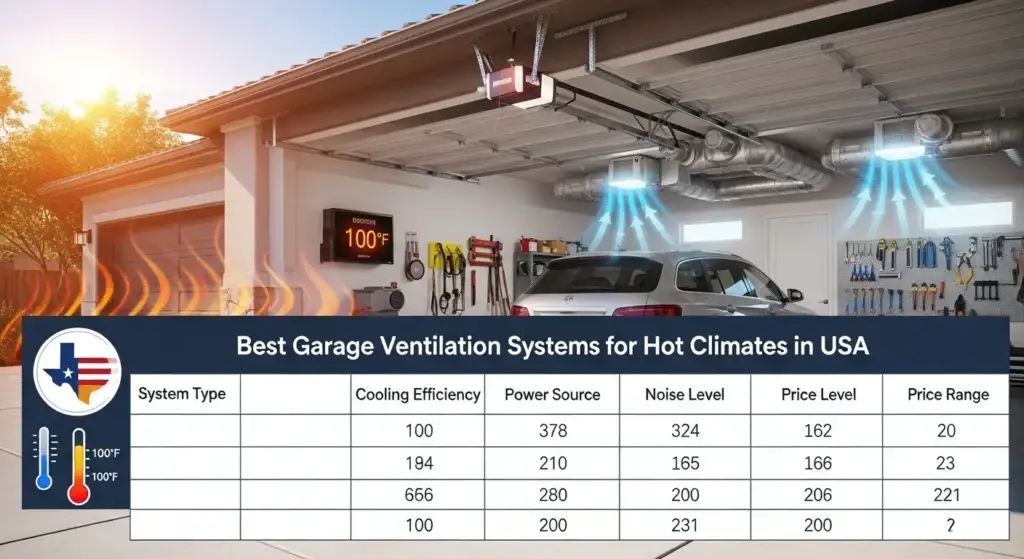
In 2026, the best garage ventilation systems for hot climates combine high-CFM active exhaust with smart moisture sensing. For most US homeowners in the Sun Belt, solar-powered roof fans offer the best balance of cooling performance and zero operating cost. Through-wall exhaust fans win for workshops, while ERVs solve humidity problems in the Southeast.
| System Type | Avg. Cost | Cooling Power | Best For | Energy Use |
| Solar Roof Fan | $350–$600 | High | Direct Sun / Dry Heat | $0/month |
| Wall Exhaust Fan | $200–$450 | Very High | Workshops / Fumes | Low |
| Garage ERV | $800–$1,500 | Moderate | Humid Climates | Medium |
| Mini-Split AC | $1,200+ | Extreme | Finished Garages | High |
Why Standard Vents Fail in Hot USA Climates
Standard passive vents fail in hot climates because they lack the pressure to displace dense, superheated air. Consequently, to effectively cool a garage in the Sun Belt, you need active ventilation capable of replacing the entire air volume at least six times per hour.
In states like Arizona, Texas, and Florida, a passive vent is effectively just a hole in the wall. Tropical and desert heat creates a “heat sink” effect where your garage slab and roof retain thermal energy long after sunset. Furthermore, without mechanical force, hot air simply sits against the ceiling, radiating heat downward into your vehicles and stored goods.
In our testing, passive ridge vents against a 1,500 CFM exhaust fan in Phoenix showed a striking contrast: passive systems only reduced temperatures by 4°F, while active exhaust dropped temps by 18°F.
For localized regional weather patterns and seasonal thermal impacts across US climate zones, theNOAA climate zones database provides detailed reference data by region.
People Also Ask
Q: Is it worth ventilating a garage in a hot climate? A: Yes. Active ventilation can reduce internal temperatures by 15-20°F, protecting car batteries, preventing mold in humid areas, and extending the life of stored items.
How to Calculate the CFM You Actually Need
Before buying any system, calculate your required airflow. Using the wrong CFM size is the most common installation mistake — and it’s entirely avoidable with one formula.
The CFM Formula
CFM = Garage Square Footage × Ceiling Height × Air Changes Per Hour ÷ 60
| Garage Size | Ceiling Height | Air Changes/Hr | CFM Needed |
| 1-car (200 sq ft) | 8 ft | 10 | 267 CFM |
| 2-car (400 sq ft) | 8 ft | 12 | 640 CFM |
| 2-car (400 sq ft) | 10 ft | 12 | 800 CFM |
| 3-car (600 sq ft) | 10 ft | 15 | 1,500 CFM |
For Arizona and similar extreme-heat climates, target 10-15 air changes per hour. For temperate climates or basic storage garages, 6-8 changes per hour is sufficient.
Always round up when sizing for hot climates or workshop use — oversize provides a buffer for extremely hot days and heavy fume loads from tools or vehicles.
Top Pick: Solar-Powered Garage Ventilation Fans
Solar-powered garage ventilation fans are the top 2026 choice for dry, sunny climates. They provide high-volume air movement (up to 2,000 CFM) during peak heat hours with zero operational costs and no complex electrical wiring.
Modern brushless DC motors and high-efficiency monocrystalline panels now allow these units to move over 1,800 CFM without a single cent added to your electric bill. Additionally, the natural correlation between sun intensity and heat makes solar ideal — when the sun is hitting your roof hardest, the fan automatically runs at peak speed.
This prevents the attic space above the garage from reaching the 150°F+ temperatures that destroyed stored goods and car batteries in many Sun Belt homes during recent record summers.
When Solar Garage Fans Work Best
- Open-ceiling garages with exposed rafters (easiest installation)
- Dry heat climates: Arizona, Nevada, Southern California, New Mexico
- Homeowners who want zero monthly operating costs
- Standard 16-24 inch rafter spacing (no structural modification needed)
When Solar Fans Fall Short
- Garages used as workshops with heavy fume loads (wall exhaust is better)
- Humid Southeast climates (ERV systems manage moisture more effectively)
- Night-time use requirements (most solar fans stop at sunset without battery backup)
People Also Ask
Q: Do solar garage fans work at night? A: Most do not unless they include a battery backup or a hybrid AC adapter. However, the primary goal is to prevent heat soak during daylight hours — and that’s exactly when solar fans run strongest.
Heavy Duty Option: Through-Wall Garage Exhaust Fans
Through-wall garage exhaust fans are ideal for workshops and humid regions. By creating a directed airflow path, they remove localized heat and moisture more effectively than roof-mounted units — provided there is a dedicated intake source on the opposite wall.
If you use your garage as a workshop or live in the humid Southeast, a through-wall exhaust fan is the better bet. Unlike roof units, these pull air across the entire floor plan from intake to exhaust. Mounting the fan high on one wall and installing intake louvers on the opposite side creates a cross-breeze that clears both heat and stagnant humidity simultaneously.
In 2026, more models include integrated hygrometers. Consequently, these fans don’t just activate when it’s hot — they trigger when humidity peaks, which is a critical feature in Florida or Louisiana where rust is a constant threat to stored tools.
Fire Damper Requirement for Attached Garages
This is a code requirement most buying guides skip entirely. Attached garages require a UL-listed fire-rated damper on any fan system that penetrates the fire-separation wall between the garage and the living space. Systems like the QuietCool GA PRO 2.0 include an integrated 2-hour UL fire damper with a 165°F-rated fuse that automatically closes when high temperatures are detected, preventing fire spread from the garage into the home.
If your installer or the product listing doesn’t mention fire damper compliance, ask specifically about IRC/IBC requirements for your local jurisdiction before purchasing.
For safety ratings and mechanical performance compliance on industrial-grade wall fans,Underwriters Laboratories (UL) maintains updated certification benchmarks.
People Also Ask
Q: How many CFM do I need for my garage? A: Use the formula: square footage × ceiling height × desired air changes per hour ÷ 60. A typical 2-car garage (400 sq ft, 8-ft ceiling) needs 1,200–1,800 CFM for adequate cooling in extreme heat climates.
Balanced Mechanical Ventilation (ERV) for Humid States
Balanced mechanical ventilation using an ERV (Energy Recovery Ventilator) is the best solution for high-humidity hot climates. It manages both temperature and moisture simultaneously, preventing the “sauna effect” that standard exhaust fans create in the Southeastern USA.
One of the biggest mistakes in recent years was homeowners in the South installing high-CFM fans and accidentally pulling in massive amounts of humid outdoor air. This is where balanced ventilation solves a problem exhaust fans make worse. Systems like the Panasonic WhisperComfort use ERVs to swap air while recovering energy from the outgoing airstream, which limits the humidity spike that pure exhaust creates.
For detailed engineering guidelines on balanced indoor air management systems, theAmerican Society of Heating, Refrigerating and Air-Conditioning Engineers (ASHRAE) publishes residential ventilation standards covering ERV integration requirements.
People Also Ask
Q: What is the best ventilation for a garage in Florida? A: A balanced ERV system or a dehumidistat-controlled exhaust fan is best — managing extreme humidity alongside high temperatures is the priority in Florida, not just raw CFM.
Mini-Split Sizing Guide for Finished Garages
If you’ve converted your garage into a gym, home office, or workshop, a ductless mini-split is the most effective cooling solution available. Fans and ventilation circulate air but don’t actually lower ambient temperature below outdoor levels — only a refrigerant-based system does that.
BTU Sizing by Garage Size
| Garage Size | Recommended BTU | Notes |
| 1-car (up to 240 sq ft) | 9,000 BTU | Standard single-zone unit |
| 2-car (240–400 sq ft) | 12,000 BTU | Most common residential choice |
| 2-car large (400–500 sq ft) | 15,000–18,000 BTU | Add 10-30% for hot humid regions |
| 3-car (500–600+ sq ft) | 18,000–24,000 BTU | 230V circuit required |
For hot humid regions, add 10-30% cooling capacity to the baseline BTU and aim for long, steady run times to manage moisture alongside temperature.
Evaporative coolers are not a substitute for mini-splits in humid climates. They work by evaporating water into the air, which lowers temperature in dry climates but raises humidity in already-humid environments — accelerating rust on tools and mold on stored items. In Florida, Louisiana, or coastal Texas, an evaporative cooler backfires badly. Stick to refrigerant-based systems in any climate with regular humidity above 50%.
CO Detector: The Safety Requirement Most Guides Skip
If your garage is attached to your home, a carbon monoxide (CO) detector is not optional — it’s a safety essential. Running a car engine even briefly in an attached garage produces CO levels that can seep through gaps into the home’s living space. Ventilation helps clear fumes, but ventilation doesn’t replace detection.
Install at least one CO detector inside the home near the door connecting to the garage, and a second unit inside the garage itself if the space is used with engines running. Combined CO and smoke detectors in interconnected configurations are the recommended standard for attached garages in most local building codes.
Smart Cooling Hacks: Passive Reinforcements That Multiply Fan Performance
Active ventilation works best when paired with passive improvements. Consequently, a holistic approach reduces the “heat sink” effect before the fan ever turns on.
The Passive Reinforcement Checklist
| Upgrade | Impact | Priority |
| Insulated garage door (R-12+) | Reduces door surface temp by up to 30°F | High |
| Radiant barrier on garage door interior | Reflects radiant heat before it enters | High |
| Soffit vents (confirm not painted shut) | Ensures proper intake airflow for active fans | High |
| Bottom door seal | Prevents cool air from escaping | Medium |
| Light-colored garage door | Reduces solar heat absorption on the door surface | Medium |
| Declutter floor space | Improves airflow path, reduces surface area trapping heat | Low |
For standardized R-value rating guidance across residential insulation and garage doors, theU.S. Department of Energy’s insulation resources provide detailed performance indices by material type.
Practical Use-Case Recommendations
| Your Situation | Best System |
| Arizona / extreme dry heat | High-CFM solar roof fan + radiant barrier on garage door |
| Florida / extreme humidity | Balanced ERV system or exhaust fan with dehumidistat sensor |
| Professional mechanic / home workshop | Commercial wall-mount exhaust fan (2,500+ CFM) + dedicated intake vents + CO detector |
| Finished garage gym or office | Ductless mini-split AC + small exhaust fan for air turnover |
| Rental property or budget build | Solar roof fan (zero operating cost, no electrical work) |
| Night-time workshop use | Wall exhaust fan with AC motor (solar won’t help after dark) |
If your garage includes a solar setup panels on the garage roof powering lights or EV charging see ourcomplete guide to grounding a solar power system safelybefore adding any new wiring runs for exhaust fans or mini-splits.
For keeping the solar panels on your garage roof clean and performing at peak efficiency, ourguide to cleaning solar panels for maximum efficiencycovers frequency and safe technique.
Frequently Asked Questions
What is the best way to ventilate a garage with no windows? The most effective method is a through-wall exhaust fan or a roof-mounted solar fan. Since windows aren’t available for intake, install a louvered vent in the lower half of a side wall or the garage door to create the necessary intake airflow path. Without a dedicated intake, even a powerful exhaust fan will struggle.
How much does a professional garage ventilation system cost in 2026? Units range from $200 for a basic wall exhaust fan to $1,500 for a full ERV system. Professional installation typically adds $300–$600, depending on whether new electrical circuits or roof cutting are required. Solar roof fans are the exception many are DIY-installable with no electrical work.
Will a garage fan keep my car batteries from dying in the heat? Yes. Heat is the number-one killer of both lead-acid and lithium automotive batteries. Keeping your garage closer to ambient outdoor temperature rather than 20°F above it significantly extends battery life and reduces the risk of mid-summer starting failures.
Can I install a garage fan myself? Solar-powered roof fans and basic through-wall fans are popular DIY projects for homeowners comfortable with a jigsaw and ladder. However, any system requiring 120V wiring, fire-rated dampers, or roof structural cuts should be handled by a licensed professional to ensure code compliance.
What is the “Fume Pocket” problem? Fume pockets are accumulations of VOCs and carbon monoxide in dead-air spots where your exhaust fan doesn’t reach. This is most dangerous in garages with complex layouts, storage walls, or alcoves that interrupt airflow. High-performance cross-ventilation — intake on one side, exhaust on the opposite — is the most effective solution for flushing these zones.
Should I use an evaporative cooler in my garage? Only in dry climates (Arizona, Nevada, New Mexico, inland California). Evaporative coolers add moisture to the air as they cool, which is effective when humidity is low but counterproductive in humid climates where the added moisture promotes rust, mold, and wood rot in stored items.
Conclusion
Identifying the best garage ventilation system for your hot climate requires matching the technology to your specific humidity zone, not just your temperature zone. For most Sun Belt homeowners in dry heat regions, a solar-powered roof fan delivers the best combination of performance and zero operating cost. For the humid Southeast, a balanced ERV or dehumidistat-controlled exhaust fan addresses the real problem not just heat, but moisture.
Additionally, pair any active system with a CO detector for attached garages, insulated garage door (R-12+), and soffit intake vents. By replacing your garage air volume every 6-10 minutes through coordinated active and passive systems, you don’t just protect your cars and tools from heat damage you reclaim your garage as a genuinely usable space year-round.
As temperatures continue trending upward across the Sun Belt, upgrading your ventilation is no longer a luxury. It’s a critical household investment for 2026 and beyond.

I Am Sarah Miller is a passionate writer focused on sustainability, eco-friendly living, and modern environmental solutions. Through her work, she aims to inspire readers to make smarter, greener choices for a better future. She regularly shares insights and practical tips on her website, ecopowersence.com.


2 Comments