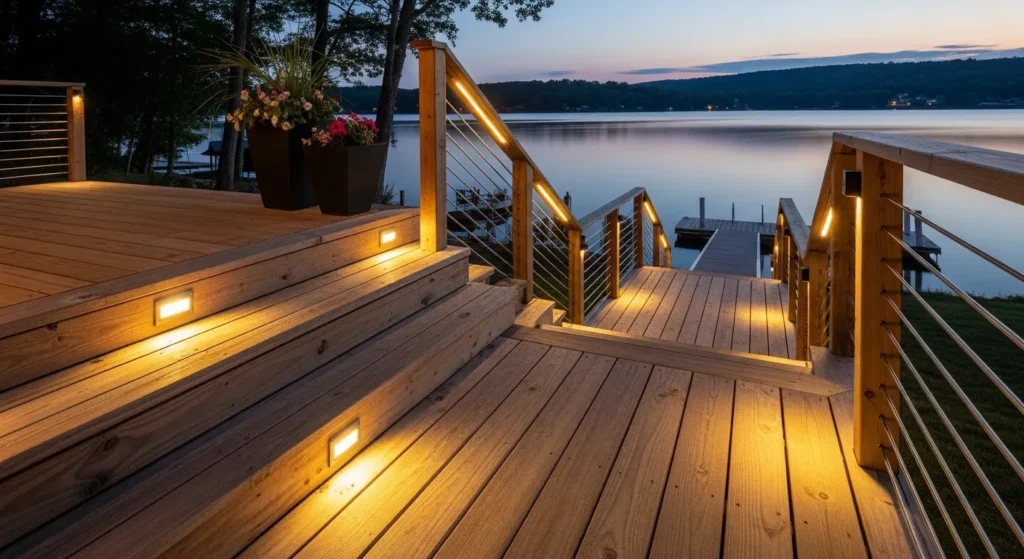
A family in coastal Maine learned this lesson the hard way. Their teenage son misjudged the last step of their unlit deck stairs one August evening a clean fall, a sprained wrist, and a $400 urgent care bill. The fix cost $34. One pack of solar stair lights, fifteen minutes of installation, and zero wiring. That story is not unique. Unlit deck stairs and dark dock edges cause thousands of preventable falls every year. Solar deck lights eliminate this hazard permanently — no electrician, no cable, no electricity cost.
Quick Answer Best Solar Deck Lights for Stairs and Docks
The VOLISUN Solar Stair Lights (6-Pack) rank as the best overall solar lights for deck stairs in 2026. They deliver 80 lumens, IP67 waterproofing, 13 LEDs per unit, and 8-hour runtime on a single charge. For dock use, the SIEDiNLAR IP68 Aluminum Dock Lights lead with 20-ton crush resistance and full submersion protection. Both products operate on automatic dusk-to-dawn sensors. Furthermore, neither requires wiring, a transformer, or professional installation.
According to the U.S. Department of Energy, outdoor solar lights convert sunlight directly into electricity via photovoltaic cells and require virtually zero maintenance after installation — making them the most cost-efficient outdoor safety lighting solution available.
Top Picks at a Glance — 2026 Comparison Table
| Rank | Product | Best For | IP Rating | Lumens | Battery | Pack | Rating |
|---|---|---|---|---|---|---|---|
| 1 | VOLISUN Solar Stair Lights | Best Overall — Stairs | IP67 | 80 lm | 800mAh | 6-pack | ⭐ 4.5 |
| 2 | SIEDiNLAR Dock Deck Lights | Best for Docks | IP68 | 15 lm | 600mAh NiMH | 4-pack | ⭐ 4.4 |
| 3 | PATIOWIN Solar Step Lights | Best Budget Pick | IP65 | 80 lm | 800mAh | 6/12-pack | ⭐ 4.3 |
| 4 | SOLPEX 16-Pack Deck Lights | Best Full Coverage | IP65 | ~30 lm | Built-in | 16-pack | ⭐ 4.2 |
| 5 | VOLISUN Dual-Color Dock Lights | Best Dual-Color Dock | IP68 | 15 lm | 1200mAh | 8/12-pack | ⭐ 4.4 |
| 6 | JACKYLED Solar Dock Lights | Best Heavy-Traffic Dock | IP68 | 15 lm | NiMH | 8-pack | ⭐ 4.3 |
| 7 | Torchstar Motion Sensor Lights | Best Motion-Activated | IP65 | 320 lm | Li-ion | 2-pack | ⭐ 4.4 |
Best Solar Lights for Deck Stairs — Full Reviews
1. VOLISUN Solar Stair Lights — Best Overall
Key Specifications
| Spec | Detail |
|---|---|
| LEDs per Unit | 13 |
| Lumens | 80 lm |
| Color Temperature | 3000K warm white |
| Battery | 800mAh |
| Charge Time | 5 hours |
| Runtime | 8 hours |
| IP Rating | IP67 |
| Mount Type | Stair riser screw-mount |
| Pack Options | 6, 8, 12, 24 |
| Warranty | 2 years |
The VOLISUN defines the 2026 benchmark for solar lighting for deck stairs. Eighty lumens is precisely the correct output tier — bright enough to define step edges and tread surfaces clearly, yet dim enough to preserve evening ambiance. Consequently, it avoids the glare problem that plagues high-output alternatives.
The 13-LED array distributes light evenly across each riser face. This eliminates the harsh hot-spot pattern produced by single-LED step lights. Furthermore, the IP67 rating handles rain, heavy dew, puddle contact, and brief submersion — a meaningful upgrade from the IP65 found on budget alternatives.
The 800mAh battery reaches full charge in 5 hours of direct sun. It then delivers consistent 8-hour output — covering a full summer evening from dusk to well past midnight. Additionally, the automatic photosensor activates at sunset and shuts off at dawn without any manual intervention.
Installation requires two screws per unit directly into the stair riser face. No wiring, no transformer, no hub. The triangular housing design fits stair corners precisely, preventing the protruding-light hazard common with rectangular riser mounts.
✅ Pros:
- 80 lumens provides real step-edge safety visibility — not just decoration
- IP67 survives rain, dew, and brief water contact without seal degradation
- 8-hour runtime covers full evening use on a single summer charge
- Triangular corner-fit design eliminates protruding housing on stair risers
- 2-year warranty — rare at this price point in the solar deck light category
❌ Cons:
- Warm white only in standard listing; cool white requires a separate ASIN
- 6-pack insufficient for decks longer than 8 steps without a second purchase
💡 EcoPower Pro Tip: Mount VOLISUN units at the horizontal center of each riser, positioned 1 inch from the bottom edge. This angle projects the 80-lumen output forward and downward — directly illuminating the tread surface below where footing decisions happen at night.
2. SIEDiNLAR Solar Dock & Deck Lights — Best for Docks
Key Specifications
| Spec | Detail |
|---|---|
| LEDs per Unit | 4 |
| Lumens | ~15 lm |
| Housing | Aluminum alloy |
| Crush Rating | 20 tons (44,000 lbs) |
| Battery | 600mAh NiMH |
| Charge Time | 6–8 hours |
| Runtime | 8–12 hours |
| IP Rating | IP68 |
| Colors Available | White, warm white, blue |
| Mount Type | Screw or adhesive |
The SIEDiNLAR is built for environments where standard deck lights fail — dock edges, boat ramp approaches, marine walkways, and high-traffic outdoor perimeters. The aluminum alloy housing withstands 20 tons of vertical pressure. Consequently, vehicle crossings, boat trailers, and loaded dock carts cause zero damage.
IP68 certification goes beyond splash resistance into full submersion tolerance. Dock lights face tidal splash, wave surge, and periodic flooding that overwhelms IP65 and IP67 products within a single season. Therefore, IP68 is not a premium feature for dock use — it is a minimum requirement.
The 15-lumen output is intentionally calibrated for perimeter marking, not step illumination. Its function is to define dock edges, mark water boundaries, and signal walkway perimeters in low-light conditions. Furthermore, the NiMH battery delivers 8–12 hours of continuous output — enough to run through a full overnight dock tie-up without recharging.
✅ Pros:
- IP68 submersion-proof — the correct rating for waterfront dock environments
- 20-ton crush rating handles vehicle and boat trailer traffic without damage
- 8–12 hour runtime covers complete overnight dock edge marking
- Blue color option follows standard dock visibility conventions
- Aluminum alloy outlasts ABS plastic in salt-air coastal environments
❌ Cons:
- 15 lumens insufficient for stair step-edge safety; use exclusively for perimeter marking
- NiMH battery loses charge capacity faster than lithium in cold-weather climates
💡 EcoPower Pro Tip: Install SIEDiNLAR units in blue at dock water-edge corners, and white along the approach walkway. This two-color system creates an intuitive visual navigation structure — blue marks the water boundary, white marks the safe walking path.
3. PATIOWIN Solar Step Lights — Best Budget Pick
Key Specifications
| Spec | Detail |
|---|---|
| LEDs per Unit | 24 |
| Lumens | 80 lm |
| Color Temperature | 3000K warm white |
| Battery | 800mAh |
| Charge Time | 4–5 hours |
| Runtime | 8 hours |
| IP Rating | IP65 |
| Mount Type | Riser / wall / fence screw |
| Pack Options | 6-pack, 12-pack |
PATIOWIN delivers the same 80-lumen output and 800mAh battery as the VOLISUN at a lower per-unit cost in the 12-pack configuration. The 24-LED array distributes light across a wider face area, which additionally suits fence mounting and railing applications beyond stair risers.
The triangular corner-fit design — shared with the VOLISUN — nestles precisely into stair corners. This eliminates the protruding housing profile that creates secondary trip hazards on narrow staircases. Furthermore, the practical mounting system allows individual unit replacement without removing the entire installation.
However, IP65 is the critical limitation here. PATIOWIN units protect against water jets and rain but not submersion. For dock edge installations or surfaces exposed to pooling water, the SIEDiNLAR’s IP68 remains necessary. Alternatively, PATIOWIN suits above-deck stair risers and covered porch steps reliably.
✅ Pros:
- Best cost-per-lumen ratio in this roundup at 12-pack pricing
- 24-LED array produces broad, even light distribution across the stair face
- 4–5 hour charge time — fastest to full charge in this comparison
- Individual unit replaceability reduces long-term maintenance cost
❌ Cons:
- IP65 limits use to above-grade, non-submerged installations only
- ABS plastic housing lacks the durability of aluminum alternatives
4. SOLPEX Solar Deck Lights 16-Pack — Best for Full Coverage
Key Specifications
| Spec | Detail |
|---|---|
| LEDs per Unit | 24 |
| Color Temperature | 3000K warm white |
| Housing Color | Brown ABS |
| IP Rating | IP65 |
| Dimensions | 3.46″ × 1.77″ × 1.85″ |
| Activation | Auto dusk-to-dawn sensor |
| Pack Size | 16-pack |
| Eco Credential | Carbon-measured lifecycle |
When the goal is covering a full deck perimeter, complete stair run, and garden path in one purchase, no product in this segment matches the SOLPEX 16-pack on coverage value. Sixteen lights cover approximately 24–32 linear feet at standard 18–24 inch spacing.
The brown ABS housing integrates visually with timber and composite deck surfaces during daylight hours — a detail that competitors with white plastic housings consistently miss. Furthermore, SOLPEX carries a carbon-measured and offset product lifecycle certification, recognized by Amazon Sustainability — directly aligned with the ecopowersence.com readership’s eco-conscious values.
Activation requires only pulling the battery insulator tab. Consequently, zero configuration, zero wiring, and zero app setup stand between the buyer and a fully operational deck lighting system.
✅ Pros:
- 16 units covers full deck perimeters and stair runs in a single purchase
- Brown housing blends with natural wood and composite decking during daytime
- Carbon-offset lifecycle certification supports eco-conscious buyers
- Pull-tab activation — no setup complexity whatsoever
❌ Cons:
- IP65 only — unsuitable for dock or direct waterfront use
- ABS construction is the least durable material across this entire roundup
5. VOLISUN Dual-Color Dock Lights — Best Dual-Color Dock Light
Key Specifications
| Spec | Detail |
|---|---|
| LEDs per Unit | 4 |
| Color Modes | White + Blue (2-in-1 switchable) |
| Battery | 1200mAh |
| IP Rating | IP68 |
| Solar Panel | Monocrystalline 2.5V/120mA |
| Crush Rating | 20 tons |
| Runtime | Up to 72 hours |
| Pack Options | 8-pack, 12-pack |
The VOLISUN dock variant addresses a specific operational need — dual-color marine walkway marking in a single unit. White illuminates approach pathways. Blue marks water-adjacent edges. Consequently, having both modes in one fixture simplifies dock lighting system design considerably.
The monocrystalline solar panel is the standout technical specification. As documented by efficiency research across outdoor solar lighting applications, monocrystalline panels achieve 17–22% efficiency versus 13–16% for polycrystalline alternatives — and critically, they maintain superior output in diffuse light, partial shade, and low-angle winter sun conditions.
The 1200mAh battery supports up to 72 hours of continuous runtime — effectively three full nights of dock edge marking without recharging. This runtime performance makes the VOLISUN dock light particularly suited to remote dock installations and unattended marina walkways.
✅ Pros:
- White/blue dual-color covers walkway and water-edge safety roles in one unit
- Monocrystalline panel outperforms polycrystalline in partial shade and winter charging
- 1200mAh / 72-hour runtime eliminates nightly recharging concerns entirely
- IP68 rated for full waterfront dock exposure and submersion
❌ Cons:
- 15 lm output is perimeter-marking use only — not suitable for stair illumination
- Premium monocrystalline unit cost is higher than polycrystalline dock light alternatives
6. JACKYLED Solar Dock Lights — Best for High-Traffic Dock Walkways
Key Specifications
| Spec | Detail |
|---|---|
| LEDs per Unit | 4 |
| Color Options | White, Blue, Green, Yellow |
| IP Rating | IP68 |
| Housing | Die-cast aluminum |
| Crush Rating | 20 tons |
| Charge Time | 6–8 hours |
| Runtime | Up to 72 hours |
| Pack Size | 8-pack |
JACKYLED’s die-cast aluminum construction positions it as the premium choice for commercial docks, marina walkways, and high-traffic boat ramp approaches. Die-cast aluminum dissipates heat more effectively than polycarbonate, which extends LED lifespan significantly in high-temperature coastal environments.
Four color options — white, blue, green, yellow — allow marina operators and dock managers to implement color-coded zone systems. Furthermore, the 72-hour runtime suits remote or unattended dock installations where daily recharging is impractical.
✅ Pros:
- Die-cast aluminum outlasts polycarbonate in UV-intensive coastal environments
- Four color options enable zone-coded dock safety marking systems
- 72-hour runtime suits remote, unattended dock installations
- IP68 with marine-grade corrosion resistance
❌ Cons:
- Higher per-unit cost than VOLISUN or SIEDiNLAR dock alternatives
- 15 lm output appropriate for perimeter marking only
7. Torchstar Solar Motion Sensor Lights — Best Motion-Activated
Key Specifications
| Spec | Detail |
|---|---|
| Lumens | 320 lm (activated) |
| IP Rating | IP65 |
| Motion Range | ~15 feet |
| Modes | Motion-activated burst only |
| Mount Type | Flat surface, wall, post |
| Pack Size | 2-pack |
At 320 lumens triggered on motion, the Torchstar operates in a completely different brightness category from the passive deck lights above. This is a security and high-visibility product — suitable for deck stair landings, dock ramp bases, and boat storage areas requiring deterrent-level illumination.
The absence of a steady-on mode is a deliberate engineering decision. Constant 320-lumen output drains the solar battery in 3–4 hours. In contrast, motion-activation conserves battery for burst use on demand — extending full-night operation on a single charge. As BobVila’s tested review confirms, the Torchstar detects motion from an ample distance with minimal false triggers, making it reliable for residential deck security use.
✅ Pros:
- 320 lumens provides genuine area illumination for safety and security deterrence
- Effective motion detection from ~15 feet with low false-trigger sensitivity
- Versatile mounting on stairs, deck posts, dock approach walls, or fences
- IP65 handles rain and standard deck moisture without seal failure
❌ Cons:
- No steady-on mode — unsuitable as ambient atmosphere deck lighting
- IP65 insufficient for direct dock-edge or waterfront submersion risk
- 2-pack limits total coverage to key safety points only
Solar Deck Lights Buying Guide
Lumen Output — Matching Brightness to Function
Lumen output is the most misunderstood specification in solar deck lighting. Marketing language — “super bright,” “high output,” “powerful LED” — provides zero actionable information. Always locate the actual lumen figure in product specifications before purchasing.
| Lumen Range | Visual Effect | Correct Application | Runtime Impact |
|---|---|---|---|
| 5–15 lm | Soft marker glow | Dock edge perimeter marking | 10–72 hours |
| 20–40 lm | Visible ambient light | Decorative deck accent only | 8–10 hours |
| 50–80 lm | Clear step-edge visibility | Deck stair safety lighting ✅ | 6–8 hours |
| 100–200 lm | Broad area illumination | Landing platforms, dock approaches | 4–6 hours |
| 300+ lm | Security burst | Motion-activated deterrence only | 3–4 hours (burst) |
For solar lighting for deck stairs, the 50–80 lumen range is the functional sweet spot. It delivers genuine step-edge safety visibility while preserving evening ambiance and maximizing battery runtime simultaneously.
IP Ratings — What You Actually Need
Deck and dock environments expose lights to persistent moisture, puddles, wave splash, and periodic flooding. Consequently, IP rating is not an optional specification — it determines product survival in real-world outdoor conditions.
| IP Rating | Protection Level | Minimum Use Case |
|---|---|---|
| IP44 | Splash-proof only | Covered porch — not open deck use |
| IP65 | Sealed against water jets | Above-deck stair risers, garden paths |
| IP67 | 1m submersion for 30 min | Deck stairs, poolside, rain-exposed surfaces |
| IP68 | Continuous submersion >1m | Dock edges, boat ramps, tidal-zone installations ✅ |
The IRC Section R325.7 — the International Residential Code governing exterior stair lighting — explicitly recognizes solar lights with automatic light-sensing controls as compliant illumination sources for stair top landings. Furthermore, this code requires at minimum that stair approaches be illuminated at night, making IP65+ rated solar stair lights a code-compliant, wire-free solution for residential decks.
Solar Panel Technology — Monocrystalline vs. Polycrystalline
The panel type embedded in a deck light determines charging efficiency in real-world conditions — particularly in partial shade, overcast days, and short winter daylight windows.
| Panel Type | Efficiency | Shade Performance | Lifespan | Best Application |
|---|---|---|---|---|
| Monocrystalline | 17–22% | Excellent — maintains output in diffuse light | 15–25 years | Partially shaded decks, dock lights |
| Polycrystalline | 13–16% | Fair — drops in partial shade | 10–15 years | Full-sun deck installations only |
| Amorphous (thin-film) | 7–10% | Best in overcast conditions | 5–10 years | Heavy shade or cloudy climates |
As established in 2025 solar panel efficiency research, monocrystalline panels maintain superior production during cloudy days and early/late charging hours — precisely the conditions that underperform polycrystalline panels. For deck and dock lights installed on structures with partial shading, monocrystalline is therefore the technically superior choice regardless of the price premium.
Battery Capacity and Winter Performance
Solar deck lights underperform in winter because shorter daylight hours reduce total panel input. A light rated for 8-hour summer runtime will deliver 3–5 hours in December at northern US latitudes. Consequently, battery capacity becomes the critical winter performance variable.
| Battery Capacity | Summer Runtime | Winter Runtime (Northern US) | Best For |
|---|---|---|---|
| 400–600mAh | 6–8 hrs | 2–3 hrs | Southern US or summer-season use |
| 800–1000mAh | 8–10 hrs | 4–5 hrs | Year-round US residential use ✅ |
| 1200mAh+ | 10–72 hrs | 6–8 hrs | Dock markers, remote unattended locations |
Material Durability — Long-Term Outdoor Exposure
| Material | Lifespan | UV Resistance | Salt Air Performance | Best Use |
|---|---|---|---|---|
| Grade 304 Stainless Steel | 10–15 years | Excellent | Good | Permanent residential deck installations |
| Die-Cast Aluminum | 6–10 years | Good | Fair (coat for coastal) | Commercial docks, high-traffic walkways |
| Anodized Aluminum Alloy | 5–8 years | Good | Fair | General deck and path installations |
| ABS Polycarbonate | 2–4 years | Poor — yellows and cracks | Poor | Budget use or seasonal installations only |
Mount Types — Matching Hardware to Deck or Dock Surface
| Mount Type | Installation | Ideal Application |
|---|---|---|
| Stair riser screw-mount | 2 screws per unit, drill required | Deck stairs — primary step illumination |
| Flush disc ground-mount | Recessed into deck board surface | Deck perimeter edge accent |
| Adhesive stick-on | No tools, adhesive pad only | Dock surfaces, smooth composite decking |
| Post cap | Drop onto railing post top | Deck railing perimeter lighting |
| Clip-on rail mount | Clips over railing edge | Temporary or rental installations |
For solar lighting for deck stairs specifically, screw-mount riser installation delivers the most stable and consistent long-term performance. Adhesive-mount units loosen progressively from vibration caused by foot traffic on adjacent steps, particularly on timber deck construction.
The Eco-Efficiency Case — Why Solar Deck Lights Matter Beyond Safety
Solar-powered LED deck lighting eliminates electricity consumption entirely for outdoor stair and dock illumination. According to the U.S. Department of Energy, switching to LED technologies reduces outdoor lighting energy costs by approximately 50% compared to conventional alternatives — with advanced solar integration pushing that figure higher.
Furthermore, the EPA estimates that switching from traditional to solar-powered LED lighting reduces energy consumption by up to 75%. A traditional 60-watt outdoor light operating 8 hours nightly costs approximately $50 per year in electricity. Solar deck lights eliminate that recurring cost on day one of installation.
Additionally, the DOE’s Solid-State Lighting Forecast projects that LED lighting will enable 569 TWh in annual energy savings by 2035 — equivalent to the output of over 92 large power plants. Solar deck lights contribute directly to this trajectory at the residential level, with zero grid dependency and zero operational carbon footprint.
How to Install Solar Stair and Dock Lights
Installing Stair Riser Lights (Screw-Mount)
Tools required: Drill, 1/8″ pilot bit (wood) or masonry bit (concrete), Phillips screwdriver.
- Mark mounting position — Center each unit on the riser face, 1 inch from the bottom edge. This angle projects output forward onto the tread surface below.
- Drill pilot holes — Pilot holes prevent timber stair risers from splitting under screw pressure.
- Mount the light — Two screws per unit. Do not overtighten on ABS housing lights — the body cracks at torque beyond hand-tight.
- Activate — Pull the insulator tab or slide the power switch to ON.
- Test activation — Cover the solar panel to simulate darkness and verify activation. Confirm the output angle illuminates the tread below, not just the riser face.
- Spacing rule — Install one light per riser. On stairs wider than 6 feet, mount one unit on each side per riser.
Installing Dock Edge Lights (Adhesive or Screw)
- Clean the dock surface — Adhesive mounting fails on oily, dirty, or damp surfaces. Clean with isopropyl alcohol and allow full drying before application.
- Plan spacing before adhering — Lay out all units with painter’s tape first. Consistent 18–24 inch spacing delivers professional-looking dock edge illumination.
- Apply firm pressure — Press adhesive units for 30 seconds per unit. Allow 24-hour cure time before water exposure or foot traffic.
- Use stainless screws for permanent installations — Standard zinc-plated screws corrode within one season in saltwater dock environments. Grade 316 stainless is the correct fastener for coastal dock use.
- Orient panels toward open sky — Dock canopies, boat lift roofs, and adjacent structures frequently shadow integrated panels. Verify each panel has unobstructed southern exposure during the 10am–2pm peak charging window.
Final Verdict
For residential deck stairs, the VOLISUN Solar Stair Lights remain the 2026 performance standard — IP67, 80 lumens, 8-hour runtime, and riser-mount installation that stays secure under daily foot traffic.
For dock edge marking and waterfront applications, pair the SIEDiNLAR IP68 aluminum disc lights in white along the approach walkway with the VOLISUN Dual-Color dock units in blue at water-edge corners. This combination creates a clear, intuitive visual navigation system that operates through full nights on a single charge.
Budget buyers covering large deck perimeters should select the SOLPEX 16-pack for maximum coverage value. Security-focused installations benefit from adding Torchstar motion-sensor units at stair landings and dock approach points.
The unlit deck stair is not an aesthetic oversight — it is a documented safety hazard and, in many jurisdictions under the IRC R325.7, a code compliance issue. Any product on this list eliminates both risks permanently, without wiring, without an electrician, and at zero ongoing electricity cost.
Frequently Asked Questions
What are the best solar lights for deck stairs? The VOLISUN Solar Stair Lights (6-pack) lead in 2026 — 80 lumens, IP67, 13 LEDs per unit, and 8-hour runtime after a 5-hour charge. The triangular corner-fit design mounts flush to risers without protruding into the walking path.
How many lumens do solar deck stair lights need? Target 50–80 lumens per unit for genuine step-edge safety visibility. Below 40 lumens is decorative only. Above 100 lumens creates glare and drains battery faster than necessary.
What IP rating do solar deck lights need? IP65 is the minimum for open deck stair use. For dock edges, tidal zones, or pooling-water surfaces, IP68 is required. Anything below IP65 fails under normal US outdoor seasonal exposure.
Can solar deck lights be used on boat docks? Yes — IP68-rated options like the SIEDiNLAR, VOLISUN Dual-Color, and JACKYLED handle wave splash, tidal flooding, and direct submersion. Standard IP65 stair lights are not suitable for dock-edge installations.
Do solar stair lights work in winter? They work, but with reduced runtime. An 8-hour summer light delivers roughly 3–5 hours in mid-winter at northern US latitudes. Consequently, 800mAh+ batteries paired with monocrystalline panels deliver the best cold-season performance.
Are solar deck lights worth it over wired lights? Absolutely. Solar deck lights cost $25–$80 installed versus $400–$1,200 for wired low-voltage systems. Furthermore, they carry zero ongoing electricity cost for their entire lifespan.
How long do solar deck lights last? LED components last 25,000–50,000 hours. The real limiting factor is battery capacity — NiMH degrades after 2–3 years, while lithium-ion extends that cycle significantly.
Do solar deck lights need direct sunlight? Direct sun is ideal, but monocrystalline panels charge effectively in diffuse daylight too. For decks receiving fewer than 4 daily sun hours, a remote external panel is strongly recommended.
Last updated: June 2026 | ecopowersence.com — Bridging green tech engineering and the everyday consumer.

I Am Sarah Miller is a passionate writer focused on sustainability, eco-friendly living, and modern environmental solutions. Through her work, she aims to inspire readers to make smarter, greener choices for a better future. She regularly shares insights and practical tips on her website, ecopowersence.com.
1 Comment