What the clean energy industry rarely tells you from toxic metals to waste mountains hitting 78 million tons.
📅 June 14, 2026⏱ 12 min read🔬 Research-Backed
Bottom Line Up Front: Solar panels are one of humanity’s best tools against climate change. But like every powerful technology, they carry a hidden side that deserves honest attention. In 2026, as global solar installations break records, the conversation about long-term side effects of solar panels on humans from cadmium leaching, EMF exposure, and a looming 78-million-ton waste crisis has never been more urgent. People searching for “the dark side of solar power review” or “side effects of solar panels on humans” often find only marketing material. This guide gives you the science instead. It covers what homeowners, workers, and communities living near solar farms need to actually know.
78MMetric tons of global solar panel waste projected by 2050 (IRENA)
30 yrsAverage lifespan of a solar panel before it enters the waste stream
3–4°CTemperature rise above wildlands caused by large solar farms at night
9.3 mg/LLead leach levels found in panel waste tests above safe EPA thresholds
Solar energy is the fastest-growing power source on Earth. According to IRENA, solar PV now meets nearly 60% of global clean electricity demand and is on track to surpass 1,600 GW of capacity by 2030. The industry’s growth story is genuinely impressive. But tucked inside that story is a set of bad things about solar energy environmental, occupational, and residential — that most solar marketing never mentions.
This is not an anti-solar article. It is a science-backed look at the real trade-offs. Understanding the dark side of solar panels doesn’t mean rejecting clean energy it means demanding that the industry manages it responsibly, and making smarter decisions as a homeowner or policymaker. Whether you are researching negative effects of solar panels on the environment or wondering about the dangers of solar panels on your roof, this guide covers every angle honestly.
Related Reads on EcoPowerSence
- Best Solar Panel Roof Mounting Systems: 2026 Guide for Flat & Metal Roofs Safer installation starts here
- Best Solar Powered Dummy Camera Waterproof (2026 Guide) Low-risk solar tech for home security
- GFI vs GFCI: What’s the Real Difference? (2026 Complete Guide) Essential electrical safety for solar homes
- Self-Cleaning Streetlight Oil Palm Waste: Green Innovation Reshaping Public Lighting Safer renewable alternatives emerging
1. The Toxic Metals Hidden Inside Every Solar Panel
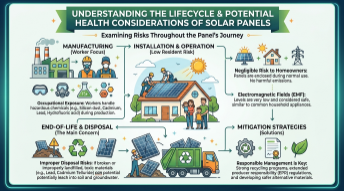
When people search for side effects of solar panels on humans, the biggest risk is not from living near an installed panel — it is from what happens to those panels during manufacturing and after disposal. Most people picture solar panels as slabs of clean glass soaking up sunlight. The reality is more complex. A standard photovoltaic module is an intricate assembly of glass (about 75%), polymer encapsulants (10%), aluminum framing (8%), and silicon cells (5%) — but also trace amounts of silver, cadmium, chromium, tin, lead, and other metals whose names rarely appear in any installation brochure.
Cadmium: The Silent Risk in Thin-Film Panels
Cadmium Telluride (CdTe) solar panels are among the most efficient and cost-effective on the market — and they contain cadmium, one of the most toxic heavy metals known to science. According to health and safety research on PV systems, long-term cadmium exposure can cause lung cancer, kidney damage, and bone disease. In manufacturing environments where cadmium compounds are handled in powder or liquid form, inhalation of fine cadmium particles is the primary route of occupational exposure. arka360.com ↗
The good news: under normal operating conditions, intact CdTe panels pose minimal risk to homeowners. The cadmium is sealed inside layers of glass and polymer. The danger emerges at end-of-life when panels are broken, improperly disposed of, or left to degrade in landfills.
Lead: The Leaching Problem
Lead-based solder is still widely used in conventional crystalline silicon panels. Independent leaching tests — including the U.S. EPA’s standard Toxicity Characteristic Leaching Procedure (TCLP) have found lead concentrations as high as 9.3 mg/L in solar panel waste, well above EPA thresholds for hazardous classification. ScienceDirect ↗
⚠️
The U.S. EPA confirmed in August 2025 that discarded solar panels can legally be classified as hazardous waste if they fail TCLP testing for lead and cadmium. Until a federal universal waste rule is finalized (currently targeted for August 2027), panels can be landfilled as ordinary trash in most U.S. states. EPA source ↗
2. The Coming Solar Waste Mountain: 78 Million Tons by 2050
Among the most serious negative effects of solar panels on the environment, this is also the most underreported story in clean energy. The first wave of large-scale solar installations from the early 2000s is now approaching its 25–30 year operational lifespan. What happens to all those panels?
According to IRENA and IEA-PVPS projections, global solar panel waste could reach 78 million metric tons by 2050. For context, that is roughly the equivalent of every Boeing 747 ever built multiplied by ten thousand. IRENA ↗
A 2025 article in PNAS (Proceedings of the National Academy of Sciences) highlighted that EU recycling plants the most regulated in the world had a combined capacity of just 40,000 tons in 2023, less than a third of what the EU alone was already producing as waste. PNAS 2025 ↗
| Region | Projected Share of Global Waste by 2050 | Risk Level |
|---|---|---|
| China | ~40% (13.5–19.9 million tons) | Very High |
| United States | ~10% | High |
| Japan | ~7% | Medium |
| European Union | ~8% (regulations strongest) | Medium |
| India | ~1.8 million tons by 2030 alone | High (Growing) |
Solar panels are composed of glass, metals, and polymers — none of which biodegrade. Silicon cells do not decompose naturally. The ethylene-vinyl acetate (EVA) encapsulant used to protect solar cells can take hundreds of years to break down. Without proper recycling infrastructure, these materials remain in the environment indefinitely, creating long-term risks to soil and groundwater from leaching toxic metals.
🌱 What’s Being Done In June 2026, SOLARCYCLE opened a high-throughput recycling facility in Georgia that recovers approximately 96% of a panel’s material value — including silver, copper, aluminum, and glass. The EU’s WEEE directive already requires manufacturers to finance panel collection and recycling. The U.S. EPA’s proposed universal waste rule is expected to be finalized by August 2027, which would streamline handling nationwide. Earth911 2026 ↗
3. EMF Radiation from Solar Inverters: What Science Actually Says
Solar panels themselves — the photovoltaic cells — do not emit meaningful EMF radiation. The concern enters with the inverter, the device that converts the DC electricity panels produce into the AC electricity your home uses. Inverters operate continuously and emit low-frequency electromagnetic fields.
Some studies have suggested that long-term exposure to EMF from inverters and associated wiring could be linked to headaches, fatigue, and insomnia, though the research is not conclusive. WaveWall 2025 ↗ Major health organizations, including the World Health Organization, do not classify the EMF levels produced by standard residential solar systems as a credible health threat.
💡
Practical Advice: If you are installing a solar + battery system, place the inverter in a utility room, garage, or outdoor enclosure rather than in a bedroom wall or living space. Maintaining even 3–5 metres of distance from the inverter during daily activities eliminates any marginal EMF concern.
4. The Solar Heat Island Effect: When Clean Energy Warms Your Neighborhood
Large-scale solar farms covering hundreds of acres alter how land absorbs and radiates heat. Research published in Scientific Reports found that temperatures over photovoltaic plants were regularly 3–4°C warmer than surrounding wildlands at night, a phenomenon called the Photovoltaic Heat Island (PVHI) effect. Nature / Scientific Reports ↗
A 2024 study published in ScienceDirect found that rooftop solar installations in humid subtropical climates elevated ambient temperatures by over 5°C compared to conventional bare roofs during heatwaves, and increased occupants’ “Extreme Danger” heat exposure by 29.8% during power outages. ScienceDirect 2024 ↗
It is important to keep perspective: modern PV panels reflect as little as 2% of incoming sunlight — similar to water and less than soil or wood shingles. For homeowners, rooftop solar does not create a meaningful neighborhood heat problem. The PVHI effect is primarily a concern for utility-scale installations spanning many acres, particularly in already-warm climates.
A 2025 PNAS study across Phoenix, Toronto, and Miami found that combining rooftop solar with energy storage is actually one of the best heat adaptation strategies available, as it powers air conditioning during extreme heat events. The nuance matters: solar’s heat effects depend heavily on scale and location. PNAS 2025 ↗
5. Occupational Hazards: The Real Health Risk Is for Solar Workers
If there is one group that faces genuine long-term health risk from solar panels, it is the people who manufacture, install, and eventually decommission them. The Wikipedia entry on occupational hazards of solar panel installation notes that injuries related to panel installation are poorly quantified — meaning the data gap itself is a problem. Wikipedia ↗
Manufacturing Workers
Workers in CdTe panel manufacturing facilities face direct exposure to cadmium compounds in powder and liquid form. The primary risk is inhalation of fine cadmium-containing particles, which can accumulate in the lungs and cause long-term respiratory damage, kidney failure, and increased cancer risk. Proper respiratory protective equipment and strict industrial hygiene protocols are essential and not uniformly enforced globally.
Installation Workers
Installation crews face risks from falls (the leading cause of fatal injuries in solar installation, with fatal cases reported in California and France), prolonged UV radiation exposure, heavy panel lifting causing musculoskeletal injuries, and electrical hazards. The long-term health effects of UV overexposure during years of outdoor rooftop work increased skin cancer risk are a concern that the industry does not discuss enough.
Decommissioning Workers
As the first generation of commercial panels reaches end-of-life, decommissioning workers who physically break down old panels face the most concentrated exposure to lead dust, cadmium, and other metals. Proper hazmat protocols are critical.
The 7 Disadvantages of Solar Energy You Should Know
Searches for “7 disadvantages of solar energy” are consistently among the top queries on this topic. Here they are — honestly assessed, with context:
| # | Disadvantage | How Serious Is It? |
|---|---|---|
| 1 | Toxic metals (lead, cadmium) in panel construction | High — at end-of-life |
| 2 | 78 million ton waste crisis approaching by 2050 | High — systemic risk |
| 3 | No federal U.S. recycling mandate until 2027 | High — regulatory gap |
| 4 | Photovoltaic Heat Island effect near large solar farms | Medium — utility-scale only |
| 5 | EMF radiation from inverters | Low — manageable with placement |
| 6 | Occupational hazards for installation and manufacturing workers | Medium — industry needs better standards |
| 7 | High upfront cost and intermittent generation (no sun = no power) | Medium — financial and practical |
6. Protecting Yourself: Practical Steps for Homeowners in 2026
The overall risk to residential homeowners from properly installed and maintained solar panels is low. Understanding the dangers of solar panels on your roof — and how to mitigate them — means your household can enjoy the benefits of solar without the downsides. Here are the six steps that matter most.
Step 01
Choose reputable brands. Opt for panels from manufacturers with verifiable take-back and recycling programs. First Solar’s closed-loop program (since 2005) is a gold standard.
Step 02
Never break or cut old panels yourself. End-of-life panels must be handled by certified recyclers. Contact your installer about manufacturer take-back before disposal.
Step 03
Install inverters away from living areas. Garages, utility rooms, and exterior mounting keep any EMF concern well out of sleeping and living spaces.
Step 04
Inspect panels annually. Cracked or delaminating panels can potentially release encapsulated materials. Your installer should include this in any maintenance check.
Step 05
Check local regulations. If you live near a large solar farm, contact your local health department. The EPA’s universal waste rule (final rule expected August 2027) will significantly improve U.S. standards.
Step 06
Ask installers about electrical safety. Proper GFCI protection is essential in any solar + grid system. See our GFI vs GFCI guide for details.
7. The Balanced Verdict: Is Solar Worth It in 2026?
Yes — with awareness. The health risks from solar panels for a typical homeowner are minimal when panels are properly installed, maintained, and eventually recycled through legitimate channels. The scientific consensus, including assessments from the World Health Organization, EPA, and NC State University, confirms that standard residential solar systems do not pose a meaningful health risk to occupants.
The more serious risks are systemic: the looming waste mountain of 78 million tons, the inadequate global recycling infrastructure, the cadmium exposure faced by manufacturing workers in under-regulated markets, and the lack of a U.S. federal framework for solar waste until at least 2027.
The dark side of solar panels — the bad things about solar energy that the industry rarely advertises — is not a reason to reject solar. It is a reason to demand better: stronger manufacturer take-back policies, more investment in recycling technology (companies like SOLARCYCLE are proving it is economically viable), and honest public conversation about the full lifecycle of every panel installed on every roof.
✅ Key Takeaway for EcoPowerSence Readers Solar panels are safe for homeowners when installed and maintained correctly. The risks are real but manageable — primarily at the manufacturing stage (cadmium exposure for workers) and end-of-life stage (toxic leaching from landfilled panels). Supporting brands with strong recycling programs and advocating for better waste policy is how consumers can help close the gap.
Stay Ahead of Solar Tech in 2026
Get honest, research-backed guides on solar energy, smart outdoor tech, and home energy solutions — no hype, just facts.Explore Energy Learning Hub →

I am Ethan Brooks is an author dedicated to exploring sustainability, technology, and forward-thinking solutions. His writing highlights simple yet powerful ways to improve everyday life while protecting the planet. He believes knowledge can drive meaningful change. Discover more at ecopowersence.com.