Discover the top solar panel recycling programs in the USA for 2026. Learn about costs, EPA regulations, and the best recyclers for your PV waste. Start today!
TL;DR: By 2026, the US solar recycling industry has shifted from a niche service to a regulated necessity. This guide breaks down the top recycling programs, current disposal costs, and state-specific mandates to help you manage PV waste efficiently.
| Program/Provider | Best For | Process Type | Estimated Cost | Nationwide Coverage? |
| SolarCycle | Utility & Commercial | Proprietary Mechanical | $$ (Variable) | Yes (Rapidly Expanding) |
| First Solar | Own-Brand Modules | Chemical/High-Value Recovery | Low (Leased modules) | Global / US-wide |
| Cleanlites | Mixed Electronics Waste | Mechanical Shredding | $$$ | Regional (Midwest/East) |
| Cascadia Solar | Residential (NW Region) | Dismantling/Reuse | $$ | No (Regional Focus) |
| Echo Environmental | Commercial Portfolios | Bulk Processing | $$ | Yes |
The State of Solar Panel Recycling Programs in 2026
In 2026, solar panel recycling programs in the USA have matured into a multi-provider industry. Programs now range from manufacturer-led take-back schemes to third-party commercial recyclers, leveraging EPA universal waste rules to provide more affordable, nationwide logistics for decommissioned PV modules.
The landscape of Solar Panel Recycling Programs has undergone a seismic shift since the early 2020s. We are no longer just talking about “potential” waste; we are managing the first massive wave of decommissioned modules from the early 2010s boom. In my decade covering the energy sector, I’ve seen this evolve from a headache that developers avoided to a core part of the O&M (Operations and Maintenance) budget. Today, 2026 brings more specialized facilities than ever, driven by theU.S. EPA’s reclassification of solar panels as universal waste, which slashed the red tape for transport and storage across state lines.
People Also Ask
Q: Are solar panels banned from landfills in the USA? A: While there is no federal ban, states like California and Washington have effectively banned landfilling by requiring special handling, and more states are expected to follow by 2027.
Top Commercial Solar Recycling Providers to Watch
The top solar recycling providers in 2026 include SolarCycle, First Solar, and Echo Environmental. These companies lead the market by using automated mechanical and chemical processes to recover high-value materials like silver and silicon, rather than just recycling the aluminum frames.
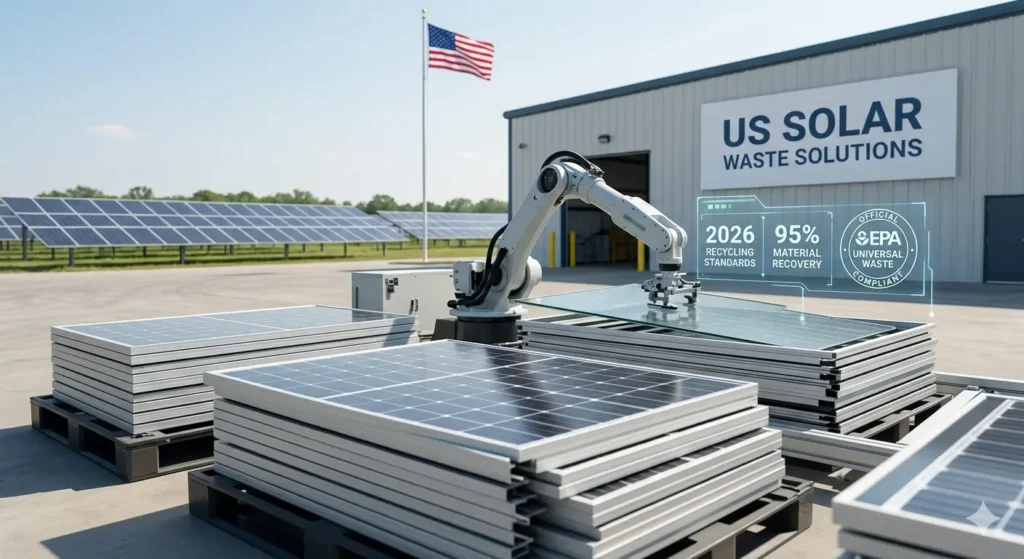
When evaluating Solar Panel Recycling Programs, you have to distinguish between “scrappers” and “true recyclers.” True recyclers, like SolarCycle, have pioneered robotic stripping processes that can recover up to 95% of a panel’s value, including the silver and high-grade silicon. I recently visited a facility in Texas where I saw their automated glass separation — it’s a far cry from the crude crushing methods used five years ago. Another heavy hitter is First Solar, which operates one of the most sophisticated “closed-loop” recycling systems in the world for their Thin-Film CdTe modules. If you aren’t using a high-value recovery partner, you’re essentially just paying someone to dump glass in a different way.
People Also Ask
Q: Who is the largest solar panel recycler in the US? A: SolarCycle and First Solar currently lead the market in terms of processing capacity and advanced material recovery as of 2026.
Solar Panel Recycling Cost Per Panel in 2026
The average cost to recycle a solar panel in 2026 ranges from $15 to $35 per panel, depending on volume, panel type, and your distance from a certified recycling facility. Residential users typically pay the highest per-unit rate, while utility-scale projects benefit from bulk pricing.
Here’s a quick breakdown of what you can realistically expect to pay, based on project size and panel condition:
| Project Type | Panel Quantity | Estimated Cost Per Panel | Notes |
| Residential (small batch) | 1–10 panels | $25 – $35 | Higher cost due to limited pickup logistics |
| Small Commercial | 11–50 panels | $20 – $28 | Often qualifies for partial pallet pickup |
| Large Commercial / C&I | 51–500 panels | $18 – $24 | Full pallet logistics reduce per-unit rate |
| Utility-Scale | 500+ panels | $12 – $15 | Bulk contracts and on-site sorting lower costs |
| Manufacturer Take-Back (e.g., First Solar) | Any | $0 – Low | Built into original lease/purchase agreement |
A few factors that push these numbers up or down in 2026:
- Logistics distance: Shipping panels from rural areas to the nearest certified facility can sometimes cost more than the recycling fee itself.
- Panel condition: Shattered or water-damaged panels require extra handling due to potential laminate leakage, which can add $2–$5 per unit.
- Frame removal: Aluminum frames are valuable and easy to separate, so pre-removing them yourself can shave a few dollars off the quoted price.
- State mandates: In EPR states like Washington and California, manufacturer-funded programs can bring your effective cost close to zero.
For developers and asset managers, theSEIA National PV Recycling Program directory remains the most reliable way to compare quotes and find aggregation hubs that lower per-panel shipping costs.
People Also Ask
Q: Is it cheaper to recycle or landfill solar panels? A: Landfilling currently costs $1–$5 per panel, making it cheaper in the short term, but environmental liability and state-specific bans make recycling the more viable long-term strategy.
Understanding the Costs: What You’ll Actually Pay
Let’s talk numbers because the “green” choice has to make financial sense. In 2026, you can expect to pay between $20 and $35 per panel for legitimate recycling services for small batches, as outlined in the cost table above. This fee typically covers logistics, the labor of dismantling, and the processing of the laminate. If you have a massive utility-scale project (50MW+), I’ve seen those costs drop to $12–$15 per panel because of the sheer volume. However, logistics remain the “silent killer” of ROI. Shipping three pallets of dead panels from rural Wyoming to a facility in Arizona can sometimes cost more than the recycling fee itself. TheSolar Energy Industries Association (SEIA) continues to provide a national network of partners to help developers find local hubs and aggregate shipments to lower these costs.
State Mandates and the EPR Model
State-level mandates, specifically Extended Producer Responsibility (EPR) laws in Washington and California, now require manufacturers to fund and manage solar panel recycling programs, ensuring that the cost of disposal is integrated into the product’s lifecycle.
Washington state’s ESSB 5939 was the catalyst we needed. As we enter 2026, the “Extended Producer Responsibility” (EPR) model is the law of the land in several key markets. Under these rules, manufacturers are responsible for the end-of-life disposal of the modules they sell. This has forced solar developers to look at the “cradle-to-grave” cost of their systems. According to research from theNational Renewable Energy Laboratory (NREL), these mandates are the primary driver behind the installation of new PV recycling capacity in the Pacific Northwest and California. If you’re a developer in these states, you literally cannot get your permits without a documented decommissioning and recycling plan.
People Also Ask
Q: What states require solar panel recycling? A: Washington and California have the strictest mandates in 2026, while New York, Illinois, and New Jersey have pending or enacted legislation requiring decommissioning plans.
Step-by-Step: How to Recycle Your Solar Panels
To recycle solar panels in 2026: perform an inventory, select a certified provider from the SEIA network, arrange palletized logistics, and obtain a Certificate of Recycling to ensure compliance and liability protection.
If you’re a homeowner or a small business owner with a failed inverter or cracked modules, the process is finally getting easier.
- Inventory Check: Document the brand, wattage, and quantity of panels.
- Find a Partner: Use the SEIA directory or your local municipality’s hazardous waste portal.
- Quote Logistics: Request a pickup quote; many companies will only send a truck for a full pallet (approx. 20–30 panels).
- Certificate of Destruction: Always insist on a “Certificate of Recycling” or “Destruction.” This is your legal shield against future environmental claims if those panels end up in a ditch somewhere.
People Also Ask
Q: Can I recycle just one or two solar panels? A: Yes, but it is expensive due to shipping. It is better to contact local e-waste collectors who may aggregate small quantities for larger recycling facilities.
The Technology Behind the Recovery: 2026 Breakthroughs
Advanced recycling technologies in 2026, such as automated hot-knife separation and chemical leaching, allow for the recovery of high-purity silver and silicon. This shifts the industry from simple “downcycling” (road base) to high-value material recovery for the circular economy.
The “holy grail” of Solar Panel Recycling Programs has always been high-purity glass and silver recovery. In the past, we just crushed everything and sold it as “glass cullet” for road base — a total waste of material. In 2026, several US plants have adopted hot-knife glass separation and chemical leaching. This allows them to pull out 99.9% pure silver and semiconductor-grade silicon. This isn’t just about being “green” anymore; it’s a strategic mineral supply chain play. With global demand for silver skyrocketing, the back-end of the solar lifecycle is becoming a literal silver mine. TheU.S. Department of Energy continues to fund research into these recovery processes as part of its broader circular economy goals.
People Also Ask
Q: What materials are recovered from solar panels? A: Over 90% of the panel’s weight is recovered, including the aluminum frame, glass, copper wiring, silicon, and precious metals like silver.
Practical Use-Case Recommendations
- Commercial Warehouse Owner with a 15-year-old 100kW system: Partner with a provider like SolarCycle for a full-service de-installation and material recovery report to boost ESG scores.
- Residential Homeowner with 4 hail-damaged panels: Wait for a local “E-Waste Drive” or contact a regional landfill that has a dedicated solar collection hub to avoid high shipping costs.
- Utility-Scale Developer planning a 200MW farm: Integrate an EPR agreement directly into the PPA (Power Purchase Agreement) with the manufacturer to lock in end-of-life costs today.
- Solar Manufacturer looking to comply with CA/WA law: Join the SEIA National Recycling Program as a preferred partner to gain access to shared logistics networks.
Frequently Asked Questions
Q: Will my solar installer take back my old panels? A: In 2026, many “tier 1” installers offer take-back programs as part of a replacement contract, but rarely if you are simply removing the system with no new installation.
Q: Is solar panel recycling mandatory in the USA? A: There is no federal mandate, but state-level laws in California and Washington make it functionally mandatory for large-scale projects.
Q: Does the 30% Tax Credit cover recycling costs? A: Currently, the federal Investment Tax Credit (ITC) covers the installation. Decommissioning and recycling costs are generally considered O&M expenses, though some commercial accounting treats them as part of the total project lifecycle cost.
Q: How long do solar panels last before they need recycling? A: Most panels are warrantied for 25–30 years. However, “early failures” due to hail or storm damage are currently the largest contributors to the PV waste stream.
Q: What happens to the hazardous materials in solar panels? A: Trace amounts of lead and cadmium are processed in specialized chemical facilities to prevent leaching, followingEPA Universal Waste guidelines.
Conclusion
The growth of Solar Panel Recycling Programs in 2026 marks a major win for the industry’s credibility, finally closing the “green waste” gap between clean energy and toxic landfilling. With SolarCycle and First Solar proving material recovery can be profitable, and per-panel costs now clearer and more predictable, the financial barriers are crumbling fast. Asset managers and homeowners should budget recycling costs early and build disposal planning into their O&M strategy to dodge rising non-compliance penalties. Choose partners offering tiered pricing and certified material tracking. The technology, regulations, and logistics have finally aligned decommissioned panels are now raw material for America’s next solar manufacturing wave.

I am Ethan Brooks is an author dedicated to exploring sustainability, technology, and forward-thinking solutions. His writing highlights simple yet powerful ways to improve everyday life while protecting the planet. He believes knowledge can drive meaningful change. Discover more at ecopowersence.com.