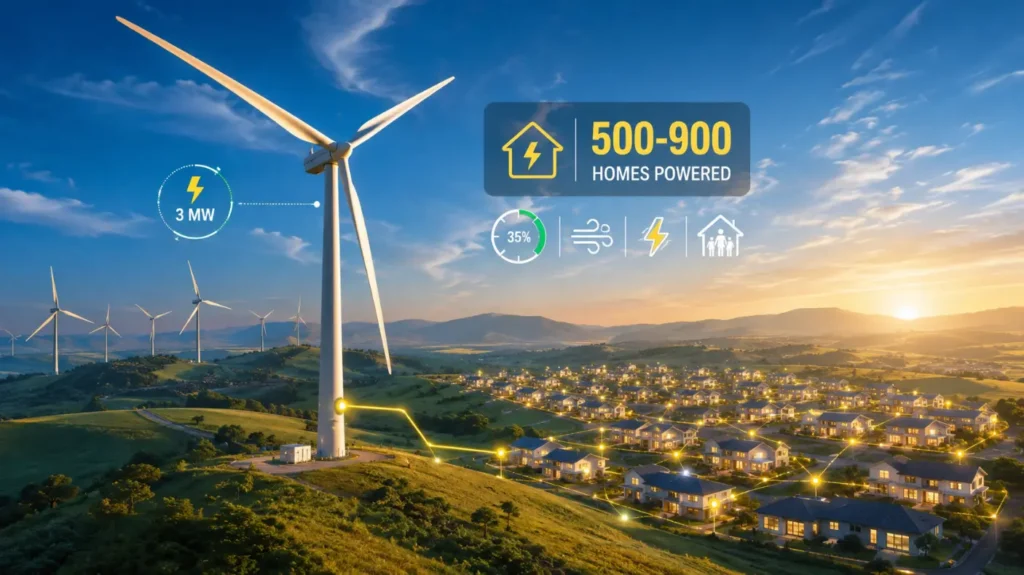
A typical onshore wind turbine (2-3 MW) can power between 460 and 940 homes per month, depending on its capacity factor and how much electricity homes in that region actually use. The exact number swings widely based on turbine size, wind speed, and location but the math behind it is simpler than most people expect.
How the Calculation Works
Every “how many homes can a wind turbine power” estimate comes down to one formula:
Turbine capacity (MW) × hours in the period × capacity factor = total energy output (MWh) → convert to kWh → divide by average home electricity use = homes powered
Here’s a worked example using a 2 MW turbine over one month (730 hours):
- Rated capacity: 2 MW = 2,000 kW
- Capacity factor: Assume 33% (a realistic average for onshore turbines)
- Monthly output: 2,000 kW × 730 hours × 0.33 ≈ 481,800 kWh
- Average US home usage: Roughly 867 kWh/month
- Homes powered: 481,800 ÷ 867 ≈ 556 homes
That single variable capacity factor is why estimates online range so widely. A turbine’s “rated capacity” is its maximum output under ideal wind conditions, but wind doesn’t blow at the perfect speed constantly. The capacity factor accounts for that gap between theoretical maximum and real-world average output.
Onshore vs Offshore Turbines: A Comparison
Turbine size has grown dramatically over the past decade, and offshore turbines now dwarf their onshore counterparts. Here’s how the numbers stack up:
| Turbine Type | Typical Capacity | Capacity Factor | Monthly Output (est.) | Homes Powered (US avg.) |
| Small onshore | 1.5 MW | 30% | ~328,000 kWh | ~378 homes |
| Modern onshore | 2-3 MW | 33% | ~480,000-720,000 kWh | ~555-830 homes |
| Large offshore | 8 MW | 40% | ~2,336,000 kWh | ~2,700 homes |
| Largest offshore (Haliade-X class) | 14-15 MW | 45% | ~4,600,000+ kWh | ~5,300+ homes |
The jump from onshore to offshore isn’t just about size offshore turbines also benefit from stronger, steadier winds over open water, which pushes their capacity factor higher. That combination of bigger blades and better wind conditions is why a single large offshore turbine can power thousands of homes, while an onshore turbine in a typical wind farm powers hundreds.
For perspective, the largest turbines in the world can generate enough electricity in roughly 90 minutes to power a single average US home for an entire month.
Why the Number Varies by Region
Two homes in different parts of the US can have very different impacts on this calculation, because average electricity consumption varies significantly by state. According to theU.S. Energy Information Administration’s residential energy data, average monthly residential electricity use ranges from around 600 kWh in some Western states to over 1,200 kWh in parts of the South, largely driven by air conditioning demand.
This means the same wind turbine output translates into a different “homes powered” number depending on where you draw the comparison:
- In a low-consumption state, a 2 MW turbine might power closer to 700-800 homes
- In a high-consumption state (heavy AC use), the same turbine might power only 400-500 homes
Wind speed and seasonality add another layer of variation. Spring and fall typically bring the strongest, most consistent winds in most US regions, while summer often sees a dip in wind speeds even though electricity demand for cooling is at its peak. This mismatch is one reason utilities pair wind power with other generation sources rather than relying on it alone.
Real-World Example: A 3 MW Turbine
Let’s apply the formula across different timeframes for a modern 3 MW onshore turbine at a 35% capacity factor a solid, achievable figure for a well-sited turbine.
Daily output: 3,000 kW × 24 hours × 0.35 ≈ 25,200 kWh/day
Monthly output: 25,200 kWh × 30 days ≈ 756,000 kWh/month
Annual output: 756,000 kWh × 12 ≈ 9,072,000 kWh/year
Homes powered (using ~10,600 kWh/year average US household consumption): 9,072,000 ÷ 10,600 ≈ 855 homes annually
This is roughly in line with the commonly cited “modern turbines can power 800-900 homes” figure and it shows why annual output, not a single day’s number, gives the most reliable picture. A single windy day might suggest a turbine could power 1,500+ homes if sustained, but averaged across calm days, maintenance downtime, and seasonal lulls, the realistic annual figure settles much lower.
How This Compares to Home Solar
If you’re weighing wind power against rooftop solar for your own home, the comparison isn’t really “wind vs. solar” at the utility scale it’s about understanding the scale difference between a utility wind turbine and a residential solar setup.
A single 3 MW wind turbine powering ~855 homes annually is producing roughly 9 million kWh per year. A typical residential solar installation (around 6-8 kW) might produce 8,000-12,000 kWh per year enough for one home’s needs, but it would take roughly 750-1,100 home solar systems to match the output of one large wind turbine.
This doesn’t mean one is “better” than the other they serve different purposes. Utility-scale wind turbines feed the broader grid and benefit from economies of scale, while rooftop solar gives individual homeowners direct control over their own energy production and bills. If you’re trying to figure out how many solar panels your specific home would need, the calculation depends on your roof’s sun exposure, your energy usage, and local panel efficiency a very different (and much more personal) version of the same math used above for wind turbines.
Common Misconceptions
1. Rated capacity isn’t actual output. A “2 MW turbine” doesn’t produce 2 MW constantly that’s its maximum under perfect wind conditions. Real-world output, factored through the capacity factor, is typically 30-45% of that maximum.
2. “Homes powered” is an annual average, not a live connection. Wind turbines feed electricity into the grid, not directly to specific houses. The “X homes powered” figure is a way of expressing total energy output in relatable terms it doesn’t mean those exact homes lose power if the turbine stops.
3. Bigger doesn’t always mean proportionally more homes. A turbine twice the size of another won’t necessarily power twice as many homes if it’s installed in a location with weaker, less consistent wind. Site selection and capacity factor often matter more than raw size.
Frequently Asked Questions
How many homes can a 1 MW wind turbine power? At a typical 30-33% capacity factor, a 1 MW turbine produces roughly 2.6-2.9 million kWh per year enough to power approximately 250-275 average US homes annually, depending on regional electricity consumption.
How many homes can the world’s largest wind turbine power? The largest offshore turbines, in the 14-15 MW class, can generate over 4.6 million kWh per month at a strong capacity factor enough to power more than 5,000 average US homes for a month from a single turbine.
Do wind turbines power homes directly, or do they go to the grid? Wind turbines feed electricity into the broader power grid, where it mixes with energy from other sources. “Homes powered” is a way to express total output in relatable terms, not a direct one-to-one connection between a turbine and specific houses.
What is a good capacity factor for a wind turbine? Onshore turbines typically achieve 30-40% capacity factors, while offshore turbines can reach 40-50% due to stronger, more consistent winds. Anything above 35% onshore is generally considered a strong site.
How many wind turbines would it take to power a city? It depends entirely on the city’s size and the turbines used. As a rough guide, a city of 100,000 homes would need roughly 115-180 modern 2-3 MW onshore turbines, or far fewer (around 20) large 14-15 MW offshore turbines, based on the homes-per-turbine figures above.
Final Thoughts
The honest answer to “how many homes can a wind turbine power” is: it depends but usually somewhere between a few hundred and several thousand, depending on turbine size, location, and capacity factor. Modern 2-3 MW onshore turbines typically power 500-900 homes annually, while the newest offshore giants can power 5,000 or more. As turbine technology continues to scale up, especially offshore, these numbers will keep climbing making wind an increasingly significant piece of the renewable energy mix alongside solar.👉 Curious how this compares to your own home’s energy setup? Explore ourComplete Guide to Solar Energy & Home Efficiency to see how rooftop solar stacks up, or browse more explainers in ourEnergy Learning Hub.

I am Ethan Brooks is an author dedicated to exploring sustainability, technology, and forward-thinking solutions. His writing highlights simple yet powerful ways to improve everyday life while protecting the planet. He believes knowledge can drive meaningful change. Discover more at ecopowersence.com.