Author: Ethan Brooks
Date Published: 2026-06-12 | Last Updated: 2026-06-27
If you have ever stood in the electrical aisle staring at outlets labeled “GFI” and “GFCI” wondering if you are buying the wrong thing, you are not alone. This is one of the most Googled electrical questions every year, and the short answer has not changed: they are the same device. But that one-line answer leaves homeowners with a dozen follow-up questions which is exactly where most articles on this topic stop short.
This guide goes further. We cover not just what GFI and GFCI mean, but how self-testing modern devices work, what changed under the 2026 NEC update, how to identify what is already in your home, why GFCI and AFCI are completely different, 2026 installation costs, and why electricians insist on one term over the other. If you are also setting upsmart energy monitors for your home circuit breakers or installingsmart light switches in kitchens and bathrooms, understanding GFCI protection first is a critical safety step.
Quick Answer: Is There a Difference Between GFI and GFCI?
No functionally, there is no difference. GFI stands for Ground Fault Interrupter, and GFCI stands for Ground Fault Circuit Interrupter. Both terms describe the exact same protective technology: a device that monitors electrical current and shuts off power within milliseconds if it detects current leaking to ground (a “ground fault”), which often means a person is being shocked.
GFCI is the term used in the National Electrical Code (NEC) and on most modern product packaging. GFI is an older, shorter version of the same term still commonly found in casual conversation, in older homes, and sometimes printed on outlet faceplates. If the box says “GFI Outlet,” it will protect you in exactly the same way as one labeled “GFCI Outlet.” The 2023 NEC update went a step further, replacing “GFCI” with the more precise designation “listed Class A GFCI” in Section 210.8 but all three terms describe the same device you find at any hardware store.
How a GFCI/GFI Actually Works
Inside a normal circuit, electricity flows out through the “hot” wire and returns through the “neutral” wire in equal amounts. A GFCI continuously compares the current flowing out versus the current flowing back. If there is a difference even as small as 4 to 6 milliamps (about 1/40th of the current needed to power a small light bulb) the device assumes that “missing” current is flowing somewhere it should not, often through a person’s body to the ground.
When that imbalance is detected, the GFCI trips and cuts power in as little as 1/40 of a second fast enough to prevent a fatal shock in most cases, though not always fast enough to prevent you from feeling it.
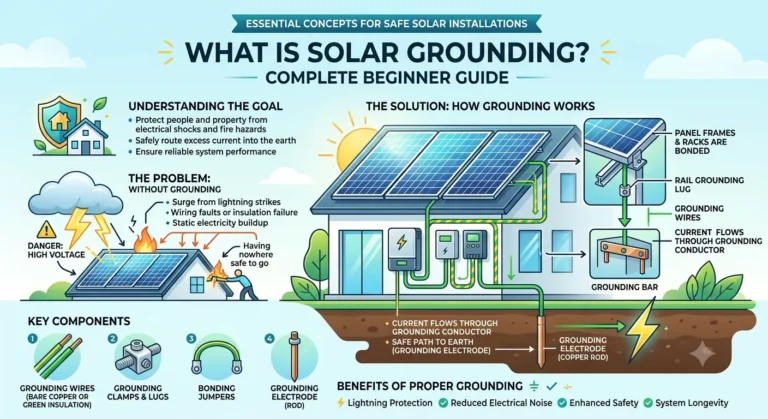
This is fundamentally different from how a standard circuit breaker works. A regular breaker protects your wiring from overheating due to overloads or short circuits. A GFCI protects people from shock, regardless of whether the circuit is overloaded. This same principle applies at the solar inverter level when you aregrounding a solar power system safely, the inverter’s built-in GFCI detection is what trips the system if a ground fault occurs in the array.
Self-Testing GFCI: What Every 2026 Buyer Needs to Know
This is a section most articles skip entirely and it directly affects every GFCI outlet sold today.
Since June 29, 2015, UL Standard 943 has required all newly manufactured GFCI receptacles and circuit breakers to include an auto-monitoring (self-test) function. This means modern GFCIs automatically test themselves approximately every 15 minutes even when you forget to press the test button. If the self-test detects a failure, one of the following happens:
- Power is denied and the device cannot reset (end-of-life lockout)
- The device trips and notifies via LED indicator light
- An audible alert sounds (on models with audible alert feature)
The CPSC requested this change because field studies revealed a significant number of installed GFCIs were inoperative and homeowners had no way of knowing, since the outlets still supplied power even after losing their ground fault protection.
What to look for when buying a GFCI in 2026:
| Feature | What It Means |
| Self-Test / Auto-Monitor | Automatically checks circuit safety every ~15 min |
| Reset Lockout | Blocks reset if the device can no longer protect prevents false sense of security |
| LED Indicator | Green = protected and working, Red = replace device immediately |
| Tamper-Resistant (TR) | Required by NEC 406.12 for all new residential installations |
| Weather-Resistant (WR) | Required for outdoor and damp locations per NEC 406.9 |
Important: Even with self-test GFCIs, monthly manual testing is still recommended. The auto-monitor tests internal electronics, but only a manual trip-and-reset verifies the physical contacts and solenoid are working correctly.
For detailed monitoring of your home’s circuits beyond what a single GFCI tells you, smart energy monitor installed at your circuit breaker panel can flag unusual current draw patterns before they cause repeated tripping giving you visibility that a GFCI alone cannot provide.
GFI vs GFCI vs AFCI Don’t Confuse These Three
This is where a lot of homeowners get tangled up, and it is a gap most articles on this topic skip entirely. GFCI and AFCI are not the same thing, even though they often sit side-by-side in the electrical panel aisle.
| Feature | GFCI / GFI | AFCI |
| Protects against | Electric shock (ground faults) | Electrical fires (arc faults) |
| Detects | Current imbalance between hot and neutral | Dangerous arcing in damaged wiring |
| Trip threshold | ~4–6 milliamps | Arc signature detection (varies) |
| Required locations | Bathrooms, kitchens, garages, outdoors, basements, laundry | Bedrooms, living rooms, hallways, closets (per 2023/2026 NEC) |
| Common form factor | Outlet or breaker | Breaker or outlet |
In plain terms: GFCIs prevent you from being electrocuted. AFCIs prevent your house from catching fire due to hidden wiring faults. Both are essential but they solve completely different problems.
The 2026 reality: Many newer homes now use Dual-Function AFCI/GFCI breakers, which combine both protections in a single device installed at the panel. If you are updating an older panel or planning a home automation upgrade including addingsmart home power strips or automating circuits confirming whether your existing breakers are dual-function is the first electrical safety checkpoint to run.
2026 NEC Updates You Need to Know
The NEC 2026 was formally issued by the NFPA Standards Council on August 20, 2025 (effective September 9, 2025). While local adoption varies by jurisdiction, these are the key GFCI-related changes affecting homeowners and contractors:
New “Class A GFCI” Terminology: NEC 2023 and 2026 replace the older term “ground-fault circuit-interrupter” with “listed Class A GFCI” throughout Section 210.8. When discussing your project with an electrician or buying devices for a permitted job, this is the correct designation.
60-Amp Outdoor Outlet Threshold (NEC 2026 Section 210.8(F)): GFCI requirements now extend to certain outdoor outlets up to 60 amps, a meaningful expansion from the previous 50-amp limit that affects EV charger circuits and outdoor HVAC equipment.
HVAC Exception Deadline September 1, 2026: An existing GFCI exception for certain HVAC circuits expires September 1, 2026. After that date, Class C SPGFCI (Special Purpose GFCI) protection is required for applicable listed HVAC equipment. If outdoor HVAC work is scheduled for your home in 2026, ask your contractor which protection path applies under your local jurisdiction.
Replacement Receptacle Rules: Simply replacing an existing outlet is no longer automatically a “like-for-like” swap. NEC now requires checking Tamper-Resistant (TR), Weather-Resistant (WR), and GFCI requirements for the specific location even on a one-for-one replacement.
Check local adoption: Not every state or municipality has adopted NEC 2026 yet. Confirm the enforced edition with your local Authority Having Jurisdiction (AHJ) before starting permitted electrical work.
This matters even for low-voltage smart home work. When installingsmart light switches in kitchens and bathrooms locations that require GFCI protection confirming that the existing circuit is already GFCI-protected (at the outlet or breaker) is required before the smart switch installation is considered complete and code-compliant.
GFCI Outlets vs. GFCI Circuit Breakers vs. Portable GFCI
Three types of GFCI protection exist, and choosing correctly depends on your specific situation.
| GFCI Outlet | GFCI Breaker | Portable GFCI | |
| Location | At the wall receptacle | Inside the main electrical panel | Plugs into any existing outlet |
| Resets | TEST/RESET button on outlet face | Flip the breaker at the panel | Button on the portable device |
| Coverage | Itself + downstream outlets on same circuit | Entire circuit from panel to all outlets | Any device plugged into the portable unit |
| Best for | Single-outlet spot protection, bathroom or kitchen upgrades | Whole circuits, hot tubs, pools, outdoor runs | Construction sites, temporary power, outdoor tools |
| Typical 2026 cost | $15–$35 per outlet | $40–$70 per breaker | $25–$60 per unit |
Downstream protection explained in plain terms: If your bathroom has one GFCI outlet with TEST/RESET buttons, plus two standard-looking outlets next to it, those standard outlets are likely protected by the first GFCI through its load terminals. This is legal and code-compliant but those downstream outlets must be labeled “GFCI Protected / No Equipment Ground” if they lack a ground wire.
The single biggest wiring mistake in DIY GFCI installation is reversing the LINE and LOAD terminals. If swapped, the outlet may appear to work and even pass its own self-test, but downstream outlets lose protection with no visible indication that anything is wrong. Always use a plug-in circuit tester to verify downstream protection after installation.
Where Is GFCI Protection Required? (2026 Code Overview)
The NEC requires GFCI protection in any location where water and electricity are likely to meet. Under the 2023 and 2026 NEC editions, required locations include:
- Bathrooms all receptacles without exception
- Kitchens all countertop receptacles; all plug-and-cord connected appliances (expanded in 2023 NEC)
- Garages and accessory buildings with floors at or below grade level
- Unfinished basements and crawl spaces
- All outdoor receptacles no distance exception
- Laundry areas
- Areas within 6 feet of any sink, including utility sinks and wet bars
- Indoor damp/wet locations spas, pool equipment areas, boathouses
- Office break rooms with sinks and permanent food preparation provisions (2023 NEC addition)
- Rooftops of non-dwelling commercial buildings
One critical detail most guides omit: Code requirements apply at the time of installation or renovation not retroactively. An older home built before these requirements is not automatically “out of code.” But the moment you renovate a kitchen, bathroom, or garage, the inspector will require GFCI protection to be added as part of that scope of work.
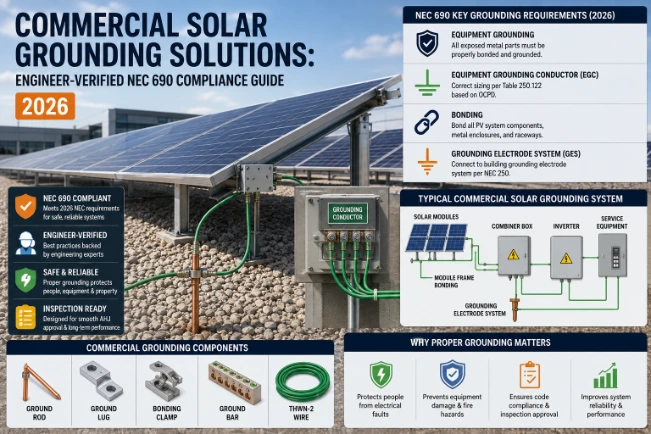
The same NEC compliance logic extends to solar installations. Whengrounding a solar power system safely under NEC 2026 Article 690 and 250, GFCI detection at the inverter is a built-in code requirement not optional equipment.
How to Identify What You Already Have
This is often the real reason someone searches “GFI vs GFCI” ; they are staring at an outlet and trying to figure out what it actually is.
Signs you have a GFCI outlet:
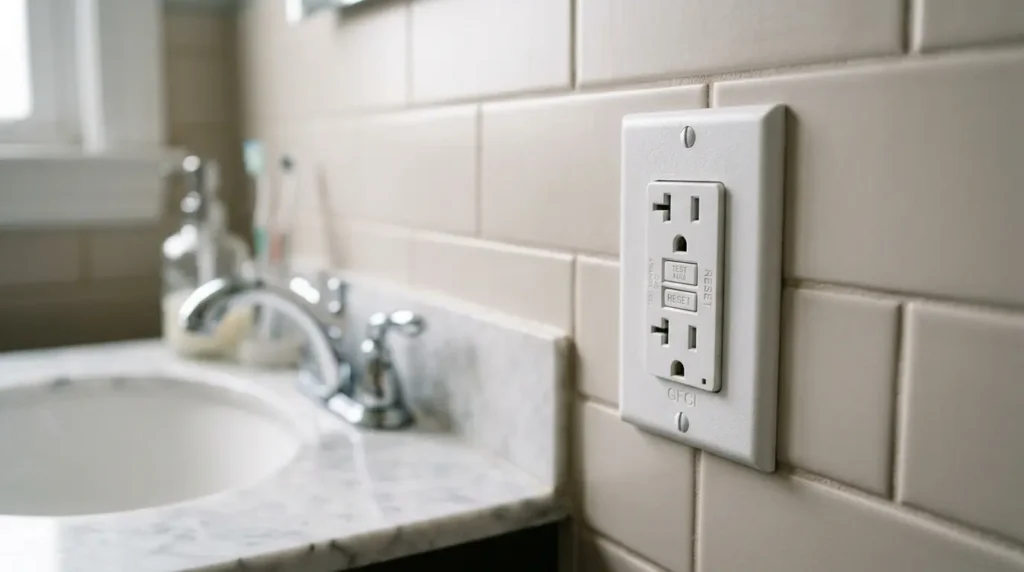
- Two buttons on the outlet face (labeled “TEST” and “RESET” often red and black, or both black)
- A label on the faceplate printed with either “GFI” or “GFCI” both indicate the same protection level
- An LED indicator light (on newer self-test models): green = protected, red = replace immediately
Sign you have a GFCI circuit breaker:
- A small “TEST” button on the breaker face inside your electrical panel
- A pigtail wire (short coiled white wire) connecting from the breaker to the neutral bus bar standard breakers do not have this
Sign you have downstream GFCI protection (no buttons on the outlet itself):
- A standard-looking outlet in a bathroom, kitchen, or garage that loses power when you press the TEST button on a different GFCI outlet nearby
- A label on the outlet face reading “GFCI Protected”
Warning sign: If an outlet in a required location (bathroom, kitchen, garage, outdoor) has no TEST/RESET buttons, no GFCI breaker upstream, and no “GFCI Protected” label, that is an unprotected outlet. It should be addressed, regardless of whether the rest of the home is grandfathered.
For a broader view of what is happening on each circuit, awhole-home smart energy monitoring system can help you spot circuits drawing abnormal current which sometimes signals a ground fault condition that a GFCI has not yet tripped on.
15-Amp vs. 20-Amp GFCI Outlets: Which Do You Need?
This detail is mentioned by some competitors but rarely explained clearly.
- 15-amp GFCI outlets are standard for general-purpose circuits, bathrooms, small appliance areas, and bedroom lighting circuits.
- 20-amp GFCI outlets (identifiable by the extra horizontal “T” slot on one prong receptacle) are required for higher-draw circuits kitchen countertops (NEC requires 20A), dedicated laundry circuits, workshops, power tools.
The amperage of the outlet must match the amperage of the circuit breaker and wiring serving it. You cannot install a 20-amp GFCI outlet on a 15-amp circuit to “upgrade” the outlet if the wiring and breaker are rated at 15 amps, a 20-amp outlet is a code violation and a potential fire hazard, even though it fits physically.
How Long Do GFCI/GFI Devices Last?
GFCI devices contain electronic sensing components that degrade over time particularly in the damp environments where they are most often installed.
- Typical reliable lifespan: 10–15 years
- Maximum potential lifespan: Up to 25 years, though performance often degrades before any physical failure becomes visible
- Primary wear factors: Moisture exposure, heat, voltage surges, lightning-induced transients, and frequent tripping cycles
Test monthly even with self-test models. Press the TEST button. Power to that outlet and any downstream outlets should cut immediately. Press RESET. Power should return. If the outlet does not trip on TEST, or will not reset after tripping, it has failed and must be replaced immediately; it may still supply power while providing zero ground fault protection.
Devices older than 15 years in bathrooms, garages, and outdoor locations should be proactively replaced with current self-test models, even if they still appear functional.
Troubleshooting: Why Does My GFCI Keep Tripping?
This is one of the highest-volume follow-up searches after “GFI vs GFCI,” and it deserves direct coverage. Common causes in order of likelihood:
- Moisture intrusion water inside the outlet box, a humid bathroom without ventilation, or a sprinkler hitting an outdoor outlet during a cycle
- A faulty appliance on the circuit refrigerators, space heaters, old holiday lights, or hair dryers with internal current leakage to ground
- Long circuit runs with multiple devices nuisance tripping can occur when too many devices with small individual leakages share a circuit, and their combined leakage exceeds the 4–6 mA threshold
- GFCI and AFCI on the same circuit in rare wiring configurations can occasionally cause cross-tripping
- The GFCI itself is at end of life especially if the device is 10+ years old and trips with nothing plugged in
Isolation test: Unplug everything on that circuit. Reset the GFCI. Plug devices back in one at a time. The device that triggers the trip is the culprit. If the GFCI trips with absolutely nothing connected, the device itself needs replacing.
Asmart energy monitor at your circuit breaker panel can flag abnormal current signatures on specific circuits over time often revealing which appliance has a developing internal fault before the GFCI starts tripping repeatedly.
When to call a licensed electrician:
- GFCI trips immediately upon reset with nothing plugged in
- Will not reset at all stuck in tripped position
- Warm outlets, burning smell, or visible discoloration on the faceplate
- Multiple GFCIs on different circuits tripping at the same time (panel-level issue)
DIY Installation vs. Hiring an Electrician (2026 Cost Guide)
Swapping a GFCI outlet is one of the most common DIY electrical projects but it is worth understanding where the real risks are.
| DIY Installation | Licensed Electrician | |
| Device cost | $15–$35 per outlet | $15–$35 (often supplied by electrician at cost) |
| Labor cost | $0 (your time) | $100–$250 for a standard outlet swap depending on region |
| Risk | Reversed LINE/LOAD leaves downstream outlets unprotected with no visible warning | Tests full downstream protection, verifies code compliance, pulls permit if required |
| Best for | Simple one-for-one outlet swaps in de-energized, accessible locations | New circuits, GFCI breaker installs, older homes without grounding, any panel work |
The critical DIY mistake to avoid: Reversing the LINE and LOAD terminal connections. LINE terminals receive power from the panel. LOAD terminals send protected power to downstream outlets. If reversed, the outlet itself may test fine but every outlet downstream is unprotected. The only way to catch this error is to test each downstream outlet individually with a plug-in GFCI tester after installation.
When integrating GFCI-protected circuits with broader home energy systems such as addingsmart home power strips in garage or office setups, or connecting outdoor devices to existing outdoor circuits, confirming proper LINE/LOAD wiring on the upstream GFCI is always the first step before assuming downstream outlets are protected.
Why Electricians Say “GFCI” and Not “GFI”
“GFCI” is the term used in the National Electrical Code, on permits, on inspection forms, and in most manufacturer documentation produced in the past two decades. The 2023 NEC update further standardized this by replacing even “GFCI” with “listed Class A GFCI” in Section 210.8 making the terminology even more precise for contractors, inspectors, and permit applications.
“GFI” persists because it is shorter and has been in use since these devices were first introduced in the 1960s and 1970s. Many supply houses, older product lines, and some current packaging still use “GFI” and it remains fully understood in the field. For homeowners: if someone says GFI, they mean GFCI. For professionals dealing with permits and inspections: GFCI (or “Class A GFCI”) is the term to use.
Frequently Asked Questions
Is a GFI the same as a GFCI?
Yes. GFI (Ground Fault Interrupter) and GFCI (Ground Fault Circuit Interrupter) are the exact same device. The terms are fully interchangeable. GFCI is the current NEC-standard terminology; GFI is an older shorthand for the same technology.
Can I install a GFCI outlet without a ground wire?
Yes. A GFCI works by comparing hot and neutral current; it does not rely on a ground wire to function. However, code requires outlets installed this way to be labeled “GFCI Protected” and “No Equipment Ground.”
How often should I test my GFCI outlets?
Once a month, even if your outlets have self-test functionality. The auto-monitor checks internal electronics every ~15 minutes, but a manual test-and-reset is the only way to verify the physical contacts and solenoid are working. If a device fails the manual test, replace it immediately.
Do I need to replace old GFCI outlets with self-test models?
Not retroactively required by code but strongly recommended. Devices manufactured before June 2015 do not self-monitor between manual tests. If your GFCI is over 10–15 years old, upgrading to a current self-test model with LED indication is a worthwhile safety investment.
Can a GFCI and AFCI be on the same circuit?
Yes and in many new installations, a single Dual-Function AFCI/GFCI breaker provides both protections from the panel. Certain locations required to have GFCI (like bathrooms) may not be satisfied by AFCI protection alone, so confirm with your electrician what your specific circuit requires.
My GFCI outlet has no buttons is it unprotected?
Not necessarily. It may be protected by a GFCI breaker at the panel, or by a GFCI outlet earlier in the same circuit (downstream protection). Test by pressing the TEST button on a nearby GFCI outlet and confirming whether this outlet also loses power.
Do all 20-amp circuits require GFCI protection?
Amperage does not determine the requirement location. A 20-amp outlet in a kitchen or garage requires GFCI protection for the same reason a 15-amp outlet in the same location does: water exposure risk.
What is a Class A GFCI?
Class A GFCI is the current NEC 2023/2026 designation for the standard ground fault protection device (trips at 4–6 milliamps) used in residential and commercial locations. Every GFCI outlet or breaker you find at a hardware store is a Class A device unless specifically labeled otherwise.
Does GFCI protection matter for smart home devices and solar setups?
Yes. When planning asmart home energy and automation system, GFCI protection on outdoor circuits, garage circuits, and any circuit near water is a code requirement that must be in place before smart devices are connected to those circuits. For solar systems, inverter-level GFCI detection is a built-in safety requirement under NEC Article 690 covered in detail in oursolar grounding safety guide.
Conclusion
GFI and GFCI describe the same life-saving technology; there is no functional, safety, or performance difference between a device labeled one way versus the other. What matters far more is where GFCI protection exists in your home, whether it is a current self-testing model under UL 943, and whether it is still functioning reliably after years of exposure to moisture and use.
If you are unsure whether your bathroom, kitchen, garage, or outdoor outlets are properly protected or if a GFCI keeps tripping and you cannot isolate the cause, a plug-in circuit tester (available at any hardware store for under $15) or a licensed electrician’s inspection is worth far more than guessing.

I am Ethan Brooks is an author dedicated to exploring sustainability, technology, and forward-thinking solutions. His writing highlights simple yet powerful ways to improve everyday life while protecting the planet. He believes knowledge can drive meaningful change. Discover more at ecopowersence.com.