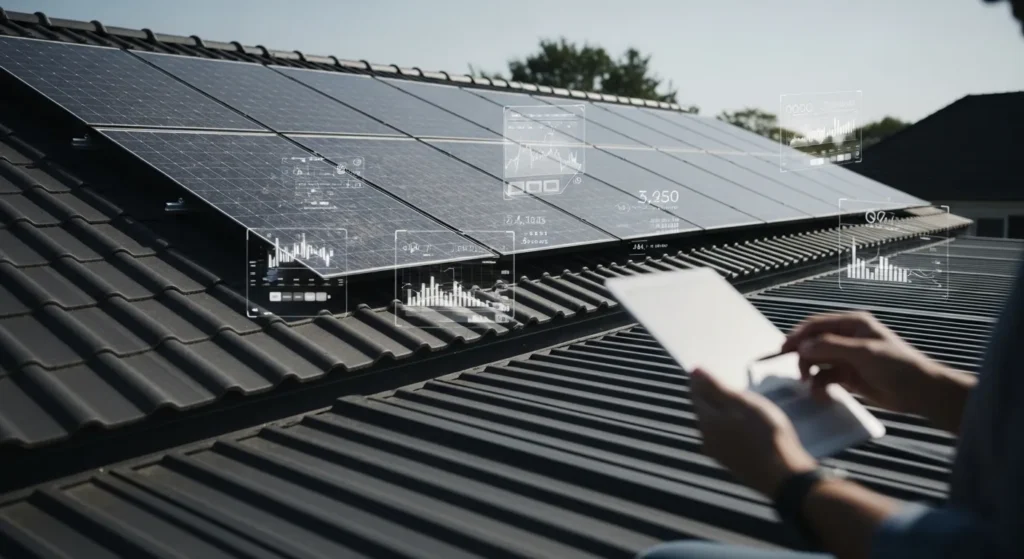
Learn how to calculate how many solar panels you need in 2026. Use our step-by-step formula for energy offset, peak sun hours, and panel wattage ROI.
TL;DR: To find out how many solar panels you need, divide your monthly kWh usage by the product of your local peak sun hours and the panel’s wattage efficiency. In 2023, most US homes require 18 to 25 high-efficiency N-type panels to reach 100% energy offset.
| Home Size | Avg. Monthly Usage | Recommended System Size | Number of 450W Panels | Best For |
|---|---|---|---|---|
| Small (1,200 sq ft) | 600 kWh | 4.5 kW | 10-12 | Condos / Energy Savers |
| Medium (2,200 sq ft) | 900 kWh | 7.2 kW | 16-18 | Standard Family Home |
| Large (3,500 sq ft) | 1,300 kWh | 10.8 kW | 24-26 | EV Owners / AC Heavy |
| Estate (5,000+ sq ft) | 2,000+ kWh | 16 kW+ | 36+ | Luxury / Multi-Zone HVAC |
Step 1: Calculate Your Annual Energy Consumption
To calculate your energy needs, sum up your electricity usage (kWh) for the past 12 months. Divide that total by 12 to get your average monthly consumption. Most American homes use approximately 880 kWh per month, requiring a system size between 6 kW and 11 kW depending on location.
Before you look at hardware, you have to look at your utility bill. To accurately determine how many solar panels I need, you shouldn’t just look at last month’s statement. Seasonality is a killer; your July AC usage looks nothing like your October energy draw. I’ve seen homeowners under-size their systems by 30% because they calculated based on a mild spring month.
Gather 12 months of statements and find the “Total Annual kWh.” If you’re planning on buying a Tesla or installing a heat pump in 2027, add a 20% buffer now. It is significantly more expensive to add three panels later than it is to install them today. The electrification of everything is a real trend, and according to the International Energy Agency residential electricity demand is projected to climb steadily as we transition away from gas-powered appliances.
Why Year-Over-Year Data Matters
In 2026, smart home devices are more ubiquitous, but they are also more efficient. Don’t assume old data holds true. If you swapped to LED lighting or a smart thermostat recently, your 2024 data might be too high. Use the most recent 6 months and extrapolate if needed, but the 12-month average remains the gold standard for solar sizing.
People Also Ask
Q: How many kWh does an average house use per day?
A: A typical US home uses approximately 29-30 kWh per day, though this varies significantly with climate and heavy appliance use.
The Peak Sun Hours Myth vs. Reality
Peak sun hours represent the number of hours per day when solar intensity averages 1,000 watts per square meter. To find how many solar panels I need, you must divide your daily kWh requirement by your local peak sun hours (ranging typically from 3.5 to 6 in the US).
A common mistake I see in DIY calculators is confusing “daylight hours” with “peak sun hours.” You might have 14 hours of daylight in the summer, but you likely only have 4 to 6 hours of peak sun defined as intensity of 1,000 watts per square meter. If you’re in Arizona, you’re laughing with 6.5 hours. If you’re in Seattle, you’re designing for 3.5 hours.
Regional Solar Potential in 2026
Climate change has shifted cloud patterns in the Northeast and Midwest, making historical averages slightly less reliable. I recommend using the Global Solar Atlas to get targeted coordinates for your specific roof. High-performing N-type monocrystalline panels handle diffuse light (cloudy days) better than older tech, but they still can’t beat physics. Less sun always equals more panels.
Pro Tip: Don’t forget the ‘Derate Factor.’ No system is 100% efficient. Between DC-to-AC conversion losses in your inverter and dirty panels, you should multiply your calculated need by 1.2 to 1.25 to ensure you actually cover your bill.
People Also Ask
Q: What are peak sun hours in my state?
A: States like Arizona and California average 5.5-6.5 hours, while northern states like Michigan or New York average 3.5-4.2 hours annually.
Panel Wattage and Efficiency in 2026
In 2026, residential solar panels typically range from 400W to 500W. To find the number of panels, divide your total system size (in Watts) by the wattage of a single panel. For a 10kW system using 450W panels, you would need approximately 23 panels.
In early 2026, the industry standard has moved toward 450W to 500W panels for residential use. Gone are the days of the 300W clunkers taking up your entire roof. Higher efficiency (now regularly topping 22.5%) means you can get more power out of a smaller footprint. This is a massive win for homeowners with complex roofs or limited south-facing space.
When you ask how many solar panels I need, the answer changes based on the module quality. Here is the math: If you need a 7kW system, that’s about 16 panels if using 450W modules. If you used 350W panels from a clearance warehouse, you’d need 20. That’s four extra sets of racking, four more microinverters, and more labor. Sometimes the ‘expensive’ panel is cheaper in the long run.
For deep technical standards on module safety and performance, the International Electrotechnical Commission provides the certifications (like IEC 61215) that you should look for on your spec sheet. If a panel isn’t IEC certified in 2026, don’t put it on your roof.
People Also Ask
Q: Is a 450 watt solar panel good?
A: Yes, 450W is the current ‘sweet spot’ for residential solar in 2026, offering a balance of high efficiency and cost-effectiveness.
The Solar Calculation Formula for 2026
To calculate your panel count: Daily kWh usage ÷ Peak Sun Hours x 1.25 efficiency factor. Divide the result by your panel’s wattage. For a home needing 30kWh/day in a 4-sun-hour zone, you would need roughly 21 panels of 450W each.
Let’s get into the weeds. The formula I use for my clients is: (Daily kWh / Peak Sun Hours) x 1.25 Derate Factor / Panel Wattage. Let’s run a real-world scenario for a home using 900 kWh per month in a region with 4 peak sun hours.
- 900 kWh / 30 days = 30 kWh per day.
- 30 kWh / 4 hours = 7.5 kW array needed.
- 7.5 kW x 1.25 (Efficiency Loss) = 9.375 kW.
- 9,375 Watts / 450W (Panel Size) = 20.8 (Round up to 21 panels).
This 21-panel array will roughly yield 100% energy offset. However, remember that 2026 net metering laws (like NEM 3.0 in California) have changed the ROI game. It’s often smarter to size for 80% offset and add a battery rather than aiming for 110% offset when the utility pays you pennies for your excess. I’ve seen homeowners regret over-sizing their systems because they didn’t account for lower export credits.
People Also Ask
Q: Should I round up or down on solar panels?
A: Always round up. Real-world conditions like dust, heat, and wire resistance will always reduce output below laboratory ratings.
Roof orientation and Shading Impact
South-facing roofs are ideal for solar. For West or East-facing roofs, you typically need to increase your panel count by 15-20% to achieve the same energy output. Shading from trees or chimneys can further increase the required system size.
Your roof isn’t a laboratory. If your roof faces West instead of South, you’re losing about 15% of your potential generation. If you have a massive oak tree casting a shadow over 10% of the array for two hours a day, your calculation is out the window. In 2026, we use LiDAR-based shading analysis to get exact. For the layman, if your roof is ‘sub-optimal,’ just add 2-3 panels to the total we calculated in the previous step.
Microinverters vs String Inverters
This affects your count too. Microinverters (like Enphase IQ9) allow each panel to work independently. In a string system, if one panel is shaded, the whole row drops in production. If you have any shading at all, don’t even try to calculate without assuming a 15% efficiency penalty unless you’re using individual power optimizers. This is where most DIY estimates fail—they assume perfectly clear horizons.
People Also Ask
Q: Can I put solar panels on a North-facing roof?
A: It is generally not recommended in the Northern Hemisphere as the ROI is significantly lower, necessitating 30-50% more panels for the same output.
Sizing for Electric Vehicles (EVs) and Heat Pumps
Adding an Electric Vehicle (EV) typically requires an additional 6 to 9 solar panels, depending on your mileage. A heat pump conversion can add another 3,000-5,000 kWh per year to your load, requiring a 25-40% larger solar array.
If you’re asking how many solar panels I need, you’re likely looking at the future of your home. A single EV driven 12,000 miles a year adds about 3,500 kWh to your annual bill. To cover that alone, you’re looking at an additional 6 to 9 panels. I’ve seen too many people install solar in 2024 only to realize in 2026 that their new F-150 Lightning has completely wiped out their solar savings.
Heat pumps are another ‘hidden’ drain. While they are more efficient than gas furnaces, they move your energy load from gas to electric. If you’re planning a HVAC renovation, consult your contractor about the expected kWh draw and add that to your solar math now. According to data from the International Renewable Energy Agency residential electrification is the single biggest driver of solar system expansions globally. Don’t be the person who has to pay for a second installation crew in two years.
People Also Ask
Q: How many solar panels does it take to charge a Tesla?
A: Charging a Tesla for average daily driving usually requires about 7 to 10 additional 400W solar panels.
Physical Space: Will They Even Fit?
Standard 2026 solar panels are approximately 19-21 sq. ft. A 20-panel system requires roughly 400-450 sq. ft. of roof space. Always account for 3-foot fire code setbacks, which limit the total number of panels you can install on any single roof plane.
A standard residential solar panel in 2026 is roughly 19 to 21 square feet (approx. 65″ x 40″). If our math says you need 30 panels, you need about 600 square feet of usable, unshaded roof space. Many homeowners find that their ‘ideal’ number of panels won’t physically fit on their best-performing roof planes. This is where high-efficiency 500W+ panels become a necessity rather than a luxury.
Fire Code and Setbacks
You can’t cover every square inch of your roof. Most local fire codes require 3-foot setbacks from the ridges and eaves to allow for firefighter access. This can reduce your ‘solar-ready’ roof area by 20% or more. Before you buy, take a tape measure to your attic or use satellite imagery to confirm you have the physical ‘real estate’ for the array size you’ve calculated. If you have a vent or a skylight in the middle of a prime spot, that’s another two panels you might have to lose.
People Also Ask
Q: Can I install solar panels over a skylight?
A: No, panels cannot be installed over skylights or vents. You must design the array around these obstructions, which often breaks up the panel groups.
Calculating Solar ROI and 2026 Tax Credits
Calculating solar ROI involves dividing the net system cost (total cost minus tax credits) by your annual electricity savings. Most 2026 systems reach a break-even point in 6 to 9 years, depending on local utility rates and available state rebates.
Knowing how many solar panels I need is only half the battle; you need to know if it’s worth the check you’re about to write. The Federal Investment Tax Credit (ITC) remains a primary driver, but state-level SRECs (Solar Renewable Energy Credits) are becoming rarer. The math has shifted toward ‘self-consumption’ rather than ‘selling back’ to the grid. In 2026, the real ROI comes from avoiding the high retail rates of utility power, which have spiked 15-20% in many regions since 2022.
When calculating your payback period, include the cost of a battery if you’re in a state with poor net metering. A 10kW system might cost $25,000, but after the 30% tax credit, you’re at $17,500. If that system saves you $200 a month, your ‘break-even’ is about 7 years. In 2026, with energy prices rising, that payback is actually accelerating. Solar isn’t just an environmental choice anymore; it’s a hedge against utility inflation.
People Also Ask
Q: Is solar still worth it in 2026?
A: Yes, primarily due to the 30% Federal Tax Credit and the rising cost of traditional grid electricity which makes self-generation more valuable.
Practical Use-Case Recommendations
- Suburban Family with EV: Go with 24-28 high-efficiency N-type panels. The high daily draw from the EV necessitates a larger array to ensure you aren’t pulling from the grid at 6 PM.
- Retired Couple in Sunbelt: 12-14 panels of 400W. Their daytime usage is likely consistent, allowing for great self-consumption without needing a massive, expensive array.
- Off-Grid Cabin: 8-10 panels paired with a large LFP battery bank. Size for ‘worst-case’ winter sun hours (2 hours) rather than the annual average.
- Small Urban Roof: 10-12 Maxeon or premium high-wattage (500W+) panels. When space is the bottleneck, efficiency is worth the premium price.
Frequently Asked Questions
Q: How many solar panels are needed for a 2,000 sq ft home?
A: Typically, a 2,000 sq ft home requires between 16 and 22 panels (450W each), assuming an average monthly usage of 900-1,000 kWh and standard sun exposure.
Q: How do I calculate panel count if I have a pool?
A: Pool pumps and heaters are massive energy drains. Add 3,000-4,000 kWh to your annual total, which usually equates to an additional 6-10 panels.
Q: What is the 120% rule in solar design?
A: The 120% rule is a NEC (National Electrical Code) standard that limits how much solar power can be back-fed through your home’s electrical panel busbar. It may limit your system size unless you upgrade your main panel.
Q: Does the number of panels change if I add a battery?
A: No, a battery stores energy but doesn’t create it. However, if you want to be fully off-grid, you may want to over-size the array by 10-20% to Ensure you can recharge the battery even on cloudy days.
Q: What is the 20% rule for solar?
A: The 20% rule in solar is a design guideline recommending that you size your solar array to produce 20% more energy than your household’s average consumption. It ensures your system generates reliable power by acting as a buffer against environmental factors, equipment losses, and unexpected usage spikes.
Conclusion
Determining how many solar panels I need in 2026 is a blend of hard math and future-proofing. While the standard 2,000 sq ft home often settles into the 18 to 22 panel range, your unique situation—from the oak tree in your backyard to the EV in your garage—will ultimately dictate your array size. Always remember that efficiency is your best friend; investing in higher-wattage 450W+ modules can save you significant labor and roof space. As we navigate a year where utility prices continue to climb and net metering laws reward self-consumption over grid-export, the most strategic move is to size for your actual needs plus a 20% electrification buffer. Ready to stop paying the utility company for good? Use the formulas we’ve discussed to audit your bills today, and consult with a professional who uses LiDAR shading analysis to ensure your final design matches the math. The sun isn’t sending a bill; make sure you’re ready to catch every watt.

I am Ethan Brooks is an author dedicated to exploring sustainability, technology, and forward-thinking solutions. His writing highlights simple yet powerful ways to improve everyday life while protecting the planet. He believes knowledge can drive meaningful change. Discover more at ecopowersence.com.

1 Comment