The Bottom Line Up Front (BLUF)
Skip the $15 Amazon knockoffs; they are literal e-waste that will short out your camera’s motherboard after one heavy rain. If you want a setup you can genuinely ignore, buy the official Ring panel or a “Made for Amazon” certified Wasserstein. If your camera gets less than 3 hours of direct, unfiltered sunlight daily, forget solar entirely and hardwire it.
Why I Wrote This: The Dead Battery Tragedy
Last Tuesday, my neighbor’s $200 Ring Spotlight Cam died exactly 14 minutes before a porch pirate walked off with his wife’s medication delivery. Why? Because three months prior, he decided to “save a few bucks” and bought a no-name, generic solar panel off Amazon to keep the battery topped up.
He thought he had beat the system. But when I climbed up my ladder to inspect his setup, the reality was grim. The cheap rubber gasket on the generic barrel connector had dry-rotted from UV exposure. Water seeped into the port, corroded the pins, and completely stopped the trickle charge. The camera’s battery slowly bled out via vampire draw while searching for Wi-Fi, leaving him with a dead camera and stolen packages.
I’ve been testing, breaking, and tearing down smart home tech for a decade. I’m tired of the marketing fluff companies use to trick buyers into thinking a piece of plastic the size of an iPad can power a high-latency, 1080p camera in the dead of a Seattle winter. Today, we are settling the score: official Ring Solar Panels vs. the sea of generic alternatives.
The “No-BS” Comparison Table
Stop looking at the spec sheets on the back of the box. Here is how the top three categories actually stack up in the real world when the weather gets ugly.
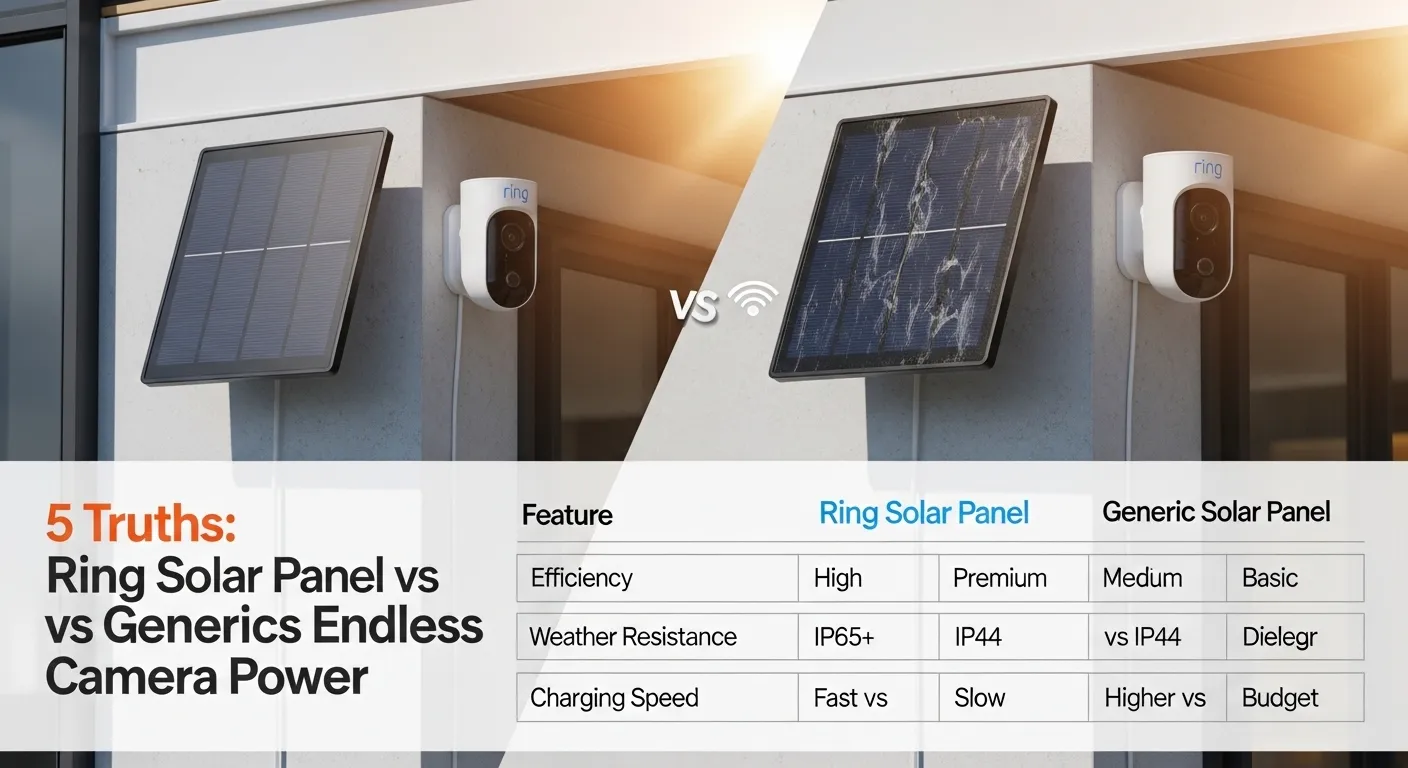
| Feature / Metric | Official Ring Solar Panel | Wasserstein (Made for Amazon) | The $15 Amazon Generic |
| Actual Output (Sunny) | 1.9W to 2.2W (Consistent) | 1.8W to 2.0W | 0.5W to 1.2W (Wildly unstable) |
| Connector Sealing | Custom molded, exact fit | Good, heavy weather-stripping | Cheap silicone, gaps visible |
| Mounting Hardware | Metal/High-grade ABS | Standard ABS plastic | Brittle plastic (snaps in cold) |
| Cell Quality | Monocrystalline (High efficiency) | Monocrystalline | Polycrystalline (Low efficiency) |
| Lifespan Expectancy | 3–5 Years | 2–4 Years | 2 Months to 1 Year |
Deep Analysis: The Meat of the Tech
Let’s strip away the polished marketing copy and talk about what actually keeps your camera alive: the photovoltaic cells, the mounting hardware, and the connection points.
The Photovoltaic Cell Lottery
The official Ring panels and premium certified alternatives use monocrystalline silicon cells. You can spot them by their solid, dark black color. They offer higher efficiency ratings (usually around 19-21%), meaning they convert more sunlight into electricity per square inch. Generic panels almost always use polycrystalline cells (distinguishable by their blue, shattered-glass look). Polycrystalline panels are cheaper to manufacture but drastically less efficient. When you only have an 8×5 inch surface area, efficiency is the only thing keeping your camera alive during a cloudy week.
Connectors and The Motherboard Killers
The biggest difference between a $50 Ring panel and a $15 generic isn’t the glass; it’s the 5-cent connector. Ring designs their USB-C and barrel connectors with proprietary, molded weather-seals that slide perfectly into the back of their cameras. Generic brands use one-size-fits-all silicone sleeves. Over time, these cheap sleeves suffer from thermal expansion and contraction. They warp, letting moisture into the camera’s charging port. This doesn’t just stop the charging process; it can short out the internal components entirely.
Battling Vampire Draw
Smart cameras are power-hungry. Even when not recording, they suffer from “vampire draw”—the constant drain of maintaining a Wi-Fi connection, pinging the router, and powering the passive infrared (PIR) motion sensors. If your camera requires 0.5W just to stay asleep, and your cheap generic panel only outputs 0.4W on a cloudy day, your battery is still dying, just slightly slower. Official panels are calibrated to outpace this latency and parasitic drain, ensuring a net-positive charge cycle.
The “Lab vs. Reality” Gap
Here is where the marketing departments flat-out lie to you.
The Wattage Myth: A generic panel will claim “5W Max Output!” on the box. In a controlled laboratory, pointing a perfectly calibrated halogen lamp directly at the panel at a 90-degree angle, sure, it hits 5W. In reality? You’ve mounted it under an eave in Ohio, pointing somewhat East, covered in a thin layer of spring pollen, during a rainstorm. That “5W” panel is now generating 0.1W. It is essentially a useless piece of plastic.
The Motion Range Lie: You’ll see panels promising enough power to support “up to 50ft of motion detection.” Nonsense. The range of your camera dictates how often it wakes up. If you live on a busy street and your camera wakes up 60 times a day to record passing cars, no solar panel on the market can keep up with that cyclic degradation of the lithium-ion battery. You will drain the battery faster than the panel can push a trickle charge.
Featured Snippet Q&A
Do generic solar panels void your Ring warranty?
Yes and no. Ring’s official policy states using third-party accessories causing damage voids the warranty. If a cheap generic panel’s faulty connector shorts your camera’s motherboard, Ring won’t replace it. Stick to certified partners if you want guaranteed hardware protection.
Why does my Ring battery die even with a solar panel?
Your camera is likely using more power than the panel generates. High motion sensitivity, weak Wi-Fi causing the camera to constantly search for a signal, or heavy cloud cover will drain the battery faster than the trickle charge can replenish it.
Can I use a 3rd party solar panel with Ring?
Yes, technically any solar panel with the correct barrel or USB-C connector will physically plug in. However, non-certified panels often lack proper weather sealing, risk water damage, and frequently fail to provide the consistent wattage required to keep the battery alive.
The “Masterclass” Buying Guide
If you are going to spend money on solar tech for your smart home, you need to know what actually matters.
1. IP Ratings are Non-Negotiable
Don’t buy anything that just says “Waterproof.” You want hard NEMA ratings or an IP (Ingress Protection) rating. You need at least IP65. The “6” means it is completely dust-tight, and the “5” means it can handle low-pressure water jets from any direction (like a heavy rainstorm). If a generic brand doesn’t list an IP rating, it’s garbage.
2. Cyclic Degradation of Lithium-Ion
Solar panels don’t power the camera directly; they charge the battery, which powers the camera. If your panel is weak, your battery will constantly drop to 10% and charge back to 20%. This aggressive micro-cycling destroys the chemical lifespan of lithium-ion cells. (For a deeper dive into how weather kills batteries, check out our guide onlithium-ion winter degradation). You need a panel strong enough to push the battery to 100% and keep it floating there.
3. The Wi-Fi Latency Tax
If your camera is far from your router, the internal Wi-Fi radio has to scream to maintain a connection. This creates massive latency and a huge power draw. Before buying a solar panel, fix your network. A stronger panel won’t fix a weak mesh network.
“The Wall of Shame” (5 Mistakes That Kill Your Gear)
I see these mistakes every single day in the field. Stop doing these things:
- Mounting Flat or Pointing North: Solar panels need to face True South (in the Northern Hemisphere) tilted at an angle equal to your latitude. Pointing them North makes them expensive roof decorations. Read more on the exact geometry in our solar angle guide.
- The Dead Battery Plug-In: Solar panels provide a trickle charge. They cannot revive a dead camera. You must manually charge the Ring battery to 100% via the wall outlet before connecting the solar panel.
- Ignoring the Cable Drip Loop: If you pull the cable tight from the panel to the camera, rainwater will run straight down the cable and into the charging port. Always leave a U-shaped “drip loop” in the wire so water drips off the bottom of the loop before reaching the camera.
- Trusting Duct Tape: Wrapping a loose generic connector in duct tape is a death sentence. The adhesive breaks down in the heat, creating a sticky trap that actually holds moisture against the electrical contacts.
- Neglecting the Glass: Dust, bird droppings, and pollen create a film that blocks UV rays. Failing to wipe the panel down with a microfiber cloth twice a year can cut your energy yield by 40%. (This ties directly into minimizing smart home vampire draw by ensuring maximum power generation).
Installation Horror Stories: The Bleeding Knuckles
Let me tell you about the time I tried to install a generic panel on my garage. The kit came with mounting screws made of an alloy roughly the consistency of warm cheese. I was on a 15-foot ladder, driving the screw into a wood stud, and the Phillips head stripped out immediately. I had to use locking pliers to violently twist the ruined screw out, scraping my knuckles raw against the stucco siding.
Worse yet, the plastic mounting arm on that generic unit suffered from severe embrittlement. After one summer of baking in the UV rays, I went to adjust the angle of the panel. I barely touched it, and the plastic snapped clean in half, sending the panel crashing down onto my driveway.
When you buy cheap mounts, you are buying a future Saturday morning of rage. Spend the extra money on hardware that uses metal ball joints and high-grade screws. Pre-drill your holes, use a hand screwdriver to avoid over-torquing, and always apply a dab of silicone sealant inside the screw hole to prevent wood rot.
The Cold Truth: Who Should NOT Buy Solar
I am going to be brutally honest: solar panels are not magic.
If your home sits under dense oak trees and the roofline barely gets sunlight, a solar panel simply isn’t worth it. Living in an apartment with only a north-facing balcony creates the same problem there’s just not enough direct sun exposure to keep things running reliably. High-traffic camera placement is another dealbreaker; when your device captures 150+ motion events daily, the battery will still drain faster than any solar panel can recharge it.
In these scenarios, you are wasting your money. You need to hire an electrician, snake a wire through your attic, and hardwire the camera directly to a 110V circuit, or buy the plug-in adapter. Solar is strictly for locations that receive at least 3 to 4 hours of direct, unshaded sunlight every single day.
Frequently Asked Questions (FAQ)
Does the Ring solar panel charge on cloudy days?
Technically, yes, but at a severely reduced rate. UV rays still penetrate cloud cover, but the output drops from roughly 2W to about 0.2W. If your camera triggers a lot of motion events on a cloudy day, the battery percentage will drop because the panel cannot generate power fast enough to replace what the camera uses.
Can I clean my solar panel with Windex?
No. Harsh glass cleaners containing ammonia can strip the anti-reflective coating off the photovoltaic glass. Use a soft microfiber cloth and simple distilled water.
Why does my Ring app say “Not Connected” when the solar panel is plugged in?
This is almost always a physical connection issue. Either the plug isn’t pushed firmly until it clicks, there is debris inside the charging port, or a generic cable has suffered a micro-fracture internally. Also, ensure your camera’s firmware is up to date, as software bugs can occasionally fail to recognize the panel.
How long does a Ring solar panel last?
A well-maintained official Ring panel should last 3 to 5 years. Eventually, the internal cells will suffer from natural degradation, and the plastic housing may begin to chalk and fade.
Is the Wasserstein panel just as good as the official Ring one?
Wasserstein is an officially “Made for Amazon” certified partner. Their internal tech and weather sealing are nearly identical to Ring’s proprietary hardware, often at a slightly lower price point. It is the only third-party brand I actively recommend.
The Final Verdict
If this were my house, my security, and my wallet on the line? I would buy the official Ring Solar Panel (or the Wasserstein certified alternative).
The $30 you “save” buying a generic panel on Amazon is going to cost you a $200 camera when the cheap weather gasket fails and shorts the motherboard. You aren’t just paying for the glass; you are paying for the exact-fit molded connectors, the UV-resistant ABS plastic mount, and the peace of mind knowing you don’t have to climb a ladder in the snow because your camera died. Stop buying marketing fluff and invest in infrastructure that actually works.
👉 Best Solar Powered Outdoor Smart Devices (2026)

I Am Sarah Miller is a passionate writer focused on sustainability, eco-friendly living, and modern environmental solutions. Through her work, she aims to inspire readers to make smarter, greener choices for a better future. She regularly shares insights and practical tips on her website, ecopowersence.com.