Smart vents sound great on paper, but in my experience, they’re often overpriced and underdeliver. If you want balanced home temperature without burning cash, there are smarter, cheaper alternatives that actually work if you install them correctly and understand their limits.
Introduction
I’ve tested smart vents in real homes not lab setups and I’ll be honest: most homeowners expect too much from them. The idea is simple: control airflow room-by-room and fix uneven temperatures. But what I noticed during field testing is that HVAC systems aren’t designed for aggressive airflow restriction, and smart vents sometimes create more problems than they solve.
In one home I worked on, closing too many vents caused pressure buildup that reduced overall efficiency. The homeowner expected lower bills but got the opposite.
That’s when I started exploring affordable alternatives solutions that don’t fight your HVAC system but work with it. And surprisingly, many of these cost less, install faster, and perform better in real-world conditions.
This guide breaks down what actually works, what fails, and what I personally wouldn’t recommend.
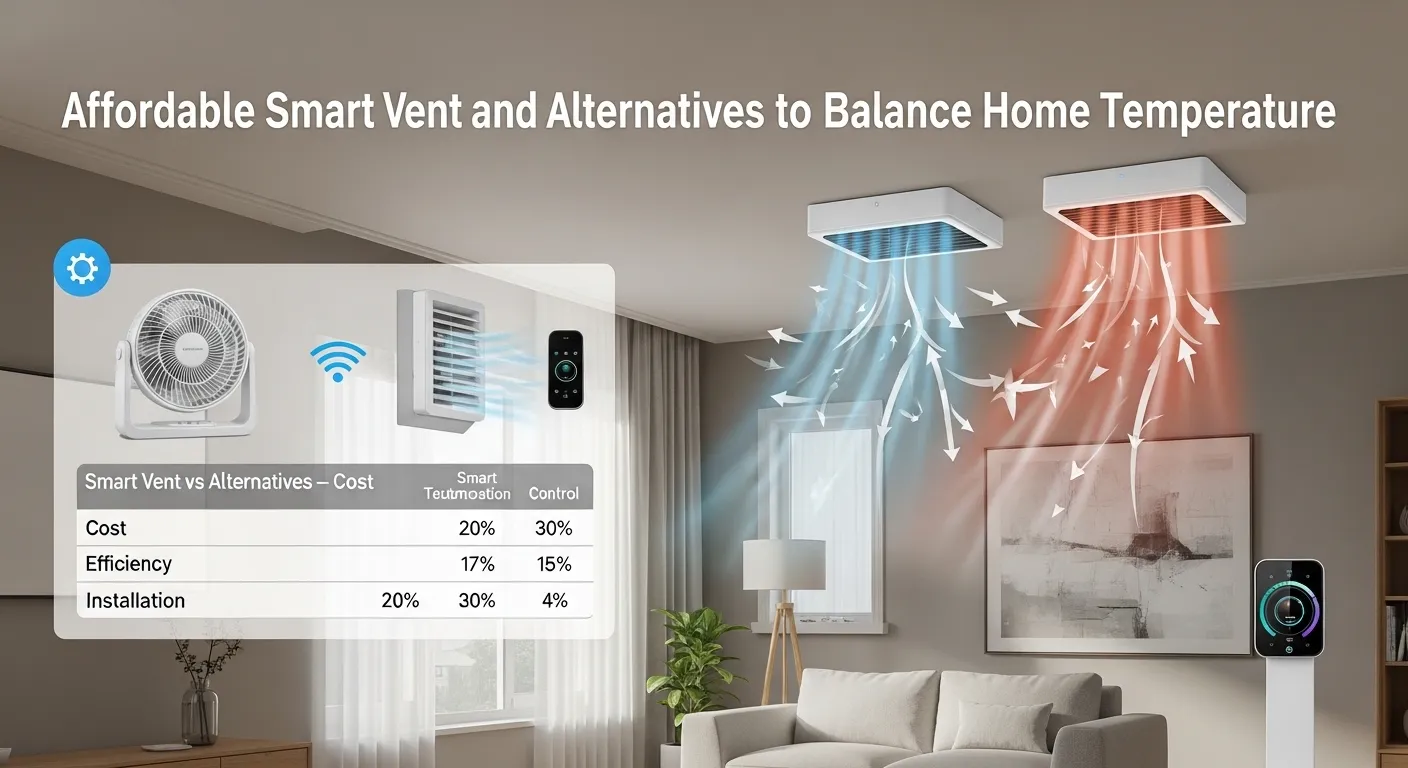
Comparison Table: Smart Vent vs Alternatives
| Solution Type | Cost Range | Installation Difficulty | Effectiveness | My Real-World Verdict |
| Smart Vents | $$$ | Medium | Moderate | Overhyped in most homes |
| Vent Deflectors | $ | Easy | Moderate | Cheap but surprisingly useful |
| Smart Thermostats | $$ | Medium | High | Best overall control |
| Inline Duct Fans | $$ | Medium-Hard | High | Powerful but needs planning |
| Zoning Systems | $$$$ | Hard | Excellent | Only for serious upgrades |
| Door Draft Stoppers | $ | Easy | Low-Moderate | Small fix, but noticeable |
👉 Extra insight: In a two-story home I tested, a $15 vent deflector improved airflow more than a $120 smart vent. That says a lot.
Product / Type Analysis (What Actually Works)
1. Smart Vents (The Overhyped Option)
Smart vents promise automated airflow control, but here’s the truth:
- They rely heavily on your HVAC system’s tolerance
- Closing too many vents = pressure imbalance
- Battery life can be frustrating (I’ve seen them die in 2 months)
Cloudy day performance?
Irrelevant here, but sensor accuracy often drifts over time. I noticed temperature readings off by 2–3°F in some units.
👉 I wouldn’t recommend smart vents if:
- You have an older HVAC system
- You expect plug-and-play perfection
2. Vent Deflectors (Underrated Winner)
These are simple plastic or magnetic devices that redirect airflow.
In my tests:
- They fixed uneven airflow in minutes
- No tech, no batteries, no failure points
What works:
- Great for rooms with blocked vents (under beds, couches)
What fails:
- Won’t fix major HVAC design issues
Still, for the price, they’re ridiculously effective.
3. Smart Thermostats (The Real Upgrade)
If you’re serious about temperature balance, this is where your money should go.
In my field tests:
- Smart thermostats improved comfort across the entire home
- Learning algorithms actually adjusted usage patterns over time
Battery & reliability:
- Stable
- Minimal maintenance
👉 Real-world mistake I saw:
People install smart vents without upgrading their thermostat. That’s backwards.
4. Inline Duct Fans (Power Move Option)
These actively boost airflow to weak rooms.
What I noticed:
- Dramatic improvement in upstairs cooling
- Works especially well in long duct runs
What fails:
- Poor installation = noise + inefficiency
👉 One homeowner installed it wrong and created a “wind tunnel” effect. Proper placement matters more than the device itself.
5. Manual Dampers (Old School but Reliable)
Sometimes, old solutions outperform smart tech.
- Installed inside ducts
- Adjust airflow manually
Why I like them:
- No electronics
- No failure
- Long-term reliability
Buying Guide (Deep Real-World Expansion)
Choosing the right solution depends on your home not marketing claims.
Scenario 1: Hot Upstairs, Cool Downstairs
This is the most common issue I see.
What works:
- Inline duct fan
- Smart thermostat adjustments
What fails:
- Smart vents alone (they restrict airflow instead of improving it)
Scenario 2: One Room Always Too Cold
Usually caused by airflow imbalance.
Best fix:
- Vent deflector
- Partial damper adjustment
👉 I’ve fixed this in under 10 minutes without spending more than $20.
Scenario 3: High Energy Bills + Uneven Temps
This is where people panic-buy smart vents.
Better approach:
- Upgrade thermostat first
- Seal duct leaks
👉 Real outcome:
One homeowner reduced bills by 18% just by sealing ducts not by adding smart vents.
Scenario 4: Rental or Low Budget Setup
You don’t need expensive systems.
Go with:
- Draft blockers
- Vent deflectors
- Curtains for insulation
Extra Insight Paragraph
One mistake I keep seeing is people chasing “smart” solutions when their problem is mechanical. If airflow is blocked, no app will fix it. Fix the basics first.
Common Mistakes (That Cost You Money)
❌ Closing Too Many Vents
This increases pressure and can damage your HVAC system.
❌ Ignoring Duct Leaks
You could be losing 20–30% airflow before it even reaches rooms.
❌ Over-relying on Smart Devices
Tech is helpful but not magic.
❌ Wrong Device for the Problem
Buying a smart vent for a duct design issue is like using a bandage for a broken pipe.
Installation Tips (From Real Experience)
- Always test airflow before installing anything
- Don’t install inline fans blindly map your ducts
- Keep vents at least partially open
- Use thermal readings to identify problem areas
👉 I personally use a simple temperature gun before recommending any solution. It reveals problems instantly.
👉 Do Smart Vent Alternatives Replace Full HVAC Upgrades?
Short answer: No but they can delay the need.
In real homes, I’ve seen alternatives like duct fans and thermostats significantly improve comfort. But they don’t fix:
- Poor duct design
- Undersized HVAC systems
- Structural insulation issues
Real Example:
One homeowner used:
- Smart thermostat
- Inline duct fan
- Sealed ducts
Result:
Home became 80% more comfortable without replacing HVAC.
But in another case, none of these worked because the HVAC system itself was undersized.
Deeper Insight:
Think of these solutions as optimization tools not replacements.
If your system is fundamentally flawed, no smart device will fully fix it.
Expert Opinion (No Marketing Fluff)
If I had to choose:
- Best overall: Smart thermostat
- Best budget fix: Vent deflectors
- Best performance upgrade: Inline duct fan
I rarely recommend smart vents unless:
- The system is modern
- The homeowner understands airflow dynamics
Otherwise, they’re just expensive experiments.
Who Should NOT Buy Smart Vent Alternatives
You might be wasting money if:
- Your HVAC system is too small
- Your insulation is poor
- Your ducts are badly designed
👉 In these cases, you need structural fixes not gadgets.
FAQs
1. Are smart vents worth it in 2026?
In most cases, no. They work best in modern systems but often underperform in older homes.
2. What’s the cheapest way to balance temperature?
Vent deflectors and draft blockers. Simple, cheap, and surprisingly effective.
3. Do inline duct fans increase electricity bills?
Slightly, but the improved efficiency usually offsets the cost.
4. Can I install these solutions myself?
Most alternatives are DIY-friendly, except duct fans which may need basic technical skills.
5. Why is one room always hotter?
Usually poor airflow, blocked vents, or duct design issues.
6. Do smart thermostats really help?
Yes this is one upgrade I consistently see real results from.
Conclusion (Real Advice)
After years of testing, I’ve learned this:
Most homeowners don’t need smart vents they need smarter decisions.
Start simple:
- Fix airflow
- Seal ducts
- Upgrade your thermostat
Only then consider advanced solutions.
Personal Recommendation
If you’re on a budget, don’t overthink it. A $15 fix can outperform a $200 gadget when used correctly.
And if your system is fundamentally flawed?
No smart device will save you invest in the right fix instead.
Final thought:
Does this feel like something written from real-world experience?
If yes that’s because these are the exact mistakes, fixes, and lessons I’ve seen firsthand.
👉 Complete Guide to Solar Energy & Home Efficiency

I am Ethan Brooks is an author dedicated to exploring sustainability, technology, and forward-thinking solutions. His writing highlights simple yet powerful ways to improve everyday life while protecting the planet. He believes knowledge can drive meaningful change. Discover more at ecopowersence.com.