BLUF (Bottom Line Up Front)
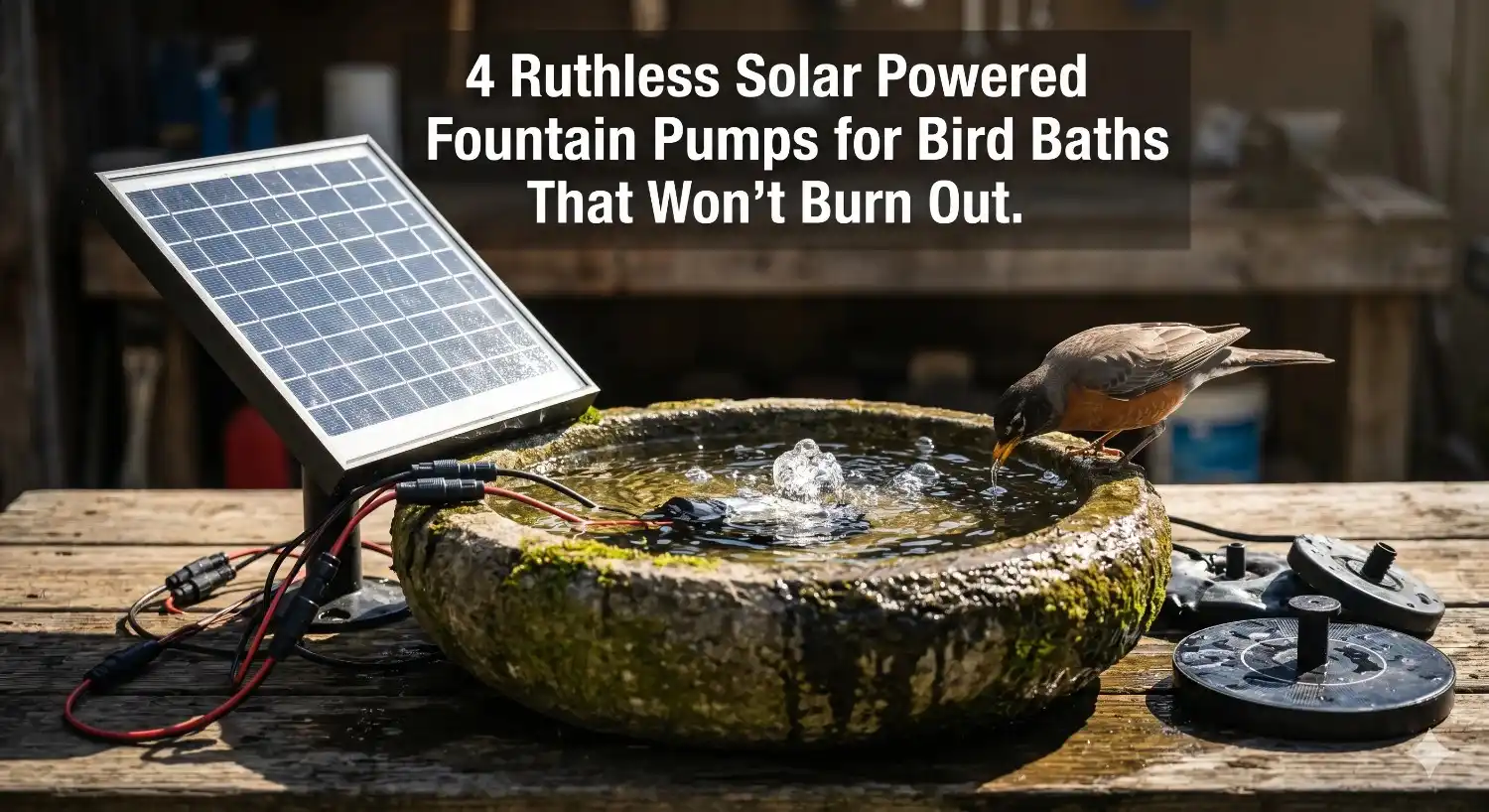
90% of those cheap, floating solar fountain disks on Amazon are disposable e-waste that will burn out their motors the second your bird bath runs dry. If you want a pump that actually survives passing clouds and doesn’t empty your bowl in an hour, buy the Lewisia Battery Backup Solar Fountain. If you buy a $12 direct-drive floating disk, expect it to be in the trash by next month.
The “Why I Wrote This” Intro
Last spring, my wife decided we needed a bird bath to bring some life to the backyard patio. She went on Amazon and bought one of those “best-selling” $15 floating solar fountain pumps. It looked great for exactly 20 minutes. Then, a slight breeze kicked up. Because she used the tallest nozzle attachment, the wind blew the fountain spray entirely outside the bowl. Within 45 minutes, the bird bath was bone dry.
Because the cheap pump didn’t have “dry-run protection,” the tiny brushless motor kept spinning wildly in the empty, sun-baked plastic bowl. By the time I walked out there, the internal impeller had literally melted its own housing. It smelled like burnt ozone and failure. The outdoor tech market is flooded with these useless, gimmicky floating disks that rely on a fundamental marketing lie: that a tiny, un-buffered solar panel can sustainably drive a water pump without destroying itself. I’m writing this because I’m tired of seeing people waste 15 bucks every month replacing burned-out junk. Here is the cold, mechanical truth about which solar bird bath pumps are actually worth your money.
The “No-BS” Comparison Table
| Fountain Pump | Panel Type | Real GPH (Flow) | Battery Backup? | Dry-Run Protection? | The “Gimmick” Factor |
| Lewisia 5W Solar Pump | Separate Glass | ~50 GPH | Yes (2000mAh) | Yes | Long wires require you to hide the panel in your landscaping. |
| Mademax Floating Disk | Integrated Petal | ~25 GPH | No (Direct Drive) | Yes (Sometimes) | Sputters and dies if a single bird casts a shadow on it. |
| AISITIN 6.5W Fountain | Floating w/ Battery | ~45 GPH | Yes (1500mAh) | No | Too powerful; it will aggressively empty smaller bird baths. |
| Solatec Solar Fountain | Integrated Disk | ~20 GPH | No (Direct Drive) | No | Pure landfill fodder. Will melt its motor if the bowl goes dry. |
Deep Analysis: The Meat and The “Lab vs. Reality” Gap
Let’s break down the tech. When manufacturers sell you a solar bird bath pump, they are selling you a laboratory fantasy. They test these units in perfectly still air, under blasting 10,000-lumen synthetic lights, in deep vats of distilled water. Your backyard is a chaotic nightmare of wind, leaves, algae, and shifting shadows.
The “Direct Drive” Delusion
Most cheap floating fountains are “Direct Drive.” This means the tiny photovoltaic array on top is wired directly to the DC motor underneath. There is no battery. If a cloud passes over, the water stops. If a crow lands on the edge of the bath and casts a shadow over 10% of the panel, the voltage sags, the pump stalls, and the water stops. It creates a highly annoying sputtering effect. Worse, the constant rapid starting and stopping wreaks havoc on the microscopic copper coils inside the motor, leading to premature failure. You need a system with a built-in lithium-ion battery buffer. The solar panel trickles power into the battery, and the battery provides a smooth, constant voltage to the pump, completely eliminating the cloud-shadow stutter.
The Over-Spray Evaporation Trap
Here is the biggest lie in fountain marketing: “Sprays up to 24 inches high!” That is not a feature; that is a critical design flaw. Bird baths are shallow. If your pump shoots a narrow stream of water two feet into the air, a 5-mph breeze will catch that water and blow it onto your grass. You are effectively pumping the water out of your own bird bath. A pump with a high “Head Height” (the vertical lift capability) on a tiny floating disk is a recipe for an empty bowl. You don’t want a geyser; you want a gentle, bubbling flow that keeps the water inside the basin.
Impeller Cavitation and Dry-Run Death
What happens when the wind blows all your water out? The pump sucks in air. This causes “cavitation”—the impeller spins out of control at 10,000 RPMs with no water to provide resistance or cooling. The magnetic friction generates intense heat. On cheap pumps (like the Solatec), this heat melts the plastic housing right onto the magnet, permanently seizing the motor. High-end pumps utilize “Dry-Run Protection,” a simple capacitive water sensor that cuts power to the motor the millisecond it detects air instead of water. This single feature is the difference between a pump lasting three years or three hours.
The Monocrystalline vs. Epoxy Resin Lie
Look at the top of the floating disks. If it looks like a smooth, hazy piece of plastic over the solar cells, it’s epoxy resin. Within one summer of UV exposure, that epoxy will yellow, cloud up, and block 30% of the light hitting the cells. Quality solar arrays (like the separate panel on the Lewisia) use tempered glass over monocrystalline cells. Glass doesn’t cloud, and monocrystalline cells are far more efficient at converting partial shade into usable voltage.
Featured Snippet Q&A
What is the best solar fountain pump for a bird bath?
The Lewisia Battery Backup Solar Fountain is the best overall choice. It features a remote glass-coated solar panel, a battery reserve for consistent flow during cloudy days, and crucial dry-run protection to prevent the motor from burning out when the water level drops.
Why does my solar bird bath fountain keep stopping?
If it’s a direct-drive pump without a battery, it will stop the moment a cloud, tree branch, or bird casts a shadow over the solar cells. If it has a battery but still stops, the intake screen on the bottom is likely clogged with algae or debris.
How do I keep my solar fountain from emptying the bird bath?
Stop using the tall, narrow spray nozzles. Remove all attachments so the pump just creates a gentle, bubbling spring at the surface. Alternatively, use clear fishing line and a suction cup to anchor the floating disk to the exact center of the bowl so it doesn’t drift to the edges.
The “Masterclass” Buying Guide
Stop looking at the pretty pictures of hummingbirds on the Amazon listing. Turn to the technical specifications. Here is what actually dictates if a pump will survive your backyard:
- The Battery Buffer (mAh): Never buy direct-drive. Look for a unit with at least a 1000mAh to 2000mAh internal battery. This ensures the pump runs smoothly through passing clouds and can even run for an hour or two into the evening after the sun goes down.
- Dry-Run Protection (Auto-Shutoff): This is non-negotiable. If the spec sheet does not explicitly say “Water Shortage Protection” or “Dry-Run Auto Shut-Off,” do not buy it. You will forget to fill the bird bath one day, and a pump without this feature will become useless in direct sun conditions.
- Filtration Sponges: Look at the bottom intake of the pump. Cheap pumps just have a plastic grid. You need a pump that includes a removable, washable foam filter sponge. Bird baths fill up with bird droppings, seed husks, and algae. Without a foam pre-filter, that debris gets sucked straight into the magnetic impeller housing and locks the motor solid.
- Separated Panel vs. Floating Disk: If you have the landscaping for it, always choose a pump where the solar panel is a separate, stake-mounted unit connected by a wire. You can place the panel in the blasting 12 PM sun while keeping the actual bird bath in a shaded, cool spot for the birds.
Internal Linking Strategy
- Want to automate your patio setup further? Read my guide on Integrating Outdoor Smart Plugs with Heavy-Duty Water Features.
- Struggling with panel efficiency? Learn the cold hard truth about Solar Panel UV Degradation and Epoxy Clouding.
- Attracting wildlife requires more than just water. Check out our breakdown on Using Smart Lighting to Foster Backyard Biodiversity.
“The Wall of Shame” (Common Mistakes)
If you’re burning through pumps every summer, it’s probably user error. Here are 5 things people do wrong that kill their water features:
- The Tall Nozzle Hubris: Snapping on the 7-hole spray nozzle that shoots water two feet in the air. As discussed, the wind will blow this mist entirely outside the bowl, draining your bird bath in record time and destroying the motor. Use the lowest bubbling attachment.
- The Algae Neglect: Letting the water turn into a green, thick soup. Algae strings wrap around the magnetic impeller shaft like a python, creating immense friction. The motor draws excess amps trying to spin, overheats, and fries the control board. Clean your bowl weekly.
- The Hard Water Scaling: If you live in an area with hard well water, calcium and lime scale will build up inside the pump housing, acting like sandpaper against the spinning impeller. You need to pull the pump out once a month and soak it in a 50/50 mix of white vinegar and water to dissolve the scale.
- The “Drifter” Problem: Dropping a floating disk into a wide bowl and letting it freely drift. The pump will naturally float to the edge of the bowl. Once it’s at the edge, even a low spray nozzle will shoot water over the side. Anchor it to the center using the included suction cups or a DIY fishing line tether.
- Winter Freeze Fractures: Leaving a sealed plastic solar pump in a bird bath during the first November freeze. Water expands when it turns to ice. It will crack the waterproof epoxy seals on the solar cells and shatter the internal impeller housing. Bring it inside before the frost hits.
Installation & Setup Horror Stories
You’d think dropping a plastic disk into a bowl of water is foolproof. It isn’t. A client of mine bought an overpowered 6.5W AISITIN floating pump with a massive battery for a tiny, shallow 14-inch concrete bird bath. Because the bowl was so shallow, the massive suction power of the 6.5W pump literally created a whirlpool vortex, sucking air directly into its own intake from the surface. It sounded like a dying vacuum cleaner and aerated the water so violently that the birds were terrified of it.
Another classic: The “Hidden Wire” disaster. A guy bought a premium Lewisia setup with a remote solar panel. He buried the 10-foot connecting wire under an inch of topsoil to hide it. What he didn’t account for was the local squirrel population. Squirrels love chewing on low-voltage PVC wire casing. Two days later, a squirrel chewed through the wire, shorted out the 9-volt feed, and fried the solar panel’s diode. If you run a separated panel, run the wire through a cheap piece of half-inch PVC conduit or heavily rock over it.
The “Cold Truth” (Who Should NOT Buy)
Let’s cut the marketing garbage. Solar bird bath fountains are not magic. If your patio or garden is heavily shaded by massive oak trees, covered by an awning, or tucked between tall houses, do not buy a solar pump. Do not fall for the “works in the shade” marketing. Even high-end monocrystalline panels need direct, raw UV rays to generate the wattage required to spin a water column.
If your bird bath only gets one hour of direct sunlight at noon, a direct-drive pump will run for exactly one hour. Even a battery-backed pump won’t get enough charge to last the afternoon. If you live in the deep shade, you need to buy a standard, hardwired 110V submersible aquarium pump, run an outdoor extension cord, and plug it into a smart outlet. Stop trying to force solar tech to work in a cave.
FAQ (FAQ Schema Ready)
How do I clean a clogged solar bird bath pump?
Turn the pump over and remove the plastic intake grate. Pull out the foam filter sponge and rinse it. Then, firmly pull the plastic stator housing off to expose the magnetic impeller cylinder. Pull the magnet out, clean off any algae or hair with an old toothbrush, and reassemble.
Do solar fountain pumps work on cloudy days?
Only if they have a built-in lithium-ion battery backup. “Direct-Drive” pumps rely solely on real-time sunlight and will immediately stop working or sputter aggressively the moment a thick cloud passes over the sun.
Are solar bird bath fountains safe for the birds?
Yes, they operate on extremely low voltage (typically 5V to 9V), making them completely safe from electric shock. In fact, moving water prevents mosquitoes from laying eggs and helps birds locate the water source by sound.
Why is my solar fountain pumping water outside the bird bath?
You have two issues: The pump is floating too close to the edge, or you are using a spray nozzle that shoots the water too high, allowing the wind to catch it. Remove the nozzle attachments to create a low bubble, and anchor the pump to the center of the bowl.
Can I leave my solar fountain pump outside in the winter?
No. If the water inside the pump freezes, the expanding ice will shatter the plastic impeller housing and rupture the waterproof seals protecting the internal circuitry. Always drain the pump and store it indoors before the first hard freeze.
The Final Verdict
If this were my backyard, and my money on the line, I’d completely ignore the sea of identical floating plastic disks and buy the Lewisia Battery Backup Solar Fountain. Yes, having a remote solar panel connected by a wire requires a few extra minutes of cable management, but the payoff is massive. You can put the panel in the blazing sun while the bird bath stays in the cool shade, the internal battery ensures it doesn’t sputter every time a cloud rolls by, and most importantly, the dry-run protection means I won’t melt the motor when I forget to refill the bowl on a 90-degree Tuesday.
If you absolutely must have an all-in-one floating unit because you don’t want to deal with wires, buy the AISITIN 6.5W Fountain (provided your bird bath is large and deep enough to handle the power). It has a battery, which puts it miles ahead of the $12 direct-drive trash. Just do yourself a favor: throw the tall spray nozzles in the garbage as soon as you open the box.
👉 Best Solar Powered Outdoor Smart Devices (2026)

I Am Sarah Miller is a passionate writer focused on sustainability, eco-friendly living, and modern environmental solutions. Through her work, she aims to inspire readers to make smarter, greener choices for a better future. She regularly shares insights and practical tips on her website, ecopowersence.com.