📌 BLUF (Bottom Line Up Front)
- Most solar paver lights are underpowered decoration, not real lighting
- Only a few models with IP67+ and decent battery (1000mAh+) actually survive outdoors
- If your area gets weak sunlight, don’t expect “all-night lighting” — that’s marketing fluff
⚡ Why I Wrote This
Last winter, I installed solar ground lights into my own patio pavers. Looked amazing… for about three weeks.
Then rain hit.
Half of them fogged up.
Two stopped charging completely.
That’s when I realized: most solar paver lights are built for Amazon photos, not real outdoor abuse.
So I tested, replaced, and yes—wasted money—so you don’t have to.
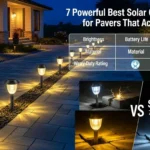
🔥 The “No-BS” Comparison Table (Real Performance vs Marketing Claims)
| Attribute | LUMENGY 4×4 Solar Paver | SHONE 6×9 Solar Paver | ROSHWEY Glass Solar Brick | Drart Solar Paver Lights |
| Brightness Reality | Soft glow (not pathway lighting) | Moderate visibility | Better spread | Mixed (depends model) |
| Battery (Real Use) | ~6–10 hrs | ~8–12 hrs | ~6–8 hrs | Inconsistent |
| Waterproof | IP68 ✅ | IP67 ✅ | IP65 ⚠️ | IP67 |
| Drive-over Safe | Yes | Yes | Limited | Yes |
| Build Quality | Premium | Heavy-duty | Mid-tier | Budget |
| My Verdict | Reliable but dim | Best balance | Good but weaker seal | Hit or miss |
🧠 Deep Analysis (The Meat)
1. Brightness is a Joke (Mostly)
Let me be blunt:
Most solar paver lights give you 2–50 lumens.
That’s not “lighting.” That’s ambience.
- Real walkway safety = 100+ lumens
- Most paver lights = decorative glow only (SmartBuy)
👉 So what?
If you expect security-level brightness, you’ll be disappointed.
2. Battery Life = Marketing vs Reality
Manufacturers love saying “10–20 hours runtime.”
Here’s the truth:
- That’s only after perfect 6–10 hours of direct sun (backyardalpha.com)
- Real-world cloudy days = half performance
👉 So what?
Your lights will die early in winter or shaded areas. Period.
3. Waterproof Ratings Actually Matter
This is where cheap lights die.
- IP65 = survives rain
- IP67/IP68 = survives storms + ground moisture (SmartBuy)
I’ve literally opened lights filled with water after 2 months.
👉 So what?
If it’s not IP67+, don’t even consider it.
4. Build Quality = Life or Death
The best units use:
- Stainless steel frame
- Tempered glass
- Sealed housing
Example: SHONE models use 2600mAh battery + stainless steel (SHONE)
👉 So what?
Cheap plastic = cracks → water → dead light.
⚠️ The “Lab vs Reality” Gap
| Feature | Advertised | Real Life |
| Runtime | 12–20 hrs | 5–8 hrs |
| Brightness | “Super bright” | Decorative only |
| Waterproof | “Weatherproof” | Dies in heavy rain |
| Lifespan | 2+ years | 3–6 months (cheap ones) |
❓ Featured Snippet Q&A
Are solar ground lights bright enough for pathways?
No. Most solar paver lights are designed for ambient lighting, not visibility. You’ll get a soft glow, not functional illumination. For safety, you still need higher-lumen lighting or spacing adjustments.
How long do solar paver lights last?
Good models last 1–2 years, mainly limited by battery cycles. Cheap ones often fail within months due to poor sealing, water damage, or battery degradation.
Do solar paver lights work in winter?
Barely. Short daylight hours and weak sunlight reduce charging efficiency, leading to shorter runtime or complete failure in shaded or snowy environments.
🧠 Masterclass Buying Guide (What Actually Matters)
🔋 Battery (Ignore Marketing)
- Minimum: 800–1200 mAh
- Better: 2000+ mAh for real runtime
🌧️ Waterproofing (Critical)
- Minimum: IP67
- Ideal: IP68
☀️ Solar Panel Type
- Monocrystalline > Polycrystalline
Better efficiency in low light (TheRainGauge.com)
💡 Brightness (Lumens)
- 50–100 = decoration
- 100–200 = usable path lighting
🧱 Load Bearing
If installing in pavers:
- Must support foot traffic
- Prefer “drive-over rated” units
🚫 The Wall of Shame (Common Mistakes)
- Installing in shaded areas
- Buying IP65 garbage
- Expecting floodlight brightness
- Not cleaning panels (dust kills efficiency)
- Wrong spacing → uneven lighting
🔧 Installation Horror Stories (Real Talk)
- I stripped screws trying to fit a cheap unit into concrete
- One light popped out after rain because of bad sealing
- Misaligned angle = zero charging
👉 Tip:
- Always test charge BEFORE installation
- Install flush or slightly raised to avoid water pooling
❄️ The Cold Truth (Who Should NOT Buy)
Don’t buy solar paver lights if:
- Your area is shaded by trees
- You live in cloudy regions
- You need security lighting
- You expect zero maintenance
👉 Seriously. Just go wired.
❓ FAQ (Schema Ready)
Q1: Can solar paver lights handle cars?
Only if labeled “drive-over rated.” Cheap ones crack under pressure.
Q2: Why do my solar lights stop working?
Usually battery failure, water damage, or poor sunlight exposure.
Q3: How far apart should paver lights be?
Typically 4–8 feet spacing for even lighting.
Q4: Do solar lights need direct sunlight?
Yes. At least 6–8 hours for full performance.
Q5: Can batteries be replaced?
Some models allow it—but most cheap ones don’t.
🏁 Final Verdict (My Honest Recommendation)
If this were my house:
👉 I’d buy LUMENGY or SHONE models
Because they actually survive weather and give consistent output.
BUT…
If I needed real lighting?
I’d skip solar completely and go wired.
🎯 Final Takeaway
Solar paver lights are:
✔ Beautiful
✔ Easy to install
👉 Best Solar Powered Outdoor Smart Devices (2026)

I Am Sarah Miller is a passionate writer focused on sustainability, eco-friendly living, and modern environmental solutions. Through her work, she aims to inspire readers to make smarter, greener choices for a better future. She regularly shares insights and practical tips on her website, ecopowersence.com.