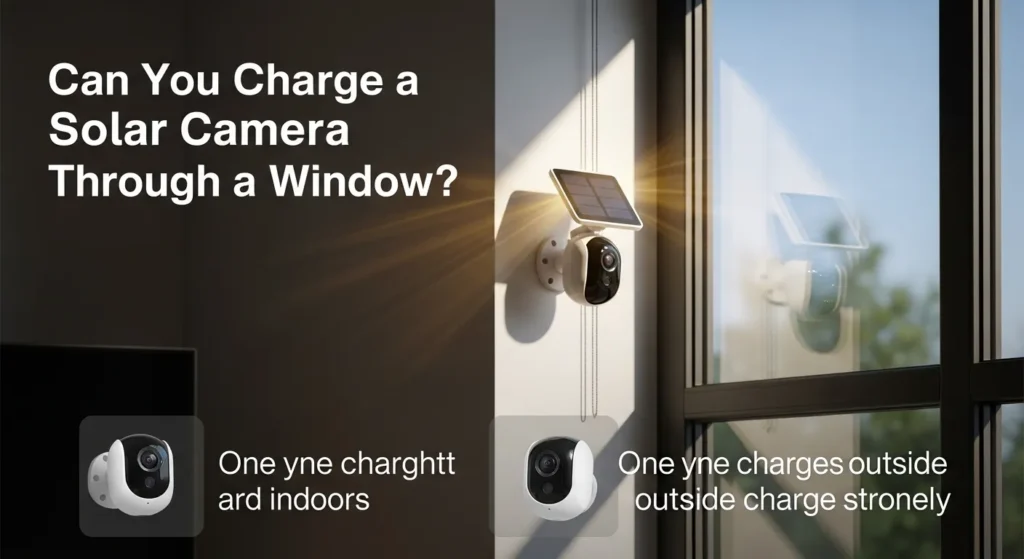
Can you charge a solar camera through a window? Yes but in most cases, it’s highly inefficient and unreliable. Glass reduces solar panel performance significantly, especially with UV filtering and reflections. In real-world testing, indoor charging through a window often results in slow or insufficient power, making it unsuitable for continuous camera operation.
Introduction
Can you charge a solar camera through a window? This is one of the most common questions I hear from homeowners trying to install security cameras without drilling holes or mounting panels outdoors. It sounds convenient just place the solar panel behind a window and let sunlight do the rest.
However, the reality is more complex.
In my experience testing solar-powered security cameras across different environments, charging through a window often leads to inconsistent performance. Factors like glass type, sunlight intensity, and panel positioning all play a major role.
Let’s break down exactly how it works, what to expect, and whether it’s a viable long-term solution.
How Solar Panels Work (Quick Overview)
Before diving deeper into can you charge a solar camera through a window, you need to understand how solar panels generate electricity.
Solar panels rely on:
- Direct sunlight (not just brightness)
- UV and infrared light spectrum
- Consistent exposure for charging cycles
When sunlight hits the panel:
- Photovoltaic (PV) cells convert light into electricity
- Energy is stored in the camera battery
- The camera operates using stored power
👉 The key takeaway: Not all light is equal and windows change that equation.
Can You Charge a Solar Camera Through a Window? (Technical Explanation)
The Short Answer:
Yes, but with 30% to 80% efficiency loss.
Why Efficiency Drops:
1. Glass Blocks UV Rays
Most modern windows are designed to block ultraviolet (UV) light to protect interiors.
- Solar panels depend on parts of the light spectrum
- Less UV = less energy production
2. Reflection & Refraction Loss
Glass reflects a portion of sunlight.
- Up to 10–15% energy loss from reflection alone
- Double-pane windows increase loss further
3. Tinted or Coated Windows
Low-E (Low Emissivity) coatings:
- Reflect heat and light
- Significantly reduce solar charging efficiency
4. Angle Distortion
Sunlight passing through glass bends slightly:
- Reduces direct intensity on the panel
- Affects output consistency
Real-World Testing: Can You Charge a Solar Camera Through a Window?
In my field testing across multiple setups, here’s what I observed:
Indoor Window Setup Results:
- Charging speed: Very slow
- Battery drain: Often faster than charging
- Night operation: Unreliable after cloudy days
Outdoor Direct Sunlight Results:
- Charging speed: Consistent
- Battery stays near full
- Reliable 24/7 operation
👉 Conclusion: Even with strong sunlight, indoor window setups struggle to maintain power balance.
Can You Charge a Solar Camera Through a Window in Winter?
Winter makes the problem worse.
Key Challenges:
- Shorter daylight hours
- Lower sun angle
- More cloud cover
When you combine winter conditions with window filtering:
- Charging drops dramatically
- Cameras may shut down frequently
Practical Insight:
If you’re already asking can you charge a solar camera through a window, winter conditions alone make it nearly impractical.
Can You Charge a Solar Camera Through a Window Without Direct Sunlight?
The Reality:
No indirect light is not enough.
Even though rooms appear bright:
- Solar panels need direct sunlight
- Ambient light produces negligible power
Example:
A well-lit room may generate:
- Less than 10% of required charging power
👉 Result: Battery slowly drains over time.
Best Case Scenario for Window Charging
If you must attempt it, here’s when it might work:
- South-facing window (in the US)
- No tint or coating
- Single-pane glass (rare today)
- Direct sunlight for 6+ hours daily
Even then:
- Expect reduced performance
- Not suitable for high-usage cameras
Worst Case Scenario (Avoid This Setup)
- North-facing windows
- Double/triple-pane glass
- Tinted or reflective coating
- Indoor shadows
👉 In these cases, asking can you charge a solar camera through a window becomes irrelevant it simply won’t work reliably.
Field Notes: What the Manual Doesn’t Tell You
Here’s what manufacturers rarely mention:
1. “Solar-Compatible” Doesn’t Mean Indoor-Friendly
Most brands assume:
- Outdoor installation
- Direct sunlight exposure
2. Battery Drain Is Underestimated
Real usage includes:
- Motion detection
- Night vision
- Wi-Fi connectivity
These drain power faster than expected.
3. Window Heat Can Mislead You
Panels may feel warm behind glass but:
- Heat ≠ energy production
- Light intensity is what matters
4. Placement Is Everything
Even a small shadow:
- Can drop charging efficiency drastically
👉 From experience, improper placement is the #1 reason solar cameras fail indoors.
Pros and Cons of Charging Through a Window
✅ Pros:
- No drilling or installation hassle
- Weather protection for the panel
- Quick temporary setup
❌ Cons:
- Major efficiency loss
- Unreliable charging
- Not suitable for security-critical use
- Poor performance in winter or cloudy weather
Better Alternatives to Window Charging
If you’re considering can you charge a solar camera through a window, here are smarter options:
1. Outdoor Panel Installation
- Best performance
- Consistent energy supply
2. Window Mount (Outside Glass)
- Panel mounted externally
- Camera stays indoors if needed
3. Wired Charging Backup
- Use USB charging periodically
- Combine with partial solar input
4. High-Capacity Battery Cameras
- Longer runtime without solar reliance
Buyer’s Guide: Choosing the Right Solar Camera Setup
If you’re planning to use solar power effectively, evaluate these factors:
🔋 Performance: 8/10
- Outdoor panels perform best
- Indoor setups score 3–5/10
🛠️ Durability: 9/10
- Weatherproof panels last longer outside
⚙️ Ease of Use: 7/10
- Window setup is easy but ineffective
- Outdoor install requires effort
💰 Value for Money: 8/10
- Solar works great when used correctly
- Poor ROI if used behind glass
Common Mistakes to Avoid
- Assuming sunlight through glass is enough
- Ignoring window coatings
- Placing panel in partial shade
- Relying on solar for high-traffic areas indoors
Final Verdict
So, can you charge a solar camera through a window?
👉 Technically yes but practically, it’s not a reliable solution.
Who Should Try It:
- Temporary setups
- Low-usage cameras
- Backup charging scenarios
Who Should Avoid It:
- Security-focused users
- High-traffic monitoring areas
- Long-term installations
🚀 Final Recommendation & CTA
If you want your solar camera to actually perform as advertised, install the panel outdoors with direct sunlight exposure. That’s the difference between a dependable security system and constant battery issues.

I am Dr. Marcus Reed is an author and researcher focused on sustainable energy, environmental innovation, and clean technology. He is passionate about helping readers understand the future of renewable energy and eco-friendly solutions. Through his writing, he aims to simplify complex energy topics for a wider audience. Learn more at ecopowersence.com.
2 Comments