Category: Energy Learning Hub
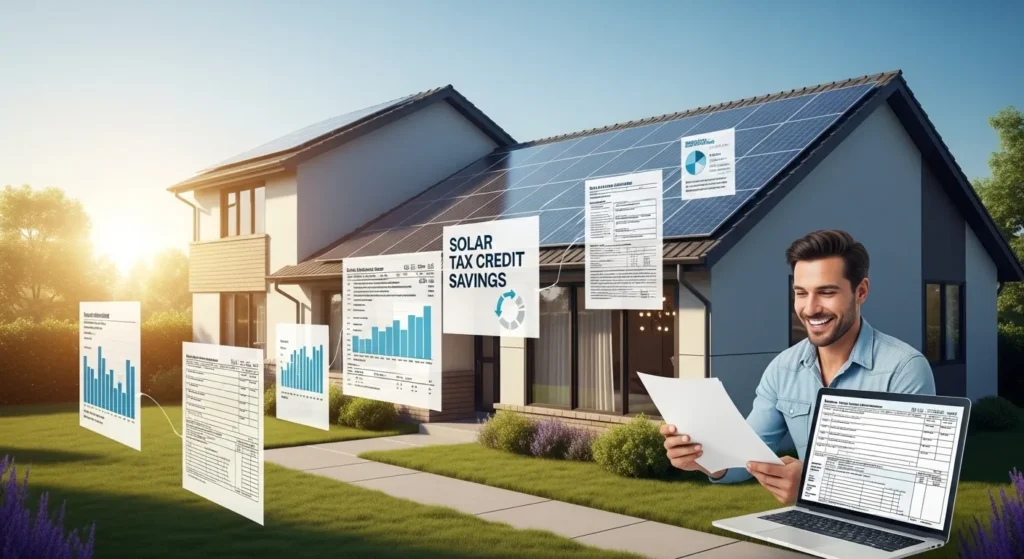
If you’re researching solar tax credits in 2026, here’s the most critical update: the federal landscape has changed permanently for most homeowners. For over a decade, the Residential Clean Energy Credit (Section 25D) gave U.S. homeowners a 30% federal tax credit on eligible solar installation costs. According to updated IRS guidance, that credit is no longer available for residential solar systems placed in service after December 31, 2025.
This guide explains exactly how the federal solar tax credit worked, what changed in 2026, who may still qualify under specific circumstances, what state-level incentives remain active, and how to keep reducing solar costs without the federal credit.
What Was the Federal Solar Tax Credit?
The federal solar tax credit officially the Residential Clean Energy Credit under Section 25D reduced a homeowner’s federal income tax liability dollar-for-dollar (not just as a deduction) by 30% of the total cost of a qualifying solar energy system.
This distinction matters: a tax deduction reduces your taxable income, while a tax credit directly cuts what you owe the IRS. A homeowner with a $7,500 credit reduced their actual tax bill by $7,500 not just their income by $7,500.
What Costs Were Eligible?
The IRS allowed a broader range of expenses than most homeowners realized:
| Eligible Expense | Included? |
|---|---|
| Solar PV panels and modules | ✅ Yes |
| Solar inverters (string, micro, hybrid) | ✅ Yes |
| Battery storage systems (min. 3 kWh) | ✅ Yes |
| Mounting hardware and racking | ✅ Yes |
| Wiring and electrical equipment | ✅ Yes |
| Installation labor and contractor fees | ✅ Yes |
| Permit and inspection fees | ✅ Yes |
| Solar shingles / solar roof tiles | ✅ Yes (if they generate electricity) |
| Traditional roofing materials | ❌ No |
Solar shingles qualified because they actively generate electricity — standard roofing materials did not, even when installed alongside a solar system.
Real-World Credit Example
| Item | Amount |
|---|---|
| Total solar system cost | $25,000 |
| Federal tax credit rate | 30% |
| Federal tax credit value | $7,500 |
| Net out-of-pocket cost | $17,500 |
The homeowner would reduce their federal tax bill by $7,500 in the year the system was placed into service. If the credit exceeded their tax liability for that year, the unused portion could be carried forward to the following tax year.
What Changed in 2026? The Federal Credit Expiration Explained
The Residential Clean Energy Credit expired for residential installations after December 31, 2025. This was not a gradual phase-down — the 30% credit rate was active through the end of 2025, then ended for most homeowner-owned systems.
| Installation Timeline | Federal Credit Available? |
|---|---|
| Installed and placed in service by Dec 31, 2025 | ✅ May qualify at 30% |
| Installed in 2026 or later | ❌ Generally not eligible |
This expiration has already affected the residential solar market. Installers report reduced demand and longer payback periods for new rooftop solar projects in 2026, as homeowners can no longer factor a $7,000–$10,000 federal credit into their financial calculations.
Important: If your system was installed and placed into service before the deadline, you may still claim the credit by filing IRS Form 5695 for the applicable tax year. Consult a tax professional if your installation straddled the 2025–2026 boundary.
Who Qualified for the Solar Tax Credit?
Before the expiration, a homeowner generally qualified if all of the following were true:
- The home was located in the United States
- The solar system was new (not used or refurbished equipment)
- The homeowner owned the system outright (leased systems did not qualify)
- The installation met IRS technical requirements
- The property served as a primary or secondary residence
The credit applied to both existing homes and newly constructed homes under qualifying circumstances. Rental properties used exclusively as investment properties were generally excluded from the residential credit, though commercial solar installations fall under a separate federal incentive framework.
For homeowners evaluating solar ownership versus leasing, see our guide on how many solar panels you need for your home — ownership is the key factor that determines tax credit eligibility.
Do Solar Batteries Still Qualify?
Battery storage became independently eligible under the Residential Clean Energy Credit beginning in 2023, provided the system offered at least 3 kWh of storage capacity. This meant a homeowner could add a standalone battery without any new solar panels and still claim the 30% credit — a significant expansion from earlier rules.
Popular eligible battery systems included:
- Tesla Powerwall (13.5 kWh usable)
- Enphase IQ Battery (3.84–10.08 kWh)
- FranklinWH aPower (13.6 kWh)
- EcoFlow Power Kits (whole-home backup configurations)
As of 2026, the federal residential battery credit has also expired alongside the solar panel credit for new installations. However, several states have introduced or expanded their own battery storage incentive programs in response to the federal gap.
For a deeper comparison of storage options, see our guide on advantages of lithium-ion batteries for solar storage.
Can You Still Save Money on Solar in 2026?
Yes — and in some states, significantly so. The federal credit was always one piece of a larger solar savings picture. State and utility-level programs often reduce installation costs by 10%–30% independently.
State-Level Solar Incentives Still Active in 2026
| Incentive Type | How It Works |
|---|---|
| Solar rebates | Upfront cash rebate from state or utility after installation |
| Property tax exemptions | Added home value from solar excluded from property tax assessment |
| Sales tax exemptions | Solar equipment purchase exempt from state sales tax |
| Net metering | Utility credits excess solar electricity sent to the grid |
| Renewable Energy Certificates (RECs) | Sell or trade certificates representing solar generation |
| Utility-sponsored incentives | Rebates or bill credits from local electric utilities |
Availability varies significantly by state and utility provider. States like California, New York, Massachusetts, and New Jersey maintain robust incentive stacks even without the federal credit.
Where to Find Current Incentives:
- DSIRE Database — The most comprehensive database of state and utility solar incentives, updated regularly
- Energy.gov Homeowner Incentives — Federal overview of remaining savings opportunities
- IRS Residential Clean Energy Credit — Official IRS guidance on the credit’s current status
These resources are updated more frequently than most solar installer websites — always verify incentive availability directly before making a purchase decision.
How Homeowners Claimed the Solar Tax Credit
When the credit was active, the IRS required homeowners to file Form 5695 Residential Energy Credits with their federal tax return for the year the system was placed into service.
Required Documentation
Homeowners were advised to retain the following records in case of audit:
- Signed installation contracts
- Itemized equipment invoices
- Proof of payment (bank statements, credit card records)
- Permit documentation from the local authority
- Utility interconnection agreement
- Manufacturer specifications confirming equipment eligibility
The IRS does not pre-approve solar systems for eligibility — the burden falls on the homeowner to maintain documentation. If you installed solar in 2025 and have not yet filed, gather these records before preparing your return.
Solar Tax Credit vs. Solar Lease: A Key Distinction
One of the most common mistakes homeowners made was assuming a leased solar system qualified for the tax credit. It did not.
| Ownership Type | Federal Tax Credit Eligible? |
|---|---|
| Homeowner-owned system (cash or loan) | ✅ Yes (while credit was active) |
| Third-party owned (leased or PPA) | ❌ No — the leasing company claimed the credit |
| HOA or community solar subscription | ❌ Generally no for residential credit |
This distinction still matters in 2026 because many state-level incentives follow similar ownership rules. Homeowners evaluating solar should always confirm whether a leased system is eligible for available state rebates before signing.
Frequently Asked Questions
Is the federal solar tax credit still available in 2026?
For most homeowner-owned residential systems, no. The Residential Clean Energy Credit (Section 25D) expired for systems placed in service after December 31, 2025. Homeowners who completed installations before that date may still claim the credit on the appropriate tax year return.
Can I still claim the credit if I installed solar in 2025?
If your system was properly installed and placed into service before December 31, 2025, you may still qualify under the prior rules. File IRS Form 5695 with your 2025 tax return and retain all installation documentation.
What if my tax liability is less than the credit amount?
Under the previous rules, unused credit amounts could be carried forward to the following tax year. This provision applied while the credit was active — consult a tax professional regarding any carry-forward amounts from 2025.
Are solar batteries still eligible for any federal incentives?
The residential battery credit under Section 25D expired alongside the solar panel credit for new installations after December 31, 2025. Some commercial and utility-scale battery projects may qualify under separate provisions. State-level battery incentives remain available in many states.
What state solar incentives are still available in 2026?
Most states continue to offer some combination of solar rebates, property tax exemptions, sales tax exemptions, net metering, and utility incentives. Use the DSIRE database to find programs specific to your state and utility provider.
Do solar shingles qualify for the same incentives as traditional panels?
Solar shingles that actively generate electricity qualified under the same Section 25D rules as traditional panels. For ongoing state incentive eligibility, check with your state energy office — treatment varies. See our detailed breakdown: Are solar shingles worth it in 2026?
What is the difference between a tax credit and a tax deduction?
A tax deduction reduces your taxable income, meaning you save a percentage of the deduction amount based on your tax bracket. A tax credit reduces your actual tax bill dollar-for-dollar — far more valuable. A $7,500 tax credit saves exactly $7,500 in taxes regardless of your income level.
What This Means for Homeowners Considering Solar in 2026
The expiration of the federal solar tax credit changes the financial calculus for residential solar — but it doesn’t eliminate the value proposition. Solar still delivers:
- Long-term utility bill reduction (20–30 year panel lifespan)
- Energy independence during grid outages (especially with battery storage)
- Home value increases (solar homes consistently sell for more in studies)
- State and utility incentives that remain active in many regions
- Net metering revenue in states with strong programs
For help sizing your system correctly, see: How many solar panels do I need? and Monocrystalline vs. polycrystalline panels: which is better for your home?
The payback period without the federal credit will be longer — typically 8–12 years depending on system cost, local electricity rates, and available state incentives, compared to 5–8 years when the 30% credit was available.
Homeowners evaluating solar in 2026 should prioritize: local rebate stacking, system efficiency per dollar, battery integration value, and net metering rates — rather than relying on a federal credit that no longer applies to most new installations.
Final Verdict
The federal solar tax credit helped millions of American homeowners reduce installation costs for more than a decade. The 30% Residential Clean Energy Credit (Section 25D) represented real money often $6,000–$10,000 on a typical residential system and its expiration marks a significant shift for the U.S. residential solar market in 2026.
That said, solar remains a financially sound investment in most markets when state incentives, net metering, energy savings, and long-term home value are factored together. The federal credit made an already-good investment great its expiration makes careful financial planning more important, not solar itself a bad idea.
Homeowners in 2026 should: check state-level incentives via DSIRE, get multiple installer quotes, compare system efficiency, evaluate battery storage ROI separately, and work with a tax professional if any 2025 installation paperwork is still pending.

I am Ethan Brooks is an author dedicated to exploring sustainability, technology, and forward-thinking solutions. His writing highlights simple yet powerful ways to improve everyday life while protecting the planet. He believes knowledge can drive meaningful change. Discover more at ecopowersence.com.