Published June 19, 2026
Do Solar Panels Actually Work in Winter?
Most homeowners assume cold weather hurts solar output. It doesn’t at least not the way people think. Solar panels are rated under Standard Test Conditions at 77°F, and performance actually declines as temperatures rise above that benchmark. In other words, cold weather makes individual cells more efficient, not less.
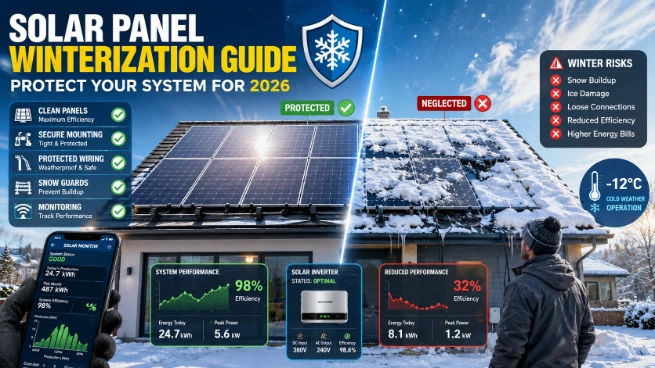
What actually hurts winter production is reduced daylight hours and a lower sun angle, not the cold itself. A proper solar panel winterization guide addresses both realities: protecting your hardware from snow and ice, while positioning your system to capture every available hour of weak winter sun.
This guide covers tilt angles, snow management, battery protection, and the full pre-winter checklist your system needs before the first freeze.
People Also Ask
Q: Do solar panels work in winter? A: Yes solar panels generate electricity year-round as long as sunlight reaches the cells. Cold temperatures slightly improve panel efficiency; the main winter challenge is shorter days and snow coverage, not the cold itself.
Pre-Winter Inspection Checklist
Before the first freeze, run through this checklist. Most of it can be done from the ground never climb onto an icy or snow-covered roof.
| Task | What to Check |
| Visual inspection | Cracks, discoloration, loose frames or wiring (binoculars from ground level) |
| Clean panels | Remove summer dust and pollen buildup before snow season starts |
| Trim overhanging branches | Reduces both shading and the risk of ice-laden branches snapping onto panels |
| Check wiring and connections | Look for fraying, exposed insulation, or corrosion at junction boxes |
| Test monitoring app | Confirm you can log in and see real-time production data |
| Inspect inverter vents | Clear of leaves and debris so airflow isn’t restricted |
| Check mounting hardware | Inspect anchor points after any major wind event |
| Battery health check | See the battery winterization section below |
This pre-winter routine prevents potential damage to panels and wiring, optimizes output despite shorter days, and extends the lifespan of every component in the system.
The Right Tilt Angle for Snow Shedding
Tilt angle is the single most important factor in passive snow shedding. A steeper angle uses gravity to slide snow off before it accumulates and blocks sunlight.
DOE-Recommended Angles by Snow Load
The Department of Energy recommends tilt angles of 30-35 degrees for meaningful snow-shedding improvements, with steeper angles up to 60 degrees providing even better results though steeper angles also increase wind load and installation cost. For locations with heavy snow accumulation risk, the DOE recommends selecting modules certified to withstand at least 5,000 Pa of static load, per the IEC 62938 standard for non-uniform snow loading.
The steeper the module tilt, the less snow weight transfers onto the panel surface itself, which matters both for output and for structural longevity over a 25-year system lifespan.
Seasonal Tilt Adjustment Formula
If your racking is adjustable, a simple seasonal formula maximizes both summer and winter output:
- October: Set panels to your latitude plus 15 degrees
- April: Return panels to your latitude minus 15 degrees
This single adjustment can boost winter production by 10-25% on ground-mounted or adjustable-rack systems, since it better matches the lower winter sun angle.
People Also Ask
Q: What is the best solar panel angle for winter? A: For most US locations, 30-35 degrees provides strong snow shedding while maintaining reasonable production. Adjustable systems can go to latitude plus 15 degrees in October for maximum winter capture.
Snow Removal: When to Clear It vs. Let It Shed Naturally
Light snow rarely needs manual intervention. Wind clears it easily, and light scatters through sparse coatings even when a thin layer remains. Heavy accumulation is different — but the right response still depends on your setup.
The Albedo Effect Explained
Snow on the ground around your array isn’t purely a loss. Reflected sunlight off surrounding snow cover known as the albedo effect can actually boost panel output once the panel surface itself is clear, since the bright white ground reflects extra light onto the cells from below the normal angle.
There’s a second hidden benefit too: as accumulated snow melts off the panel surface, it bonds with dirt and debris and washes it away, often leaving panels cleaner and more efficient than before the snowfall.
Safe Removal Practices
If snow doesn’t clear on its own within a day or two of sun exposure, a soft-bristle snow rake with a rubber blade, used from the ground via an extension pole, is the safest removal method. Never use metal shovels, scrapers, or sharp tools — these can scratch the tempered glass surface and create permanent micro-shading.
Never climb onto a snow- or ice-covered roof to clear panels. This is the single most repeated safety warning across every credible solar maintenance source, and for good reason roofs in winter are slippery and dangerous, and the marginal energy gained from clearing a day early is rarely worth the fall risk. If your array is roof-mounted and inaccessible by pole, wait for natural melt or call a qualified solar service.
People Also Ask
Q: Will heavy snow damage my solar panels? A: It’s highly unlikely. Solar panels are stress-tested to withstand heavy snow loads and hail when properly rated for your region. Schedule a post-winter inspection for microcracks only if panels were exposed to unusually heavy ice or snow loads.
Battery Winterization for Off-Grid and Battery-Backed Systems
If your system includes battery storage, cold weather is the bigger threat — not to the panels, but to the batteries themselves.
Lead-Acid vs. Lithium: Different Cold-Weather Behavior
Cold weather affects different battery chemistries in different ways. In lead-acid batteries, cold thickens the electrolyte, which reduces the battery’s ability to discharge and recharge efficiently. In lithium batteries, extreme cold causes the battery management system to automatically reduce charge rate to prevent internal damage a protective measure, but one that limits how fast your battery bank refills on short winter days.
Most solar batteries lose roughly 10% of their rated capacity for every 15-20 degrees below 80°F as measured at the cell level. That capacity loss compounds with reduced winter sun hours, which is why battery sizing and protection matter more in winter than any other season.
Battery Protection Methods
- Insulate outdoor batteries with foam insulation, heated battery blankets, or purpose-built heated battery boxes designed for solar storage
- Bring batteries indoors where possible a garage or insulated utility room is the most reliable protection
- Maintain lead-acid batteries by adding water every 2-4 weeks and equalizing cells every 2-3 months during heavy-use winter months
- Avoid extended full discharge letting a battery sit at very low charge for multiple weeks during a low-sun stretch can significantly shorten its usable lifespan
- Check manufacturer operating range some battery systems are rated for operation between -13°F and 140°F, but confirm your specific model’s limits before relying on it through a deep freeze
People Also Ask
Q: Can solar batteries freeze? A: Lead-acid batteries can freeze at below-zero temperatures, particularly when left at a low state of charge, since a discharged battery’s electrolyte freezes at a much higher temperature than a fully charged one. Lithium batteries handle cold better but still lose usable capacity.
Wiring, Inverter, and Connection Checks
Winter conditions put real strain on a system’s electrical components, not just the panels themselves.
After any strong wind event or heavy snowfall, inspect outdoor wiring and connections — wind and ice/snow buildup can loosen cables from their mounting points or stress electrical connections, creating both a performance issue and a safety concern. Check inverter vents to confirm they’re clear of leaves and debris, since restricted airflow can cause an inverter to overheat or throttle output even in cold ambient temperatures.
A Maximum Power Point Tracking (MPPT) charge controller earns its keep most clearly in winter. With limited sunlight available, an MPPT controller optimizes the power actually extracted from your panels far more effectively than older PWM controllers — the efficiency gap matters more when every available watt is scarce.
Confirm your monitoring app is logging correctly before the first storm hits. The fastest way to catch a winter problem is a sudden production drop that doesn’t match the weather forecast — if it’s sunny out and production reads zero, that’s your signal to check for heavy snow cover or a system fault from the comfort of indoors, rather than guessing.
Common Winter Damage and How to Prevent It
| Risk | Prevention |
| Ice dam buildup at roof edges | Ensure proper attic insulation and ventilation to prevent uneven roof melting |
| Branch strikes from ice-laden trees | Trim overhanging branches before the first freeze, not after |
| Wildlife nesting under panels | Birds and squirrels often seek shelter under panel arrays in winter; droppings and nesting material can cause damage over time — install critter guards if this is a recurring issue |
| Loosened mounting hardware | Inspect anchor points and supporting structures after extreme wind events |
| Battery deep-discharge damage | Monitor charge level during extended low-sun stretches; avoid letting batteries sit fully depleted |
| Microcracks from heavy load cycling | Schedule a post-winter inspection if your region saw unusually heavy snow or ice accumulation |
This kind of proactive maintenance approach — checking systems before problems appear rather than reacting after a failure — is increasingly standard practice across the solar industry, particularly following high-profile cold-weather grid stress events in recent years that left some under-maintained systems offline when homeowners needed them mo
For the cleaning component of winterization specifically, ourcomplete guide to cleaning solar panels for maximum efficiency covers safe techniques and the right tools for pre-winter cleaning.
If your system includes ground-level components like inverters or combiner boxes, confirming yoursolar grounding system meets NEC standards is worth revisiting before winter storm season loosened grounding connections are exactly the kind of issue that worsens with wind and ice.
Frequently Asked Questions
How much does winter reduce solar panel output? Winter production can drop by up to 30% compared to summer months, primarily due to shorter daylight hours and lower sun angles rather than cold temperatures. Cold weather itself slightly improves cell efficiency.
Do I need to cover my solar panels in winter? No. Covering panels blocks them from generating any electricity at all. The goal of solar panel winterization is to keep panels clear and protected, not covered.
What temperature is too cold for solar panels? Solar panels themselves have no meaningful low-temperature limit and often perform better in extreme cold than extreme heat. Battery storage components are the actual limiting factor check your specific battery’s rated operating range, which commonly extends down to around -13°F for quality lithium systems.
Should I adjust my solar panel angle for winter? If you have adjustable racking, yes. Setting panels to your latitude plus 15 degrees in October captures more of the lower winter sun and improves snow shedding. Fixed-tilt systems are typically already optimized for a year-round average.
How do I know if my solar panels have winter damage? A sudden drop to zero production on a clear, sunny day is the clearest warning sign check first for snow cover, then for a system fault if the panels are visibly clear. Schedule a professional inspection for microcracks after any unusually heavy snow or ice event.
Conclusion
A proper solar panel winterization guide isn’t about protecting your system from the cold — it’s about protecting it from snow load, ice-related wiring stress, and battery capacity loss while making sure your panels are positioned to catch every available hour of winter sun. Run the pre-winter checklist before the first freeze, adjust tilt angle if your racking allows it, and pay closer attention to battery health than panel health through the coldest months.
Get this right once each fall, and your system handles the entire winter season with minimal intervention generating clean power through snow, short days, and freezing nights alike.

I Am Sarah Miller is a passionate writer focused on sustainability, eco-friendly living, and modern environmental solutions. Through her work, she aims to inspire readers to make smarter, greener choices for a better future. She regularly shares insights and practical tips on her website, ecopowersence.com.