Solar vs wind energy for residential use? Compare costs, ROI, and efficiency in 2026. Discover which renewable power source wins for your home and budget.
TL;DR: Both solar and wind have evolved, but solar remains the practical king for 90% of suburban homes. However, 2026 turbine tech has made wind a massive ROI contender for rural, high-velocity wind corridors and off-grid setups.
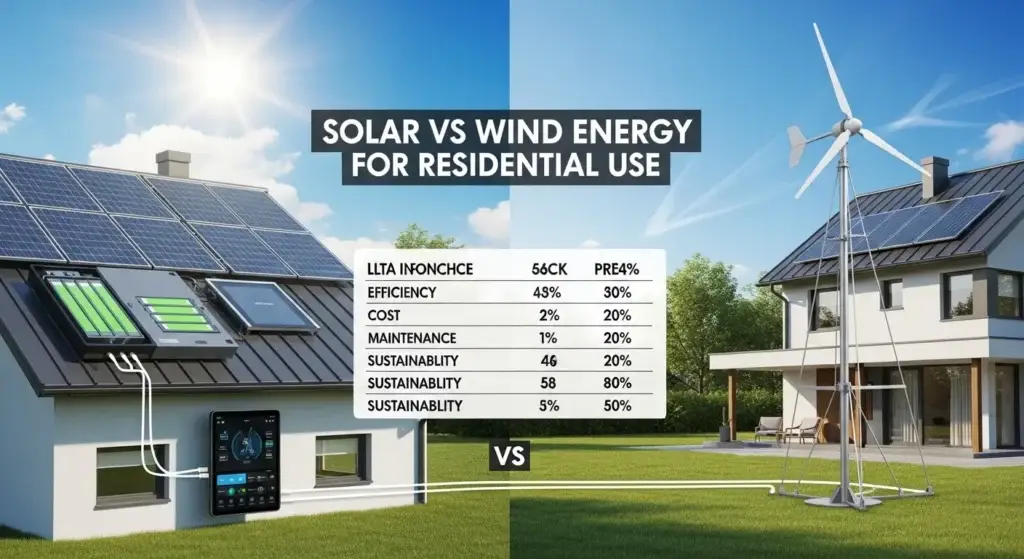
| Feature | Solar Photovoltaic (PV) | Residential Wind (Small Turbine) |
|---|---|---|
| Initial Cost | Moderate ($15k – $25k) | High ($20k – $50k) |
| Maintenance | Very Low (Cleaning & Inverters) | High (Moving parts, Bearings) |
| Reliability | Daylight dependent (No night power) | Weather dependent (Works at night) |
| Space Needs | Roof or Ground mount | Large lot (Tall tower height) |
| 2026 Verdict | Best for Suburban/Urban | Best for Rural/Coastal |
Understanding Solar vs Wind Energy for Residential Use
Solar vs wind energy for residential use is a choice between passive site-location independence (solar) and high-output kinetic generation (wind). Solar is the standard for suburban reliability, while wind turbines offer superior 24/7 generation potential in rural or coastal environments with consistent wind speeds.
Solar vs wind energy for residential use boils down to resource accessibility. While most homes get enough sunlight to justify a 5kW array, few residential lots possess the ‘unobstructed wind flow’ required for a turbine. According to the National Renewable Energy Laboratory residential turbines need consistent speeds to overcome mechanical inertia. Solar is passive, predictable, and remarkably quiet. Wind energy, conversely, is a kinetic powerhouse that produces energy day or night, provided the atmosphere is moving. In 2026, the tech gap is closing, but the physics of location remain the primary deciding factor for most homeowners.
People Also Ask
Q: Can I have both solar and wind at home?
A: Yes, hybrid systems are common for off-grid homes, using wind to supplement solar during nights or winter months.
The Realities of Residential Wind Power Efficiency
Residential wind power efficiency depends on laminar wind flow. While solar panels have a theoretical efficiency limit of roughly 22%, wind turbines can achieve 30-45% efficiency in ideal conditions. However, turbulence from trees or buildings can drop a home turbine’s output to nearly zero.
Residential wind turbines take mechanical energy and flip it into electricity using an alternator. Unlike solar, which is limited by the daylight cycle, wind can generate power 24/7. However, ‘turbulence’ is the enemy. If your neighbors have tall trees or houses, your turbine won’t perform. We’ve seen owners frustrated by low outputs caused by placing turbines too close to the ground. For those in high-velocity zones, however, we found that certain US Department of Energy small wind turbine guidelines recommend a tower height of at least 30 feet above local obstacles to ensure efficiency. When it works, the energy density far outpaces solar panels in terms of kWh per dollar spent.
People Also Ask
Q: What wind speed is needed for a home turbine?
A: Most residential turbines require a ‘start-in’ wind speed of 7-9 mph and reach peak efficiency at roughly 25-30 mph.
Solar Energy Home Efficiency in 2026
Solar energy home efficiency has jumped significantly in 2026 due to bifacial panel technology and micro-inverter advancements. Solar’s lack of mechanical wear gives it a long-term efficiency edge over wind, maintaining roughly 80% output even after 25 years of operation.
Maximizing solar energy home efficiency is now easier with the advent of N-Type monocrystalline cells. These panels handle heat better and degrade slower than previous generations. When you solar energy home efficiency into account, you must consider the lack of moving parts. This ‘set it and forget it’ nature makes it the safer financial bet. In my experience, even a mediocre solar roof outperforms a poorly placed wind turbine every time. Integration with smart home systems has also improved, allowing homeowners to shift heavy loads—like EV charging—to peak production hours. This synergy ensures that the energy harvested isn’t just generated, but utilized effectively before it hits the grid.
People Also Ask
Q: How long do solar panels actually last?
A: Modern Tier-1 solar panels are warrantied for 25 to 30 years, though they can continue producing power at a reduced rate for 40 years.
Cost Breakdown: Solar vs Wind Infrastructure
The cost of solar is generally lower ($15,000–$25,000) than wind ($20,000–$50,000) for residential scales. Solar benefits from economies of scale and standardized installation, whereas wind requires custom site engineering, heavy equipment for tower raising, and ongoing mechanical maintenance expenses.
When comparing the financial outlay, solar wins on upfront predictability. A standard 8kW solar system in 2026 costs roughly $2.50 per watt installed before incentives. Contrast this with wind, where a 5kW turbine might cost more due to the massive concrete footing and tower infrastructure involved. If you’re looking for the best solar power for wind coastal areas, the corrosion-resistant mounting hardware adds cost but prevents salt-air degradation. While wind has a higher ceiling for power generation, the maintenance costs—replacing bearings every 5-7 years—can eat into your savings compared to the minimal costs found in the ultimate solar panel maintenance checklist for 2026.
People Also Ask
Q: Which has a better ROI: wind or solar?
A: Solar typically offers a faster ROI (6-9 years) for suburban homeowners, while wind can offer better ROI (5-8 years) only in exceptionally windy rural zones.
Permitting and Zoning: The Silent Dealbreaker
Zoning laws heavily favor solar over wind. Most US municipalities have streamlined solar permitting, while wind turbines often face height restrictions (typically 35-foot limits), noise ordinances, and neighbor ‘nuisance’ complaints that can lead to permit denials or expensive litigation.
Zoning is the graveyard of residential wind dreams. Many HOAs and city ordinances have height restrictions that effectively ban wind towers. Solar panels, however, are protected by ‘Solar Easement’ laws in many US states, preventing neighbors or boards from blocking your sun. If you are building a secluded cabin, the best off grid solar kits for tiny houses are rarely challenged by planners. For wind, you’ll likely need a conditional use permit and noise assessments. Noise pollution is a real factor; while modern ‘vertical axis’ turbines are quieter, the traditional horizontal props still produce a rhythmic whoosh that can bother neighbors in tight quarters. Always check local ordinances before buying a turbine kit.
People Also Ask
Q: Are wind turbines noisy for residential areas?
A: Standard turbines produce 50-60 decibels of sound, roughly equivalent to a humming refrigerator or light rainfall, but the low-frequency vibration can be noticeable.
Hybrid Systems: The Best of Both Worlds
Hybrid residential systems combine the daytime reliability of solar with the 24-hour potential of wind. This diversification reduces the size of the battery bank needed for off-grid living and ensures energy production during winter months when solar radiance is at its annual minimum.
If you have the space and the budget, a hybrid system is the ultimate 2026 energy hedge. By combining photovoltaics with a small wind turbine, you solve the ‘nighttime solar gap’ without relying solely on batteries. This is particularly effective for those who need a medical-grade backup. To maximize these setups, homeowners are investing in the best battery backup for home medical equipment to bridge the moments when neither resource is active. Research from the EPA Clean Energy generation guide suggests that multi-source microgrids reduce battery cycles, extending the life of your storage system and ensuring a more stable voltage for sensitive home electronics.
People Also Ask
Q: Do I need a special inverter for hybrid solar and wind?
A: Yes, you typically need a ‘hybrid’ inverter or separate charge controllers that can handle both DC inputs from solar and AC/DC inputs from a turbine.
Durability and Longevity in Extreme Weather
Solar panels are highly durable with no moving parts, rated for 140mph winds. Wind turbines are more vulnerable to mechanical failure during extreme weather; they require sophisticated braking systems to survive gale-force winds and are prone to lightning strikes due to their height.
Extreme weather testing reveals big differences in reliability. Solar panels are rated for hail and heavy snow loads, though performance dips in winter. You can mitigate this by learning how to boost solar panel efficiency in winter through tilt adjustments. Conversely, wind turbines are susceptible to ‘overspeed’ during storms. High-quality turbines have furling mechanisms or electronic brakes to prevent them from spinning apart in hurricanes. For those in the Southeast or coastal areas, we’ve found that solar is generally more survival-prone than wind. If a storm is strong enough to rip solar panels off a roof, it’s likely strong enough to bend a turbine tower or snap the blades entirely.
People Also Ask
Q: Can wind turbines survive hurricanes?
A: Most residential turbines are designed to ‘furl’ (turn out of the wind) or brake automatically at speeds above 45-50 mph to survive higher gusts.
Frequently Asked Questions About Solar vs Wind
The choice between solar and wind depends on your property’s average wind speed and solar irradiance. Solar is better for urban/suburban sites, while wind excels in large, open, rural spaces. Hybrid systems offer the highest energy security for off-grid or critical-need applications.
When choosing between solar vs wind energy for residential use, the decision often comes down to your specific property constraints. While wind has a higher energy-per-square-foot potential, it requires a specialized environment that 95% of American homes simply don’t have. Solar is the ‘universal donor’ of energy. Many homeowners also worry about aesthetic impact. We’ve seen that modern solar shingles have made photovoltaics invisible to the eye, whereas a wind turbine is always a prominent skyline feature. Before pulling the trigger, consult with a local installer who can provide a multi-season anemometer reading for wind or a shading analysis for solar to ensure your investment actually pays off.
People Also Ask
Q: Does solar work better than wind in winter?
A: Wind often outperforms solar in winter due to higher average wind speeds and shorter daylight hours, making it a critical seasonal supplement.
Practical Use-Case Recommendations
- Suburban quarter-acre lot: Go 100% solar. Wind turbines will be hindered by turbulence from houses and likely face HOA rejection.
- Remote off-grid mountain cabin: Install a hybrid system. Use solar for summer and a small turbine to capture high mountain wind during dark winter months.
- Coastal property with high salt spray: High-quality solar with marine-grade mounting. Wind is viable but requires monthly maintenance to prevent mechanical seizure from salt.
- Small farm or acreage (5+ acres): Install a large tower-mounted wind turbine. You have the ‘clearances’ to get into the fast-moving laminar air that makes wind profitable.
Conclusion
Reflecting on the solar vs wind energy for residential use debate, 2026 has brought us to a point of extreme specialization. Solar remains the pragmatic, low-maintenance choice for the majority of homeowners, offering a predictable path to energy independence with minimal regulatory friction. However, for those with the privilege of a rural landscape and high wind velocity, the turbine represents a superior energy-density tool that compensates for solar’s inherent nighttime limitations. For the most resilient home, look toward hybrid integration. By pairing these technologies, you eliminate single points of failure and maximize your ROI across all seasons. Whether you pursue the passive elegance of solar or the mechanical power of wind, your decision should start with a professional site assessment. The future of home energy isn’t just about picking a side; it’s about optimizing for the resources your specific land provides.
Frequently Asked Questions
Q: Which generates more electricity, a 5kW solar or 5kW wind system?
A: In a windy area (12+ mph average), the 5kW wind turbine will produce more energy because it can operate 24 hours a day. In most US locations, the 5kW solar system will produce more total energy annually.
Q: Is insurance higher for wind turbines?
A: Yes, homeowners insurance premiums are typically higher for wind turbines due to the risk of collapse, falling blades, and mechanical failure compared to roof-mounted solar.
Q: Can I install a wind turbine on my roof?
A: It is generally not recommended. The vibration from the turbine can cause structural damage to the house, and the ‘wind shadow’ of the roof edge creates turbulence that destroys efficiency.
Q: Are there tax credits for both in 2026?
A: Yes, the Federal Investment Tax Credit (ITC) currently covers both residential solar and small wind systems, allowing you to deduct up to 30% of the installation cost.
Q: Do wind turbines kill birds in residential areas?
A: At a residential scale, bird strikes are extremely rare. Domestic cats and window collisions are statistically much larger threats to local bird populations than small-scale turbines.

I am Ethan Brooks is an author dedicated to exploring sustainability, technology, and forward-thinking solutions. His writing highlights simple yet powerful ways to improve everyday life while protecting the planet. He believes knowledge can drive meaningful change. Discover more at ecopowersence.com.