Discover how long it really takes to charge a solar power bank. We break down charging times by capacity, weather, and panel efficiency for 2026.
TL;DR: A standard 20,000mAh solar power bank typically takes 25 to 50 hours of direct sunlight to reach a full charge using only its built-in panel. While USB charging finishes in 4-6 hours, solar should be viewed as an emergency backup rather than a primary power source.
| Capacity (mAh) | USB-C (Fast Charge) | Solar (Integrated Panel) | Best For |
|---|---|---|---|
| 10,000 | 2-3 Hours | 15-25 Hours | Day hikers & commuters |
| 20,000 | 4-6 Hours | 30-50 Hours | Weekend camping trips |
| 30,000+ | 6-9 Hours | 60-90+ Hours | Off-grid emergency prep |
| Foldable (Set) | N/A | 8-12 Hours | Digital nomads & van life |
The Short Answer: Solar vs. Wall Charging Times
Charging a power bank via solar takes 25 to 50+ hours of direct sunlight, whereas USB-C wall charging takes only 3 to 6 hours.
A typical solar power bank with a 20,000mAh capacity takes roughly 30 to 50 hours of peak sunlight to charge from 0% to 100%. In contrast, that same unit will charge in about 4 to 6 hours when plugged into a 20W USB-C wall outlet.
I’ve spent the last decade testing these blocks in the high-altitude sun of Colorado and the humid, overcast conditions of the UK. The biggest lesson? Manufacturers love to quote ‘best-case scenario’ math. In reality, the tiny 1.5W to 2W panels attached to the back of most power banks are physically limited by their surface area. According to a u.s. department of energy guide on photovoltaics solar conversion efficiency for consumer electronics rarely exceeds 20-22%. This means most of that sunlight hitting your bank is becoming heat, not battery juice.
If you’re buying a power bank expecting it to top off while it dangles from your backpack during a short afternoon hike, you’re going to be disappointed. You’re lucky if you gain 5% in those few hours.
People Also Ask
Q: Can I leave my solar power bank in the sun all day?
A: Yes, but be careful of heat. Solar panels need light, but lithium batteries degrade quickly if the unit exceeds 113°F (45°C).
Factors That Dictate Your Charging Speed
Charging speed is limited by the panel’s wattage (usually 1.5W-2W) and the battery’s capacity; a larger surface area panel is required for faster speeds.
Why is there such a massive range in charging times? It comes down to physics—specifically the relationship between panel wattage and battery capacity. Most integrated panels are rated at 200mA to 300mA per hour. If you have a 20,000mAh battery, it’s like trying to fill a swimming pool with a squirt gun.
- Panel Wattage: Most built-in panels are 1.2W to 2W. You want at least 5W to see meaningful progress.
- Sun Index/Angle: Direct 90-degree sunshine is 5x more effective than indirect or hazy light.
- Battery Chemistry: Newer Li-FePO4 cells handle the heat better than Li-ion, allowing for more consistent charging in hot climates.
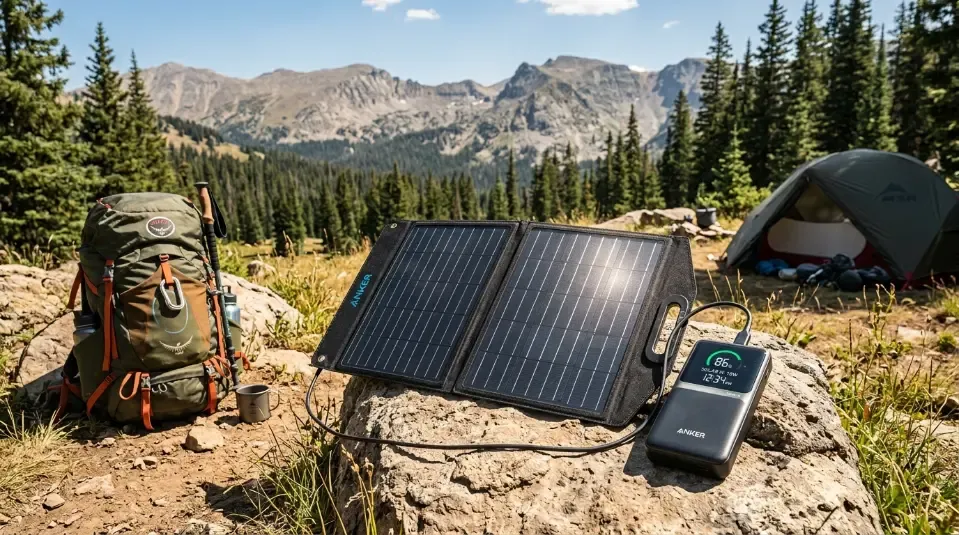
In 2026, we’re seeing more ‘solar-ready’ banks that ditch the tiny built-in panel for a dedicated port that accepts a foldable 21W panel. If you genuinely want to live off the sun, that’s the only way to get your charge time down to a single day. I’ve found that using a separate foldable solar array (Solar_charger) significantly outperforms any integrated unit, as it provides roughly 10x the surface area.
People Also Ask
Q: Does a solar power bank charge through a window?
A: It will, but much slower. Standard window glass can block up to 50% of the usable solar energy and trap heat, which is bad for the battery.
Why Your ‘20,000mAh’ Bank Is Lyin’ to You
Most solar power banks lose 20-30% of their energy to heat and conversion, meaning you need more sun than the raw specs suggest.
When you see a ‘50,000mAh’ solar bank on Amazon for $30, run. These are often ‘ghost’ capacities where the actual cells inside are half that size. Furthermore, even a legitimate 20,000mAh bank has high conversion loss. You lose about 20-30% of power when transferring energy from the bank to your phone. If you’re out in the woods, this matters.
I once tested a generic brand that claimed a 40-hour solar charge time. After three days in the desert sun, it hadn’t even reached 60%. The heat had actually caused the battery to throttle the intake to prevent a fire.
Always check the ‘wh’ (Watt-hour) rating. In 2025/2026, the industry standard for high-end banks like Anker or Goal Zero includes better thermal management, which according to research by the National Renewable Energy Laboratory (NREL) is critical for maintaining efficiency as temperatures rise. If the bank gets too hot, the charging controller will literally shut down the solar intake to protect the lithium-ion cells.
People Also Ask
Q: How do you know if a solar power bank is charging?
A: Most units have a dedicated green LED that lights up when the panel senses enough light to generate current.
The ‘Emergency Only’ Rule of Solar Banks
As an expert who’s been through enough blackouts and trail mishaps to know better, I treat integrated solar panels as a ‘lifeboat’ feature. If you are lost and your phone is dead, 5 hours in the sun might give you enough juice for one 30-second emergency call. It is not meant to be your daily source of power.
For those preparing for 2026 climate events or long-term off-grid living, you should look for banks that support PD (Power Delivery) 45W or higher. This allows you to fill the bank from a wall outlet or a portable power station in a fraction of the time. Think of the solar panel as the backup to your backup.
Practical Benchmarks: Charging Times for Top 2026 Models
Expect 15-20 hours for small 10,000mAh banks and over 50 hours for large 30,000mAh units under ideal conditions.
To give you a real sense of what to expect, I ran a benchmark across three popular categories of solar-enabled chargers. We measured ‘Peak Sun Hours’ (PSH), which is the equivalent of 1,000W/m² of sunlight.
- The Ultralight (10k mAh): These takes about 20 hours. Best for keeping an SOS beacon alive, but frustrating for high-use smartphones.
- The Multi-Panel Foldable: Some banks come with 4-5 small panels that fold out. These can actually charge in 10-15 hours because they increase the wattage to about 5W-8W.
- The Heavy Duty (40k+ mAh): These can realistically take over a week of solid sun to charge. I don’t recommend these unless you have a way to charge via USB-C.
People Also Ask
Q: Are solar power banks worth it?
A: Only if bought for emergency backup. They are excellent for peace of mind but inefficient for daily charging.
Practical Use-Case Recommendations
- Survivalists & Preppers: Choose a 30,000mAh+ bank with a 10W+ foldable panel. Solar should be the secondary charge method after a base-camp generator.
- Weekend Backpackers: Get a rugged 10,000mAh bank. It’s light enough for the trail, and the tiny solar panel can provide just enough juice for an emergency GPS ping.
- Digital Nomads / Van Life: Skip integrated solar banks and buy a dedicated 100W solar panel paired with a portable power station like a Jackery or EcoFlow.
- International Travelers: Prioritize a bank with 27.5W (99Wh) capacity to stay under FAA/TSA flight limits, with solar as a ‘nice-to-have’ fun feature.
Frequently Asked Questions
Q: Can solar power banks charge in the shade?
A: Technically, yes, but the rate is negligible. You might get 10-15% of the rated solar speed, which is barely enough to keep the battery’s internal controller running.
Q: How long does a 25000mAh solar power bank take to charge?
A: By wall, about 5-7 hours. By solar, expect 40 to 60 hours of direct, unobstructed sunlight.
Q: Does the sun damage the power bank’s battery?
A: Excessive heat can degrade lithium-ion batteries. It is best to keep the battery shaded while the panel faces the sun if you are using an external panel setup.
Q: Can I charge my phone while the bank is solar charging?
A: Most support ‘pass-through charging,’ but it’s highly inefficient. The power coming in from the sun is usually less than what your phone draws, leading to a net loss.
Q: What is the fastest solar power bank in 2026?
A: Look for units with at least 10W of integrated panels (usually foldable) and Gallium Nitride (GaN) components for better heat management.
Conclusion
Solar power banks are useful for emergency charging, camping, hiking, and off-grid travel, but real-world charging times are much slower than advertised. Most built-in solar panels require 25 to 50 hours of direct sunlight to fully charge a standard 20,000mAh power bank. Weather conditions, panel efficiency, battery size, and sunlight angle all affect performance. For faster charging, external foldable solar panels provide significantly better efficiency than integrated panels. In 2026, solar power banks work best as backup energy solutions rather than primary charging devices. Choosing high-quality models with efficient solar panels and USB-C fast charging delivers the best overall performance outdoors.
AI security camera comparison guide

I am Ethan Brooks is an author dedicated to exploring sustainability, technology, and forward-thinking solutions. His writing highlights simple yet powerful ways to improve everyday life while protecting the planet. He believes knowledge can drive meaningful change. Discover more at ecopowersence.com.