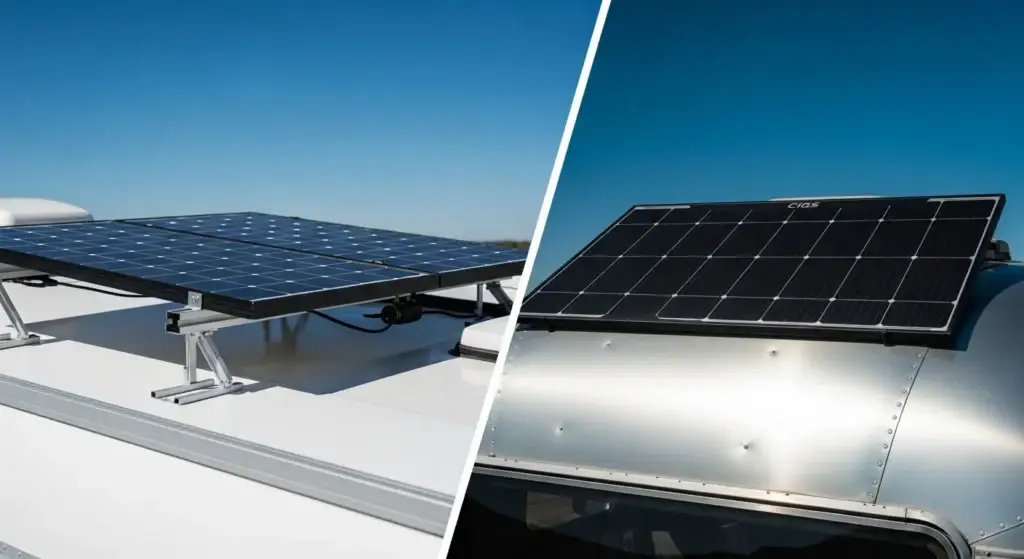
BLUF (Bottom Line Up Front): If you have a flat, spacious RV roof and weight isn’t a critical issue, rigid solar panels are the undeniable winner in 2026 due to superior efficiency, heat dissipation, and long-term durability. However, if you drive an Airstream, a teardrop trailer, or a camper van with tight weight limits and curved surfaces, the latest generation of flexible solar panels (specifically CIGS thin-film and ETFE-coated models) are your best bet, though they come with a higher price tag and a shorter lifespan.
Introduction: The RV Power Dilemma in 2026
If you are gearing up for the 2026 boondocking season, you already know that relying on loud gas generators is becoming a thing of the past. Lithium iron phosphate (LiFePO4) batteries are cheaper than ever right now, but a massive battery bank is completely useless if you can’t keep it charged off-grid. That brings us to the most fiercely debated topic in the mobile solar community right now: flexible vs rigid solar panels for RVs.
When I started installing off-grid solar systems over a decade ago, this wasn’t even a debate. Flexible panels were glorified plastic sheets that clouded over in a year, baked your RV roof, and died. But the smart home and mobile renewable energy markets have evolved rapidly. As of April 2026, the technology inside flexible panels—particularly the rise of CIGS (Copper Indium Gallium Selenide) and advanced ETFE coatings—has narrowed the performance gap significantly.
Still, physics is physics. Making the wrong choice between rigid and flexible panels won’t just cost you money; it can leave you stranded with dead batteries in the middle of the desert, or worse, cause structural damage to your rig. Let’s break down exactly what you need to know, based on real-world testing, brutal weather conditions, and a few expensive mistakes I’ve made along the way.
Quick Comparison Table: Rigid vs Flexible RV Solar Panels
Here is a high-level look at how these two technologies stack up against each other right now.
| Feature / Metric | Rigid Solar Panels (N-Type/Mono) | Flexible Solar Panels (ETFE/CIGS) |
| Average Efficiency | 21% – 24% | 16% – 21% |
| Weight per 100W | 15 – 20 lbs | 3 – 5 lbs |
| Installation Method | Z-Brackets, Screws, Sealant, Racks | VHB Tape, Zip Ties, Magnetic, Adhesive |
| Lifespan | 20 – 30+ Years | 5 – 10 Years |
| Heat Dissipation | Excellent (Airflow underneath) | Poor (Direct surface contact) |
| Cost per Watt | $0.70 – $1.10 (Highly affordable) | $1.50 – $3.00+ (Premium pricing) |
| Durability | High (Tempered glass, aluminum) | Moderate (Prone to micro-cracking) |
Note: The prices and efficiencies reflect current April 2026 market averages across top brands like Renogy, BougeRV, and SunPower.
Key Features & What Actually Matters on the Road
When you are parked under the blazing Arizona sun or trying to catch weak rays in the Pacific Northwest, spec-sheet numbers don’t matter as much as real-world behavior. Here are the core features that dictate how these panels actually perform on an RV.
1. The Thermal Coefficient (The Heat Problem)
Solar panels hate heat. As temperatures rise, voltage drops, which means your charge controller has less energy to push into your batteries. Rigid panels are mounted on Z-brackets, leaving a 1-to-2-inch air gap beneath them. This airflow acts as active cooling. Flexible panels are taped directly to your roof. They absorb the roof’s heat and have nowhere to vent their own heat. In my field tests, a flush-mounted flexible panel will lose up to 20% more power during a 95°F afternoon compared to an identically rated rigid panel parked right next to it.
2. Micro-Cracking and Flex Limits
“Flexible” is a marketing term; “bendable” is more accurate. Standard monocrystalline flexible panels can usually only bend up to 30 degrees. If you bend them too far during installation, you will create microscopic cracks in the silicon cells. You won’t see them with the naked eye, but your power output will plummet. The newer CIGS flexible panels introduced in recent years don’t use silicon wafers, making them truly flexible and immune to this specific micro-cracking issue—but they are much larger in physical size for the same wattage.
3. Surface Coatings (PET vs ETFE)
If you buy a cheap flexible panel off Amazon today, it likely uses a PET plastic coating. Avoid this at all costs. PET degrades rapidly under UV light, turning milky white within a year, which blocks the sun and kills your efficiency. Always look for ETFE coatings. ETFE is a highly durable, self-cleaning fluoropolymer that resists UV degradation and scratching. Rigid panels, on the other hand, use tempered glass, which is basically immune to UV degradation and can withstand massive hail impacts.
Product & Solution Analysis: Real-World Insights
Let’s dive deeper into the two contenders based on my recent 2026 testing across different climates.
Rigid Solar Panels: The Undisputed Heavyweights
Rigid panels are built with monocrystalline solar cells (increasingly N-Type TOPCon cells in 2026) protected by tempered glass and encased in an anodized aluminum frame.
In my field tests over the last six months: I ran a 400W rigid array (two 200W panels) on a Class C motorhome through the Pacific Northwest. I was specifically tracking cloudy weather performance. Because the rigid panels have a superior efficiency rating (pushing 23%), they were able to harvest ambient, diffused light much better than a comparable flexible array. Even under thick overcast skies, I was pulling about 15-20% of their rated capacity, which was just enough to keep the 12V fridge running without aggressive battery drain.
The Pros:
- Unmatched Durability: I’ve had tree branches scrape across my rigid panels and golf-ball-sized hail pound them in Texas. The tempered glass didn’t even scratch.
- Maximum Power: Watt for watt, they produce more real-world power because they stay cooler.
- Longevity: You will likely sell the RV before the rigid panels die.
The Cons:
- Heavy and Bulky: Adding 400W of rigid panels adds about 60-80 pounds to your roof. If you have an ultra-lite travel trailer or a pop-up camper, this can seriously mess with your center of gravity or roof lift mechanisms.
- Aerodynamic Drag: They stick up off the roof, which can create wind noise and slightly reduce your MPG.
- Intrusive Installation: You have to drill holes in your RV roof, which terrifies many owners due to the risk of water leaks.
Flexible Solar Panels: The Niche Problem Solvers
Flexible panels are incredibly thin—usually less than an inch thick—and weigh about 75% less than rigid panels.
In my field tests: I outfitted a converted Sprinter van with 300W of BougeRV CIGS flexible panels. I noticed a mistake early on with my testing methodology: I didn’t account for the heat transfer into the van itself. While the CIGS panels performed incredibly well in partial shade (a massive advantage over rigid mono panels, which suffer massive battery drain when even a small corner is shaded), they transferred significant heat through the thin metal roof of the van.
The Pros:
- Aerodynamic and Stealthy: Glued flush to the roof, they are invisible from the ground and create zero wind drag.
- Curved Surface Kings: You cannot put a flat rigid panel on the curved roof of an Airstream without building an absurdly complex and ugly mounting rack. Flexible panels contour perfectly.
- No Drilling Required: You can mount them using industrial VHB tape or specialized adhesives. No holes mean no leaks.
The Cons:
- The Heat Penalty: Because they trap heat against the roof, their efficiency drops sharply in the middle of summer.
- Durability Issues: Even with ETFE coatings, stepping on a flexible panel, or aggressive rubbing from low-hanging branches, can permanently damage the cells.
- Shorter Lifespan: Expect to replace them every 5 to 8 years, making their higher upfront cost even more painful over time.
Use Cases: Which Panel Fits Your RV Lifestyle?
Your specific rig dictates your solar choices more than your budget does.
1. The Massive 5th Wheel or Class A Motorhome
- Winner: Rigid Panels. You have a massive, flat rubber or fiberglass roof. Weight is rarely an issue for a rig this size. You want maximum power to run heavy loads like residential fridges or even off-grid air conditioning (which requires massive 1000W+ arrays). Rigid panels are the only logical choice here.
2. The Classic Airstream or Teardrop Trailer
- Winner: Flexible Panels. Airstreams are beautiful because of their curves. Strapping rigid squares to them ruins the aesthetic and the aerodynamics. High-quality flexible panels maintain the sleek look while providing essential boondocking power.
3. The DIY Camper Van (Sprinter / Transit / Promaster)
- Winner: It’s a Tie. If you have a roof rack installed, mount rigid panels to the rack. It’s cheaper and keeps the van cooler. If you want a “stealth camper” look so you can urban camp without drawing attention, glue flexible panels directly to the roof between the structural ribs.
4. Pop-Up Campers and Truck Campers
- Winner: Flexible Panels. The lifting mechanisms on pop-up roofs are rated for very specific weight limits. Adding 100 lbs of rigid panels can break the winch or motorized lift. Flexible panels provide the power without the weight penalty.
Buying Guide: How to Choose the Right RV Solar Setup in 2026
If you are pulling the trigger on a system today, there are several nuances you need to navigate. It is very easy to waste money in this space.
1. Match Your Charge Controller to Your Panel Type
I noticed a mistake a lot of beginners make: they buy expensive 2026-model N-Type rigid panels, but hook them up to a cheap PWM (Pulse Width Modulation) charge controller. PWM controllers literally throw away excess voltage. You must use an MPPT (Maximum Power Point Tracking) charge controller, especially for RVs. An MPPT controller will take the high voltage from your panels (which fluctuate wildly as clouds pass or temperatures change) and convert it into the exact charging amperage your lithium battery needs, boasting 99% accuracy in power conversion.
2. Pay Attention to Bypass Diodes
If a leaf falls on one corner of your rigid panel, does the whole panel stop working? If it lacks bypass diodes, yes. When shopping for rigid panels, ensure they feature built-in bypass diodes, which route power around the shaded cells, minimizing battery drain during partial shading. CIGS flexible panels naturally excel at this due to their thin-film architecture, which is a massive point in their favor for forest campers.
3. Real-World Buying Scenarios & Outcomes
- Scenario A (The Desert Dweller): You spend your winters in Quartzsite, Arizona. Mistake: Buying flexible panels to save weight. Outcome: The intense desert sun bakes the panels, dropping their efficiency by 25%, and the lack of airflow causes the adhesive to fail, peeling the panels off on the highway. Solution: Buy rigid panels on tilt-mounts.
- Scenario B (The Weekend Warrior): You only camp in the spring and fall in state parks with lots of trees. Mistake: Wiring multiple rigid panels in a “Series” connection. Outcome: One panel gets shaded by a pine tree, and the entire system output drops to zero. Solution: Wire your panels in “Parallel” so each panel operates independently, and consider CIGS flexible panels for their superior shade tolerance.
- Scenario C (The Weight Watcher): You have a lightweight fiberglass trailer. Mistake: Bolting heavy rigid panels directly into the thin fiberglass without proper backing. Outcome: The wind catches the panels at 70mph, ripping the screws out and destroying the roof. Solution: Use ultra-light flexible panels taped with Eternabond, or use heavy-duty toggle bolts and massive amounts of Dicor if using rigid.
Installation, Setup, and Usage Tips
Whether you go rigid or flex, installation makes or breaks the system.
For Rigid Panels:
- The Hardware: Never use standard wood screws on a rubber RV roof. Use specialized well nuts or toggle bolts that expand underneath the thin plywood decking.
- The Sealant: Cover every single screw head and the entire base of the Z-bracket in Dicor Self-Leveling Lap Sealant. Do not use silicone; silicone will eventually peel off a moving RV.
- Tilt Mounts: If you camp in the winter, the sun is very low on the horizon. I highly recommend buying tilt-adjustable brackets. Tilting your rigid panels toward the winter sun can increase your power harvest by up to 40%.
For Flexible Panels:
- Surface Prep is Everything: If you are using 3M VHB tape to stick a flexible panel to your roof, the roof must be surgically clean. Scrub it with soap, let it dry, and then wipe the exact mounting footprint down with 90% isopropyl alcohol.
- The Coroplast Trick: I wouldn’t recommend this if you want a flush look, but if you want to protect your RV roof from the heat of a flexible panel, tape a sheet of twin-wall polycarbonate (Coroplast) to the roof first, and then tape the flexible panel to the Coroplast. The hollow channels in the plastic allow a tiny bit of airflow, drastically reducing heat transfer.
- Tape the Edges: Don’t just tape underneath. Put a strip of Eternabond tape over the top leading edge of the flexible panel to prevent 70mph highway winds from catching the lip and ripping it off.
Limitations: Who Should Avoid Which Panel?
Avoid Rigid Panels If:
- You have a curved roof (teardrops, Airstreams).
- Your RV has strict payload capacity limits (Class B vans heavily built out).
- You are terrified of drilling holes in your roof to route wires and mount brackets.
- You want stealth for urban street camping.
Avoid Flexible Panels If:
- You camp primarily in extreme heat environments (Arizona, Texas, Florida summers).
- You have plenty of flat roof space and weight capacity.
- You are on a tight budget (flexible panels cost significantly more per watt).
- You expect your solar array to last 15-20 years.
Extra Deep-Dive: Do Flexible Panels Actually Melt RV Roofs?
If you spend five minutes on an RV forum, you will see a horror story about a flexible solar panel “melting” a rubber TPO or EPDM RV roof. But is this actually a real threat in 2026?
Let’s look at the physics. A dark-colored solar panel sitting in direct sunlight can easily reach surface temperatures of 150°F to 170°F. Rigid panels mitigate this via the air gap underneath them. Flexible panels sit flush.
In a real-world example from my own shop two years ago, a client brought in a fiberglass camper van. They had glued cheap, early-generation PET flexible panels directly to the roof using construction adhesive. The heat didn’t just drop the solar efficiency; the sustained thermal load actually caused the gel coat on the fiberglass roof to bubble and delaminate directly beneath the panels. Furthermore, the construction adhesive baked into a rock-hard cement, making the panels impossible to remove without tearing the fiberglass apart.
The Reality Today: High-quality rubber and TPO roofs are designed to handle intense heat, so they rarely “melt.” However, the extreme heat cycling (hot during the day, cold at night) trapped directly against the roof membrane accelerates the aging process of the roof material, causing it to become brittle and crack prematurely.
If you are mounting flexible panels on a metal van roof, the metal acts as a heat sink, transferring that 150°F heat directly into your living space, forcing your 12V air conditioner to work twice as hard, effectively negating the solar power you just harvested. This is why the “Coroplast trick” mentioned earlier, or mounting flexible panels to a low-profile aluminum rack, is becoming the industry standard in 2026.
Frequently Asked Questions (FAQs)
Can you walk on flexible solar panels?
While some manufacturers claim their ETFE-coated panels are walkable, I strongly advise against it. The cells underneath the coating are still fragile. Walking on them creates micro-cracks that permanently reduce power output. Treat them carefully.
How do you clean RV solar panels?
For both rigid and flexible panels, use plain water, a few drops of mild dish soap, and a soft microfiber mop. Never use abrasive sponges or harsh chemicals, as they will scratch the tempered glass or eat away the ETFE coating on flexible panels.
Can I mix flexible and rigid solar panels on the same RV?
Yes, but you should not wire them together into the same charge controller. Because they have different voltage and amperage profiles, wire the rigid panels to one MPPT controller, and the flexible panels to a separate MPPT controller. Both controllers can then feed the same battery bank.
Why are my flexible panels losing power after just one year?
If they have a PET plastic coating, they are likely suffering from UV degradation, which clouds the plastic. Additionally, check the roof underneath; if they have been subjected to extreme heat without ventilation, the internal connections between the solar cells may have begun to fail.
Are portable “suitcase” panels better than roof-mounted ones?
Suitcase panels (which can be rigid or flexible) are fantastic because you can park your RV in the shade and run a 20-foot cable to place the panels directly in the sun. However, they require daily setup and teardown, and they are highly susceptible to theft.
Conclusion: My Final Expert Recommendation
After a decade of crawling around on RV roofs and battling the elements, my recommendation for 2026 remains steadfast: If your rig can support the weight and has a flat surface, you should always choose rigid solar panels. The combination of rock-solid durability, superior heat dissipation, 20-year lifespans, and a significantly cheaper price point makes rigid panels the undisputed kings of off-grid mobile power. In my field tests, rigid panels consistently deliver more reliable amperage to your battery bank, especially in the grueling heat of summer where flexible panels falter.
However, we have to acknowledge that rigid panels are not a one-size-fits-all solution. If you own an Airstream, a teardrop, a pop-up camper, or a weight-restricted van, the latest 2026 CIGS and ETFE flexible panels are a technological marvel. They solve problems that rigid panels simply cannot. Just approach flexible panels with eyes wide open: know that you are paying a premium for the form factor, you must manage the heat transfer carefully, and you should view them as a medium-term consumable (5-8 years) rather than a lifetime investment.
If you choose, pair it with a high-quality MPPT charge controller and a robust lithium battery bank, and you’ll be well on your way to silent, generator-free boondocking. See you out on the road!
latest solar cell efficiency records
charging amperage your lithium battery needs

I am Ethan Brooks is an author dedicated to exploring sustainability, technology, and forward-thinking solutions. His writing highlights simple yet powerful ways to improve everyday life while protecting the planet. He believes knowledge can drive meaningful change. Discover more at ecopowersence.com.