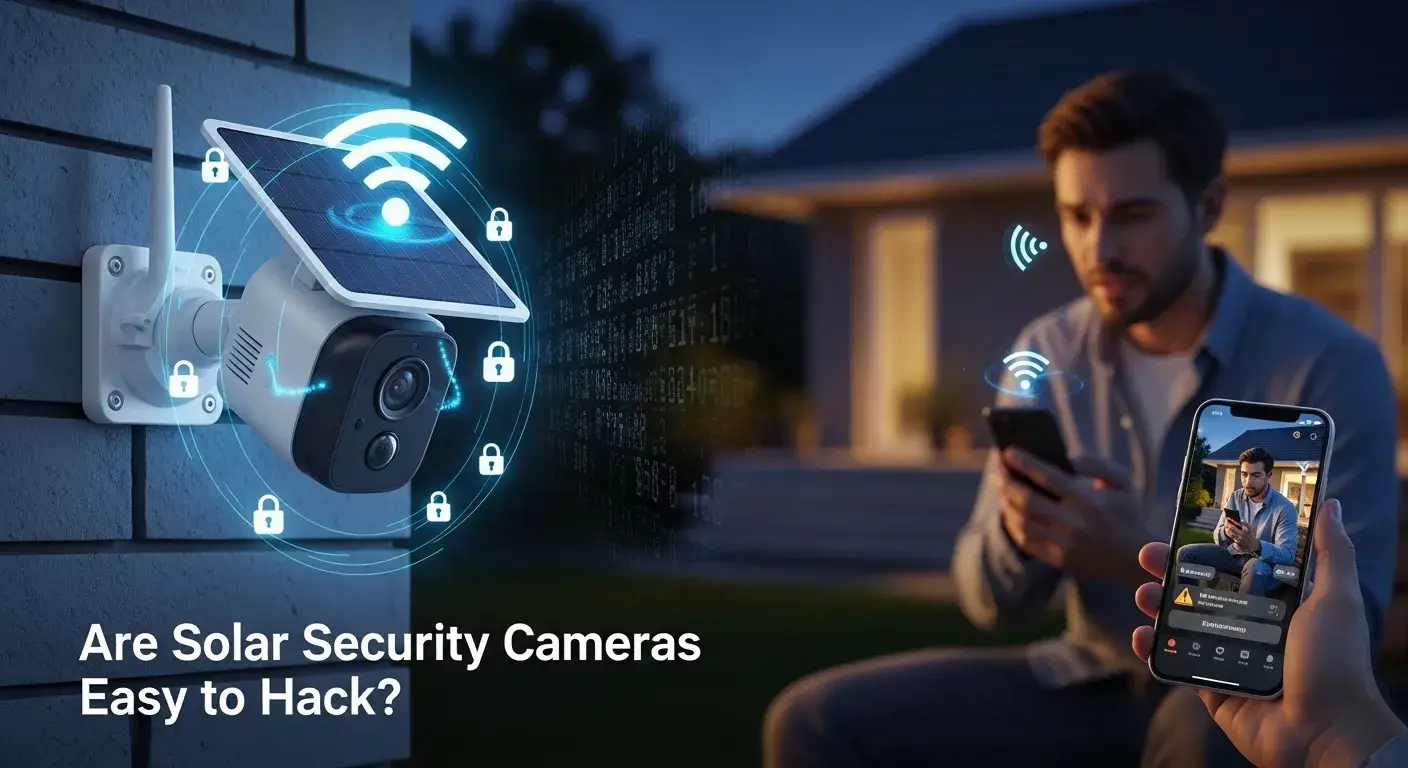
If you’ve invested in a solar-powered security camera to protect your home or business, you’ve made a smart, eco-friendly choice. But here is a question that doesn’t get asked nearly enough: are solar security cameras easy to hack?
The uncomfortable answer is yes — they can be, under certain conditions. But before you panic, the full picture is far more nuanced. Whether your solar security camera becomes a hacker’s easy target or a hard-to-crack system depends almost entirely on how it’s configured, maintained, and which brand you chose in the first place.
This guide breaks down everything you need to know: how solar security cameras get hacked, what makes them vulnerable, which warning signs to watch for, and — most importantly — the practical steps you can take today to lock yours down.
[IMAGE SUGGESTION: Infographic showing a solar security camera with labeled vulnerability points — Wi-Fi connection, cloud storage, mobile app, and firmware chip — each with a risk level indicator. Great for breaking up the introduction and establishing context visually.]
What Makes Solar Security Cameras Different From Standard Cameras?
Before diving into hacking risks, it helps to understand what sets solar security cameras apart from their wired counterparts.
Solar-powered security cameras are wireless by design. They rely on rechargeable batteries topped up by solar panels, which means there is no power cable tethering them to the wall — and in most cases, no data cable either. They transmit footage and receive commands entirely over Wi-Fi or cellular networks.
This wireless-first architecture is exactly what gives solar cameras their flexibility. You can mount them in remote areas, on fences, in fields, or anywhere a power outlet doesn’t reach. But that same wireless connectivity is also what introduces cybersecurity risk.
Unlike a wired, locally-stored CCTV system that only records to an on-site hard drive, most solar security cameras:
- Stream footage to cloud servers over the internet
- Communicate with a smartphone app for remote viewing
- Receive firmware updates over the air
- Connect to your home or business Wi-Fi network
Each of these touchpoints is a potential entry point for attackers. The question is not whether they exist — it’s whether your camera and network are configured to close them off.
Are Solar Security Cameras Easy to Hack? The Honest Answer
The honest answer depends on two factors: the quality of the camera and the security practices of the owner.
Any device connected to the internet can be hacked if not properly secured. That principle applies to smartphones, laptops, smart TVs — and solar security cameras. Security researchers have repeatedly demonstrated that cameras with poor default settings, outdated firmware, or no encryption can be compromised by attackers who, in some cases, require nothing more than a basic search engine query to find vulnerable devices.
A well-documented example: tools like Shodan — a search engine that indexes internet-connected devices — allow anyone with basic technical knowledge to find cameras with open administrative portals and no login credentials required. Security researchers have used Shodan to identify thousands of exposed cameras broadcasting live feeds to the public internet without the owners even knowing.
That said, solar cameras from reputable manufacturers, properly configured and regularly updated, are not easy to hack. The vulnerability gap between a budget, unconfigured camera and a well-maintained, enterprise-grade device is enormous.
[IMAGE SUGGESTION: Side-by-side comparison graphic showing a “vulnerable camera setup” (default passwords, no encryption, no updates) versus a “secure camera setup” (strong passwords, WPA2 encryption, latest firmware, two-factor authentication). Simple visual format works well here.]
The Most Common Ways Solar Security Cameras Get Hacked
Understanding the attack vectors helps you defend against them. Here are the most frequently exploited methods hackers use to access solar security cameras:
1. Default Passwords That Were Never Changed
This is the single most common cause of hacked security cameras worldwide. Every camera ships from the factory with a default username and password combination — often something as simple as “admin/admin” or “admin/12345.” These defaults are publicly documented, available on manufacturer websites, and well-known to hackers.
Automated bots continuously scan the internet for internet-connected cameras still using default credentials. Once found, gaining access takes seconds. The 2017 mass security camera hack — in which bots scanned for vulnerable DVRs and changed settings on thousands of devices simultaneously — exploited exactly this weakness.
2. Outdated or Unpatched Firmware
Firmware is the embedded operating system running inside your camera. Like any software, it contains bugs — and some of those bugs are security vulnerabilities. When a manufacturer discovers a critical flaw, they release a firmware update to patch it.
The problem is that many solar camera owners never apply these updates. An unpatched camera is running known vulnerabilities that are often publicly documented and actively exploited. Security researchers have found cameras on retail shelves whose firmware was already months out of date before the box was even opened — because new CVEs (Common Vulnerabilities and Exposures) are disclosed at a rate of dozens per day.
3. Weak or Unencrypted Wi-Fi Networks
Solar cameras that connect to poorly secured Wi-Fi networks are exposed to man-in-the-middle (MITM) attacks, where an attacker intercepts the data flowing between your camera and your router. If that data is transmitted without encryption, the attacker can view your live footage, capture credentials, or inject commands into the data stream.
Cameras using outdated Wi-Fi security protocols — or networks with weak WEP encryption instead of WPA2 or WPA3 — are particularly vulnerable. Hackers can also spoof wireless networks, creating a fake access point that tricks your camera into connecting to their device rather than your legitimate router.
4. Vulnerable Cloud Platforms and Mobile Apps
Even if your physical camera is well-secured, the cloud platform or mobile app used to view footage can be the weak link. Security researchers from cybersecurity firm Forescout uncovered 46 vulnerabilities in solar and renewable energy equipment from major vendors in 2025, including flaws in web portals, mobile apps, and cloud services that could allow attackers to take over connected devices entirely.
Third-party apps with weak authentication, insecure direct object references (IDOR), or cross-site scripting (XSS) vulnerabilities have allowed attackers to hijack camera accounts without ever interacting with the physical hardware.
5. Lack of Two-Factor Authentication
Two-factor authentication (2FA) adds a second layer of verification — typically a code sent to your phone — before granting access to your camera’s account or management portal. Without it, a stolen or guessed password is all an attacker needs. Most budget solar cameras either don’t offer 2FA or don’t require it by default, leaving the account protected by a single password.
6. Port Forwarding Without a VPN
Many users configure their routers to use port forwarding — a method of allowing remote access to their camera from outside their home network. The problem is that port forwarding directly exposes your camera’s interface to the open internet, with only a username and password as protection. Without a VPN to create an encrypted tunnel, this setup dramatically increases the attack surface.
[IMAGE SUGGESTION: Diagram showing the difference between an unsecured port-forwarding setup versus a VPN-secured remote access setup, with a simple “lock” visual on the secure path. Useful for less technically experienced readers.]
Real-World Evidence: Solar and IoT Camera Hacks Are Not Theoretical
It would be easy to dismiss camera hacking as an abstract concern if there weren’t a long trail of documented real-world incidents.
A security researcher investigating solar-powered Flock cameras found that administrative portals were left completely open with no login credentials required, allowing access to camera settings, diagnostic functions, and activity logs. The cameras were, in the researcher’s words, “extremely accessible” to anyone with basic technical knowledge.
In a separate series of incidents, hackers gained access to over 150,000 IP cameras globally — including inside hospitals, schools, and corporate facilities — by exploiting a single compromised cloud account at surveillance startup Verkada. No advanced hacking was required; one set of credentials opened the door to tens of thousands of devices.
In Japan, approximately 800 remote monitoring devices were hijacked using a known software flaw linked to the Mirai botnet — a type of malware that recruits poorly-secured internet-connected devices into large networks used for coordinated cyberattacks.
These are not edge cases. They represent a systemic pattern rooted in the same root causes: default credentials, unpatched firmware, and inadequate encryption.
Are Solar Cameras More Vulnerable Than Wired Cameras?
This is a fair question. Wired CCTV systems transmit data through physical cables rather than over Wi-Fi, which eliminates the wireless interception attack vector entirely. A system that is not connected to the internet at all can only be accessed by someone physically present on-site — a much higher bar for attackers.
However, modern wired cameras are also increasingly internet-connected for remote monitoring. And the broader comparison misses the point: the vulnerability of any camera system depends far more on how it is configured and maintained than on whether it uses a cable or radio waves to transmit data.
A solar wireless camera with strong passwords, WPA2 encryption, up-to-date firmware, and two-factor authentication is significantly more secure than a wired camera with a default password and no encryption.
[IMAGE SUGGESTION: Simple comparison table graphic: Wired camera vs. Solar wireless camera — listing pros and cons of each in terms of physical security, cyber attack surface, remote access risk, and ease of use. Tables perform well for featured snippets in Google search results.]
9 Proven Ways to Secure Your Solar Security Camera Against Hacking
The good news is that the vast majority of successful camera hacks exploit preventable weaknesses. Here is a practical, step-by-step hardening guide:
1. Change the Default Password Immediately
The moment you set up your solar camera, change the default username and password to something unique, complex, and not used anywhere else. Use at least 12 characters combining letters, numbers, and symbols. Never use the device’s brand name, your address, or “password123.”
2. Enable Two-Factor Authentication
If your camera’s platform supports 2FA — and any reputable modern platform does — enable it immediately. This ensures that even if someone obtains your password, they cannot access your account without also having physical access to your phone or email.
3. Keep Firmware Updated
Check your camera’s app or management portal for firmware updates at least every 90 days. Many modern cameras allow automatic updates — turn this feature on. Manufacturers regularly patch newly discovered vulnerabilities, and running outdated firmware is one of the most dangerous and easily avoided risks.
4. Secure Your Wi-Fi Network
Make sure your home or business Wi-Fi network uses WPA2 or WPA3 encryption — never the older, easily cracked WEP standard. Use a strong, unique Wi-Fi password. Consider creating a dedicated guest network or VLAN specifically for your cameras, separating them from your computers and other devices. This is called network segmentation, and it limits the damage if one device is compromised.
5. Use a VPN for Remote Access Instead of Port Forwarding
If you need to access your camera footage from outside your network, use a VPN rather than configuring port forwarding. A VPN creates an encrypted tunnel between your device and your home network, making the connection invisible and impenetrable to outsiders.
6. Buy From Reputable Brands With a Security Track Record
Not all solar cameras are created equal. Budget-priced cameras from little-known manufacturers often ship with minimal security features, no encryption, and no meaningful firmware update program. Look for brands that offer SSL/TLS encryption, WPA2-AES support, and have a published CVE response process — meaning they take reported vulnerabilities seriously and patch them promptly.
7. Disable Features You Don’t Use
Many cameras ship with features like UPnP (Universal Plug and Play), remote access ports, and Telnet enabled by default. If you aren’t using these features, disable them. Every open port and active service is a potential attack surface.
8. Regularly Monitor Access Logs
Most quality camera management platforms log all access attempts, including failed logins. Make it a habit to review these logs periodically. Unexpected login attempts from unknown IP addresses or unusual geographic locations are a clear warning sign that someone is trying to access your system.
9. Check Your Camera’s Physical Security
Solar cameras are often mounted in exposed outdoor locations. Ensure the camera is positioned high enough and angled in a way that makes physical tampering difficult. Some sophisticated attackers use physical access to extract stored credentials or reset the device to factory defaults, bypassing all your software security measures.
[IMAGE SUGGESTION: Checklist-style infographic of the 9 security steps above, with icons for each item. Checklists tend to earn rich snippet treatment from Google and are highly shareable on social media.]
Warning Signs Your Solar Security Camera Has Already Been Hacked
Even with good security practices, it pays to know the early warning signs of a compromised camera:
Unexpected settings changes. If your camera’s configuration — recording schedules, motion sensitivity, alert settings — has changed without your input, someone else may have access to your account.
Camera movement you didn’t trigger. PTZ (pan-tilt-zoom) cameras that move on their own are a classic sign of unauthorized access.
Degraded performance or unusual data usage. A hacked camera may be running additional processes or streaming footage to an unauthorized server, causing slower performance and unusually high data consumption on your network.
Unfamiliar devices in your camera’s app. If your camera management app shows sessions or logins from devices or locations you don’t recognize, treat this as a serious red flag.
LED indicator behaving oddly. Some cameras use status LEDs that behave differently when the camera is actively streaming. If the LED pattern is inconsistent with your usage, investigate.
What to Do If You Suspect Your Solar Camera Has Been Hacked
Act quickly and methodically:
- Disconnect the camera from your network immediately to prevent further unauthorized access or data exfiltration.
- Change your camera account password and Wi-Fi password from a separate, trusted device.
- Perform a factory reset on the camera, then reconfigure it with strong credentials from scratch.
- Check other devices on your network — a compromised camera can sometimes serve as a foothold for attackers to access computers, phones, or smart home devices on the same network.
- Report the incident to the camera manufacturer, especially if you believe a firmware vulnerability was exploited. Responsible manufacturers take these reports seriously and issue patches.
How to Choose a Solar Security Camera With Strong Built-In Security
When shopping for a solar-powered security camera, cybersecurity should be a primary evaluation criterion — not an afterthought. Here is what to look for:
End-to-end encryption. The camera should encrypt footage both in transit (using SSL/TLS or HTTPS protocols) and at rest in cloud storage using AES-256 encryption or equivalent.
Mandatory password change on setup. Quality cameras force users to create a new password during initial setup rather than allowing the default to remain in place.
Two-factor authentication support. This should be available as standard, not a premium add-on.
Active firmware update program. Check the manufacturer’s website for a record of firmware update history. Brands that regularly release updates are taking security seriously.
Local storage option. Cameras that support local SD card storage give you the option to keep footage off the cloud entirely — eliminating the risk of cloud account compromise.
No history of unpatched CVEs. Before purchasing, search “[brand name] security vulnerability” or “[brand name] CVE” to see if the manufacturer has a track record of leaving critical vulnerabilities unaddressed.
[IMAGE SUGGESTION: Product-style feature comparison graphic showing what security specifications to look for on a camera’s spec sheet — encryption type, 2FA support, firmware update frequency, local storage support. Helps readers apply the advice at point of purchase.]
Frequently Asked Questions
Can solar security cameras be hacked remotely?
Yes. Solar security cameras that are connected to the internet — which most are, for remote viewing and cloud storage — can be accessed remotely by attackers who exploit weak passwords, unpatched firmware vulnerabilities, or insecure cloud platforms. The risk is real but largely preventable with proper configuration.
Are solar-powered cameras less secure than wired ones?
Not inherently. The wireless nature of solar cameras does introduce additional attack vectors, such as Wi-Fi interception. However, a solar camera with strong passwords, WPA2 encryption, two-factor authentication, and up-to-date firmware can be significantly more secure than a poorly-configured wired camera.
What is the most common reason solar security cameras get hacked?
The most common cause is failure to change the factory default password. Default credentials are widely published and exploited by automated bots that continuously scan the internet for vulnerable devices. Changing your password on day one eliminates a significant portion of the risk.
How do I know if my solar camera has been hacked?
Warning signs include unexplained changes to camera settings, the camera moving without your input, unusual LED behavior, unrecognized login sessions in your camera app, and higher-than-normal data usage. If you notice any of these, disconnect the camera, reset it, and change all associated passwords immediately.
Does using a VPN protect my solar security camera?
Yes, meaningfully so. Using a VPN for remote access instead of port forwarding encrypts the connection between your viewing device and your home network, making it far harder for attackers to intercept data or gain unauthorized access. Many routers support built-in VPN server functionality.
Should I buy a solar camera with local storage or cloud storage?
Both have trade-offs. Local storage (SD card or NVR) keeps your footage off external servers, eliminating cloud account hacking risk — but physical theft of the camera or storage device can compromise it. Cloud storage is convenient and resilient to physical theft, but requires strong account security. Ideally, choose a camera that supports both options so you can layer your security strategy.
Are cheap solar security cameras safe to use?
Budget solar cameras from unknown manufacturers carry significantly higher security risks. They frequently ship with default passwords, lack proper encryption, and receive little to no firmware support after sale. Investing in a reputable brand with active security support is strongly recommended — the cost difference is small compared to the privacy and security implications of a hack.
Conclusion
So, are solar security cameras easy to hack? They can be — but only when they are improperly configured, running outdated firmware, or purchased from manufacturers who cut corners on security. The vulnerability is rarely in the solar-charging technology itself. It lies in the wireless connectivity, cloud integration, and software ecosystem that makes modern solar cameras so convenient.
The good news is that the most dangerous attack vectors are entirely within your control. Changing default passwords, enabling two-factor authentication, keeping firmware updated, securing your Wi-Fi network, and buying from reputable brands closes off the vast majority of the risk. Hackers are pragmatic — they look for easy targets. A properly hardened solar security camera is not one.
Treat your solar security camera with the same cybersecurity discipline you would apply to any other connected device in your home or business, and the technology will do exactly what you bought it to do: keep you safer, not put you at greater risk.
Disclaimer: This article is for informational purposes only. Always consult a qualified cybersecurity professional for advice specific to your installation and threat environment.
AI-Powered Outdoor Security Monitoring Systems

I Am Sarah Miller is a passionate writer focused on sustainability, eco-friendly living, and modern environmental solutions. Through her work, she aims to inspire readers to make smarter, greener choices for a better future. She regularly shares insights and practical tips on her website, ecopowersence.com.