BLUF (Bottom Line Up Front)
Most rural driveway alarms are cheap plastic landfill fodder that trigger every time a squirrel twitches or a cloud passes. If you have actual acreage, heavy tree cover, and need a signal to penetrate a brick house, you need the Dakota Alert BBA-4000 break-beam system. If you have a clear line-of-sight and are on a strict budget, the eMACROS 1/2 Mile is an acceptable backup. Throw the rest in the trash.
The “Why I Wrote This” Intro
Last November, a buddy of mine out in rural Montana called me furious. He lives at the end of a winding, 1,500-foot gravel driveway flanked by dense pine trees. He had dropped $60 on an Amazon “best-seller” solar drive-thru alert to let him know when the FedEx guy showed up. One Tuesday, the alarm stayed completely silent while a delivery driver dropped a $2,500 custom diesel exhaust part right at his front gate—which was promptly stolen three hours later by a meth-head in a rusted Tacoma.
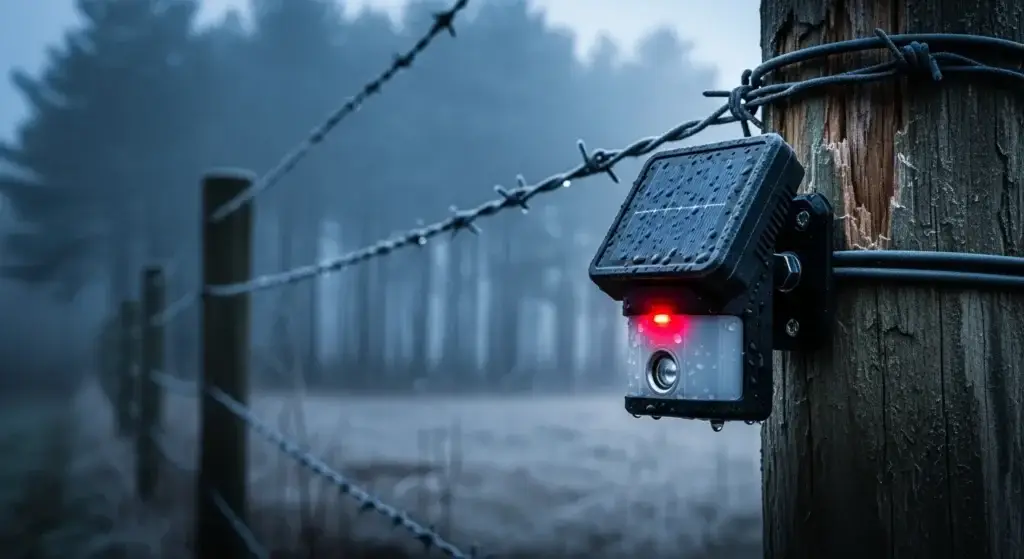
I drove out there, tore the sensor off his fence post, and cracked it open. The antenna was a joke, the solar panel was frosted over, and the RF frequency it used couldn’t penetrate a wet paper bag, let alone a quarter-mile of dense timber. The rural security market is absolutely flooded with marketing fluff. Companies claim a “1-Mile Range” knowing damn well they tested it in a perfectly flat, barren desert. I’m writing this because relying on bad tech in the country isn’t just an annoyance; it costs you real money and compromises your safety. Here is the unvarnished truth about which solar drive-thru alerts actually work off the grid.
The “No-BS” Comparison Table
| Alarm System | Sensor Tech | Claimed Range | Real Wooded Range | False Alarm Rate | IP Rating | The “Gimmick” Factor |
| Dakota Alert BBA-4000 | Dual Break-Beam | 1 Mile | ~1/2 Mile | Almost Zero | IP66 | Massive sensors look like military hardware. |
| eMACROS 1/2 Mile | Single PIR | 1/2 Mile | ~1000 ft | Medium (Hates Deer) | IP65 | “Half mile” only applies in a literal vacuum. |
| Guardline Solar | Dual PIR | 1/4 Mile | ~600 ft | Low | IP55 | Rubber gaskets dry rot after two summers. |
| HTZSAFE Solar | Single PIR | 1/2 Mile | ~800 ft | High | IP65 | Volume control is either deafening or silent. |
Deep Analysis: The Meat and The “Lab vs. Reality” Gap
Let’s break down the tech. When companies sell you a rural driveway alarm, they weaponize best-case scenarios. Let’s talk about why your current alarm is failing you, and what the specs actually mean for your wallet.
The RF Propagation Lie
Wireless sensors talk to your house base station using Radio Frequency (RF). Most budget systems operate on the crowded 433MHz frequency. The box will scream “Half-Mile Range!” but that is a Line-of-Sight (LoS) measurement. If you have a perfectly flat, paved driveway with zero trees, hills, or metal barns between the sensor and your house, sure, it might hit a half-mile. But in reality? Wood, leaves, moisture, and earth absorb RF waves. A thick pine forest can cut a 433MHz signal range by 70%. If your house has aluminum siding or foil-backed insulation, your home is acting as a Faraday cage, bouncing the weak signal right off your exterior walls. You need a 900MHz system (like the Dakota Alert). Lower frequencies have larger wavelengths, allowing them to physically bend around trees and penetrate heavy residential building materials.
PIR vs. Break-Beam Technology
Passive Infrared (PIR) is the standard for 90% of driveway alerts. It detects a sudden change in background temperature when an object crosses the fresnel lens. Here is the problem: a PIR sensor does not know the difference between a hot UPS truck engine and a warm 12-point buck walking across your driveway. Furthermore, on a 100-degree summer day, the ambient background heat is so high that the PIR sensor goes blind, failing to detect a 98-degree human walking past it.
If you want zero false alarms, you need Active Break-Beam technology. This involves mounting two separate solar sensors across from each other. They shoot an invisible dual-infrared laser beam across the driveway. The alarm only triggers if both beams are broken simultaneously by a large, solid mass (like a car or a human torso). Falling leaves, heavy rain, or a stray dog walking under the top beam won’t trigger it. It is vastly superior, but it requires more effort to install and align.
The Vampire Draw of Cold Weather
Just because a sensor has a solar panel doesn’t mean you have unlimited power. Most of these units utilize cheap internal Lithium-ion (Li-ion) battery packs. When you place a Li-ion battery in an environment that drops below 32°F (0°C), the internal chemistry slows down. The solar panel might be generating a charge, but the battery’s protective circuitry will block it to prevent the cells from crystallizing and shorting out. If you live in a northern rural environment, the sensor will survive entirely on its stored battery reserve during the winter. A system with a high vampire draw (due to poorly optimized standby circuitry) will go dead by January, leaving your driveway completely unmonitored.
Featured Snippet Q&A
What is the best solar drive-thru alert for rural homes?
The Dakota Alert BBA-4000 is the most reliable system for rural properties. It uses dual break-beam technology to eliminate false alarms from wildlife and operates on a powerful 900MHz frequency, allowing the wireless signal to penetrate heavy tree cover and brick walls up to a mile away.
Do solar driveway alarms work in the woods?
Yes, but range is severely reduced. Trees, leaves, and moisture absorb radio frequencies. A system claiming a 1/2-mile range in an open field will often only reach 1,000 feet through dense timber. To overcome this, use a 900MHz transmitter rather than a standard 433MHz system.
How do I stop deer from triggering my driveway alarm?
Upgrade from a PIR (Passive Infrared) sensor to an active Break-Beam system. Break-beam systems require a solid mass to break two separate infrared beams simultaneously. Alternatively, you can mount a PIR sensor higher up (about 4 feet) and point it slightly downward to physically shoot over the heads of most wildlife.
The “Masterclass” Buying Guide
Stop looking at the glossy pictures on the box. Look at the technical data sheet. Here is what actually dictates if an alert system is worth your money:
- Frequency Band: 433MHz is fine for suburban driveways. For rural properties with hills, metal shops, and timber, you absolutely must demand a 900MHz system. It’s the only way to push a signal a quarter-mile through obstacles.
- Sensor Type: Single PIR is garbage (triggers on sunbeams and shadows). Dual PIR is better (requires two heat zones to trigger). Break-beam is the gold standard for zero false positives.
- NEMA/IP Ratings: IPX4 is a joke; it means splash-proof. You want IP65 or IP66. The housing needs to be dust-tight and capable of surviving high-pressure water jets, otherwise, the first heavy horizontal rainstorm will short the motherboard.
- Expandability: Can you add multiple sensors to one base station? Can you assign different chime tones to different sensors? You want to know immediately if the alert is coming from the front gate or the rear equipment barn without looking at the receiver.
Internal Linking Strategy
- Before you lock down the driveway, make sure your perimeter fencing is actually powered. Read my teardown of the Best Solar Fence Chargers for Heavy Weed Loads.
- Struggling to keep lithium batteries alive in the cold? Learn about Optimizing Solar Battery Banks for Winter Temperatures.
- Pair your driveway alert with off-grid illumination. Check out our guide to the Most Durable Solar Flood Lights for Barns and Shops.
“The Wall of Shame” (Common Mistakes)
If your driveway alarm is constantly giving you false positives or missing trucks entirely, you probably installed it like an amateur. Here are 5 things people do wrong that kill their equipment:
- The Sun Blindness Trap: Mounting a PIR sensor facing directly East or West. During sunrise or sunset, the harsh, direct thermal load of the sun hits the fresnel lens and overloads the infrared sensor, causing a continuous loop of phantom alarms in your house. Face them North or South.
- The Faraday Fence Post: Mounting the transmitter directly onto a massive steel gate or corrugated metal fence. Metal absorbs and disrupts RF signals. You are effectively shielding the antenna. Always mount the transmitter on a wooden post or use a heavy-duty plastic standoff bracket.
- The “Ankle Biter” Height: Mounting the sensor 18 inches off the ground. You will get an alert for every stray cat, raccoon, and tumbleweed that crosses your driveway. Mount PIR sensors at 3 to 4 feet high and angle them slightly downward so they catch vehicle engines and human torsos.
- Neglecting the Solar Panel: Thinking “solar” means “maintenance-free.” Rural driveways kick up massive amounts of gravel dust. A thin layer of silica dust on a 3-inch solar panel will drop its charging efficiency by 50%. Wipe it down with a damp cloth once a month.
- Ignoring Receiver Placement: Putting the base station receiver in your basement or next to your Wi-Fi router. Concrete walls kill incoming signals, and a high-powered 2.4GHz Wi-Fi router can create localized electromagnetic interference that drowns out the incoming 433MHz alert. Put the receiver near a window facing the driveway.
Installation & Setup Horror Stories
You’d think screwing a plastic box to a tree is idiot-proof. It isn’t. A client of mine bought a highly-rated Guardline solar system. Instead of using the included mounting bracket, he decided to drill directly through the back of the plastic housing into an oak tree to make it “more secure.” He cracked the internal waterproof seal. Three weeks later, morning dew wicked into the hairline fracture, corroded the internal battery terminals, and permanently bricked the unit.
Another classic: The “Line of Sight” delusion. A guy in upstate New York installed an eMACROS system at his gate, 1,200 feet from his house. Between the gate and the house was a 40-foot tall earthen berm. He spent three days calling customer support complaining the unit was defective because the signal wouldn’t reach his kitchen. RF signals do not magically tunnel through millions of tons of solid earth. I had to tell him to move the sensor to the top of the berm where it had a clear shot at his roofline. Know your topography before you buy.
The “Cold Truth” (Who Should NOT Buy)
Let’s be brutally honest. RF-based solar drive-thru alerts are not magic. If you have a driveway that is two miles long, snakes through a dense, wet forest, and your house is built out of solid stone… an RF alarm will not work. Stop trying to force a $100 wireless toy to do a commercial-grade job.
If you are dealing with massive distances and heavy topographical obstruction, you need to abandon RF entirely. You have two real options: get out a trencher and hardwire a low-voltage sensor system the entire length of your property, or buy a cellular-based trail camera (like a Spypoint or Tactacam) that runs on solar and sends push notifications to your phone via an AT&T or Verizon tower. Yes, you will pay a monthly cellular fee, but it actually works when a 433MHz system inevitably fails.
FAQ (FAQ Schema Ready)
Do solar driveway alarms need Wi-Fi to work?
No. Traditional solar driveway alerts operate on dedicated Radio Frequencies (like 433MHz or 900MHz) to communicate directly between the outdoor sensor and the indoor receiver. They are completely independent of your home network and will still chime even if your internet goes down.
How do I clean the sensor without triggering the alarm?
Most base stations have a simple on/off switch or volume dial. Turn the receiver completely off inside the house before you go down to the gate to wipe the solar panel and fresnel lens with a microfiber cloth.
Can I use multiple sensors with one receiver?
Yes, high-quality systems from Dakota Alert and Guardline allow you to pair multiple outdoor sensors to a single indoor base station. You can usually program distinct chime melodies for each sensor, so you know exactly which zone was triggered.
What temperature destroys a solar driveway alarm?
Most quality alarms are rated to operate down to -4°F (-20°C). However, at those temperatures, the lithium-ion batteries cannot accept a charge from the solar panel. Prolonged exposure below -10°F can permanently damage the battery chemistry and crack cheap plastic housings.
Will heavy fog set off a driveway alarm?
Standard PIR (heat-sensing) alarms are rarely triggered by fog, but thick fog can drastically reduce their detection range. Active Break-Beam sensors can sometimes be falsely triggered by extremely dense, pea-soup fog because the moisture droplets physically scatter the infrared laser beam, simulating a solid object.
The Final Verdict
If this were my property, and I didn’t want to get out of bed at 3 AM because a raccoon walked past my gate, I would buy the Dakota Alert BBA-4000. It is expensive, it is slightly annoying to align the dual laser beams during installation, but it is a professional-grade tool. The 900MHz frequency actually penetrates trees, and the break-beam tech completely eliminates wildlife false positives.
If you have a clear, straight driveway under 1,000 feet, no major obstacles, and you want to save cash, the eMACROS 1/2 Mile is acceptable. Just know that you are buying a PIR sensor, and you will get occasional phantom chimes when the sun hits it wrong or a large deer wanders past. Skip the rest of the Amazon noise; you’re just paying for frustration.

I Am Sarah Miller is a passionate writer focused on sustainability, eco-friendly living, and modern environmental solutions. Through her work, she aims to inspire readers to make smarter, greener choices for a better future. She regularly shares insights and practical tips on her website, ecopowersence.com.