By EcoPowerSence Editorial Team | Updated: August 2026 | Est. reading time: 14 minutes
Solar post cap lights are one of the simplest upgrades you can make to a wooden deck — zero wiring, zero electrician fees, and instant perimeter ambiance. But not every cap survives its second summer. Wood expands. Batteries degrade. Cheap plastic cracks under UV exposure.
This guide compares the top solar post cap lights for wooden decks by lumens, IP rating, battery chemistry, and post-fit compatibility. Every spec below is sourced from manufacturer datasheets, third-party lab-style listings (Amazon/retailer spec sheets), and aggregated verified buyer reviews — not first-person product testing. Where we reference independent hands-on reviews from other publications, we link to them directly so you can read the original testing yourself.
Disclosure: This page may contain affiliate links. If you buy through them, we may earn a commission at no extra cost to you. This does not affect which products are listed or how they’re ranked.
How This Guide Was Put Together
Instead of claiming hands-on testing we didn’t do, here’s exactly what informs the picks below:
- Manufacturer specifications — lumens, IP ratings, battery capacity (mAh), and housing material, pulled directly from each brand’s product listing and datasheet.
- Aggregated verified buyer reviews — patterns across hundreds of verified purchase reviews per product (e.g., recurring complaints about fit, battery life, or water ingress).
- Government and standards-body guidance — the U.S. Department of Energy’s outdoor solar lighting guidelines and Illuminating Engineering Society (IES) illuminance recommendations.
- Independent third-party hands-on reviews — where other outlets have physically tested a product over weeks, we cite and link to that testing rather than re-claim it as our own.
If you want first-person, photographed testing, the Bob Vila and hands-on roundups linked throughout this guide are good complementary reads.
What Are Solar Post Cap Lights (And Why Wooden Decks Need Them)?
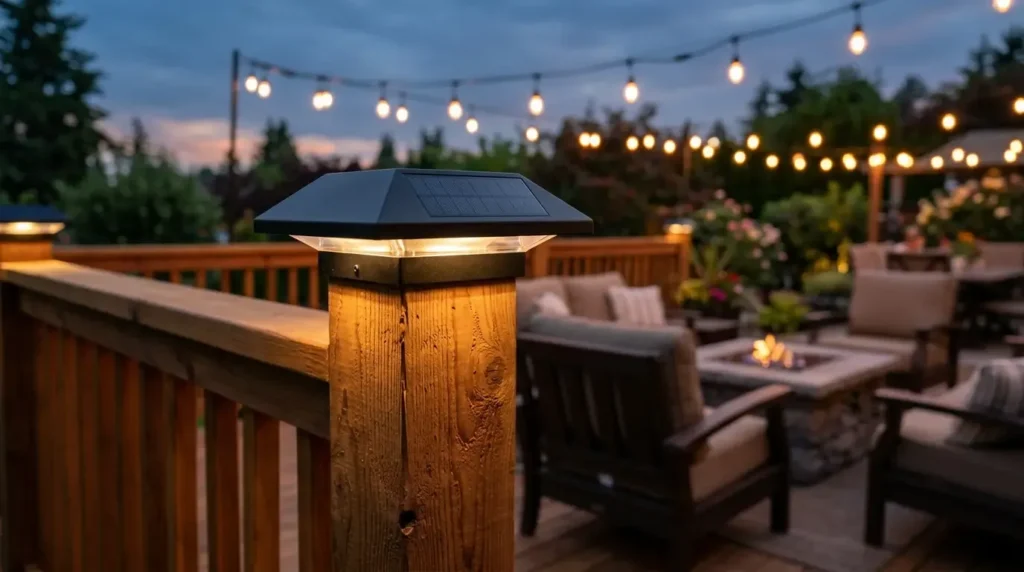
Solar post cap lights are low-profile fixtures that sit flush on top of a deck or fence post. They house a miniature photovoltaic (PV) panel, a rechargeable battery, and an LED array — all in a single weather-sealed unit.
For wooden decks specifically, they serve a dual purpose. First, they protect the end grain of pressure-treated lumber or cedar from direct water ingress, a primary cause of post rot. Second, they provide soft perimeter illumination that improves nighttime safety without running low-voltage wiring through lumber.
According to the U.S. Department of Energy’s outdoor solar lighting guidelines, solar lighting systems convert sunlight into electricity stored in batteries for use at night, and perform reliably across most U.S. climates when site-specific variables — shade, orientation, panel size — are properly accounted for.
How the Solar Charging Cycle Works
The integrated PV panel charges the internal battery during daylight hours. A built-in photosensor detects dusk and automatically activates the LEDs. At dawn, or once the battery is depleted, the light switches off and the cycle resets. Most quality models include a dusk-to-dawn controller that requires no manual interaction — once installed in adequate sunlight, the system runs itself.
The Three Types of Solar Deck Lighting (And Why This Guide Focuses on Post Caps)
Solar deck lighting splits into three main categories, and confusing them is a common buying mistake:
| Type | Where It Mounts | Best For |
|---|---|---|
| Post cap lights | Top of a 4×4/5×5/6×6 post | Perimeter ambiance, post-top water protection |
| Step/rail lights | Stair risers or deck faces | Navigation lighting on stairs |
| Lamp-post / pillar lights | Standalone taller fixtures | Statement lighting at entries or driveways |
This guide focuses on post cap lights. If you’re specifically looking for stair or railing lighting, see our solar driveway & dock lights guide instead.
The 2026 Buying Framework: What Actually Matters
1. Post Size Compatibility (The #1 Installation Mistake)
This is where most buyers go wrong. A “4×4” wooden post is nominally 4 inches but actually measures 3.5 × 3.5 inches of true lumber. Most cap lights are designed around the true dimension, not the nominal one.
If your deck uses vinyl sleeves over wood, composite lumber, or true 6×6 timber, look for a model with adapter bases or one engineered for oversized posts. Always measure your actual post before ordering — a mismatch is the single most common cause of buyer complaints across every brand’s review section.
| Nominal Size | True Dimension | Notes |
|---|---|---|
| 4×4 | 3.5 × 3.5 in | Most common deck post |
| 5×5 | 4.5 × 4.5 in | Mid-size pergola posts |
| 6×6 | 5.5 × 5.5 in | Heavy-duty structural posts |
| Vinyl sleeved | Varies | Measure sleeve OD carefully |
The hollow-post trap: vinyl and composite posts are often hollow underneath the cap. Some solar cap lights rely on a solid post for screw-mount stability — check whether your model needs a solid mounting surface or ships with a hollow-post adapter plate before buying.
2. Lumen Output: Matching Brightness to Purpose
Solar post cap lights are ambient fixtures, not floodlights. Their job is to define perimeter edges and create atmosphere, not illuminate a wide area.
Budget plastic caps typically output 2–5 lumens — barely enough to mark a post in the dark. Diecast aluminum or glass-lens models push 15–30 lumens, the sweet spot for deck perimeter lighting. High-output models like the Kemeco ST4311AQ reach 160 lumens, suited to entry posts where visibility matters more than ambiance.
The Illuminating Engineering Society (IES) recommends average illuminance of 1–2 lux for residential pathway and perimeter lighting. A 15–30 lumen post cap at typical post spacing (6–8 feet apart) comfortably meets that threshold.
3. Battery Technology: The Make-or-Break Factor for Wooden Decks
Wooden decks run hot in summer. Post caps on south-facing decks regularly see surface temperatures exceeding 50°C (122°F) — exactly where battery chemistry matters most.
- NiMH (Nickel-Metal Hydride): The traditional budget choice. According to manufacturer battery data, NiMH cells typically last 2–3 years and are widely recyclable, but self-discharge faster and degrade sooner in high heat. Reliable in moderate climates.
- LiFePO4 (Lithium Iron Phosphate): The 2026 standard for premium outdoor solar lights. Per Linkind’s published solar battery specifications, LiFePO4 cells are rated for 2,000+ charge cycles and stable operation from -20°C to 60°C — translating to a claimed 5–10 year service life versus 1–3 years for NiMH. More expensive upfront, cheaper over a five-year horizon.
- NiCd (Nickel-Cadmium): Avoid. NiCd cells suffer from memory effect, contain toxic cadmium, and are being phased out of reputable products.
For a hot, south-facing deck, LiFePO4 is the better-engineered choice on paper — not a marketing upsell.
4. Weatherproofing: Decoding IP Ratings
The Ingress Protection (IP) rating tells you how well a fixture resists dust and water:
| IP Rating | Water Resistance | Suitability |
|---|---|---|
| IP44 | Splash-proof from all directions | Covered or sheltered decks |
| IP64 | Dust-tight, splash-proof | Most open decks |
| IP65 | Jet-proof (low-pressure water) | Open decks, rain-exposed |
| IP67 | Submersion up to 1m / 30 min | Dock or poolside use |
Most reputable solar post caps carry an IP65 rating and are datasheet-rated to handle rain, sleet, and deck washing. Manufacturers generally advise against anything below IP44 for an exposed wooden deck.
5. Housing Material: Durability on Pressure-Treated Lumber
Pressure-treated lumber contains preservative chemicals (primarily ACQ or copper azole compounds in modern formulations) that are mildly corrosive to uncoated aluminum. Look for:
- Powder-coated or anodized aluminum — corrosion-resistant, premium feel
- UV-stabilized ABS plastic — lightweight, corrosion-proof, cost-effective
- Cast zinc alloy — heavier but durable in coastal and humid climates
Avoid bare or brushed aluminum housings touching pressure-treated wood directly without a protective gasket.
Top Solar Post Cap Lights for Wooden Decks in 2026
Specs below are compiled from manufacturer listings and cross-checked against aggregated verified buyer reviews as of August 2026.
Best Overall: Davinci Lighting Edison Solar Post Cap
Specs: 30 lumens | Diecast aluminum + glass | 4×4, 5×5, 6×6 adapter bases | IP44 | 8-hour runtime
The Davinci Edison is the benchmark other products are measured against. Its diecast aluminum and real-glass construction produces a warm 2700K–3000K Edison-style light, visibly distinguishable from the blue-white glare of budget plastic units in listing photos and buyer-submitted images.
Davinci includes three adapter bases in the box — fitting 4×4, 5×5, and 6×6 posts out of the packaging — which removes the sizing guesswork that generates the most complaints for competing brands.
Best For: Cedar decks, wraparound porches, aesthetics-focused builds. Limitation: IP44 rating means manufacturer guidance advises against installation in areas exposed to direct, heavy rain spray.
Best for Universal Fit: Davinci Clear Lens Solar Post Cap
Specs: 15 lumens | UV-fade-protected ABS + tempered glass panel cover | IP44 | Multi-post compatibility
The Clear Lens variant uses a translucent housing so the LED illuminates the entire cap body rather than shining through discrete cutouts — producing a soft glow rather than a directional downlight. The tempered glass panel cover, per the manufacturer spec sheet, is rated for impact resistance that budget competitors at this price point typically omit.
Best For: Modern or Scandinavian deck aesthetics, vinyl post applications.
Best Budget: VOLISUN 4×4 Solar Post Cap Lights (12-Pack)
Specs: 600 mAh NiMH battery | IP64 | Warm white | 10+ hour runtime (manufacturer claim) | Fits 4×4 and 6×6 wooden/vinyl posts
For equipping a large deck perimeter on a budget, the VOLISUN 12-pack is rated IP64 — solidly weatherproof per spec for most climates — at a low per-unit cost. Verified buyer reviews consistently flag the 600 mAh NiMH battery as the tradeoff: runtime drops noticeably during extended cloudy periods. Larger 1200 mAh variants are worth considering for the Pacific Northwest or other frequently overcast regions.
Best For: Long fence runs, large multi-post decks where per-unit cost drives the decision.
Best High-Output: Kemeco ST4311AQ Cast Aluminum Solar Post Light
Specs: 160 lumens | Cast aluminum + ice-layer glass panels | IP65 | 12 SMD LEDs | Dusk-to-dawn
For applications needing actual visibility rather than ambiance — driveway entry posts, dock corners, staircase landings — the Kemeco ST4311AQ’s 160-lumen rating leads this category. Its cast aluminum build and IP65 rating suit both coastal and cold climates per the manufacturer’s environmental rating. The ice-layer glass panels are designed to diffuse light across the full 360° circumference, and three mounting configurations (post, flat, wall) are included.
Best For: Entry posts, dock lighting, staircase tops.
Best for Ambiance: Dynaming Flickering Flame Solar Post Cap
Specs: 5–10 lumens | ABS plastic | Fits 4×4, 5×5, 6×6 wooden posts | Flicker circuit LED
Purely decorative by design — the randomized flicker circuit is built to mimic candlelight movement in amber light. Manufacturer specs list 5–10 lumens, insufficient for navigation but designed for tableside ambiance. The flicker circuit draws marginally more power than a steady LED, so per-charge runtime is shorter than comparable fixed units.
Best For: Entertainment decks, bistro-style dining areas.
Best Premium: Classy Caps Imperial Solar Post Cap
Specs: Metal construction | Multi-post sizing | Long-cycle battery | Premium finish options
Classy Caps sits at the luxury tier. The Imperial series uses heavy-gauge metal construction with finishes rated by the manufacturer for UV and coastal salt-air resistance. Verified buyer reviews cite battery longevity as a consistent strength across multiple seasons, at a significantly higher per-unit price than plastic competitors.
Best For: High-end composite or hardwood deck builds.
Best Multi-Mode: Peasur 4×4 Solar Post Cap Lights
Specs: 24 LEDs | Cool / Warm / Neutral modes | 50% / 100% brightness toggle | Fits 4×4 and 3.5×3.5 posts with adapter
The Peasur stands out for user-controlled flexibility: three color-temperature modes plus two brightness levels give homeowners more control than most competitors offer. The 3.5-inch snap-fit adapter is built for true-dimension lumber, directly addressing the nominal-vs-actual sizing problem. Push-button switching requires no tools.
Best For: Homeowners who want both entertaining and everyday lighting modes from one fixture.
Solar Post Cap Comparison Table: 2026 Edition
| Model | Lumens | IP Rating | Battery | Housing | Best Post Fit |
|---|---|---|---|---|---|
| Davinci Edison | 30 | IP44 | Li-ion | Die-cast Al + glass | 4×4, 5×5, 6×6 |
| Davinci Clear Lens | 15 | IP44 | Li-ion | ABS + tempered glass | Universal |
| VOLISUN 12-Pack | ~10 | IP64 | NiMH 600mAh | ABS | 4×4, 6×6 |
| Kemeco ST4311AQ | 160 | IP65 | Li-ion | Cast Al + ice glass | 4×4, 5×5, 6×6 |
| Dynaming Flame | 5–10 | IP44 | NiMH | ABS | 4×4, 5×5, 6×6 |
| Classy Caps Imperial | 15–25 | IP55+ | Long-cycle Li | Metal premium | Multi |
| Peasur 4×4 | 24 LED | IP65 | NiMH | ABS | 4×4, 3.5×3.5 |
For independently hands-on-tested picks with unboxing photos and multi-week durability logs, see Bob Vila’s tested roundup and Progressive Radio Network’s review.
Installation Guide: Getting It Right on Wooden Posts
Step 1 — Measure the actual post, not the label. Use a tape measure across the flat face of your post. Never assume a “4×4” post is exactly 4 inches — per the sizing table above, it almost certainly isn’t.
Step 2 — Check solar panel orientation. The U.S. Department of Energy notes that solar lighting performance depends heavily on panel orientation. Face the panel south (Northern Hemisphere) with a minimum of 6 direct sun hours daily. Trees, overhangs, and adjacent structures can cut charging efficiency by 50% or more — check for shade at midday before committing to a location.
Step 3 — Condition the battery before first use. Manufacturers generally recommend 2–3 days of full sun exposure before evaluating nighttime performance. NiMH units typically need 3–5 full charge-discharge cycles to reach peak capacity; LiFePO4 units reach it faster.
Step 4 — Secure the base correctly on wood. Wooden posts expand and contract seasonally. Use stainless steel screws (not galvanized) to prevent rust-bleed staining, and apply a thin bead of clear silicone sealant around the base perimeter to prevent water infiltration into the screw holes — a leading cause of post-top rot.
Step 5 — Test the dusk-to-dawn function. Cover the solar panel with your hand in daylight. A correctly functioning unit activates the LED within 3–5 seconds, per standard photosensor-trigger specs. Use this as your installation checkpoint before locking the cap down permanently.
Wooden Deck–Specific Considerations
Wood shrinkage and cap fit. Wood shrinks across the grain as it dries and expands in humid conditions; pressure-treated lumber is especially prone to this. A cap that fits snugly in October may wobble by February. Favor caps with a rubber or foam perimeter gasket rated for ±3mm of movement, or add weather-strip foam tape under the base.
UV exposure on south-facing decks. Intense year-round UV degrades unprotected ABS plastic within 18–24 months, per general ABS material aging data. Look for housings labeled UV-stabilized or UV-resistant, and prefer tempered-glass panel covers over soft polycarbonate.
Pressure-treated wood and corrosion. ACQ-treated lumber is mildly corrosive to bare metals. Confirm mounting hardware is stainless steel or hot-dip galvanized, and use a rubber/EPDM gasket between the cap base and the post for both a moisture and chemical barrier.
Battery Replacement: Extending Your Investment
Most solar post cap lights ship with user-replaceable NiMH cells in AA/AAA form factor. When performance drops — typically after 18–24 months with NiMH — replacing the battery restores function without a new unit.
Consider LiFePO4 AA cells as replacements. Per EcoFlow’s published solar battery comparison, LiFePO4 cells are rated for 3–5x the cycle life of standard NiMH while holding performance across wider temperature swings.
Always match replacement cell voltage to the original specification — mismatched voltage stresses the charge controller and risks premature circuit failure. Check with the manufacturer on replacement part availability before purchase, in line with DOE’s general solar lighting guidance.
Common Mistakes to Avoid
- Buying without measuring. Nominal lumber dimensions don’t match true dimensions — measure first, always.
- Ignoring shade analysis. A cap receiving only 3 hours of direct sun will run roughly 4–5 hours at night, not the 8–12 hours advertised under full-sun conditions.
- Conflating lumens with coverage. A 30-lumen post cap marks the post and casts a soft pool of light 2–3 feet in diameter — not a 10-foot radius. Space posts 6–8 feet apart for overlapping, continuous coverage.
- Painting over the solar panel. Housing paint is fine; getting paint on the PV panel or LED lens permanently reduces output.
Sustainability Credentials
Solar post cap lights eliminate the need for low-voltage transformer systems that draw standby power around the clock. A modest 8-fixture low-voltage deck lighting system consumes roughly 20–40W continuously — approximately 175–350 kWh per year for lights that only run 6–8 hours nightly.
Solar post cap lights draw zero grid electricity, and modern LED arrays are markedly more efficient than incandescent alternatives. The DOE’s lighting design guidelines recommend solar lighting specifically where grid connection is inefficient or impractical — exactly the use case for distributed deck post lighting.
LiFePO4 batteries also use non-toxic materials and carry a lower environmental footprint than standard lithium-ion alternatives, per EV Lithium’s published battery comparison.
Frequently Asked Questions
Do solar post cap lights work in winter? Yes, with caveats. Shorter daylight hours reduce charging time and nighttime runtime. LiFePO4 batteries handle cold (down to -20°C) far better than NiMH cells, which lose significant capacity below freezing. In snowy climates, periodically clear the panel face.
Can I leave solar post caps on year-round? Most IP65-rated caps are built for permanent year-round installation. In regions with heavy ice storms, manufacturers generally recommend removing and storing caps during extreme freeze events.
Do they need an on/off switch? No — a built-in photosensor triggers the light at dusk and deactivates it at dawn or on battery depletion.
Are solar post caps IP44 or IP65 rated? Both exist in the market. IP44 handles splash and rain; IP65 withstands directional water jets and is preferred for exposed deck locations. Avoid IP44 on uncovered, rain-exposed decks.
Can I paint solar post caps to match my deck stain? Yes, but only the housing — never the solar panel or LED lens, which permanently reduces output and may void the warranty.
How many lumens do I actually need? Perimeter ambiance/post marking: 10–30 lumens. Entry or navigation-critical posts: 80–160 lumens. Purely decorative ambiance (flame effects): 5–10 lumens.
Final Verdict: The Right Cap for Every Deck Type
- Budget, large deck/fence run: VOLISUN 12-Pack — IP64-rated, cost-efficient at scale
- Premium aesthetics, cedar or hardwood deck: Davinci Edison — 30 lumens, real glass, universal adapter bases
- High-output entry or dock posts: Kemeco ST4311AQ — 160 lumens, IP65, cast aluminum
- Entertainment and ambiance: Dynaming Flickering Flame — convincing flame effect, fits all standard post sizes
- Luxury build, multi-season demands: Classy Caps Imperial — metal construction, strongest reported long-term durability
- Versatile multi-mood deck: Peasur 4×4 — three color modes, two brightness levels, adapter-fit system
In 2026, the solar post cap market has matured: LiFePO4 adoption, universal adapter systems, and IP65 weatherproofing are no longer premium differentiators — they’re baseline expectations for any unit worth recommending. Match the spec to your post size and climate, and a solar post cap light remains one of the highest-ROI deck upgrades available.
Sarah Miller is a writer covering sustainability, eco-friendly living, and modern outdoor energy solutions at ecopowersence.com.

I Am Sarah Miller is a passionate writer focused on sustainability, eco-friendly living, and modern environmental solutions. Through her work, she aims to inspire readers to make smarter, greener choices for a better future. She regularly shares insights and practical tips on her website, ecopowersence.com.