Published June 14, 2026 · 14 min read · Dr. Marcus Reed
Quick Answer: Can Balcony Solar UK Renters Install in 2026?
Balcony solar UK renters can now install legally but with important conditions. Furthermore, the exact route depends on timing. Plug-in balcony solar became legally enabled when BS 7671 Amendment 4 came into force on 15 April 2026. However, the BSI product standard that certifies specific plug-in kits for self-installation still awaits publication. Consequently, the practical route for balcony solar UK renters today requires a hardwired connection by a CPS-registered electrician. Additionally, this guide covers every legal, financial, and practical detail you need before spending any money.
| Key Fact | Detail |
|---|---|
| Legal status (June 2026) | Enabled by BS 7671 A4 — hardwired route only |
| Max system size | 800W (two 400W panels) |
| DIY plug-in route | Does not yet exist — BSI product standard expected July 2026 |
| Landlord permission | Required in writing — Renters’ Rights Act 2025 applies |
| Annual saving (800W system) | £150–£215 depending on location |
| Payback period | 4–9 years depending on install route and location |
| SEG export payments | Plug-in systems do not qualify (no MCS certification route) |
Plug-In Balcony Solar UK Renters Guide: The Honest Status for 2026
For millions of UK renters, plug-in balcony solar panels have felt like a revolution happening somewhere else. Germany passed 1.1 million registered plug-in installations by mid-2025. Moreover, the Netherlands, France, and Italy all established plug-and-play frameworks years ahead of Britain. The UK lagged behind — until now.
That changed in spring 2026. The government’s UK Solar Roadmap targets 47 GW of solar capacity by 2030, and plug-in solar UK solutions for renters now feature explicitly in that plan. The regulatory path is open. Nevertheless, the honest status in June 2026 is more nuanced than the marketing suggests — and renters deserve a straight answer before spending money.
This guide gives you exactly that: what the law permits now, what costs to expect, and how to approach your landlord with the strongest possible case.
The 2026 UK Plug-In Solar Timeline: Every Key Date
Most articles get this wrong. Specifically, they blur the distinction between framework legalisation and product certification. Here is the precise sequence of events:
| Date | Event | What It Means for Renters |
|---|---|---|
| June 2025 | UK Solar Roadmap published | Government commits to legalising plug-in solar |
| 16 March 2026 | DESNZ Written Ministerial Statement | Political commitment only — no legal change yet |
| 24 March 2026 | Government policy announcement | “Available within months” — Amazon, Lidl, Iceland named as retail partners |
| 15 April 2026 | BS 7671 Amendment 4 in force | Legal foundation established — hardwired route fully compliant |
| 30 June 2026 | DESNZ consultation closes | Product specification reaches finalisation |
| July 2026 (expected) | BSI product standard publishes | First certified plug-in kits available for self-installation |
| 15 October 2026 | BS 7671 A4 transition period ends | Full compliance required for all new installations |
The critical distinction: BS 7671 Amendment 4 legalised the installation framework. However, it did not certify individual products for self-installation. Furthermore, until the BSI product standard publishes in July 2026, no certified DIY kit exists. Buying the hardware now remains fine. Additionally, hiring a CPS-registered electrician to hardwire it is fully legal. Simply plugging it into a wall socket, in contrast, breaks current compliance.
People Also Ask
Q: Is plug-in solar legal in the UK in 2026? A: Yes — partially. BS 7671 Amendment 4 (April 2026) established the legal framework. Consequently, the hardwired route via a registered electrician is fully compliant now. The self-install plug-in route becomes available once the BSI product standard publishes, which should happen in July 2026.
How Plug-In Balcony Solar Panels Work for Renter Solar Panels
A plug-in balcony solar system works on straightforward principles. Understanding the components helps you evaluate products and avoid misleading marketing claims.
Three Core Components of a Balcony Solar Kit
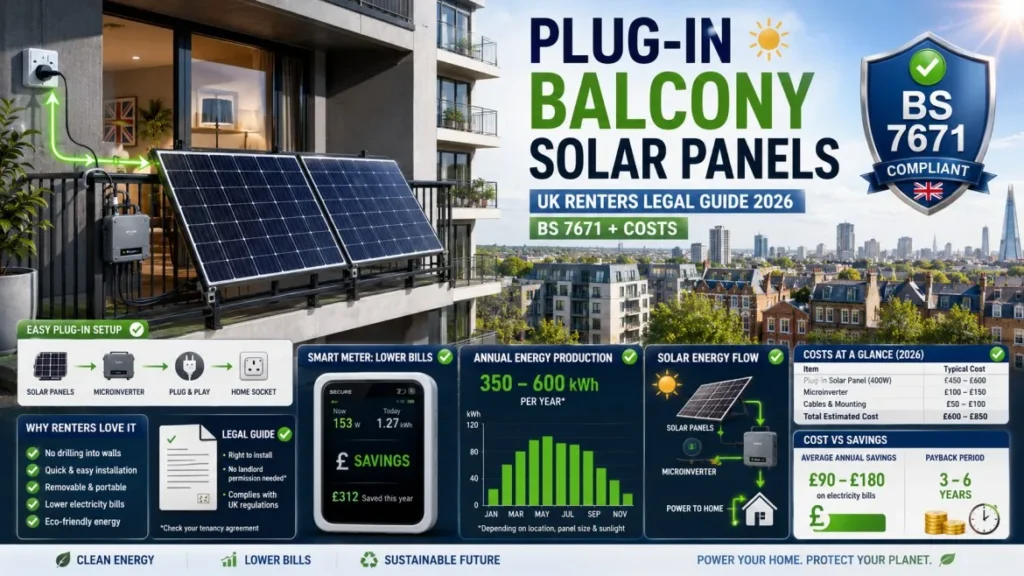
1. Solar panels (one or two): Most UK balcony solar kit options use one or two monocrystalline panels rated at 400W each. The 2026 regulations cap total system capacity at 800W. Panel lifespan typically reaches 20–25 years with approximately 0.5% annual output degradation. Moreover, manufacturers generally back panels with 25-year performance warranties.
2. Microinverter: This converts the panels’ DC electricity into grid-compatible 230V AC. The microinverter builds into the cable between the panel and your home circuit. Specifically, it must include anti-islanding protection — an automatic shutdown mechanism that prevents the system from feeding power to the grid during a power cut. Consequently, electrical engineers working on the lines stay safe at all times.
3. Mounting hardware: Most renter-friendly kits use adjustable clamp brackets that attach to balcony railings without drilling. This is the crucial feature for balcony solar UK renters — no permanent modifications to the property result from installation. Additionally, you can remove and reinstall the panels at a new address when you move.
How Solar Electricity Feeds Into Your Flat
Sunlight hits the panels and generates DC electricity. The microinverter then converts it to AC and feeds it into your home’s circuit through the connection point. As a result, your appliances consume this solar electricity first, before drawing from the grid. Consequently, your meter runs slower — or backward on export-capable meters.
The 2026 regulations cap systems at 800W specifically because this represents the safety sweet spot. Moreover, it prevents power feeding back into the ring main circuit faster than the circuit handles, eliminating the risk of unexpected circuit energisation. The IET’s technical guidance on Amendment 4 explains the full technical rationale behind these safety thresholds.
UK Renter Rights: Installing Solar Panels for Renters Legally
This section matters more than any product comparison. In practice, understanding your legal position prevents wasted money, disputes with landlords, and potential voidance of your tenancy agreement.
The Renters’ Rights Act 2025 and Balcony Solar
The Renters’ Rights Act 2025 represents the most significant legal change for tenants in England and Wales in a generation. Under the Act, landlords cannot “unreasonably refuse” a tenant’s request to make energy improvements, including low-carbon technologies like balcony solar. Furthermore, the Act shifts the burden of justification onto landlords rather than tenants.
What this means in practice:
- A landlord cannot refuse purely on aesthetic grounds
- A system that leaves no permanent marks, no structural damage, and no drilling has a strong case for approval
- Landlords must engage with the request and provide specific reasons for any refusal
What it does NOT mean:
- Tenants do not hold an absolute right to install without landlord knowledge or consent
- Written landlord consent before installation remains strongly recommended
- If a landlord refuses with a legitimate reason (listed building, structural concern, leaseholder issues), that refusal stands
If your landlord refuses: Contact Citizens Advice and reference the Act by name. The Private Rented Sector Ombudsman is the formal escalation route for England and Wales. Additionally, Shelter’s Renters’ Rights Act guidance provides free advice on exactly how to challenge an unreasonable refusal.
Leasehold vs Freehold: Extra Consent Layer for Flat Renters
If you rent a flat, your landlord may themselves hold a leasehold interest in the building. This creates an additional consent layer most buyers overlook. Specifically:
Your landlord’s consent requires fulfilment under your tenancy agreement. Additionally, the freeholder or management company’s consent may require separate fulfilment under the lease, since the balcony structure typically classifies as common property.
Even if your landlord approves, the freeholder can block installation if the balcony falls under building-wide leasehold restrictions. Therefore, always check both your tenancy agreement and the building lease before purchasing any system. The House of Commons Library briefing on the Renters’ Rights Act provides detailed analysis of how leasehold complications interact with the new tenant rights framework.
How Renters Should Request Balcony Solar Permission
A well-prepared request dramatically increases approval chances. Consequently, invest time in the written proposal before spending any money. Present your landlord with:
- A written proposal describing the system, its compliance with BS 7671 Amendment 4, and the name of the CPS-registered electrician who will install it
- Photographs of the proposed mounting location
- Confirmation that no permanent fixings or structural modifications follow from installation
- Reference to the Renters’ Rights Act 2025 by name
- A statement that you will bear all costs and can remove the system without trace when you vacate
Moreover, mentioning that a solar system can improve the property’s Energy Performance Certificate (EPC) rating at no cost to the landlord serves as a persuasive secondary argument. The gov.uk guidance for tenants under the Renters’ Rights Act confirms that energy improvement requests fall squarely within the protections the Act provides.
People Also Ask
Q: Can my landlord stop me from installing balcony solar? A: Under the Renters’ Rights Act 2025, landlords cannot unreasonably refuse. However, they can refuse for specific legitimate reasons — listed building status, structural concerns, or leasehold restrictions. Therefore, always get written consent before spending any money.
Plug-In Balcony Solar Costs for UK Renters: Full 2026 Breakdown
Equipment Costs for a Balcony Solar Kit
| System Type | Equipment Cost | Notes |
|---|---|---|
| 400W single panel, no battery | £100–£300 | Basic daytime-only saving |
| 800W dual panel, no battery | £300–£600 | Maximum savings, most popular |
| 400W panel + battery storage | £400–£800 | Evening use covered |
| 800W dual panel + battery | £700–£1,200 | Maximum self-sufficiency |
The £400 kits from EcoFlow and Hoymiles (800W, listed on Amazon UK) are real hardware. However, they do not yet hold BSI certification for plug-in self-installation. Until July 2026, these require a CPS-registered electrician to hardwire them — add £150–£300 for labour. Additionally, most electricians include G98 DNO notification in their service fee.
Annual Savings by UK City
| City | 400W System (kWh/yr) | 800W System (kWh/yr) | Annual Saving (24p/kWh) |
|---|---|---|---|
| London | 350–450 kWh | 700–790 kWh | £168–£190 |
| Manchester | 300–350 kWh | 600–700 kWh | £144–£168 |
| Edinburgh | 280–320 kWh | 560–640 kWh | £134–£154 |
| Bristol | 340–420 kWh | 680–780 kWh | £163–£187 |
| Brighton | 370–460 kWh | 740–820 kWh | £178–£197 |
These figures assume a south-facing balcony orientation. In contrast, north-facing balconies reduce output by 30–40%. The Energy Saving Trust’s solar panel savings calculator provides postcode-level estimates based on current energy tariffs if you want a precise figure for your location.
Realistic Payback Periods for Balcony Solar UK Renters
| Route | Total Cost (800W) | Payback Period |
|---|---|---|
| DIY (once certified, July 2026) | £300–£600 | 2–4 years |
| Electrician-hardwired (current route) | £450–£900 | 3–5 years |
| With battery storage | £700–£1,200 | 5–7 years |
The “move-with-you” advantage fundamentally changes the calculation for balcony solar UK renters. Unlike rooftop solar, your balcony system is portable. An electrician disconnects it in under an hour, and you reinstall it at your next home. Furthermore, savings accumulate across multiple tenancies meaning the payback clock never resets to zero.
People Also Ask
Q: How much can balcony solar save a UK renter? A: A south-facing 800W system in most UK cities saves £150–£215 per year on electricity bills at current rates. Moreover, payback ranges from 2–7 years depending on installation route and location.
Planning Rules for Solar Panels for Renters in the UK
Do You Need Planning Permission?
In most cases, no. Installing panels on a balcony rail, garden fence, shed roof, or flat roof does not require planning permission, provided the panels don’t protrude more than 200mm from the surface. However, listed buildings and conservation areas carry additional restrictions on external alterations.
For the vast majority of plug-in solar UK setups, planning is not a factor. Nevertheless, always verify with your local authority if you remain uncertain. The government’s clean energy solar guidance page confirms the planning permission thresholds that apply to residential solar installations.
G98 DNO Notification: The Non-Negotiable Step
Under G98 regulations, you must notify your District Network Operator (DNO) before connecting any generation system. Specifically, the process works as follows:
- Identify your DNO at the Energy Networks Association website
- Submit a G98 notification form (usually online, free to submit)
- You have up to 28 days after installation to submit the notification
Most registered electricians handle G98 notification as part of their installation service. Consequently, confirm this when booking to avoid an additional admin step.
Smart Export Guarantee: An Important Warning for Balcony Solar UK Renters
Several marketing materials imply that balcony solar earns SEG export payments. In practice, this claim misleads most buyers. The Smart Export Guarantee requires MCS certification, and plug-in balcony systems cannot achieve MCS certification under current rules. As a result, any electricity your system generates beyond your home’s real-time consumption flows to the grid unpaid.
The practical solution: maximise daytime consumption. Therefore, run the dishwasher, washing machine, and device charging during solar generation hours to capture the maximum value from your system. For detailed and regularly updated official guidance on how the SEG works, the Energy Saving Trust’s solar panel resource covers export tariffs and which systems qualify.
DC-Only Balcony Solar: The Legal Route for Renter Solar Panels Right Now
This option rarely appears in mainstream guides — however, it represents the most accessible route for renters who want to start immediately without waiting for July 2026.
A DC-only setup places panels on your balcony to charge a portable power station a large battery device with its own inverter, USB ports, and AC outlets. The system does not connect to your home’s fixed wiring at all. Consequently:
- No BS 7671 compliance issues arise
- No electrician is required
- No landlord consent is required for the electrical connection (though you still need consent for the balcony mounting)
- No G98 DNO notification required
The trade-off involves efficiency: you charge the portable station during the day and use it for specific appliances, rather than feeding solar power directly into your home circuit. However, for covering laptop charging, phone charging, LED lighting, and small appliances, a DC-only balcony solar kit works well and carries zero regulatory friction.
This is the recommended starting point for balcony solar UK renters who want to act now rather than waiting for the BSI product standard. Moreover, you can later integrate the same panels into a compliant hardwired system once the certified kits become available. Solar Energy UK, the trade association representing the UK solar sector, provides industry updates on when certified self-install kits reach the market.
Frequently Asked Questions
Do I need my landlord’s permission for plug-in balcony solar in the UK? Yes — always get written permission before installation. Under the Renters’ Rights Act 2025, landlords cannot unreasonably refuse. However, a refusal based on listed building status, structural concerns, or leasehold restrictions stands as legitimate. Furthermore, a well-prepared written request citing the Act significantly increases approval chances. MoneyHelper’s guide to the Renters’ Rights Act explains your rights in plain language.
Can I install balcony solar panels myself as a UK renter right now? Not via plug-in connection — the BSI product standard needed to certify self-install kits should publish in July 2026. Until then, a CPS-registered electrician must hardwire the connection. In contrast, the DC-only route (charging a portable power station) is fully legal for self-installation today.
What happens if I plug in a balcony solar kit without an electrician? Doing so voids most home insurance policies, breaks BS 7671 compliance, and could energise the circuit unexpectedly during a fault. Moreover, it gives your landlord grounds for tenancy termination under most standard tenancy agreements. Therefore, wait for the certified kits expected in July 2026. The IET’s edition checker explains exactly which compliance standard applies until October 2026.
Will my EPC rating improve with balcony solar? In principle, yes — solar generation improves energy performance scores. In practice, plug-in balcony solar is portable rather than a permanent fixture. Consequently, most standard EPC assessments won’t factor it in unless the assessor specifically evaluates it.
Are there any grants for balcony solar for UK renters? Currently no specific grants target plug-in balcony solar in the UK. Standard energy efficiency grants (ECO4, Great British Insulation Scheme) apply to other measures. Nevertheless, watch the government’s Clean Power 2030 Action Plan updates, as targeted renter solar incentives are under active policy discussion.
What direction should my balcony face for solar panels? South-facing is optimal, generating 10–15% more than southeast or southwest orientations. East or west-facing balconies still generate meaningful output — roughly 70–80% of a south-facing equivalent. In contrast, north-facing balconies are generally not viable for balcony solar in the UK. The Energy Saving Trust’s UK solar hotspots analysis provides location-specific output data if you want to benchmark your postcode.
Conclusion: Should Balcony Solar UK Renters Invest in 2026?
Plug-in balcony solar for UK renters crossed a decisive legal threshold in April 2026. BS 7671 Amendment 4 is in force, the regulatory framework is clear, and the political commitment has never been stronger. Nevertheless, June 2026 remains a transition period the hardwired electrician route is fully legal now, and the self-install plug-in route follows once the BSI product standard publishes.
For balcony solar UK renters who want to act immediately, the DC-only route is legal today with no electrician and minimal landlord friction. Furthermore, the Renters’ Rights Act 2025 gives UK tenants more leverage than ever before to request energy improvements that landlords cannot arbitrarily block.
Therefore, choose a south-facing balcony, budget for an 800W dual-panel system, get written landlord consent referencing the Act, and hire a CPS-registered electrician until certified kits arrive. By autumn 2026, the UK’s plug-in solar framework should reach full operation and the payback clock on your investment will already be running

I am Dr. Marcus Reed is an author and researcher focused on sustainable energy, environmental innovation, and clean technology. He is passionate about helping readers understand the future of renewable energy and eco-friendly solutions. Through his writing, he aims to simplify complex energy topics for a wider audience. Learn more at ecopowersence.com.