Introduction
Step outside in New Orleans in July and the air hits you like a warm, wet blanket. Your shirt is soaked before you reach your car. Your glasses fog the moment you leave an air-conditioned building. That feeling has a name high dew point and some American cities live with it almost every day of the year.
This guide ranks the most humid cities and states in the US using both relative humidity and dew point, explains exactly why those two numbers tell different stories, and covers what high humidity actually means for your health, your home, and your energy bills.All humidity and dew point data referenced in this guide comes fromNOAA’s National Centers for Environmental Information andthe National Weather Service.
What Does “Most Humid” Actually Mean?
When people say a place feels “humid,” they usually mean the air feels thick, sticky, and difficult to breathe sweat doesn’t evaporate, and the heat feels far worse than the thermometer suggests.
But the word “humid” means different things in weather data, and that gap causes real confusion when comparing city rankings. Most weather apps report relative humidity, but climatologists and health experts say dew point is the far more useful number for understanding how uncomfortable a place actually feels.
Relative Humidity vs. Dew Point — The Key Difference
Understanding these two metrics is essential before reading any humidity ranking.
Relative Humidity (RH) measures how much moisture is in the air as a percentage of the maximum moisture that air could hold at that temperature. The critical word is “relative.” Cold air holds much less moisture than warm air — so even a small amount of water vapor in cold air can produce very high relative humidity.
Dew Point measures the actual temperature at which air becomes fully saturated and condensation begins to form. It’s a direct measure of how much moisture is present, independent of air temperature. According to the National Weather Service:
| Dew Point | How It Feels |
| Below 55°F | Comfortable, dry |
| 55°F – 60°F | Noticeable moisture |
| 60°F – 65°F | Noticeably humid |
| 65°F – 70°F | Oppressive, uncomfortable |
| Above 70°F | Miserable, dangerous for outdoor activity |
Why this matters: A city in Alaska might report 85% relative humidity on a cold morning, while Miami reports 72%. But Miami’s dew point is 72°F in August far more oppressive while Alaska’s dew point sits well below 50°F and feels perfectly comfortable. That’s why dew point is what actually tells you which place feels stickier.
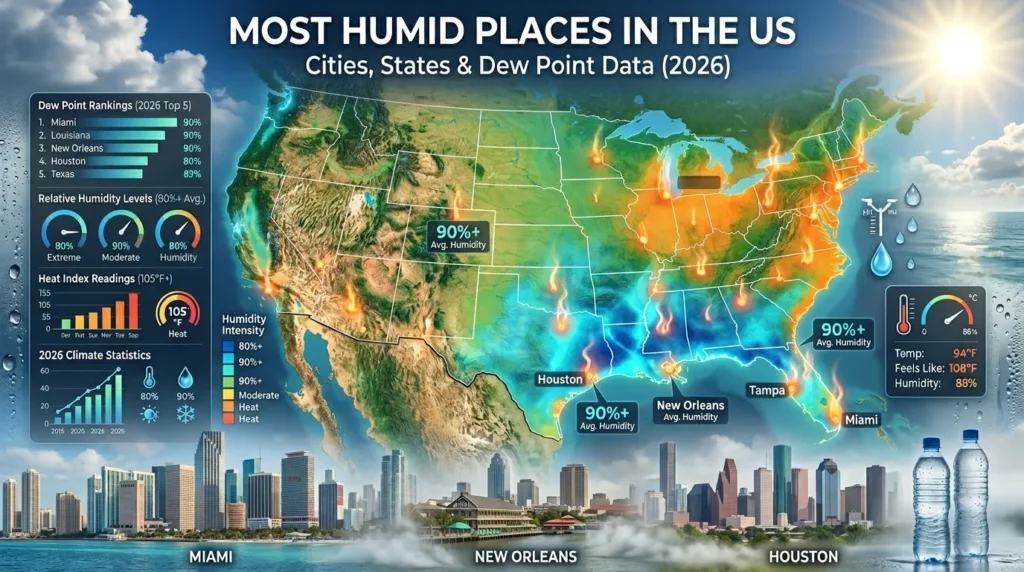
The Most Humid Cities in the US (Ranked by Average Relative Humidity)
Based on NOAA annual average relative humidity data, these cities consistently rank at the top. Note that morning readings run 20–30 percentage points higher than afternoon readings the figures below are annual daily averages.
| Rank | City | Avg. Daily Humidity | Peak Summer Dew Point |
| 1 | New Orleans, LA | ~86% | ~74°F (July) |
| 2 | Jacksonville, FL | ~83% | ~73°F (July) |
| 3 | Houston, TX | ~82% | ~72°F (August) |
| 4 | Tampa, FL | ~80% | ~72°F (July) |
| 5 | Miami, FL | ~79% | ~74°F (August) |
| 6 | Lake Charles, LA | ~78% | ~75°F (July) |
| 7 | Jackson, MS | ~75% | ~71°F (July) |
| 8 | Corpus Christi, TX | ~76% | ~73°F (August) |
| 9 | Brownsville, TX | ~74% | ~72°F (August) |
| 10 | Mobile, AL | ~74% | ~72°F (July) |
| 11 | Meridian, MS | ~73% | ~70°F (July) |
| 12 | Port Arthur, TX | ~72% | ~74°F (August) |
Data sourced from NOAA climate normals and Current Results climate data. Summer dew point figures represent monthly averages for peak months.
New Orleans, Louisiana The Most Humid Major City in the US
New Orleans consistently earns the top spot in humidity rankings among major American cities, with an average daily relative humidity of nearly 86%. The city sits at or below sea level, encircled by the Mississippi River, Lake Pontchartrain, and the Gulf of Mexico there’s nowhere for moisture to escape.
During July and August, New Orleans regularly records dew points above 74°F, levels the National Weather Service classifies as oppressive or dangerous. A 92°F afternoon at a dew point of 74°F produces a heat index near 113°F. Mold and mildew growth in homes is a persistent year-round concern, and air conditioning runs nearly continuously from May through October.
Jacksonville, Florida Second Highest Humidity Among Major Cities
Jacksonville ranks second nationally among large cities for average relative humidity. The city’s location near the Atlantic coast in northeast Florida feeds it a near-constant supply of warm, moist maritime air. Summer morning humidity regularly exceeds 90%, and dew points in July average 73°F — high enough to make outdoor activity feel genuinely dangerous during heat events.
Houston, Texas The Stickiest Big City in Texas
Houston’s combination of Gulf proximity, low elevation, and a sprawling urban heat island makes it one of the most oppressively humid cities in the country. The city’s annual average humidity sits around 82%, and summer dew points regularly exceed 70°F. Concrete and asphalt throughout the metro area absorb heat during the day and radiate it at night, preventing the relief that cooler nighttime temperatures sometimes bring to other humid cities.
Lake Charles, Louisiana Consistently Among the Worst
Lake Charles sits in southwestern Louisiana near the Gulf of Mexico, surrounded by bayous and wetlands that release constant moisture into the air. Morning humidity in summer regularly climbs above 90%, and its dew point average in July approaches 75°F — among the highest of any US city. Tropical systems and Gulf hurricanes add periodic humidity spikes on top of the already-saturated baseline.
Miami, Florida Humid Day and Night
Miami’s location between the Atlantic Ocean and Biscayne Bay means moisture approaches from both directions. What makes Miami unusual is that humidity doesn’t drop meaningfully after sunset — the tropical climate and surrounding water bodies keep dew points elevated even through the night. Average daily humidity sits around 79%, and the city experiences only brief periods of relief during dry winter months.
Most Humid Cities: Month-by-Month Breakdown
Humidity isn’t constant — it builds through spring and peaks in summer before easing in fall. Here’s how the top cities compare across the year:
| Month | New Orleans | Houston | Miami | Jacksonville |
| Jan | 78% | 76% | 71% | 76% |
| Feb | 75% | 73% | 70% | 73% |
| Mar | 74% | 73% | 70% | 71% |
| Apr | 73% | 74% | 72% | 72% |
| May | 76% | 78% | 74% | 76% |
| Jun | 80% | 82% | 78% | 81% |
| Jul | 83% | 84% | 80% | 83% |
| Aug | 84% | 85% | 81% | 83% |
| Sep | 83% | 84% | 80% | 82% |
| Oct | 78% | 79% | 77% | 77% |
| Nov | 75% | 76% | 73% | 74% |
| Dec | 78% | 77% | 72% | 77% |
Monthly averages approximate; based on NOAA climate normals. Figures represent full-day average relative humidity.
Key takeaway: June through September is the critical window in Gulf Coast and Florida cities. Even “low” months in these cities sit well above comfortable humidity ranges for most people.
The Most Humid States in the US (2026 Rankings)
At the state level, rankings shift depending on whether you use relative humidity or dew point. Here’s how the data looks using daily average relative humidity from World Population Review and NOAA data:
By Average Relative Humidity
| Rank | State | Avg. Daily RH |
| 1 | Alaska | ~74.3% |
| 2 | Louisiana | ~74.25% |
| 3 | Mississippi | ~72.5% |
| 4 | Michigan | ~72.2% |
| 5 | Florida | ~72.2% |
| 6 | Hawaii | ~71% |
| 7 | Iowa | ~71% |
| 8 | Alabama | ~70% |
| 9 | Tennessee | ~70% |
| 10 | Georgia | ~69% |
By Dew Point (Who Actually Feels Stickiest)
| Rank | State | Avg. Annual Dew Point |
| 1 | Hawaii | ~65.2°F |
| 2 | Florida | ~62.7°F |
| 3 | Louisiana | ~58.3°F |
| 4 | Mississippi | ~55.8°F |
| 5 | Alaska | ~Below 50°F |
Dew point is the meaningful measure when comparing how states actually feel to live in. Louisiana, Florida, and Mississippi dominate the dew point rankings because their warm air actually holds enormous amounts of water vapor. Alaska appears at the top of relative humidity rankings for an entirely different reason — explained below.
The Surprising Case of Alaska
Alaska is technically the most humid state in the US by average relative humidity — around 74.3% — and certain locations like St. Paul Island average close to 88% relative humidity. This surprises most people. Here’s why it happens.
Alaska’s air is cold. Cold air has a very low capacity to hold water vapor. That means even a tiny amount of moisture pushes cold air close to its saturation limit, producing a high relative humidity reading. Think of a small cup that’s nearly full — it reads “nearly full” even though it holds far less water than a large cup that’s half full.
Alaska’s average annual dew point sits below 50°F. Compare that to New Orleans at 62°F+ annually, and 74°F in July. Alaska’s air holds dramatically less actual moisture than Gulf Coast air, even though its relative humidity percentage appears higher.
The practical result: Alaska doesn’t feel humid in the way that southern states feel humid. The air is cool and damp, not hot and muggy. Dew point tells you the actual moisture story. Relative humidity tells you how saturated the air is relative to its capacity — a different and often misleading comparison across climates.
Heat Index — What Humidity Actually Feels Like
The heat index is the “feels like” temperature that combines actual air temperature with relative humidity. High humidity slows sweat evaporation, reducing the body’s ability to cool itself. The result: hot, humid days feel dramatically hotter than the thermometer reads.
NWS Heat Index Reference Table
| Air Temp | 40% RH | 60% RH | 80% RH | 90% RH |
| 85°F | 84°F | 90°F | 99°F | 105°F |
| 90°F | 91°F | 100°F | 113°F | 122°F |
| 95°F | 98°F | 114°F | 133°F | — |
| 100°F | 109°F | 132°F | — | — |
Source: National Weather Service heat index chart. Dashes indicate conditions beyond chart range.
A 90°F day in New Orleans at 85% humidity produces a heat index of approximately 113°F — conditions the NWS classifies as “danger” level, where heat cramps and heat exhaustion are likely with prolonged outdoor exposure. Compare that to Phoenix, Arizona, where 95°F at 20% humidity produces a heat index of just 90°F — hot, but manageable.
Most Dangerous Heat Index Cities in the US (July Average)
| City | Avg. July High | Avg. July RH (3pm) | Est. Heat Index |
| New Orleans, LA | 91°F | 72% | ~108°F |
| Houston, TX | 94°F | 70% | ~113°F |
| Miami, FL | 89°F | 73% | ~103°F |
| Lake Charles, LA | 92°F | 73% | ~111°F |
| Jacksonville, FL | 91°F | 72% | ~108°F |
Afternoon RH and heat index are estimates based on climate normals. Actual readings vary.
How Humidity Damages Your Home
High humidity isn’t just uncomfortable. It causes real, costly damage to residential structures over time. Homeowners in the Gulf Coast and Southeast face higher maintenance costs directly attributable to sustained humidity exposure.
Mold Growth
The EPA documents that indoor relative humidity above 60% creates conditions favorable to mold growth within 24 to 48 hours. In cities like New Orleans and Jacksonville, outdoor humidity regularly pushes indoor air into that range without active dehumidification. Mold remediation costs range from a few hundred dollars for surface treatment to tens of thousands of dollars for structural infestations in walls, floors, or HVAC systems.
Rooms most at risk: Bathrooms without exhaust fans, basements, crawl spaces, attics with inadequate ventilation, and closets on exterior walls.
Wood Rot and Structural Damage
Wood framing and flooring absorbs moisture when indoor relative humidity consistently exceeds 70%, eventually leading to swelling, warping, and structural degradation. Crawl spaces in Gulf Coast homes are particularly vulnerable — ground moisture migrates upward, and without proper vapor barriers and ventilation, wood framing in subfloor areas can begin deteriorating within a few years.
Increased Cooling Costs
Air conditioners in humid climates carry a dual workload: removing heat and removing moisture from the air. Dehumidification is energy-intensive, and HVAC systems in humid markets run more frequently and wear faster than those in dry climates. US Energy Information Administration data consistently shows Louisiana and Florida households consuming significantly more electricity per home than the national average, with cooling accounting for a disproportionate share.
Material and Finish Degradation
- Paint and drywall: High humidity causes paint to bubble and peel, and drywall to soften and develop moisture stains.
- Metal fixtures: Corrosion and rust accelerate significantly in persistently humid environments.
- Electronics: Moisture causes oxidation on circuit boards and connectors in homes without consistent climate control.
- Wood furniture and cabinetry: Joints loosen, finishes crack, and drawers swell and stick.
Health Effects
Beyond structural damage, sustained high humidity affects human health. Elevated indoor moisture levels increase dust mite populations (a major asthma and allergy trigger) and mold spore counts. The body’s primary cooling mechanism — sweat evaporation — slows dramatically when outdoor air is already near saturation, increasing the risk of heat exhaustion and heat stroke during outdoor activity.
Dew points above 70°F — common in Gulf Coast cities during summer push the body’s thermal regulation toward its limits during prolonged outdoor exposure.
Tips for Living in High-Humidity Areas
Living in a high-humidity area can affect comfort, indoor air quality, and even your home’s structure. The key is controlling indoor moisture before it leads to mold, mildew, or HVAC problems.
Start by monitoring indoor humidity with a digital hygrometer. Experts recommend keeping indoor relative humidity between 30% and 50%, as levels above 60% can encourage mold growth and dust mites. (US EPA)
A dehumidifier is one of the most effective tools for humid climates, especially in basements, crawl spaces, and poorly ventilated rooms. During the summer of 2026, many homeowners across humid regions of the U.S. are using dehumidifiers to maintain healthier indoor conditions. (Consumer Reports)
Proper ventilation is equally important. Run bathroom exhaust fans during showers and for at least 15 minutes afterward. Kitchen exhaust fans should also be used while cooking to remove excess moisture before it spreads throughout the home. (US EPA)
Your HVAC system plays a major role in humidity control. Replace air filters every 30–60 days during peak summer months and schedule annual maintenance to inspect condensate drains and evaporator coils, which are common moisture-collection points.
Seasonal inspections can prevent costly repairs. Check attics and crawl spaces for leaks, condensation, or musty odors, especially after heavy rain. Installing vapor barriers and ensuring adequate ventilation can significantly reduce moisture-related issues. (US EPA)
Finally, choose moisture-resistant materials such as tile, luxury vinyl plank flooring, and mold-resistant drywall when renovating. These materials perform better in humid environments and help protect your home long term.
By maintaining proper humidity levels and addressing moisture sources early, you can stay comfortable and prevent expensive damage year-round. (US EPA)
The Driest Places in the US (For Comparison)
Understanding the driest cities puts the humid ones in sharper context — and explains why the same temperature can feel so different across the country.
Least Humid States by Average Relative Humidity
| Rank | State | Avg. Annual RH |
| 1 | Nevada | ~38.3% |
| 2 | Arizona | ~38.5% |
| 3 | New Mexico | ~45.9% |
| 4 | Utah | ~51.7% |
| 5 | Colorado | ~54.1% |
Driest Cities
- Las Vegas, Nevada — ~36% average annual humidity; less than half the moisture of New Orleans
- Phoenix, Arizona — ~38% average; afternoon summer humidity can drop below 15% during heatwaves
- Bishop, California — ~38%; high desert location with extremely low moisture year-round
- El Paso, Texas — ~50%; located in the Chihuahuan Desert, making it dramatically drier than Houston despite both being in Texas
- Denver, Colorado — ~52%; mile-high elevation keeps air thinner and drier than plains cities
The Arizona caveat: The desert Southwest experiences a summer monsoon season from July through September. During monsoon events, Phoenix afternoon humidity can spike from 15% to 55% within hours. These are temporary spikes, not sustained conditions, but they represent a real seasonal shift that surprises people who relocate from dry-climate assumptions.
Same Temperature, Different Feel
This comparison illustrates why dew point matters more than temperature:
| Condition | Location | Temp | RH | Dew Point | Feels Like |
| Typical July afternoon | New Orleans | 91°F | 72% | 74°F | ~108°F |
| Typical July afternoon | Phoenix | 105°F | 18% | 47°F | ~99°F |
| Typical July afternoon | Denver | 90°F | 30% | 53°F | ~89°F |
Phoenix is 14°F hotter than New Orleans, but New Orleans feels hotter due to dew point. Denver at 90°F feels completely manageable despite technically being in the heat. Dew point is the single most useful number for understanding thermal comfort.
FAQs
What is the most humid city in the US? New Orleans, Louisiana holds the title for highest average relative humidity among major US cities, with an annual average close to 86%. By dew point — the more meaningful measure of stickiness — New Orleans and Lake Charles, Louisiana, trade the top spot depending on the month.
What is the most humid state in the US? Alaska leads all states in average relative humidity at approximately 74.3%, but this reflects cold-air physics rather than oppressive heat. By dew point, Hawaii is the most consistently muggy state year-round, followed by Florida and Louisiana.
Is relative humidity or dew point more important? Dew point is more useful for understanding how a place actually feels. Relative humidity tells you how full the air is relative to its maximum capacity — but that capacity changes with temperature. Dew point measures actual moisture content directly. A dew point above 65°F is noticeably uncomfortable; above 70°F is oppressive.
What humidity level causes mold? The EPA recommends keeping indoor relative humidity below 60% to prevent mold growth. Below 50% is the recommended target for comfort and mold prevention. Above 60% sustained exposure can produce mold within 24–48 hours on susceptible surfaces.
Which US cities have the worst heat index in summer? Houston, New Orleans, Lake Charles, and Jacksonville consistently produce the highest heat index readings in summer, where 90°F+ air temperatures combine with 70°F+ dew points to push “feels like” temperatures above 110°F.
What are the least humid cities in the US? Las Vegas (36%), Bishop CA (38%), Phoenix (38%), El Paso (50%), and Denver (52%) are among the least humid cities by annual average relative humidity.
Conclusion
The most humid places in the US cluster around the Gulf Coast Louisiana, Texas, Mississippi, Alabama, and Florida consistently dominate both relative humidity and dew point rankings. New Orleans and Lake Charles sit at the top for major and mid-sized cities respectively, with dew points in July routinely reaching levels the National Weather Service classifies as oppressive.
Alaska presents a unique case: technically the most humid state by relative humidity, but genuinely comfortable to live in because its cold air holds far less actual moisture than Gulf Coast air. Understanding the difference between relative humidity and dew point is the single most important insight for interpreting humidity rankings correctly.
For homeowners, the consequences of high humidity extend far beyond summer discomfort. Mold risk, HVAC wear, wood damage, and elevated energy bills are real, measurable costs of living in persistently humid climates and manageable ones with the right strategies.
Explore Our Energy Learning Hub Page For More Intrested Things

I am Ethan Brooks is an author dedicated to exploring sustainability, technology, and forward-thinking solutions. His writing highlights simple yet powerful ways to improve everyday life while protecting the planet. He believes knowledge can drive meaningful change. Discover more at ecopowersence.com.