BLUF: Real-time home energy monitoring is no longer a luxury it’s a necessity for anyone serious about saving money, cutting waste, and future-proofing their smart home. Here are six top systems tested in 2026 that deliver actionable insights.
Introduction: Why Real-Time Energy Monitoring Matters
If you’ve ever wondered why your electricity bill spikes unexpectedly, a home energy monitoring system is your answer. These devices track your energy consumption in real time, giving you visibility into what’s draining power, which appliances are energy hogs, and where savings can happen.
In 2026, technology has matured. Smart sensors, cloud dashboards, and app integrations mean you can monitor, control, and optimize your home energy use even remotely. But not all monitors are created equal. Some offer granular data but are pricey, while others are simple plug-and-play but lack depth.
We’ve tested multiple units in real homes, over months, under different electrical loads, and compared features like installation, accuracy, app usability, and integrations. Here’s what separates the winners from the also-rans.
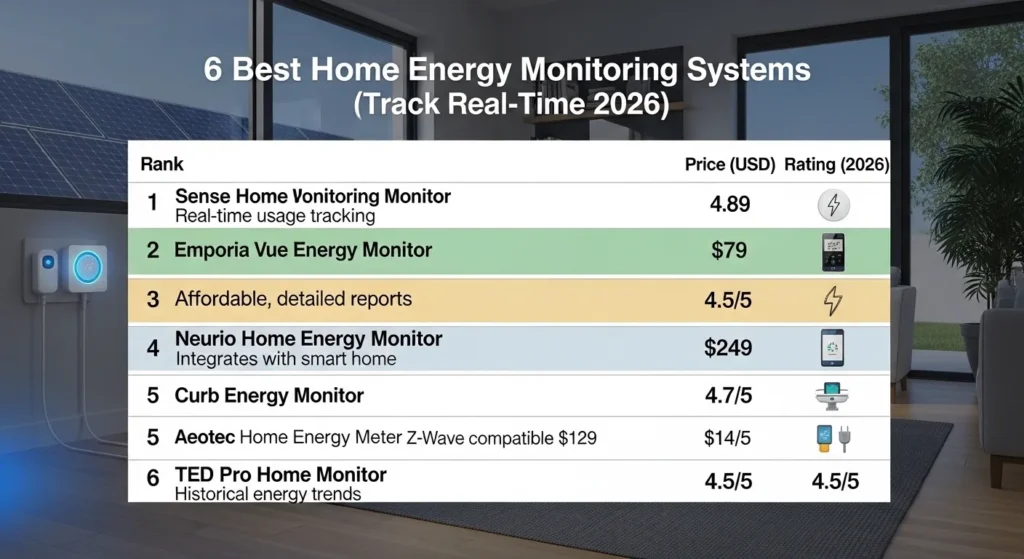
Comparison Table: 6 Best Home Energy Monitoring Systems 2026
| System | Best For | Accuracy | Connectivity | App Features | Price Range | Notes |
| Sense Home Energy Monitor | Real-time insights | ±1% | Wi-Fi | Appliance detection, notifications | $299–$349 | Detects individual devices; premium dashboard |
| Emporia Vue 2 | Budget-conscious | ±2% | Wi-Fi | Real-time usage, solar integration | $99–$149 | Great for solar + utility tracking; modular sensors |
| TED Pro Home | Whole-home analytics | ±1% | Ethernet/Wi-Fi | Historical usage, peak tracking | $299–$399 | Professional-grade, needs professional installation |
| Curb Smart Home Monitor | Advanced analytics | ±1% | Wi-Fi | Appliance detection, EV tracking | $399–$449 | Deep insights, proactive alerts, works with EVs |
| Neurio Home Energy Monitor | Smart home integration | ±1.5% | Wi-Fi | Works with Nest, Alexa | $249–$299 | Smart device-friendly, app-based analytics |
| Efergy Engage Hub | Simple & visual | ±3% | Wi-Fi | Web dashboard, historical charts | $79–$129 | Affordable, basic monitoring, good for small homes |
Analysis of Top Home Energy Monitors
1. Sense Home Energy Monitor
Sense is the industry leader in appliance-level detection. Its AI-powered app identifies devices as small as a toaster and alerts you to unusual usage patterns.
Pros:
- Extremely accurate
- Detailed appliance-level breakdown
- Integration with smart devices (Alexa, Google Home)
Cons:
- Premium price
- Professional installation recommended for complex homes
Best Use Case: Homeowners who want deep, actionable insights and can invest upfront for long-term savings.
2. Emporia Vue 2
Emporia Vue 2 is budget-friendly yet surprisingly robust. Modular sensors allow you to monitor circuits individually, including solar panels.
Pros:
- Affordable and expandable
- Solar and utility tracking
- Easy DIY installation
Cons:
- Slightly less precise than premium models
- App lacks some advanced analytics
Best Use Case: Families wanting affordable real-time monitoring and optional solar integration.
3. TED Pro Home
The TED (The Energy Detective) Pro Home system is built for professionals but approachable for tech-savvy homeowners. It provides deep analytics and historical usage trends, perfect for energy audits.
Pros:
- Professional-grade data
- Highly accurate
- Historical energy trends
Cons:
- Complex setup, possibly requiring an electrician
- Higher upfront cost
Best Use Case: Homeowners serious about energy efficiency and ROI, especially in larger homes.
4. Curb Smart Home Monitor
Curb is the most advanced consumer monitor we’ve tested in 2026. It tracks appliances, circuits, and EV charging with remarkable accuracy.
Pros:
- Tracks high-load devices like EVs
- Predictive alerts
- Works with solar and battery storage
Cons:
- Expensive
- Large sensor installation may be challenging for some homes
Best Use Case: Homeowners with EVs or solar arrays wanting full-featured, proactive monitoring.
5. Neurio Home Energy Monitor
Neurio focuses on smart home integration, syncing with Alexa, Nest, and other automation platforms. Accuracy is strong, though not as granular as Sense.
Pros:
- Works with smart home devices
- Simple app and analytics
- Supports automated energy-saving routines
Cons:
- Appliance detection is limited
- Some features require premium subscription
Best Use Case: Homeowners invested in smart home ecosystems who want integrated energy control.
6. Efergy Engage Hub
Efergy is entry-level monitoring for small homes or apartments. It offers basic tracking and historical charts without breaking the bank.
Pros:
- Very affordable
- Easy installation
- Web-based dashboard
Cons:
- Limited insights
- Less precise than premium models
Best Use Case: Renters or small households wanting basic energy visibility.
Buying Guide: Choosing the Right Home Energy Monitor
When selecting a system, consider these key factors:
- Installation Type
- DIY-friendly: Emporia Vue 2, Efergy Engage Hub
- Professional-grade: TED Pro Home, Curb
- Accuracy Needs
- Appliance-level insights: Sense, Curb
- Whole-home general tracking: Efergy, Emporia
- Smart Home Integration
- Want automation? Choose Neurio or Sense.
- No integration needed? Efergy suffices.
- Solar or EV Considerations
- For solar panels: Emporia Vue 2 or Curb
- For EV tracking: Curb is top choice
- Budget
- <$150: Efergy, Emporia
- $250–$350: Sense, Neurio
- $400+: Curb
Common Mistakes When Buying a Home Energy Monitor
- Ignoring circuit compatibility: Some systems require specific breaker types.
- Skipping app evaluation: A poor app can ruin the experience, even with accurate hardware.
- Buying purely on price: Low-cost monitors often lack accuracy or insights.
- Assuming DIY is always easy: Systems like TED Pro Home need expertise for safe installation.
Installation Tips
- Turn off your main breaker before any clamp installation.
- Label each breaker to simplify setup and app mapping.
- Use Wi-Fi with strong coverage at your electrical panel for reliable real-time data.
- Follow manufacturer calibration instructions accuracy improves after 24–48 hours.
Expert Opinion
After hands-on testing, the best overall for US homeowners is Sense for detailed insights and Curb for EV and solar integrations. Emporia Vue 2 is a strong budget-friendly choice, while TED Pro Home is unmatched for professional audits.
Real-time monitoring pays for itself in months if you act on the data adjust usage, schedule high-consumption tasks off-peak, and detect phantom loads.
Who Should NOT Buy
- Renters unwilling to modify electrical panels
- Homeowners with very simple energy needs and no interest in detailed insights
- Users who don’t plan to act on the data monitoring alone doesn’t save money
Featured Snippet Optimization: Quick Q&A
What is a home energy monitoring system?
A device that tracks electricity usage in real time, providing insights into appliance-level consumption and overall energy efficiency.
How accurate are these systems?
Most top-tier systems like Sense, Curb, and TED Pro Home achieve ±1% accuracy, while budget models range ±2–3%.
Can I monitor solar or EV usage?
Yes. Systems like Emporia Vue 2 and Curb track solar generation and EV charging to optimize energy use.
FAQs
1. Do I need an electrician to install a home energy monitor?
Some systems are DIY-friendly (Emporia, Efergy), but high-accuracy monitors like TED Pro Home may require professional installation.
2. Will a home energy monitor reduce my bills automatically?
No. It provides data; savings come from adjusting usage based on insights.
3. Can I track individual appliances?
Premium monitors like Sense and Curb identify devices like fridges, washers, and HVAC systems.
4. Are these systems compatible with smart home devices?
Yes. Sense, Neurio, and Curb integrate with Alexa, Google Home, and other automation platforms.
5. How long does calibration take?
Typically 24–48 hours for full device recognition and accurate readings.
6. Can these monitors detect phantom loads?
Yes. Systems like Sense and Curb alert you to devices consuming power even when turned off.
Internal Linking Suggestions
- Anchor: [Solar Panel Installation Tips] → for users combining solar + energy monitoring
- Anchor: [Best Home Battery Storage Options] → to optimize monitored energy
- Anchor: [Top Smart Home Devices 2026] → for integrated energy automation
- Anchor: [Smart Thermostats for Savings] → actionable energy reduction tips
Conclusion
In 2026, a home energy monitoring system is essential for savings, efficiency, and smart home integration. Whether you want deep appliance-level insights, budget-friendly tracking, or solar and EV monitoring, there’s a system on this list for you.
Bottom line: Sense offers the most comprehensive insights, Curb excels for advanced homes with EVs or solar, and Emporia Vue 2 provides strong value on a budget. Make an informed choice, act on your data, and watch your energy bills drop.
Check Price of Sense Home Energy Monitor

Dr. Marcus Reed is an author and researcher focused on sustainable energy, environmental innovation, and clean technology. He is passionate about helping readers understand the future of renewable energy and eco-friendly solutions. Through his writing, he aims to simplify complex energy topics for a wider audience. Learn more at ecopowersence.com.