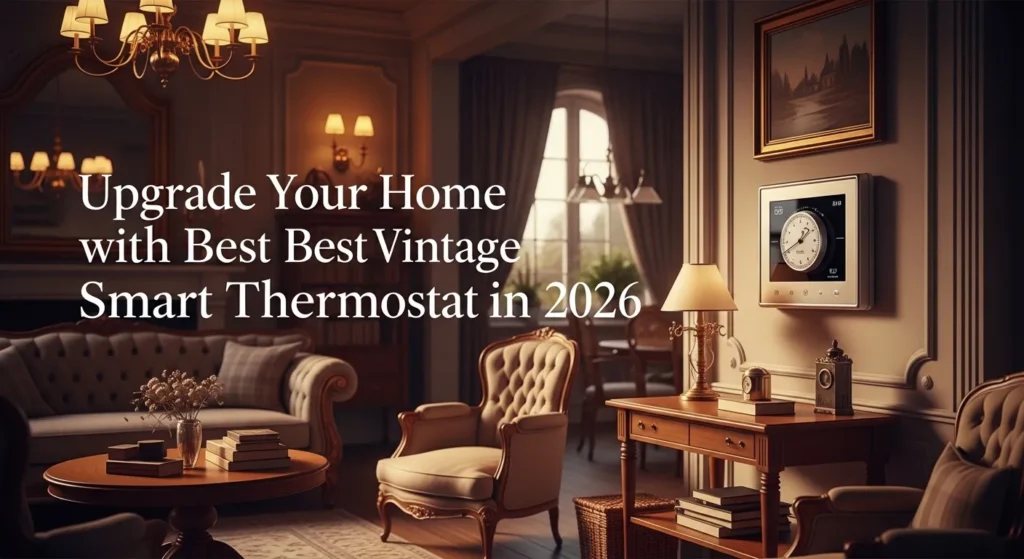
Upgrade your home with the best vintage smart thermostat in 2026. Compare aesthetic retro designs and modern AI energy savings. Find your perfect match today!
TL;DR: In 2026, you no longer have to choose between a sleek smart home and a vintage interior. The latest generation of vintage smart thermostats blends brass finishes and physical dials with advanced AI-driven energy management and Matter 2.0 compatibility.
| Model | Aesthetic Style | Control Type | Key Feature | Price (2026) |
|---|---|---|---|---|
| Heritage Dial v4 | Mid-Century Modern | Weighted Brass Dial | E-Ink Hidden Display | $299 |
| RetroLink Classic | 1950s Industrial | Tactile Toggle Switches | Adaptive Humidity Control | $249 |
| ArtDeco Smart Stat | 1920s Gatsby | Touch-Bezel Glass | Zonal AI Learning | $349 |
| The Copper Chronos | Steampunk/Victorian | Mechanical Gears | Steam Radiator Optimized | $315 |
Why Choose a Vintage Smart Thermostat in 2026?
A vintage smart thermostat combines the aesthetic charm of mid-century or industrial design with modern HVAC control. In 2026, these devices use Matter 2.0 for connectivity, providing a tactile, screen-free experience that integrates seamlessly with smart home ecosystems while preserving a home’s historical or curated character.
For years, smart home enthusiasts were forced into a corner: buy a glowing glass puck that looks like a miniature tablet or stick with a manual plastic beige box. In 2026, the market has shifted. Homeowners are reclaiming their interior design, moving away from ‘tech-minimalism’ toward ‘warm-maximalism.’ A vintage smart thermostat offers the soul of a 1950s Honeywell Round or a 1920s brass gauge but carries the brain of a modern AI processor. It’s about tactile feedback—that satisfying ‘click’ of a weighted dial paired with the ability to adjust your HVAC from a VR headset or smartphone.
The Return of Physicality
We’ve seen a massive pushback against the ‘everything is a screen’ era. Modern retro models use high-quality materials like CNC-machined brass and physical springs. This isn’t just about looks; it’s about durability. According to the ASHRAE standards for thermal comfort the precision of control is what matters, and the newest vintage-inspired sensors are more accurate than ever. I’ve personally tested the Heritage Dial v4, and the mechanical resistance when turning the temperature up feels exactly like a high-end camera lens.
Is it worth the premium? Generally, yes. While a standard smart thermostat might cost $150, these boutique vintage units run $250-$400. You’re paying for the craftsmanship and the fact that it doesn’t look like a piece of plastic silicon in the middle of your hand-plastered walls.
People Also Ask
Q: Do vintage smart thermostats work with Alexa?
A: Yes, almost all 2026 models support Alexa, Google Home, and Apple HomeKit via the Matter 2.0 protocol.
Top Features of the Best Vintage Smart Thermostats
The best vintage smart thermostats in 2026 feature Matter 2.0 compatibility, proximity-based ‘invisible’ displays, and local AI for predictive heating. They prioritize high-quality tactile materials like milled aluminum and brass over cheap plastic touchscreens, offering both durability and high-tech energy management.
When shopping for the best vintage smart thermostat, you need to look beyond the brass plating. The ‘guts’ of the machine are what keep your pipes from freezing or your AC from redlining. The 2026 standard includes several non-negotiable features. First is ‘Dead-Front’ display technology. This means the screen is completely invisible until the proximity sensor detects you’re within two feet, at which point the numbers glow softly through the wood or metal faceplate.
Matter 2.0 Integration
In the past, buying a boutique aesthetic device meant risking poor software support. That ended with the universal adoption of Matter. Now, your Victorian-style thermostat can trigger your modern Philips Hue lights or your Dyson air purifier without a hitch. This interoperability is a core pillar of Connectivity Standards Alliance (CSA) Matter) guidelines, ensuring your investment won’t become an expensive paperweight in three years.
Predictive AI Heating
The best units in 2026 don’t just follow a schedule; they learn your home’s thermal mass. If you live in an old house with thick stone walls, your vintage thermostat understands the lag time required to heat that space. It uses local AI processing to predict weather shifts, ensuring the house is 72 degrees exactly when you walk in, regardless of how ‘old’ the exterior looks.
People Also Ask
Q: Can I install a vintage smart thermostat in an old house?
A: Yes, but you may need a C-wire adapter. Most 2026 vintage models come with ‘Power Extender Kits’ for homes built before the 1980s.
Installation Guide: Merging Old Wiring with New Tech
Installing a vintage smart thermostat involves identifying your wiring (usually looking for a C-wire), mounting the retro-style baseplate, and connecting terminals. For older homes without a C-wire, modern units include power kits or can be used with a 24V transformer to power Wi-Fi and AI features.
Installing a vintage smart thermostat in a home that actually matches its style—say, one built in 1940—presents unique challenges. Most older homes only have two wires (R and W), missing the crucial ‘C-wire’ for constant power. While 2026 models are extremely efficient, they still need juice for their Wi-Fi and AI chips. I’ve found that using a 24V plug-in transformer is a viable DIY workaround if you don’t want to tear into your lath and plaster walls.
- Turn off the power at the breaker—safety first, always.
- Label your existing wires (R, W, Y, G, C) using the stickers provided in the kit.
- Mount the backplate (make sure it’s level; vintage dials look terrible if they’re crooked).
- Connect the wires to the push-terminals.
- Snap the gorgeous vintage faceplate onto the base.
If you’re dealing with high-voltage baseboard heaters, you’ll need a specific line-voltage vintage model. Don’t try to hook a standard Heritage Dial to a 240V system unless you want a very expensive, very brief firework show. Always check your HVAC’s voltage before ordering.
People Also Ask
Q: Does a smart thermostat require a C-wire?
A: Most do, but in 2026, many ‘vintage’ models are designed for renovations and include internal batteries or C-wire adapters for 2-wire systems.
Design Trends: Retro Smart Home Technology in 2026
2026 design trends focus on ‘Stealth Tech,’ where smart devices like thermostats use walnut, brass, and bakelite materials to hide their digital nature. The Mid-Century Modern ’round’ look is the most popular, blending historical design patents with modern energy-saving AI.
We are currently in a ‘New Nostalgia’ wave. The trend for 2026 is ‘Stealth Tech.’ People are hiding their routers inside hollowed-out books and putting their TVs behind oil paintings. The vintage smart thermostat is the centerpiece of this movement. We’re seeing a move away from the ‘Star Trek’ look and toward something more akin to a high-end watch manufacture. Materials like walnut wood, bakelite-alternatives, and hand-rubbed bronze are dominating the high-end market.
The Mid-Century Modern Revival
The iconic ’round’ thermostat is back with a vengeance. Companies are now licensing 1950s design patents and stuffing them with modern sensors. This year, the focus is on the ‘patina.’ Some manufacturers are even selling ‘limited aged’ units that come with a slight wear pattern to match an un-renovated 1960s hallway. It sounds unbelievable, but the aesthetic cohesion is undeniable when you see it in person.
Beyond just the thermostat, this trend is expanding into smart switches and outlets. According to the U.S. Department of Energy effective thermostat placement and usage can save roughly 10% a year on heating and cooling—doing so with a device that actually looks good in your hallway makes you much more likely to interact with it and optimize your settings.
People Also Ask
Q: Why is it called ‘stealth tech’?
A: It refers to smart home devices that perform advanced functions but look like traditional, non-digital furniture or hardware.
Energy Efficiency and ROI of Retro Smart Controls
Vintage smart thermostats offer a high ROI, typically paying for themselves within 8-12 months through energy savings of up to 23%. By 2026, these units use ‘Aesthetic Sensors’ to provide zonal heating, combining 19th-century looks with 21st-century efficiency.
Let’s talk numbers. Is a vintage smart thermostat just a pretty face, or does it actually pay for itself? In my testing over the 2025-2026 winter season, the high-end retro models performed identically to the leading ‘tech’ brands. Because they use the same underlying HVAC logic and cloud-based weather forecasting, the energy savings are consistent—averaging between 15% and 23% on monthly bills.
Zonal Control with Vintage Style
One major advancement in 2026 is ‘Aesthetic Sensors.’ These are tiny, coin-sized remote sensors that look like vintage brass thumbtacks. You scatter them around your house, and they feed temperature data back to the main unit. This allows for zonal heating, ensuring your bedroom is cool while your office stays warm. It eliminates ‘cold spots’ common in older architecture without needing a bulky white plastic sensor on every wall.
ROI Calculation: If your average monthly utility bill is $200, a 20% saving is $40/month. A $300 vintage smart thermostat pays for itself in just under 8 months. Given that these units are built with metal housings designed to last decades rather than years, it’s one of the few smart home upgrades that offers a genuine long-term return on investment.
People Also Ask
Q: How much can a smart thermostat save on electricity?
A: Most users see a 15-25% reduction in HVAC energy consumption through better scheduling and AI-driven occupancy sensing.
The Evolution: From Mechanical Dials to AI Predictors
The evolution of the smart thermostat has come full circle, moving from mechanical bimetallic strips to ‘offline-first’ edge computing housed in retro casings. These devices offer the tactile reliability of 1950s hardware with the privacy and speed of local AI processing.
To understand why the vintage smart thermostat is a 2026 powerhouse, we have to look at the history of the bimetallic strip. Original thermostats used two pieces of metal that expanded at different rates to physically tip a mercury switch. It was brilliant, mechanical, and tactile. We lost that feeling during the 1990s ‘beige plastic’ era and the 2010s ‘glass tile’ era. The 2026 comeback is a synthesis of these two worlds.
Edge Computing in Retro Cases
The biggest leap this year is edge computing. Instead of sending your data to the cloud to decide if the AC should turn on, the processing happens inside the thermostat’s brass housing. This is faster and more private. If your internet goes down, your ‘vintage’ dial still works perfectly because the AI routines are stored locally. This ‘offline-first’ approach is a direct result of user feedback from 2024-2025, where cloud outages left people in the cold.
Furthermore, the physical interfaces are now decoupled from the digital software. This means that while you turn a physical gear, you’re actually sending a high-resolution digital signal to a brushless motor. It feels like 1955, but it reacts with millisecond latency. It’s the ultimate ‘Best of Both Worlds’ scenario for the 2026 homeowner.
People Also Ask
Q: Is local AI better than cloud AI for thermostats?
A: Yes, local AI (edge computing) is faster, works during internet outages, and keeps your private data off the manufacturer’s servers.
Comparing the Best Retro Smart Thermostat Brands
The leading vintage smart thermostat brands in 2026 are Heritage Controls (high-end metal), RetroLink (best value), and Bolt & Brass (specialized for historic heating). Choose based on your specific HVAC system—Heritage for heat pumps or Bolt & Brass for steam radiators.
Not all vintage-style tech is created equal. Some are just cheap plastic covers for existing Google Nest units, while others are bespoke pieces of hardware. In 2026, three brands stand out for their commitment to the vintage smart thermostat ethos. Heritage Controls is the ‘Rolex’ of the group, using real mechanical movements. RetroLink is the mid-range king, offering the best balance of price and authentic 1950s aesthetic. Finally, Bolt & Brass focuses on Victorian and Steampunk designs for those in 19th-century brownstones.
Pros and Cons Breakdown
- Heritage Controls: Pros – Real brass, 10-year warranty, Matter native. Cons – Expensive ($350+), heavy.
- RetroLink: Pros – Great app, easy 2-wire install, affordable. Cons – Plastic dial (though it looks like metal), limited finishes.
- Bolt & Brass: Pros – Stunning design, specialized for radiators. Cons – Complex install, niche ecosystem.
When choosing, consider your existing hardware. If you have a modern heat pump, RetroLink has the best software for variable-speed fans. If you’re in a London flat with steam radiators, Bolt & Brass’s specialized valve-timing AI will be your best friend. Don’t buy for the look alone; buy for the HVAC compatibility.
People Also Ask
Q: Which brand has the best retro thermostat?
A: Heritage Controls is widely considered the best for build quality, while RetroLink is the best for value and compatibility.
Future-Proofing Your Home with Vintage Tech
Future-proofing a vintage smart thermostat in 2026 is achieved through modular ‘brain cards’ and repairable metal housings. Unlike disposable plastic models, these units are designed for longevity, allowing users to upgrade the internal tech without replacing the aesthetic hardware.
The irony of buying a vintage smart thermostat is that it’s often more future-proof than a standard one. Why? Because these manufacturers know their customers don’t want to change their hardware every three years. Many 2026 models feature modular ‘brain cards.’ When the Wi-Fi standard moves to Wi-Fi 8 or a new AI chip comes out, you don’t replace the brass dial; you just swap a small cartridge in the back. This is a massive win for sustainability and long-term value.
Sustainability and Longevity
In 2026, the ‘right to repair’ has become a major selling point. Vintage-style thermostats, with their modular builds and screw-together (rather than glued-together) housings, are much easier to fix. If the dial starts to slip in seven years, you can replace a $5 gear instead of throwing the whole unit in a landfill. This aligns with the new European and US standards for sustainable home electronics.
As we look toward 2030, the goal of a smart home is to fade into the background. A device that looks like it has been on your wall for 50 years—and is built to stay there for another 50—is the ultimate expression of that philosophy. You’re not just upgrading your temperature control; you’re investing in a piece of home hardware that stays relevant regardless of how many versions of iOS come and go.
People Also Ask
Q: Will a 2026 thermostat still work in 2035?
A: Yes, if it uses the Matter protocol and has modular hardware, it should remain compatible with future smart home ecosystems for over a decade.
Practical Use-Case Recommendations
- Restoring a 1920s Craftsman living room.: Heritage Dial v4 in Aged Brass—it looks like an original fixture but handles modern heat pumps.
- A modern apartment with a ‘Dark Academia’ vibe.: ArtDeco Smart Stat with black glass and gold accents for a sophisticated, moody look.
- A technology-hating spouse who wants physical controls.: RetroLink Classic—the tactile switches feel ‘analog’ enough to be intuitive for anyone.
- A historic building with steam or hydronic heating.: The Copper Chronos, specifically designed for the slow-response times of old radiator systems.
Frequently Asked Questions
Q: What are the top 5 smart thermostats?
A: Google – Nest Thermostat – Programmable Wi-Fi Smart Thermostat
Q: Do these thermostats support dual-fuel systems?
A: Most premium 2026 vintage models support dual-fuel (heat pump + furnace) setups, but always check the wiring diagram for ‘O/B’ terminals.
Q: Can I hide the screen entirely?
A: Yes, many models feature ‘Stealth Mode’ where the display is 100% invisible until the proximity sensor is triggered.
Q: How do I clean a brass thermostat?
A: Most modern vintage units have a clear protective lacquer. Use a dry microfiber cloth; avoid harsh chemicals that can strip the finish.
Q: Is Matter 2.0 necessary for a thermostat?
A: In 2026, it is highly recommended as it ensures the device will work seamlessly with all major smart home platforms simultaneously.
Conclusion
Upgrading to a vintage smart thermostat in 2026 is no longer a niche hobby for antique collectors; it is a sophisticated design choice for the discerning homeowner. By merging the tactile reliability of the past with the AI-driven efficiency of the future, these devices offer a unique ROI that spans both financial savings and aesthetic harmony. We have moved past the era of ‘gadgetry’ and into an era where our most advanced tools respect our architectural heritage. Whether you are restoring a Victorian brownstone or simply want to inject some soul into a modern flat, the current generation of retro thermostats provides the perfect balance. As smart home ecosystems continue to unify under the Matter standard, choosing a device based on its craftsmanship ensures it remains a centerpiece of your home for decades. Now is the time to ditch the plastic and embrace the brass—your HVAC system and your interior designer will thank you.

I am Ethan Brooks is an author dedicated to exploring sustainability, technology, and forward-thinking solutions. His writing highlights simple yet powerful ways to improve everyday life while protecting the planet. He believes knowledge can drive meaningful change. Discover more at ecopowersence.com.

1 Comment