Last Updated: June 2026 | Category: Indoor Energy Solutions | Reading Time: ~10 min | Dr. marcus reed
If you’re still running your home on a basic dial thermostat or e an older programmable one you’re almost certainly leaving money on the table every single month.
The average U.S. household spends around $900 per year on heating and cooling. That’s your single biggest energy expense. The type of thermostat controlling your HVAC system directly affects how much of that you can claw back.
In this guide, we break down the smart thermostat vs programmable thermostat debate with real numbers, feature-by-feature comparisons, and a clear recommendation based on your lifestyle and home setup including how both options interact with solar panels and smart home energy monitors.
What Is a Programmable Thermostat?
A programmable thermostat lets you pre-set temperature schedules based on the time of day and day of the week. You enter the schedule manually — usually by pressing buttons on the device itself — and the thermostat follows that pattern automatically until you change it.
Most programmable models offer two scheduling formats:
- 5-2 scheduling — one schedule for weekdays, a separate one for weekends
- 7-day scheduling — a unique schedule for each day of the week, giving you more flexibility
Once programmed correctly, a programmable thermostat does its job quietly and reliably. It doesn’t need Wi-Fi, a smartphone, or a monthly subscription. It simply follows the instructions you gave it.
Key features of a programmable thermostat:
- Set-and-forget temperature schedules
- No internet connection required
- Works with virtually any HVAC system
- Upfront cost: $20–$80
- Simple installation — usually DIY in under 30 minutes
The limitation is also its core feature: it only does exactly what you tell it to. If your schedule changes, you have to update it manually at the device. If you leave for a two-week vacation and forget to adjust it, it will keep heating or cooling your empty house on schedule.
What Is a Smart Thermostat?
A smart thermostat does everything a programmable thermostat does — and then goes significantly further. It connects to your home’s Wi-Fi and can be controlled, monitored, and adjusted remotely through a smartphone app, tablet, or voice assistant like Alexa or Google Home.
The defining feature of a smart thermostat isn’t just remote access — it’s intelligence. Leading models like the Google Nest Thermostat and Ecobee SmartThermostat learn your daily patterns over time and build a schedule that matches your actual behavior, not just the one you programmed.
Key features of a smart thermostat:
- Wi-Fi connectivity — control from anywhere via app
- Learning algorithm — adapts to your routine automatically
- Geofencing — detects when you leave or arrive and adjusts temperature accordingly
- Energy usage reports — see exactly how much your HVAC runs and what it costs
- Smart home integration — works with Alexa, Google Home, Apple HomeKit, and more
- Solar and energy monitor compatibility — can shift HVAC usage to peak solar hours
- Upfront cost: $150–$250
A practical example of geofencing: if you normally get home at 6 PM but leave work early at 4 PM, your smart thermostat detects your location via your phone and starts warming (or cooling) your home in time for your actual arrival — not just the time you pre-programmed. According to ENERGY STAR, smart thermostats can save homeowners an average of $50 per year on energy costs, with many households saving significantly more depending on climate and usage patterns.
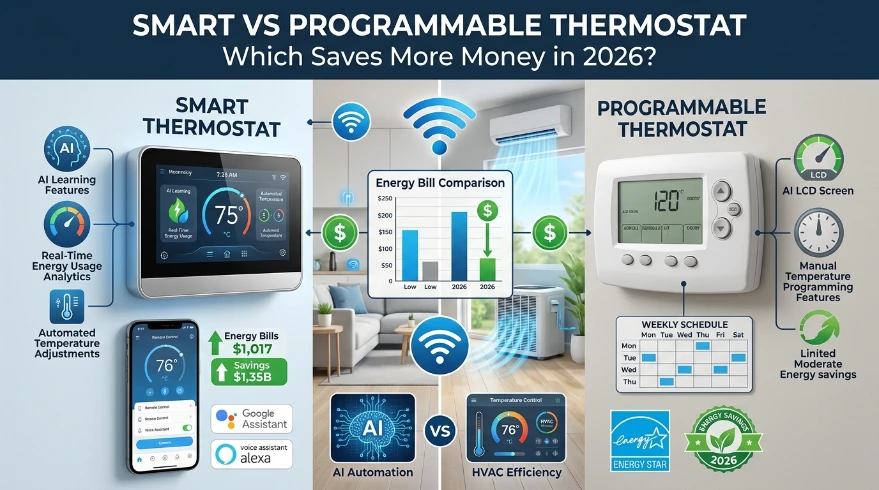
Smart Thermostat vs Programmable Thermostat: Side-by-Side Comparison
Here’s everything you need to know in one place:
| Feature | Programmable Thermostat | Smart Thermostat |
|---|---|---|
| Wi-Fi connectivity | ❌ No | ✅ Yes |
| Remote app control | ❌ No | ✅ Yes |
| Learning/auto-adapting | ❌ No | ✅ Yes |
| Geofencing | ❌ No | ✅ Yes |
| Energy usage reports | ❌ No | ✅ Yes |
| Voice assistant support | ❌ No | ✅ Yes |
| Solar system integration | ❌ No | ✅ Yes |
| Smart home ecosystem | ❌ No | ✅ Yes |
| Works without internet | ✅ Yes | ⚠️ Limited |
| Typical upfront cost | $20–$80 | $150–$250 |
| Annual energy savings | ~10–15% | ~15–25% |
| DIY installation | ✅ Easy | ✅ Usually (C-wire needed) |
| HVAC compatibility | Universal | Check C-wire requirement |
Energy Savings: Real Numbers Compared
This is where the decision becomes financial rather than just about features.
Programmable thermostat savings:
The U.S. Department of Energy states that setting your thermostat back 7–10°F for 8 hours per day can save around 10% per year on heating and cooling. On a $900 annual HVAC bill, that’s roughly $90–$135 saved per year — but only if you actually program it correctly and stick to it. Studies show a significant number of homeowners never fully optimize their programmable thermostat settings.
Smart thermostat savings:
Smart thermostats consistently outperform programmable models because they optimize automatically. According to Ecobee’s internal data, their smart thermostats save homeowners an average of 23% on heating and cooling costs. On a $900 HVAC bill, that translates to roughly $135–$225 saved per year.
Payback period calculation:
| Thermostat Type | Upfront Cost | Annual Savings | Payback Period |
|---|---|---|---|
| Programmable | $50 | $112/year | ~6 months |
| Smart Thermostat | $200 | $180/year | ~13 months |
Both pay for themselves quickly. The smart thermostat takes slightly longer to break even but delivers higher savings every year after that and keeps improving as it learns more about your home.
Smart Thermostat Features That Programmable Can’t Match
1. Geofencing Your Thermostat Knows When You’re Home
Geofencing uses your smartphone’s GPS to detect when you’ve left the house or are on your way back. When you leave, the thermostat automatically switches to an energy-saving “away” mode. When it detects you approaching, it starts heating or cooling so the house is comfortable when you arrive.
For households with unpredictable schedules parents, shift workers, remote workers with variable hours geofencing alone can reduce HVAC runtime by 10–15% compared to a fixed-schedule programmable thermostat.
2. Learning Algorithm It Programs Itself
Models like the Nest Thermostat spend the first week learning when you prefer warmer or cooler temperatures, then build an automated schedule that matches those preferences. No manual programming required. You simply adjust the temperature when you want it different, and the thermostat takes note.
3. Remote App Control Change Settings From Anywhere
Left for vacation and forgot to set your thermostat to “away” mode? With a smart thermostat, you can fix that in 10 seconds from your phone, anywhere in the world. You can also check in on your home temperature, get alerts if something seems off, and make seasonal adjustments without touching the device.
4. Energy Usage Reports — See Exactly What You’re Spending
Smart thermostats generate detailed reports showing how many hours your HVAC ran, what triggered it, and how your usage compares to similar homes in your area. This data is invaluable when paired with a home energy monitor you can see your full energy picture in one place.
5. Smart Home Integration — Part of a Bigger System
Smart thermostats don’t work in isolation. They integrate with smart lighting, smart vents, energy monitors, and voice assistants to create a genuinely intelligent home. For example, when you tell Alexa “I’m leaving,” your smart thermostat, lights, and plugs can all switch to an energy-saving mode simultaneously.
When a Programmable Thermostat Is the Better Choice
A smart thermostat is the better device in most situations — but not all. A programmable thermostat makes more sense if:
- Your home has no Wi-Fi or unreliable internet — a smart thermostat depends on connectivity
- Your budget is tight — a $25–$50 programmable thermostat still saves real money vs. a manual dial
- Your household schedule is highly predictable — same time in, same time out, every day. A fixed schedule works perfectly.
- Your HVAC system lacks a C-wire — many smart thermostats require a common wire (C-wire) that older systems don’t have. Retrofitting one adds cost and complexity.
- You prefer simplicity — if the idea of app updates, Wi-Fi setup, and firmware sounds like too much overhead, a programmable thermostat does its job without any of that.
Installation: Which One Is Easier to Set Up?
Both types are DIY-friendly for most homeowners. The process is similar: turn off power at the breaker, remove the old thermostat, label the wires, connect them to the new unit, and restore power.
Programmable thermostat installation: Straightforward. Most models include a clear wiring diagram. No app setup or Wi-Fi needed. Takes 20–30 minutes for the average homeowner.
Smart thermostat installation: Also DIY-friendly, but with one important caveat most smart thermostats require a C-wire (common wire). This wire provides continuous power to keep the Wi-Fi and display running. Many homes built after 2010 already have one. Older homes often don’t.
Before buying a smart thermostat: Check your current thermostat’s wiring. If you see a wire connected to the terminal labeled “C,” you’re good. If not, check whether your HVAC system’s control board has a C-wire terminal that was never run to the thermostat. An HVAC technician can add one for around $100–$150 if needed. Some models like the Nest Thermostat include an optional power adapter that eliminates the C-wire requirement entirely.
If your smart thermostat ever seems to be blowing cold air when it shouldn’t, check out our guide on why your smart thermostat blows cold air in winter it’s one of the most common setup issues and almost always fixable.
Which Works Best With Solar Panels and Smart Home Systems?
This is where smart thermostats offer an advantage that no programmable thermostat can match — and it’s particularly relevant if you have or are planning to install solar panels.
Smart thermostat + solar panel integration:
A smart thermostat can be programmed (or learned) to run your HVAC system heavily during the hours when your solar panels produce the most electricity — typically 10 AM to 3 PM. Instead of buying electricity from the grid to run your heating or cooling at peak rate hours, you’re using your own free solar power. This strategy, sometimes called solar load shifting, can effectively make a significant portion of your HVAC energy cost-free on sunny days.
When combined with a home energy monitoring system, you can track exactly how much of your HVAC usage is covered by solar generation versus grid power giving you actionable data to optimize further. You can also pair your smart thermostat with smart vents to direct conditioned air precisely where it’s needed, reducing how hard your HVAC has to work in the first place.
For a complete picture of how thermostats fit into a broader smart home energy strategy, see our Smart Energy & Home Automation Guide.
A programmable thermostat, by contrast, has no awareness of solar production, grid pricing, or your home’s energy state. It simply follows the clock.
Smart Thermostat vs Programmable: Which Should You Buy?
Use this to make your decision:
| Buy a Programmable Thermostat if… | Buy a Smart Thermostat if… |
|---|---|
| Your budget is under $75 | You want maximum energy savings |
| Your schedule is perfectly predictable | Your schedule changes frequently |
| You have no reliable Wi-Fi | You want remote app control |
| Your HVAC has no C-wire and you don’t want to add one | You have solar panels or an energy monitor |
| You prefer simple, low-maintenance tech | You want smart home integration |
| It’s a rental property or secondary home | You want detailed energy usage reports |
Bottom line: For most US homeowners in 2026, a smart thermostat is the better investment. The payback period is under 14 months, the savings compound every year, and it works harder the more irregularly you live your life. If budget or simplicity is a concern, a well-programmed programmable thermostat still beats a manual dial by a wide margin.
Frequently Asked Questions
Is a smart thermostat worth the extra cost?
For most households, yes. A smart thermostat typically costs $150–$250 and saves $135–$225 per year on heating and cooling. That means it pays for itself in 12–18 months and continues saving money every year after. Homes with irregular schedules or solar panels tend to see even faster payback.
Do smart thermostats work without Wi-Fi?
Most smart thermostats will maintain their last saved schedule if Wi-Fi goes down, but you lose remote control, energy reporting, and learning features until connectivity is restored. They are not designed for permanent offline use.
Can I install a smart thermostat myself?
In most cases, yes. The main barrier is the C-wire requirement. If your home already has a C-wire at the thermostat (check for a wire on the “C” terminal), installation is a straightforward DIY job that takes 30–45 minutes. If you don’t have a C-wire, some models include workarounds, or an HVAC technician can add one.
How much can a smart thermostat save per year?
According to ENERGY STAR, the average smart thermostat saves around $50 per year at minimum. Ecobee reports average savings of 23% on HVAC costs. On a $900 annual bill, that’s $135–$225 per year in savings, depending on your climate, home size, and how often your schedule varies.
What is the difference between a programmable and smart thermostat?
A programmable thermostat follows a fixed schedule you set manually. A smart thermostat connects to Wi-Fi, learns your patterns, adapts automatically, allows remote control via app, and integrates with smart home systems including solar panels and energy monitors. Both save money compared to a manual dial thermostat, but the smart thermostat vs programmable thermostat gap in actual savings widens significantly for busy households with variable schedules.
Final Thoughts
The programmable thermostat was a genuine upgrade over manual dials when it launched — and for simple, budget-conscious setups, it still earns its place. But for the modern homeowner who wants real control, meaningful savings, and integration with a broader energy management system, the smart thermostat wins on every axis that matters.
If you already have solar panels, a home energy monitor, or smart vents, adding a smart thermostat is the missing link that ties your energy ecosystem together.
Want to go deeper on cutting your home energy costs? Explore our 6 Best Home Energy Monitoring Systems for 2026 to see how much you can save when you can actually see where your power is going.
Written by Dr. Marcus Reed — energy researcher and smart home technology analyst with over a decade of hands-on testing across US households. Learn more at ecopowersence.com

I am Dr. Marcus Reed is an author and researcher focused on sustainable energy, environmental innovation, and clean technology. He is passionate about helping readers understand the future of renewable energy and eco-friendly solutions. Through his writing, he aims to simplify complex energy topics for a wider audience. Learn more at ecopowersence.com.