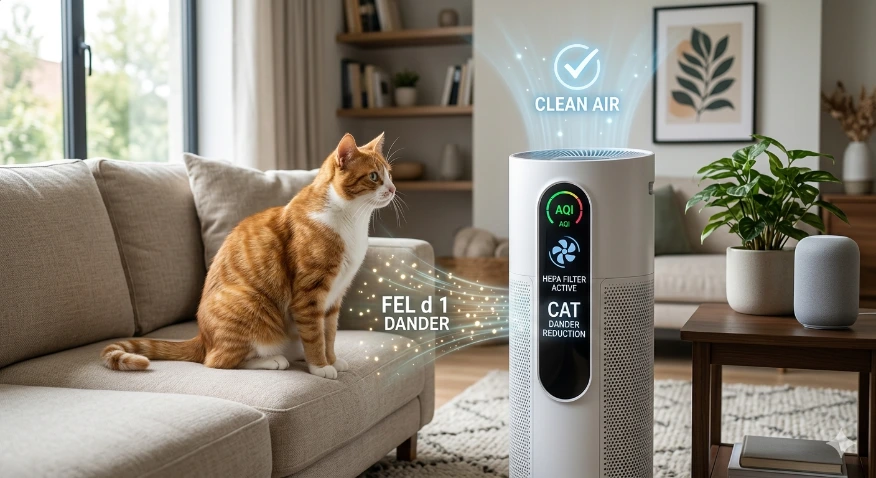
Pet lovers frequently face a frustrating dilemma when managing environmental health. Specifically, microscopic airborne triggers cause persistent respiratory discomfort. Many people mistakenly blame feline fur for their sneezing fits and itchy eyes. However, the true culprit is a sticky protein known as Fel d 1, which resides in cat saliva, urine, and skin cells. When your pet grooms itself, these dried microscopic skin particles readily flake off to form airborne pet dander.
Consequently, these microscopic elements circulate throughout your entire living space. Fortunately, high-efficiency mechanical purification systems can decisively target these microscopic invaders. In this guide, we will analyze how modern purification technology transforms your smart home ecosystem, referencing key insights from the best-air-purifiers-for-allergies_mindmap_2026-06-17.jpg.
Understanding Cat Allergies: The Real Culprits
To defeat indoor allergens, you must understand their microscopic behavior. Feline dander behaves quite differently than heavy canine dander or dust mites.
Dander and Fel d 1 Protein符号 Explained
Feline dander is exceptionally small, typically measuring between 0.5 to 10 microns. Because these particles are incredibly lightweight, they remain suspended in the air for hours. Consequently, you might experience severe allergic reactions even when your cat is in a completely different room. Furthermore, the sticky nature of the Fel d 1 protein allows it to adhere easily to walls, furniture, and fabrics.
Therefore, simple cleaning methods like sweeping often fail to eliminate the problem. Instead, aggressive air filtration becomes necessary to pull these floating irritants out of your breathing zone.
How Fel d 1 Interacts with Human Physiology
When inhaled, these tiny proteins bypass normal nasal filtration defenses. They settle deep inside your respiratory tract, triggering an immediate immune response. Consequently, your body releases histamines, leading to classic symptoms like watery eyes, coughing, and airway inflammation. For asthmatics, this exposure can trigger severe respiratory distress within minutes.
Furthermore, because cats roam freely across furniture, the protein builds up in high-density areas. Therefore, an effective mitigation strategy must combine constant air cleaning with targeted surface management.
How Air Purifiers Neutralize Cat Allergies
Modern air purification tools act as defense shields against persistent airborne particles. They pull contaminated air through specialized matrices to trap harmful contaminants.
The Vital Role of True HEPA Filters
True HEPA filtration represents the gold standard for removing airborne dander. According to strict parameters, these filters capture at least 99.97% of airborne particles as small as 0.3 microns. Alternatively, advanced medical-grade systems, such as HyperHEPA, successfully trap particles down to 0.003 microns. You can explore the official EPA Guide to Air Cleaners in the Home to verify performance benchmarks.
By continuously circulating indoor air, a HEPA system safely isolates dander before it settles onto your carpets.
[Contaminated Air] ---> [Pre-Filter: Hair/Fur] ---> [True HEPA: Dander] ---> [Purified Air]
Activated Carbon and Eliminating Pet Odors
Standard particle filters cannot capture microscopic gas molecules or foul pet odors. Therefore, high-quality purifiers incorporate an auxiliary layer of pelleted activated carbon. This porous layer utilizes chemical adsorption to trap litter box smells and volatile organic compounds (VOCs).
Consequently, your home smells pristine while the system simultaneously neutralizes hidden allergens. For maximum efficiency, you should choose filters with heavy carbon pellets rather than thin, carbon-coated fabric sheets.
Understanding Clean Air Delivery Rate (CADR)
CADR measures an air cleaner’s effectiveness based on room space and the volume of clean air produced per minute. It tracks three specific pollutants: smoke, dust, and pollen. When combating cat allergies, look for a high pollen and dust rating, as dander behaves similarly to these particles.
Furthermore, ensure the unit provides at least 4 to 5 Air Changes per Hour (ACH) in your specific room size. This high turnover rate ensures allergens are trapped before they can settle onto bedding or flooring.
Deep Dive: The Core Filtration Mechanisms
To implement an effective solution, we must look deeper into how air purifiers actually function. They rely on distinct physics principles to capture particles of varying sizes.
Interception, Impaction, and Diffusion
HEPA filters do not work like simple sieves where only large items get blocked. Instead, they use three scientific mechanisms to capture microscopic matter. First, large particles collide directly with the dense glass fibers, a process called impaction. Second, medium particles travel along airflow lines but get caught when passing close to a fiber, known as interception.
Finally, the smallest particles move erratically due to Brownian motion, causing them to collide with fibers, which is called diffusion. Consequently, this multi-layered physics framework guarantees that particles of all sizes are successfully removed from circulation.
The Risk of Ozone and Ionization Systems
Some low-quality air cleaners rely heavily on ionizers or electronic grids to drop particles from the air. However, these systems often generate ozone as a byproduct, which severely irritates human lungs. For allergy and asthma sufferers, ozone exposure can actually worsen respiratory inflammation instead of healing it.
Therefore, you should strictly avoid units that release ozone, sticking exclusively to mechanical True HEPA filtration. Check certifications from bodies like the California Air Resources Board (CARB) to ensure absolute safety.
Selecting the Best Air Purifiers for Pets
Choosing the perfect appliance requires analyzing specific performance metrics, room dimensions, and proprietary features.
Top Recommendations for Cat Owners
Market testing reveals several outstanding options for managing pet environments. For instance, the Levoit Core 400S offers an exceptional balance of price and particle clearance speed. In addition, models like the Mila Air A3 provide highly customizable filtration options tailored for multi-pet spaces.
If you are researching premium options, you might wonder: is a Dyson air purifier worth it? These premium machines excel because they combine clean air projection with completely sealed H13 HEPA engineering. Furthermore, classic workhorses like the Honeywell HPA300 remain highly effective for large living areas.
| Model Name | Filter Class | Best Use Case | Smart Connectivity |
| Levoit Core 400S | True HEPA (H13) | Medium Rooms | Wi-Fi / App |
| IQAir HealthPro Plus | HyperHEPA (0.003 µm) | Medical-Grade / Severe Allergies | Premium / Pro |
| Coway AP-1512HH | True HEPA | Best for Hair & Pollen | Auto Mode |
| Dyson Purifier Cool | H13 Fully Sealed | Large Spaces & Cooling | Wi-Fi / Voice Control |
| Honeywell HPA300 | True HEPA | Extra-Large Areas | Manual / No Wi-Fi |
Portable vs. Large Space Performance
A single compact device cannot purify an entire multi-story house. Instead, portable air purifiers work best when dedicated to single, closed rooms. Alternatively, you must evaluate the CADR to match large open floor plans. High CADR ratings ensure the machine exchanges the room’s air volume four to five times per hour.
Analyzing the Longevity of Pet Filters
Pet environments place a heavy load on filter elements due to floating hair and dander. Consequently, a standard filter rated for 12 months might only last 6 months in a multi-cat home. To prevent unexpected costs, look for systems that utilize durable, budget-friendly replacement filters.
Furthermore, choosing units with separate pre-filters allows you to extend the life of the expensive underlying HEPA layer.
Smart Home Automation Protocols for Air Quality
Modern sustainable living relies on unifying environmental sensors with automated appliance responses.
Integrating Zigbee and Z-Wave Air Purifiers
Smart ecosystems allow air purifiers to respond dynamically to changing conditions. For example, Zigbee and Z-Wave air quality sensors can monitor localized particulate spikes. When pet dander rises during grooming sessions, these sensors instantly transmit signals to your smart hub.
Consequently, your home automation system automatically throttles the purifier’s fan speed to maximum. This proactive routine saves energy while maintaining ideal air quality metrics.
The Evolution of Matter and Thread Protocols
The introduction of Matter and Thread protocols completely transforms smart home connectivity. Because Matter acts as a universal language, your air purifiers can communicate natively across Apple Home, Google Home, and Home Assistant. Furthermore, Thread offers a self-healing mesh network that eliminates latency.
Therefore, your smart automated purifiers interact reliably without slowing down your primary home Wi-Fi network. You can monitor industry standards directly via the Connectivity Standards Alliance platform.
Building Custom Automation Scripts
Advanced users can leverage platforms like Home Assistant to build smart, automated rules. For example, you can program your purifier to run at full power whenever your smart door lock detects you are away from home. This allows the system to clean the air deeply without disturbing you with fan noise.
Alternatively, you can link the purifier to smart motion sensors near the litter box. Consequently, the machine spins up to clear localized odors and dust the moment your cat exits the box.
Maximizing Air Purification: A Comprehensive Strategy
While mechanical filtration yields incredible results, it represents only one component of a healthy home ecosystem. You must combine technology with consistent maintenance routines.
Smart Placement and Maintenance Rules
To maximize airflow, always place your purifier away from walls or tight corners. Ideally, position the unit near your cat’s favorite lounging spot or close to the bedroom door. Additionally, you must inspect the washable pre-filter every two weeks.
Vacuuming away trapped pet hair prevents the main HEPA layer from clogging prematurely. Consequently, your device maintains its peak delivery rate over its entire operational lifespan.
               [Smart Purifier Placement]
                           │
       ┌───────────────────┴───────────────────┐
       ▼                                       ▼
[Near Pet Areas]                       [Open Airspace]
- Places unit near source       - Avoids walls/corners
- Catches dander immediately    - Allows 360-degree intake
Combining Filtration with Smart HVAC Management
Your central heating and cooling system can assist portable purifiers. Upgrading to a high-MERV allergy filter transforms your HVAC system into a whole-house air cleaner. Furthermore, you can use smart thermostats to run the system’s fan continuously during peak shedding seasons.
This comprehensive arrangement ensures that heavy pet hair and microscopic dander are captured simultaneously across all rooms. For comprehensive data on filter classifications, review the ASHRAE Filtration Standards.
Source Tracking and Environmental Changes
In addition to air purification, minimizing soft surfaces helps control pet allergen build-up. Consider replacing heavy fabrics or thick carpets with hard floors like wood or tile, which do not harbor dander.
Furthermore, using anti-allergen covers on your mattresses and pillows adds an extra layer of defense. When combined with a highly automated air purifier, these environmental steps dramatically reduce your daily exposure to allergens.
Frequently Asked Questions About Cat Allergies
How long does it take for an air purifier to remove cat dander?
A properly sized air purifier can noticeably lower airborne dander levels within 30 to 60 minutes. However, completely clearing a heavily contaminated room can take several hours of continuous operation. To maintain clean air, keep the unit running on a low, steady automated setting around the clock.
Will an air purifier help with cat shedding and hair?
Air purifiers excel at capturing small, floating dander, but they cannot collect heavy clumps of fur from your floors. However, their built-in pre-filters will trap lightweight floating hairs before they drift onto surfaces. To manage heavy shedding effectively, combine your purifier with a dedicated pet vacuum.
Can I keep an air purifier running 24/7 safely?
Yes, modern high-quality air purifiers are designed for safe, continuous 24/7 operation. They utilize low-wattage energy-efficient motors that consume very little electricity, especially on low speeds. Running your unit non-stop ensures that newly shed dander is captured immediately before it settles.
Where is the absolute best spot to place my air purifier?
The ideal location is the room where you or your pet spends the most time, such as the bedroom or living room. Ensure the intake grilles have at least two feet of clear space around them for unrestricted airflow. Avoid tucking the purifier behind couches or curtains, as this limits its cleaning range.
Final Synthesis: Achieving an Allergen-Free Smart Home
Tackling cat allergies requires an active, multi-layered approach rather than relying on a single quick fix. While True HEPA filtration acts as your primary shield, smart home automation maximizes its efficiency. By integrating air quality sensors with modern protocols like Matter and Thread, you create a responsive, energy-efficient defense system.
Consequently, your home environment automatically adapts to handle allergen spikes without requiring manual adjustments. Combining high-performance hardware, smart automated rules, and routine maintenance allows you to enjoy life with your feline companion completely free from respiratory discomfort.
explore more topic and smart outdoortech and indoor energy solutions

I am Dr. Marcus Reed is an author and researcher focused on sustainable energy, environmental innovation, and clean technology. He is passionate about helping readers understand the future of renewable energy and eco-friendly solutions. Through his writing, he aims to simplify complex energy topics for a wider audience. Learn more at ecopowersence.com.