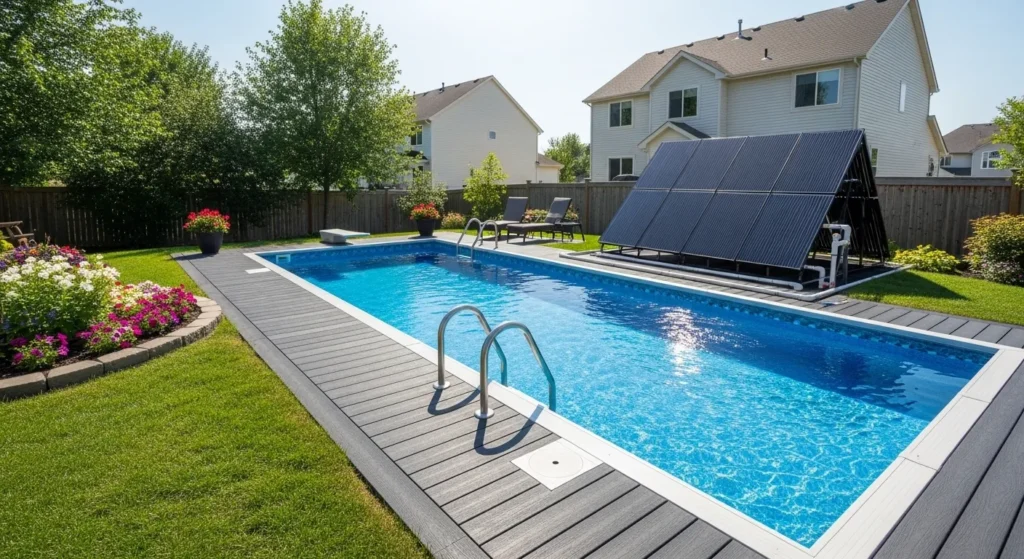
If you own an above ground pool, you already know the frustration: the water finally feels comfortable in late July, and by early September it’s too cold to swim again. A solar pool heater can stretch your swim season by weeks sometimes months without adding a single cent to your electric bill. But picking the right one isn’t as simple as grabbing the cheapest box on Amazon.
This guide walks you through everything that actually matters when choosing a solar pool heater for an above ground pool: sizing, collector types, flow rate, climate considerations, installation realities, and the mistakes that cause most solar heaters to underperform. We’ll also break down real costs, payback periods, and how to avoid the most common buying regrets.
How Solar Pool Heaters Actually Work
Before comparing products, it helps to understand the basic system, because every buying decision flows from this.
A solar pool heater pulls double duty with your existing filtration system. Pool water is pumped through your filter, then diverted through a solar collector (a panel, mat, or set of dome-shaped units), where it absorbs heat from the sun before flowing back into the pool. A flow control valve manual or automatic determines whether water goes through the collector or bypasses it.
The four core components are:
- Solar collector – where the actual heating happens
- Filter – keeps debris out of the collector
- Pump – your existing pool pump usually handles this
- Flow control valve – directs water through or around the collector
In hot climates, some systems can even be run at night to cool the pool by radiating heat back out — though this is rarely a priority for above ground pool owners.
Step 1: Understand the Two Main Collector Types
Most buying guides skip straight to product recommendations, but the collector type is the single biggest factor in how well your heater performs and it depends entirely on your climate and how long you want to swim.
Unglazed Collectors
Unglazed collectors are made from UV-treated rubber or heavy-duty plastic, with no glass covering. They’re the standard choice for above ground pools because:
- They’re significantly cheaper
- Easier to install (often just connect to your existing hose/filter line)
- Perform well in moderate climates during the main swim season
The tradeoff is efficiency in cooler weather. Once outside air temperatures drop, unglazed collectors lose heat faster than glazed ones.
Glazed Collectors
Glazed collectors use copper tubing on an aluminum plate, covered with tempered glass similar to a flat-plate solar water heater. They cost more but:
- Retain heat much better in cold or cloudy conditions
- Can extend swimming into shoulder seasons (spring/fall)
- Are sometimes dual-purpose, also capable of heating domestic hot water
For most above ground pool owners in moderate climates, unglazed collectors offer the best value. If you’re in a region with cool nights even during summer, or you want a longer swim season, glazed systems pay for themselves through extra usable weeks.
Both types require freeze protection if used in colder regions something many product pages don’t mention but is critical if you live anywhere that sees frost.
Step 2: Size Your Solar Heater Correctly (This Is Where Most People Go Wrong)
Undersizing is the #1 reason solar pool heaters disappoint buyers. A heater that’s “too small” for your pool will run, but you’ll barely notice a temperature change.
The Sizing Rule
Your collector area should equal 50% to 100% of your pool’s surface area, depending on climate:
| Climate | Recommended Collector Size |
|---|---|
| Warm, sunny year-round (e.g. Florida, Arizona) | 50%–80% of pool surface area |
| Moderate climate, 6-8 month swim season | 60%–80% |
| Cooler or cloudier regions, shorter season | 80%–100% |
Worked Example
Say you have a 16-foot round above ground pool. That’s roughly 201 square feet of surface area. In a moderate climate, you’d want a collector area of about 120–160 sq ft which usually means linking 2-3 standard panel units together, since most single units cover 32-48 sq ft.
For dome-style or mat-style heaters, manufacturers usually list a “rated gallon capacity” (e.g., “ideal for pools up to 8,000 gallons”). Match this to your actual pool volume, not your pool’s footprint and round up if you’re between sizes.
A Detail Most Guides Miss: Adding a Pool Cover Changes Your Math
Using a solar pool cover at night dramatically reduces heat loss, which means you can often get away with a smaller (cheaper) solar collector setup and still hit your target temperature. If budget is tight, pairing a smaller solar heater with a cover is often more cost-effective than buying a larger uncovered system.
Step 3: Check Your Sun Exposure and Site Conditions
A solar heater is only as good as the sunlight hitting it. Before buying, walk your yard and note:
- Hours of direct sunlight – Aim for 6-8 hours minimum. Less than that, and even a well-sized system will underperform.
- Shade sources – Trees, fences, sheds, or your house casting shadows during peak hours (10 AM–4 PM) will cut efficiency significantly.
- Available mounting space – Ground-mounted panels need flat, sun-facing space near the pool. Roof-mounted requires a south-facing roof (in the northern hemisphere) with enough structural area.
- Orientation – True south is ideal, but panels facing up to 45° east or west of south still perform reasonably well without major losses.
- Tilt angle – For summer-only use, tilt roughly equal to your latitude minus 10-15°. For year-round use, tilt closer to your latitude. That said, studies show flat-mounted panels (not tilted at all) still perform reasonably so don’t let a flat roof or yard be a dealbreaker.
Step 4: Match the Heater to Your Pump’s Flow Rate
This is the gap almost every buying guide leaves out — and it’s a leading cause of “my solar heater doesn’t work” complaints.
Most solar collectors are designed for a flow rate of roughly 3-7 gallons per minute (GPM) per panel. If your pool pump pushes water through too fast, the water doesn’t spend enough time in the collector to absorb heat. Too slow, and you’re not circulating enough volume to make a noticeable difference.
Before buying:
- Check your pump’s GPM rating (usually on a label or in the manual)
- Check how many collector panels/units the product is rated for at that flow rate
- If you’re adding multiple panels, look for products with a bypass kit this lets excess flow skip the collector instead of overwhelming it
If your numbers don’t line up, some installers recommend a smaller secondary pump dedicated to the solar loop — more common for larger setups, but worth knowing about if you’re scaling up later.
Step 5: Material Quality and Durability
Since the collector sits outside year-round, exposed to UV rays, pool chemicals, and weather, material quality determines how long it lasts and how well it performs over time.
Look for:
- UV-stabilized materials – prevents cracking and brittleness from sun exposure
- Corrosion and chemical resistance – pool chemicals (chlorine, etc.) will degrade lower-quality plastics over time
- Freeze tolerance or easy drain-down design – critical if you winterize your pool; collectors that can’t drain fully can crack in freezing temps
- Warranty length – ranges widely, from 1-2 years on budget dome heaters to 10-20 years on premium rigid panels
Step 6: Installation Considerations for Above Ground Pools
Above ground pools have some installation quirks that in-ground guides don’t address:
- Hose connections matter – Most solar heaters connect via flexible hose to your filter return line. Make sure the kit includes the right diameter adapters for your existing pump/filter hoses (commonly 1.25″ or 1.5″).
- Ground mounting vs. leaning against the pool wall – Lightweight dome and mat-style heaters can often lean against the pool’s exterior wall, angled toward the sun, with no permanent mounting needed. This is the easiest setup for renters or anyone who doesn’t want a permanent installation.
- Protecting your lawn – Curved or raised-leg panel designs reduce grass damage underneath compared to flat mats left in place all season.
- Linking multiple units – If you need more collector area than one unit provides, confirm the product explicitly supports daisy-chaining (linking inlet-to-outlet) without needing extra fittings purchased separately.
Step 7: Calculate Real Costs and Payback Period
According to the U.S. Department of Energy, a solar pool heating system typically costs between $2,500 and $4,000 installed, with a payback period of 1 to 7 years depending on local fuel costs and sun exposure. For above ground pools using smaller DIY-style kits, costs are often much lower frequently $200-$800 for a complete setup, since installation is simple enough to do yourself.
To compare collectors on value rather than price alone, the DOE recommends calculating Btu per day per dollar spent:
Btu/day ÷ collector price = Btu/day per dollar spent
A higher number means more heating output for your money. Most manufacturers list a thermal performance rating (Btu/ft²/day) — if two collectors are within about 25 Btu/(ft²/day) of each other, consider their performance roughly equivalent and let price/durability be the tiebreaker.
Common Mistakes to Avoid
- Buying based on pool gallons alone without checking surface area and sun exposure — a shaded 10,000-gallon pool may need a bigger system than a sunny 8,000-gallon one
- Ignoring flow rate compatibility, leading to weak performance even with a “correctly sized” collector
- Skipping a pool cover, especially overnight you lose much of the day’s heat gain to evaporation and radiation
- No backup heating plan for unexpectedly cold or cloudy stretches solar works best as your primary heater with realistic expectations about cloudy-day performance
- Forgetting winterization – collectors left full of water in freezing temps can crack, voiding warranties
Quick Decision Checklist
Before you buy, confirm you can answer yes to each:
- [ ] I know my pool’s exact surface area (not just gallons)
- [ ] My collector size covers at least 50-100% of that area based on my climate
- [ ] I get 6+ hours of direct sun on the mounting location
- [ ] The collector’s flow rate matches my pump’s GPM (or includes a bypass kit)
- [ ] The materials are UV and chemical resistant with a reasonable warranty
- [ ] I have a plan for winterizing/draining if I’m in a freeze-prone area
- [ ] I’m pairing it with a pool cover for overnight heat retention
If you can check every box, you’re set up for a solar heater that actually delivers rather than one that sits there looking good but barely moves the temperature needle.
Final Thoughts
The best solar pool heater for your above ground pool isn’t necessarily the most expensive or the most popular — it’s the one correctly sized for your pool’s surface area, matched to your sun exposure and climate, and compatible with your existing pump’s flow rate. Get those three things right, and even a budget-friendly unglazed collector can add 5-10°F to your pool and extend your swim season by weeks.
For more detailed technical guidance on sizing, collector efficiency ratings, and cost comparisons, the U.S. Department of Energy’s Solar Swimming Pool Heaters guide is an excellent authoritative resource worth bookmarking as you plan your purchase.

I Am Sarah Miller is a passionate writer focused on sustainability, eco-friendly living, and modern environmental solutions. Through her work, she aims to inspire readers to make smarter, greener choices for a better future. She regularly shares insights and practical tips on her website, ecopowersence.com.