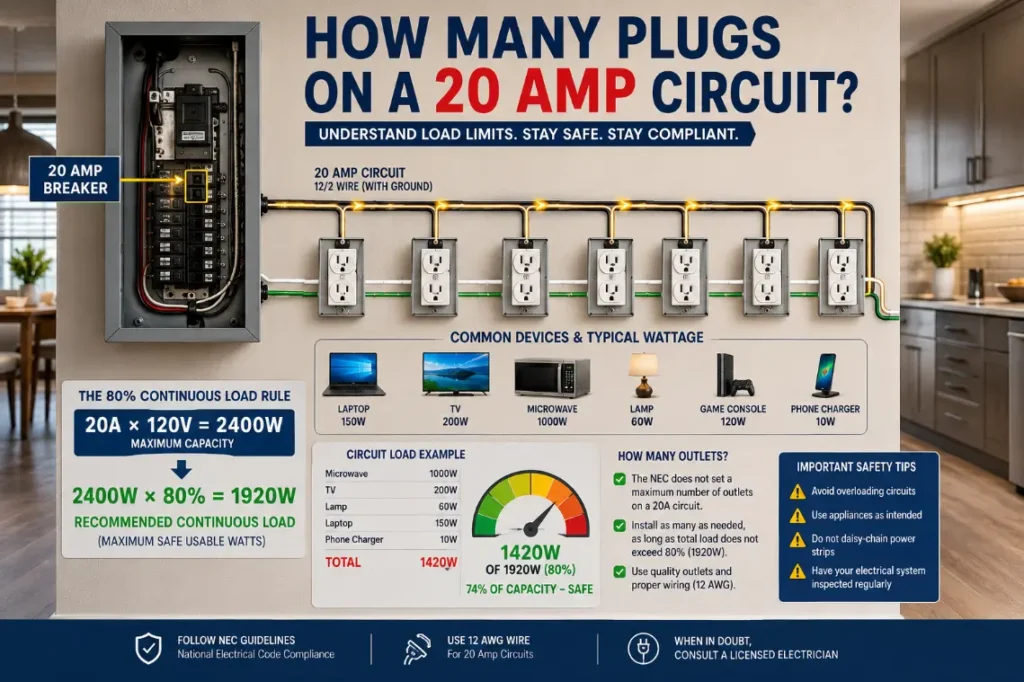
If you’re planning a new outlet, a garage workshop, or just wondering whether your kitchen circuit can handle one more appliance, the question “how many plugs can I put on a 20 amp circuit?” comes up constantly. The short answer is around 10 outlets, but the real answer depends on math, code guidelines, and what you’re actually plugging in.
This guide breaks down the numbers, explains the National Electrical Code (NEC) guidelines, and clears up a common point of confusion: using standard 15-amp receptacles on a 20-amp circuit.
The Quick Answer
A 20-amp, 120-volt circuit can safely support about 10 standard outlets, based on a simple calculation:
- Total circuit capacity: 20A × 120V = 2,400 watts
- Apply the NEC’s 80% continuous load rule: 2,400W × 0.8 = 1,920 watts
- Assume an average load of 1.5A (180W) per outlet: 1,920W ÷ 180W = 10.6, rounded down to 10 outlets
This is a planning guideline, not a hard legal cap the NEC doesn’t set a strict numeric limit for dwelling units. Most licensed electricians stop at 8–10 receptacles per circuit simply because it’s a practical, safe round number that leaves headroom for unexpected loads.
How Many 15A Receptacles on a 20A Circuit?
This is one of the most misunderstood parts of home electrical work and one most guides skip entirely.
Yes, you can legally install standard 15-amp duplex receptacles on a 20-amp circuit, as long as there are two or more receptacles on that circuit. The NEC permits this because no single 15A outlet is expected to draw the full 20A available the circuit’s wiring (typically 12 AWG) and breaker are rated for 20A, while each individual outlet is rated to handle 15A safely.
The rule changes only in one specific case:
- If only ONE receptacle is on the circuit, it must be rated for 20A (a 5-20R outlet, which has that extra slot shape).
- If multiple receptacles share the circuit, standard 15A duplex outlets are allowed.
This is exactly why most homes have ordinary-looking 15A outlets in kitchens and garages, even though the circuit breaker is rated for 20A. The wiring and breaker provide the 20A capacity; the outlets simply distribute that capacity across multiple devices.
Practical takeaway: when counting “how many plugs on a 20A circuit,” it doesn’t matter whether the receptacles themselves are rated 15A or 20A the 10-outlet planning guideline and 80% load rule still apply the same way.
Wire Gauge Matters More Than People Think
A common point of confusion is mixing up wire gauge with breaker size. The NEC pairs specific wire gauges with specific breaker ratings:
| Circuit Rating | Required Wire Gauge | Cable Color (NM Sheath) | Typical Use |
| 15A | 14 AWG | White | Bedrooms, living rooms, general lighting |
| 20A | 12 AWG | Yellow | Kitchens, bathrooms, garages, laundry |
| 30A | 10 AWG | Orange | Electric dryers, water heaters, large AC units |
The rule is simple but critical: the wire must be rated for at least the breaker’s amperage. A 20A breaker requires 12 AWG wire using 14 AWG on a 20A circuit is a code violation, because the wire can overheat and the insulation can melt before the breaker trips. The breaker protects the wire, not the other way around.
Interestingly, the reverse isn’t a problem: 12 AWG wire on a 15A breaker is perfectly fine (just more expensive than necessary), since thicker wire can always handle a lower amperage safely.
If you ever open an outlet box and see white-sheathed cable (14 AWG) connected to a 20A breaker, that’s a red flag worth having an electrician check it’s one of the most common wiring mistakes found during home inspections.
Real-World Examples by Room
Numbers are easier to understand with real scenarios. Here’s how the 10-outlet, 1,920-watt budget plays out in different rooms:
Home Office (20A circuit, ~8 outlets) A typical setup includes a desktop computer (200–300W), two monitors (30W each), a laser printer (400W when printing), a desk lamp (15W), and phone/laptop chargers (20–60W combined). Total active load: roughly 700–800W well within the 1,920W budget, even with all 8 outlets in use. This is why home offices rarely have circuit issues.
Kitchen Countertop (20A dedicated circuit, often just 4–6 outlets) A coffee maker (1,000W), toaster (1,200W), and blender (300W) running together already hit 2,500W over the 20A limit. This is exactly why the NEC requires at least two dedicated 20A small-appliance circuits in kitchens, and why countertop outlets are often split across multiple circuits even though they look identical.
Garage Workshop (20A circuit, ~6–8 outlets) A shop vacuum (1,000–1,400W), bench grinder (500W), and battery charger (100–200W) can add up quickly. Power tools like circular saws (1,400W) or compressors (1,000–1,500W startup surge) mean garages often benefit from a dedicated 20A circuit per major tool, especially for anything with a motor that draws a startup surge 2–3x its running wattage.
Living Room (15A circuit, ~6–8 outlets) A TV (100–200W), soundbar (50W), gaming console (150W), router (20W), and a few lamps (60W each) total well under 1,000W. A 15A circuit (1,440W safe limit) handles this comfortably, which is why living rooms are typically wired at 15A rather than 20A.
Why the Number Isn’t Fixed
The 10-outlet figure assumes an average load. In reality, what matters far more than the outlet count is what’s plugged in:
- Ten outlets powering lamps, phone chargers, and a router? No issue at all.
- Four outlets each powering a space heater, microwave, or window AC unit? You’ll trip the breaker fast.
This is why kitchens, laundry rooms, and garages areas with high-draw appliances often get dedicated 20A circuits with far fewer outlets, sometimes just one or two.
Devices That Typically Need Their Own 20A Circuit
According to NEC guidelines, the following appliances commonly require a dedicated circuit rather than sharing space with other outlets:
- Microwaves (built-in or high-wattage countertop units) typically 1,000–1,500W
- Dishwashers typically 1,200–1,500W
- Garbage disposals motor-driven, with high startup surge
- Washing machines 1,200W average, more for water heaters
- Window air conditioners 500W (small unit) to 1,500W (large unit)
- Portable space heaters almost always 1,500W, the maximum a 15A circuit can handle continuously
- Bathroom receptacle circuits NEC requires at least one dedicated 20A bathroom circuit, which can power all receptacles, lights, and fans within that single bathroom only
Common Mistakes to Avoid
Daisy-chaining extension cords and power strips. A power strip doesn’t increase circuit capacity it just adds more places to plug in on the same 1,920W budget. Three power strips on one outlet can still overload the circuit if the combined draw is too high.
Assuming all outlets in a room are on the same circuit. Many rooms especially kitchens and living rooms with multiple walls split outlets across two or more circuits specifically to spread the load. Tripping one breaker doesn’t always mean the whole room loses power.
Ignoring startup surge (inrush current). Motors in refrigerators, air compressors, and power tools can briefly draw 2–3x their running wattage when starting. A circuit that looks fine on paper can still trip if two motor-driven devices start at the same moment.
Using the wrong receptacle on a single-outlet circuit. If a circuit serves only one outlet (common for dedicated appliance circuits), that outlet must match the breaker rating a 20A breaker requires a 20A-rated receptacle (NEMA 5-20R) in that specific configuration.
Frequently Asked Questions
Can I put a refrigerator on the same 20A circuit as other outlets? It’s allowed by code in most jurisdictions, but many electricians recommend a dedicated circuit for refrigerators to avoid nuisance tripping from the compressor’s startup surge, especially if other appliances share the same circuit.
Is it safe to use a 20A breaker with 15A outlets throughout the house? Yes, as long as the circuit has 12 AWG wiring and two or more receptacles. This is actually standard practice in many homes the breaker and wire provide 20A capacity, while individual 15A outlets simply distribute that capacity safely.
How do I find out what’s on my circuit? Turn off one breaker at a time and check which outlets and lights lose power. Label your panel as you go most homes have this information missing or outdated, which makes troubleshooting much harder later.
Signs Your Circuit Is Overloaded
If you’re unsure whether your existing setup is within safe limits, watch for:
- Frequent breaker trips
- Outlets or switch plates that feel warm
- A burning plastic smell near outlets
- Lights dimming when an appliance turns on
Any of these signs mean it’s time to redistribute the load or call a licensed electrician to evaluate your panel and wiring.
Final Answer
For general planning purposes:
- 20A circuit, 120V → approximately 10 standard outlets (15A or 20A receptacles both work, as long as 2+ are present)
- 15A circuit, 120V → approximately 8 outlets
- The real limit is the 80% load rule (1,920W on a 20A circuit) not the number of holes in the wall
When in doubt, especially for kitchens, garages, and rooms with heavy appliances, consult a licensed electrician before adding new circuits or outlets. For full code details, refer to theNational Electrical Code (NEC) from the NFPA and energy safety resources fromEnergy.gov. Check Home For Smartoutdoor Tech

I am Dr. Marcus Reed is an author and researcher focused on sustainable energy, environmental innovation, and clean technology. He is passionate about helping readers understand the future of renewable energy and eco-friendly solutions. Through his writing, he aims to simplify complex energy topics for a wider audience. Learn more at ecopowersence.com.