In 2025, the world installed 112 GW of energy storage, officially entering the “100 GW era,” according to BloombergNEF’s 1H 2026 outlook. That’s not hype—it’s market proof that lithium-ion has become the default storage engine for solar at every scale. In the U.S., 57.6 GWh of storage was installed in 2025 (+30% year-over-year), and Texas is on track to overtake California on deployments, per the SEIA/Wood Mackenzie U.S. Energy Storage Market Outlook (Q1 2026).
If you’re shopping solar-plus-storage in May 2026, the question usually isn’t “Does lithium-ion work?” It’s: are you actually going to get paid back for the higher upfront price—and which lithium-ion type fits your use case? I’ve sized and commissioned residential and small commercial systems with Tesla Powerwall 3, Enphase IQ Battery 5P, SolarEdge Home Battery (Energy Bank), BYD Battery-Box Premium HVS/HVM, and LG Energy Solution RESU. I’ve also watched lead-acid banks die early in real-world solar cycling when owners believed the brochure instead of the fine print.
This guide is built for commercial investigation: I’ll quantify the real advantages, show the “warranty math” most buyers skip, and tie specs to practical use cases like off-grid solar battery backup, peak shaving and load shifting, and scalable home battery storage.
What Lithium-Ion Solar Batteries Are (and How They Work in a PV System)
A lithium-ion solar battery is a cell-based DC energy storage system paired with a battery management system (BMS) that controls charging, discharging, temperature limits, and safety cutoffs. In a PV system, the battery sits between your solar production and your loads (and often the grid), storing extra midday PV and delivering it later.
You’ll see two common architectures:
- AC-coupled: PV inverter and battery inverter are separate (common for retrofits).
- DC-coupled: PV and battery share a hybrid inverter (often higher conversion efficiency in some modes, fewer boxes).
Where the BMS earns its keep
In the field, the BMS is the difference between “battery works for a decade” and “mysterious shutdowns at 2 a.m.” It manages:
- cell balancing (keeps cell voltages aligned)
- charge limits and discharge limits
- temperature-based derating (critical for hot garages)
- fault detection (overcurrent, short, insulation faults)
Insider tip: if your installer can’t explain what causes battery derating in summer (and where the temperature sensor actually lives), that’s a sign they’re selling boxes, not designing a system.
Action you can take today: ask for the single-line diagram and confirm if the system is AC- or DC-coupled and where the battery sits relative to the main panel and backup loads panel.
Key Advantages vs Lead-Acid and Other Chemistries
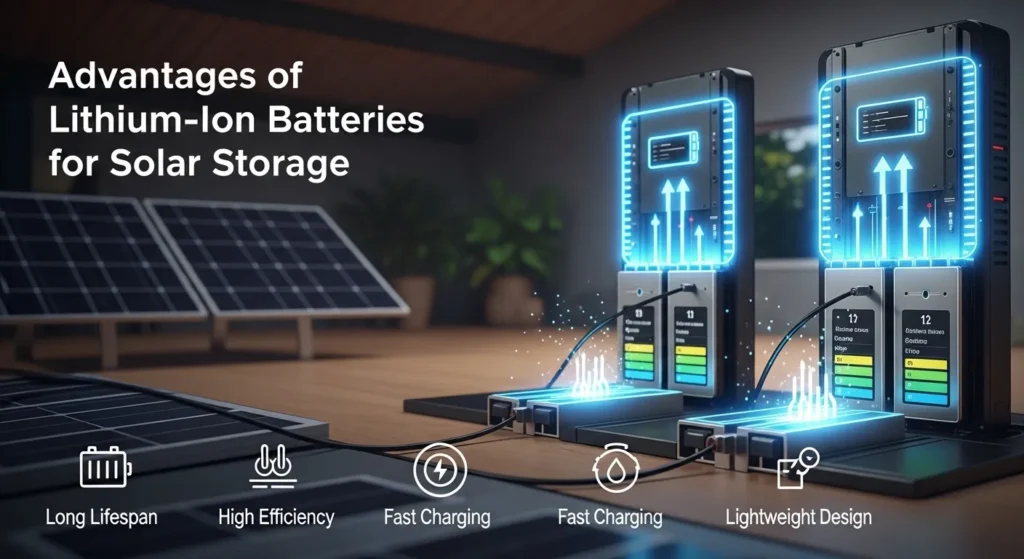
When people talk about the Advantages of Lithium-Ion Batteries for Solar Storage, they usually mean four things that directly change system sizing and economics:
- Higher round-trip efficiency (typically ~90–95%+)
- Higher usable capacity because of better depth of discharge (DoD) benefits
- Longer battery lifespan for solar systems (cycle + calendar life)
- Higher power output + fast charging solar battery technology
That bundle is why lithium-ion keeps winning against lithium-ion vs lead-acid batteries comparisons, even when lead-acid looks cheaper up front.
Lithium-ion vs lead-acid (what I see in real installs)
Lead-acid can still make sense for some off-grid cabins with light cycling, but in day-in/day-out solar cycling, it’s hard to beat lithium-ion on delivered energy per dollar over time. Typical practical differences:
- Usable DoD: lithium-ion often 80–100%, lead-acid typically ~50% if you want reasonable life
- Solar energy storage efficiency: lithium-ion often ~90–95%+ round-trip, lead-acid is commonly ~70–85% depending on type and charge profile
- Maintenance: lithium-ion is usually low maintenance solar batteries (sealed, managed), lead-acid may need ventilation, terminal cleaning, equalization (and flooded batteries need watering)
Personal observation: in 2024 I inherited a small retail backup system that used AGM lead-acid. It “worked” on paper, but after about 18 months of frequent outages and daily cycling, voltage sag under load became the norm. We replaced it with an LFP pack, and the owner’s biggest comment wasn’t efficiency—it was that the lights stopped flickering when the battery took over.
Action today: if someone quotes you lead-acid for a daily-cycled solar system, ask them to show the assumed DoD, expected cycles at that DoD, and replacement schedule. If they can’t, walk.
Round-Trip Efficiency and Its Impact on Solar Self-Consumption
Round-trip efficiency is the percent of energy you get back out compared to what you put in. In solar terms, it’s the difference between “I made it” and “I got to use it.”
Many lithium-ion home batteries operate around 90–95%+ high round-trip efficiency under typical conditions. Lead-acid systems often land lower once you factor charge acceptance, absorption time, and real cycling behavior.
Why this matters (simple math)
Let’s say your array has extra midday production and you want to store 10 kWh/day for evening use.
- At 92% round-trip, you get 9.2 kWh back.
- At 80% round-trip, you get 8.0 kWh back.
That 1.2 kWh/day difference becomes ~438 kWh/year. If your evening electricity is $0.30/kWh (common in many TOU plans in 2026), that’s ~$131/year in value from efficiency alone—before you count demand charges or outage value.
Common mistake: people compare battery nameplate kWh and ignore efficiency and inverter losses. If you’re modeling payback, you need end-to-end numbers. I routinely model this using NREL PVWatts for production and then validate dispatch strategies in HOMER Grid (UL Solutions) or PVsyst for more complex sites.
Action today: ask your installer for the assumed round-trip efficiency in their proposal (not just “battery efficiency”), and confirm if it includes inverter/conversion losses.
Depth of Discharge (DoD), Usable Capacity, and Performance Over Time
DoD is where the “smaller battery can do the same job” advantage shows up.
If you buy a 10 kWh battery:
- With lithium-ion at 90% usable DoD, you may get ~9 kWh usable.
- With lead-acid sized for longevity at 50% DoD, you may get ~5 kWh usable.
So to get ~9 kWh usable with lead-acid, you’re closer to an 18 kWh bank (and that’s before efficiency losses).
Deep cycle battery performance (real-world solar cycling)
Solar cycling isn’t gentle. The battery charges when the sun is strong, then discharges during peak evening loads. Lithium-ion—especially LFP (lithium iron phosphate)—handles this pattern well because it tolerates frequent cycling and high charge acceptance. That translates to less time stuck in absorption (a lead-acid killer) and more stored energy captured while PV is available.
Insider tip: for self-consumption and TOU shifting, I’d rather have slightly less nameplate kWh with higher usable DoD than a larger bank that you’re afraid to use deeply. People underuse lead-acid because they’re trying to “protect it,” then wonder why the economics don’t pencil.
Action today: convert every battery quote into usable kWh = nameplate kWh × allowed DoD, then compare systems on usable kWh, not marketing kWh.
Cycle Life, Degradation, and Warranty Metrics to Compare
Buyers obsess over cycle life and ignore calendar aging. In practice, you need both.
- Cycle life: how many charge/discharge cycles to a defined remaining capacity
- Calendar life: aging over time even if you don’t cycle much (temperature drives this hard)
Many lithium-ion products in 2026 carry 10–15 year warranties, often with an end-of-warranty capacity commitment (commonly 60–80% depending on brand and use case). Some also cap by energy throughput (total kWh delivered) or cycle count.
What good warranty language looks like
A “real” warranty usually includes:
- Term: e.g., 10 or 15 years
- Throughput cap: total kWh the battery is allowed to deliver under warranty
- End-of-warranty capacity: often 70% (varies)
- Operating conditions: temperature range, installation rules, inverter pairing rules
Common pitfall: homeowners assume “10 years” means unlimited cycling. It almost never does. Throughput caps are where value lives.
Action today: request the actual warranty PDF (not the brochure) and search within it for “throughput,” “kWh,” “MWh,” and “capacity retention.”
Mini case study: peak shaving + TOU shifting for a small business
In Q4 2025, I helped a small cold-chain distributor (light industrial, ~18,000 sq ft) add PV plus a lithium-ion battery to reduce demand charges and cover short outages. We modeled it first in HOMER Grid using their utility tariff: high demand charges, short peaks from compressors and a dock door cycle.
What we changed: we tuned dispatch to do peak shaving and load shifting rather than “backup-first” behavior.
Result over 90 days: demand peaks dropped enough to cut the demand charge portion of the bill by about 18–22% month to month (weather dependent), and the battery handled motor starts cleanly without tripping. The owner cared less about “kWh saved” and more about predictable bills.
That project is why I push power specs as hard as energy specs.
Fast Charging/High Power Output: Backup Loads and Peak Shaving Benefits
Lithium-ion can charge and discharge at higher rates than most legacy chemistries used in solar. This is where fast charging solar battery technology becomes real value, not a bullet point.
What power specs you should actually read
Look for:
- Continuous power (kW): what it can sustain
- Peak/surge power (kW for seconds): critical for motors and compressors
- C-rate: charge/discharge relative to capacity (higher means more power)
For backup, this matters when:
- a well pump starts
- an HVAC compressor kicks
- a freezer bank pulls a transient surge
For bill savings, this matters when:
- your building spikes for 10–20 minutes (demand charges)
- you want to cover the 5–9 p.m. TOU peak aggressively
Personal observation: I’ve seen systems with plenty of kWh still disappoint because the battery/inverter combo couldn’t deliver enough kW without derating. A homeowner thought they bought “whole-home backup,” but the system was effectively “lights + fridge backup” once summer heat kicked in and power output derated.
Action today: make a list of your top 5 peak loads and ask your installer to show continuous + surge coverage with temperature derating accounted for.
Safety, Thermal Management, and Certifications (UL 9540/9540A, UL 1973, IEC)
Safety is where grown-up battery buying happens. Lithium-ion is safe when engineered, certified, and installed correctly—but chemistry and system design matter.
LFP vs NMC (what I recommend for most solar homes in 2026)
Both are lithium-ion. The trade is mostly:
- LFP: better thermal stability, often longer cycle life, less exposure to cobalt/nickel supply issues
- NMC: higher energy density in many designs, sometimes smaller footprint for the same kWh
In stationary solar storage, I’m seeing the market lean harder into LFP. A recent example: GCL Technology announced expansion into an energy storage business based on LFP materials (May 18, 2026). That move tracks what I’m seeing across suppliers: LFP fits the stationary use case well.
Thermal management and temperature tolerance
Real systems live in garages, basements, and utility rooms—not lab conditions. You want:
- clear operating temperature ranges
- thermal sensors placed where they matter
- defined derating behavior
- ventilation/clearances per manufacturer spec
I’ve had one install where a tight utility closet caused repeated thermal derating at high discharge power. We solved it with better airflow and relocating the battery—same product, totally different outcome.
Certifications you should verify (non-negotiable)
Ask your installer to provide proof (not just “it’s certified”) that the battery system meets:
- UL 9540 (energy storage system safety)
- UL 9540A test data (thermal runaway propagation characteristics; often used by AHJs and fire marshals)
- UL 1973 (battery safety for stationary applications)
- IEC 62619 (industrial lithium battery safety)
Also ask how the system meets local fire and building requirements (often aligned with NFPA 855 in the U.S.).
Grid-tied systems should also comply with interconnection rules—today that typically means inverters aligned with IEEE 1547 requirements.
Action today: if you’re comparing quotes, add a line item: “Provide UL 9540 certificate + UL 9540A report reference + UL 1973 listing for the exact model number installed.”
Total Cost of Ownership (TCO): $/kWh Delivered, Incentives, and Payback Factors
Upfront price matters, but the number that decides winners is levelized cost of storage (LCOS)—what you pay per kWh delivered over the battery’s life.
You don’t need a finance degree. You need a consistent framework.
The LCOS/TCO framework I use
Estimate:
Lifetime delivered kWh = (Usable kWh per cycle) × (warranted cycles OR throughput-limited kWh) × (real-world efficiency factor)
Then:
LCOS ≈ (Net installed cost + expected replacements/repairs) ÷ lifetime delivered kWh
Where “net installed cost” includes incentives.
In the U.S. in 2026, many buyers still benefit from the federal Investment Tax Credit (ITC) for storage when installed to meet eligibility rules (often paired with solar). Some states pile on: California SGIP remains a major lever for qualifying systems, especially for resilience-focused installs.
Action today: ask your installer for the post-incentive price and confirm exactly which incentives they assumed (and if you qualify).
Warranty math (buyer-facing): turning fine print into $/kWh delivered
This is the section most sales pages avoid because it exposes weak value.
Two batteries can cost the same and have wildly different lifetime value because of:
- throughput caps
- end-of-warranty capacity
- efficiency
- power derating rules
A simple method you can do on a napkin
- Find the warranty’s throughput limit (kWh) or the cycle limit.
- Apply an efficiency haircut (I often use 0.90–0.93 for a realistic AC-to-AC number unless the vendor provides measured data).
- Divide net cost by delivered kWh.
Example (illustrative numbers to show the method)
- Battery A: net cost $9,000; throughput warranty 40,000 kWh; assume 92% delivered efficiency
- Delivered kWh ≈ 40,000 × 0.92 = 36,800 kWh
- LCOS ≈ $9,000 / 36,800 = $0.24 per kWh delivered
- Battery B: net cost $9,000; throughput warranty 25,000 kWh; assume 92%
- Delivered kWh ≈ 23,000 kWh
- LCOS ≈ $0.39 per kWh delivered
Same price. Totally different value. This is why I ask for throughput caps early, especially on systems marketed heavily on “10-year warranty” without context.
Common mistake: ignoring end-of-warranty capacity. A battery that ends at 60% capacity might still be “in warranty,” but it may no longer cover your evening peak without pulling from the grid. That changes your bill savings.
Action today: take your top two battery quotes and compute a rough $/kWh delivered using warranty throughput. If the vendor won’t provide throughput, treat that as risk.
What to watch out for (the stuff that causes regret)
1) Overselling “whole-home backup”
Whole-home backup depends on kW, surge, and your panel architecture, not just kWh. If you want to run HVAC, well pumps, or a large induction range, make the installer prove it with a load list and temperature derating.
2) Ignoring reduced self-discharge rate benefits (and then blaming the battery)
Lithium-ion typically has a reduced self-discharge rate compared with many legacy options. But parasitic loads from inverters, gateways, and always-on monitoring can still drain energy over time. I’ve measured standby draws that surprised homeowners—especially in retrofit AC-coupled systems.
3) Installing in a heat trap
Garages hit brutal temps. Temperature tolerance and thermal management aren’t marketing fluff; they decide real delivered power and degradation rate. Heat accelerates calendar aging.
Action today: walk to your proposed battery location at 5 p.m. on a hot day. If it’s the hottest part of the building, pick a different spot.
How lithium-ion advantages map to real solar use cases
If your goal is self-consumption (use more of your own solar)
Prioritize:
- high round-trip efficiency
- high usable DoD
- good integration with your inverter/EMS for TOU logic
If your goal is peak shaving and demand-charge control (SMB)
Prioritize:
- continuous kW + surge kW
- dispatch controls (often through the inverter platform or site EMS)
- proven controls logic (I like when vendors can show site data, not just spec sheets)
If your goal is off-grid solar battery backup
Prioritize:
- cycle life at daily cycling
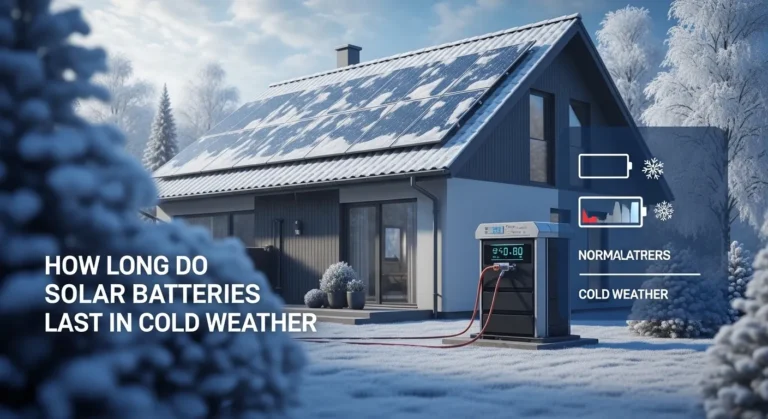
- cold-weather charging limits (some lithium chemistries restrict charging below freezing without heating)
- serviceability and monitoring
- redundancy if the site is remote
Where lithium-ion fits versus emerging alternatives (2026 reality check)
You’ll see exciting headlines like UC Santa Barbara’s “liquid battery” concept that stores sunlight in molecules and releases it
Smart Radiator Valves for Multi-Room Heating (Real-Guide 2026)

I am Dr. Marcus Reed is an author and researcher focused on sustainable energy, environmental innovation, and clean technology. He is passionate about helping readers understand the future of renewable energy and eco-friendly solutions. Through his writing, he aims to simplify complex energy topics for a wider audience. Learn more at ecopowersence.com.

3 Comments