Every year, the global oil palm industry generates over 55 million tonnes of agricultural waste — empty fruit bunches, palm kernel shells, mesocarp fibers, and mill effluent. Most of it gets burned or dumped. Meanwhile, cities worldwide spend billions maintaining streetlights that lose 30–40% of their efficiency within months due to dust and grime buildup on solar panels. The self-cleaning streetlight oil palm waste concept solves both problems simultaneously — turning agricultural residue into renewable energy while automating the maintenance that kills traditional solar lighting performance.
This is not a distant concept. Pilot programs are already running across Southeast Asia and West Africa. Furthermore, smart city planners in tropical urban centers are actively evaluating this technology as part of broader sustainability infrastructure goals.
What Is a Self-Cleaning Streetlight Using Oil Palm Waste?
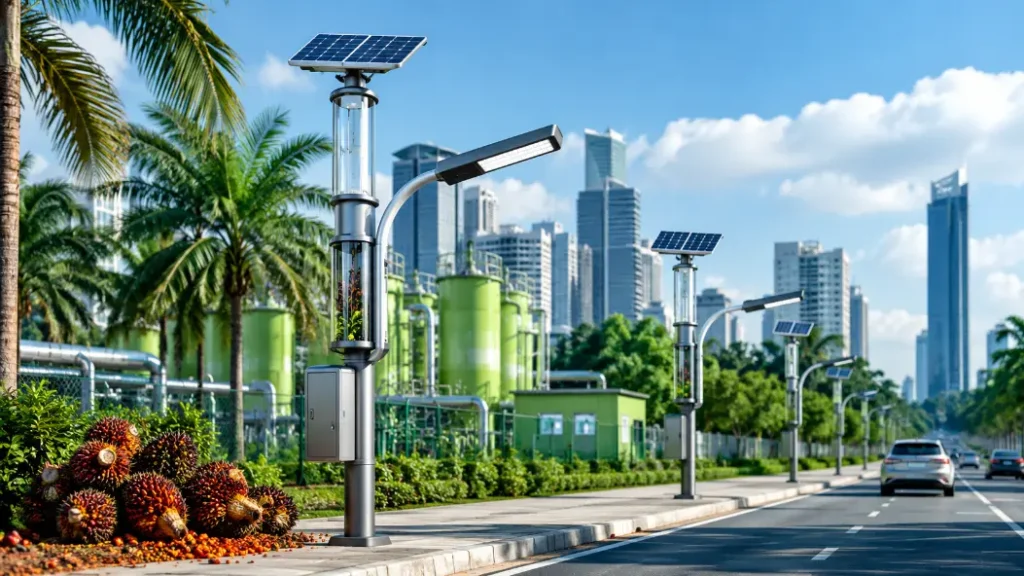
A self-cleaning streetlight is a solar-powered outdoor light that maintains its own cleanliness without needing workers to climb up and wipe the panels by hand. The oil palm waste component adds a second innovation layer — replacing or supplementing conventional grid power with energy generated from agricultural biomass that would otherwise go to waste.
The system combines three core technologies:
- Biomass energy conversion — palm waste converted to biogas or biofuel powers the light during cloudy periods and nighttime
- Hydrophobic self-cleaning coating — derived from palm oil fuel ash (POFA), repels dust, water, and debris from the optical surface automatically
- Solar PV panel — primary daytime charging source, protected by the self-cleaning coating for sustained efficiency
Consequently, the result is a streetlight that charges itself, cleans itself, and draws backup power from locally available agricultural waste — requiring minimal human maintenance after installation.
The Oil Palm Waste Problem — And the Opportunity
Palm oil production is one of the most significant agricultural industries on the planet. According to the USDA Foreign Agricultural Service, global palm oil production exceeded 77 million metric tonnes in 2024/2025. Furthermore, the Council of Palm Oil Producing Countries (CPOPC) estimates that for every tonne of crude palm oil produced, approximately 4–5 tonnes of solid waste residue are generated.
This waste stream includes:
- Empty fruit bunches (EFB) — the largest single waste category, typically burned or composted
- Palm kernel shells (PKS) — hard biomass suitable for combustion energy generation
- Mesocarp fiber — fibrous residue with moderate energy content
- Palm oil mill effluent (POME) — liquid waste rich in biogas-producing organic matter
These by-products, historically considered waste, can now be transformed into renewable energy sources for palm biomass powered smart lights. Additionally, palm oil fuel ash — the residue from burning palm biomass — contains silica compounds with natural hydrophobic properties, making it a low-cost raw material for self-cleaning surface coatings.
How the Self-Cleaning Mechanism Works
The POFA Hydrophobic Coating
Palm oil fuel ash (POFA) forms the basis of the self-cleaning coating used on the solar panel surface and optical lens cover. When processed and applied as a nanoparticle coating, POFA creates a superhydrophobic surface — water droplets bead and roll off instantly, carrying dust particles with them.
Self-cleaning street light palm oil keeps 95% power all year, compared to conventional solar streetlights that lose 30–40% efficiency within months. The coating requires no active mechanical component — rain and morning dew provide sufficient surface moisture to trigger the self-cleaning action automatically.
Research published in Surface & Coatings Technology confirms that POFA-derived silica coatings achieve contact angles above 150° — the threshold for superhydrophobic behavior — when applied at nanoparticle concentrations between 0.5–2% by weight.
Automated Wiper Systems — Secondary Cleaning Layer
In extremely arid environments where rainfall is insufficient to activate the hydrophobic coating, some implementations add a small automated microfiber wiper driven by a low-power motor. The wiper activates on a timer — typically once every 48–72 hours — consuming less than 0.5Wh per cleaning cycle. Consequently, the energy cost of self-cleaning is negligible relative to the efficiency gains from maintaining a clean panel surface.
The Biomass Energy System
Converting Palm Waste to Power
Oil palm waste can be converted into biomass energy or biofuel through controlled processing methods. This process generates electricity that can be stored and used to power streetlights during nighttime hours.
Two primary conversion pathways exist:
Biogas via anaerobic digestion — POME and EFB fed into anaerobic digesters produce methane-rich biogas. This biogas fuels a micro-generator providing backup power when solar input is insufficient. Furthermore, the digestion residue produces organic fertilizer, closing the agricultural waste loop completely.
Direct biomass combustion / gasification — PKS and mesocarp fiber burn in small-scale gasifiers producing syngas for electricity generation. This pathway suits plantation-road installations where the palm mill is on-site and waste feedstock is continuously available.
Energy Storage Integration
Modern implementations combine lithium iron phosphate (LiFePO4) battery storage with the biomass backup system. Solar charges the battery during daylight hours. Consequently, biomass generation activates only when battery state-of-charge falls below a set threshold — typically 20% — minimizing fuel consumption while ensuring uninterrupted lighting.
According to the International Renewable Energy Agency (IRENA), hybrid solar-biomass systems achieve energy availability rates above 99% in tropical climates — outperforming pure solar installations that drop to 85–90% availability during extended cloud cover periods.
Environmental Impact — Real Numbers
One hundred self-cleaning palm waste streetlights stop 40 tonnes of CO2 each year — equivalent to taking eight cars off the road. Waste becomes power. Empty fruit bunches and mill effluent turn into fuel or coating material. Nothing goes to landfill.
The carbon accounting works at three levels:
Avoided emissions from waste burning — Open burning of EFB and PKS releases CO2, methane, and black carbon. Converting this waste to controlled energy generation eliminates uncontrolled burning emissions entirely.
Grid electricity displacement — Each streetlight running on palm biomass and solar removes approximately 400–600 kWh of annual grid electricity demand, depending on wattage and operating hours.
Avoided panel replacement — Conventional solar streetlights require panel replacement every 3–5 years due to efficiency degradation from surface contamination. Self-cleaning POFA-coated panels maintain efficiency for 10–15 years, reducing the manufacturing carbon footprint by 60–70% over the installation lifetime.
Furthermore, the EPA’s Renewable Energy and the Environment guidelines classify biomass waste-to-energy conversion as carbon-neutral when the feedstock comes from agricultural residue — meaning the system qualifies for carbon credit programs in most jurisdictions.
Where This Technology Is Being Deployed
Southeast Asia — The Primary Market
Malaysia and Indonesia together account for approximately 85% of global palm oil production. Both countries run active research programs exploring biomass energy from agricultural waste, and both have government initiatives targeting the environmental impact of their palm oil industries.
Streetlight pilot programs combining solar power with palm biomass backup have been explored at plantation roads, rural highways, and industrial estate perimeters in these countries. Malaysia’s Green Technology Master Plan specifically identifies palm biomass as a priority renewable energy source for rural electrification through 2030.
West Africa and Latin America — Emerging Markets
Nigeria, Ghana, Colombia, and Ecuador operate growing palm oil sectors where this technology is realistically deployable. In these regions, rural electrification remains a significant challenge — grid extension costs are prohibitive, but palm waste feedstock is locally abundant. Consequently, self-cleaning palm waste streetlights offer a compelling off-grid solution that does not require external fuel supply chains.
Smart City Applications
Beyond plantation roads and rural highways, smart city planners in tropical urban centers evaluate this technology for integration with IoT lighting management systems. By 2030, experts predict most new plantation roads will use this tech. Phones will talk directly to lights. Lights will change brightness when trucks come. AI will predict when a panel needs extra care.
Key Technical Specifications — What to Look For
When evaluating self-cleaning streetlight systems based on oil palm waste technology, these are the specifications that determine real-world performance:
Self-cleaning coating contact angle — Minimum 150° for superhydrophobic performance. Coatings below 130° provide limited self-cleaning benefit in low-rainfall environments.
Solar panel efficiency retention — Quality POFA-coated panels maintain above 93% efficiency at 12 months. Uncoated panels in equivalent environments typically retain 65–70%.
Biomass backup capacity — Size the biogas or gasification system for a minimum 5-day equivalent storage capacity. This covers extended low-solar-irradiance periods without grid dependency.
Battery chemistry — LiFePO4 chemistry is mandatory for tropical climate installations. Standard lithium-ion degrades significantly above 45°C ambient temperature, which plantation and tropical urban environments routinely exceed.
LED efficacy — Minimum 150 lumens per watt. Modern LED fixtures at this efficacy level reduce total system energy demand by 40% compared to older 100 lm/W fixtures, directly reducing the required biomass backup capacity.
Economic Case — Cost vs. Conventional Streetlighting
The upfront cost of a self-cleaning palm waste streetlight system is 25–40% higher than a conventional solar LED streetlight. However, the total cost of ownership over 10 years reverses this comparison decisively.
A conventional solar streetlight requires:
- Panel cleaning every 3–6 months at $15–$30 per service visit
- Panel replacement at years 3–5 due to efficiency degradation: $80–$150 per unit
- Battery replacement at year 4–6: $60–$120 per unit
A self-cleaning palm waste system requires:
- No routine cleaning labor
- Panel replacement deferred to years 10–15
- Biomass fuel sourced locally at near-zero cost from existing agricultural waste streams
Furthermore, municipalities that qualify palm waste energy under renewable energy incentive programs can access subsidies that offset 20–35% of initial capital costs in Malaysia, Indonesia, and several West African nations.
Challenges and Honest Limitations
No technology is without trade-offs. Self-cleaning streetlight oil palm waste systems face three genuine challenges:
Feedstock supply chain reliability — The biomass backup system requires consistent palm waste supply. Seasonality in palm oil production creates feedstock availability gaps of 2–3 months annually in some regions. Consequently, system designers must size battery storage to bridge these gaps without biomass input.
POFA coating durability in saline coastal environments — Salt air accelerates coating degradation. Coastal installations require recoating every 4–5 years rather than the standard 10–15 year interval. This increases maintenance requirements for coastal urban deployments.
Sustainable sourcing verification — Palm oil production carries significant deforestation risk. According to the Roundtable on Sustainable Palm Oil (RSPO), only RSPO-certified palm waste sources guarantee that feedstock does not drive forest conversion. Municipalities and infrastructure developers must require RSPO certification for any palm waste energy supply contract to ensure genuine environmental benefit.
The Road Ahead
The self-cleaning streetlight oil palm waste concept represents a genuine convergence of circular economy principles and smart infrastructure engineering. It converts a massive agricultural waste problem into a distributed renewable energy asset, while solving the efficiency degradation that undermines conventional solar lighting in tropical environments.
The International Energy Agency’s World Energy Outlook identifies agricultural waste-to-energy as one of the fastest-growing renewable energy segments in Southeast Asia and Sub-Saharan Africa through 2030. Furthermore, falling LiFePO4 battery costs and improving POFA coating formulations are making the economics increasingly competitive with conventional grid-connected streetlighting.
For ecopowersence.com readers tracking the intersection of renewable energy, smart home automation, and eco-friendly infrastructure — this is precisely the kind of technology that bridges laboratory innovation and real-world community impact. It is not a conceptual prototype. It is already lighting roads in palm country. And consequently, it is coming to more cities faster than most urban planners currently expect.
Last updated: June 2026 | ecopowersence.com — Bridging green tech engineering and the everyday consumer.

I Am Sarah Miller is a passionate writer focused on sustainability, eco-friendly living, and modern environmental solutions. Through her work, she aims to inspire readers to make smarter, greener choices for a better future. She regularly shares insights and practical tips on her website, ecopowersence.com.