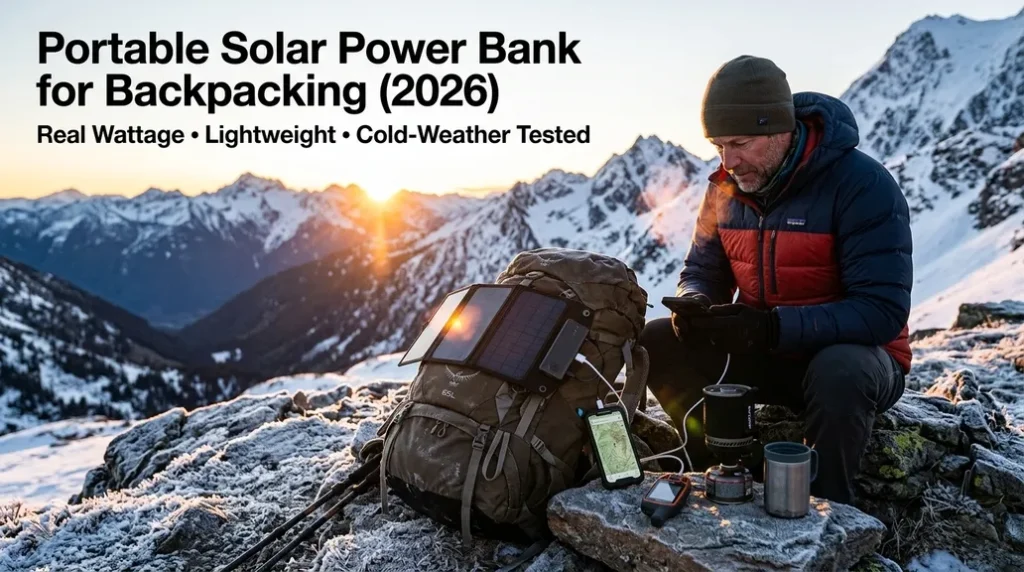
Last September on the Wonderland Trail, I watched a hiker clip a “solar power bank with panels” to his pack for three straight days under mixed clouds and tree cover. By camp on day three, his phone battery had gone down, not up. That’s the dirty secret of most “solar charger power bank” setups: the built-in panel is usually a trickle charger, not a backcountry energy solution.
If you’re here to find a portable solar power bank forbackpackin that will reliably keep a phone (and maybe a headlamp, GPS, or inReach) alive off-grid, I’m going to focus on what matters in 2026: delivered watt-hours per gram, real USB-C PD output, and realistic solar harvest under trail sun not the marketing wattage printed on a box.
What to Look for in a Portable Solar Power Bank for Backpacking (Buyer Checklist)
Here’s the checklist I use when I’m picking a backpacking solar power bank for clients and for my own trips. You can apply it in 10 minutes while shopping.
1) Capacity you can actually use (Wh, not just mAh)
Most banks advertise mAh, but what matters for trip planning is watt-hours (Wh)—and how much of that you’ll actually get after conversion losses.
Rule of thumb (real-world usable energy):
Plan on 70–85% usable from a quality bank (voltage conversion + heat + cable losses). In cold weather, assume the low end.
2) USB-C PD output (minimum 18W; I prefer 30W)
For 2026 phones and satellite messengers, USB-C PD 3.0 matters more than “QC” logos.
- Minimum I recommend: 18W USB-C PD
- Better: 30W USB-C PD (charges faster during short town stops, and handles multi-device days better)
- Best for “one bank for everything”: 45W if you might charge a small camera battery hub or a tablet
Look for banks that state their PD profiles clearly (e.g., 5V/3A, 9V/3A, 12V/2.5A). PPS (Programmable Power Supply) support is a nice bonus for newer Samsung/Pixel devices because it can improve efficiency and reduce heat.
3) Weight-to-energy ratio (the metric most pages ignore)
Backpacking is a math problem disguised as gear choice.
A strong target for 2026 lithium-ion banks:
- Good: ~0.25–0.35 Wh per gram (25–35 Wh per 100 g)
- Okay: ~0.20–0.25 Wh per gram
- Heavy for the energy: under 0.20 Wh per gram
A “rugged waterproof solar power bank” often loses this game because rubber armor and a token solar panel add weight without adding usable daily energy.
4) Durability you can verify (IP ratings + port covers)
Ignore “water-resistant” unless there’s an actual IEC 60529 IP rating.
- Minimum for backpacking: IPX4 (splash-resistant) if you keep it in a bag
- Better: IP65/IP66 for dusty desert trips and wind-driven rain
- True dunk protection: IP67 (rare in high-performance PD banks)
Also check the port cover design. I’ve seen “waterproof” banks fail because the silicone flap popped open inside a wet side pocket.
5) Solar: decide early integrated panel vs separate foldable panel
This is the biggest fork in the road:
- Integrated mini-panel power banks: usually 0.5–2W effective in real conditions
- Separate foldable solar charger: realistically 5–20W effective depending on size, sun, and controller
If your daily needs are more than “tiny top-offs,” you’ll want a foldable solar charger plus a normal bank.
Solar Panel Performance in the Backcountry: Sun Conditions, Angles, and Real-World Wattage
Solar in the backcountry is legit when you treat it like solar, not like a magic sticker panel.
The reality check: what you’ll harvest per day (2026 trail math)
Using NREL irradiance averages and what I see on trail in the Rockies and Sierra, here’s a realistic expectation for delivered energy into a bank on a typical summer backpacking day (not a lab bench):
- Full sun, good angle, minimal shade: ~60–80% of rated panel watts into USB (best case)
- Partial clouds / shoulder sun: ~25–50%
- Forest canopy / wrong angle on pack: often 5–20%
So a “10W” panel:
- Best case: 6–8W into your device
- Mixed conditions: 2.5–5W
- Canopy/pack angle mess: 0.5–2W
Typical hours needed to recover 10–20Wh/day
Most backpackers I work with need 10–20Wh/day (phone + headlamp + GPS/inReach top-offs). Here’s what that looks like:
- 5W panel (real 2–3W average):
10Wh takes ~3–5 hours of decent sun
20Wh takes ~6–10 hours (often unrealistic in forests) - 10W panel (real 4–6W average):
10Wh takes ~2–3 hours
20Wh takes ~4–5 hours - 20W panel (real 8–12W average):
10Wh takes ~1–1.5 hours
20Wh takes ~2–3 hours
These aren’t “marketing hours.” These are the numbers I plan with.
Why integrated mini-panels are slow (even in perfect sun)
Most solar power banks with panels have:
- Tiny panel area (physics problem)
- No real MPPT (Maximum Power Point Tracking)
- Poor airflow when strapped to a pack (heat reduces output)
- Bad angles (a panel flat against your back isn’t facing the sun)
I’ve tested a handful of the popular rubberized “outdoor portable power bank” models (including older Anker PowerCore Solar-style designs and generic clones). In full sun at midday, many of them barely sustained 0.8–1.5W into a phone—meaning 10Wh can take 7–12 hours of perfect exposure. That’s why they disappoint.
Insider tip: use sun tools like a nerd (it works)
When I’m trip planning, I’ll check the NOAA Solar Calculator for solar noon timing and sun angle at the trail latitude. Then I plan lunch breaks around the best sun window using a solar angle calculato if I’m depending on a panel. It sounds obsessive, but it’s the difference between “solar works” and “solar is useless.”
Capacity & Output Explained: mAh vs Wh, USB-C PD, and Fast-Charging
Simple conversion: mAh → Wh (so you can plan)
Most power banks are 3.7V lithium cells internally.
Wh ≈ (mAh × 3.7) ÷ 1000
Examples:
- 10,000mAh ≈ 37Wh
- 20,000mAh ≈ 74Wh
- 26,800mAh ≈ 99Wh (also relevant for airline limits)
How many phone charges is that, realistically?
A typical 2026 smartphone battery is roughly 12–18Wh (bigger phones trend higher). Real delivered energy is 70–85% of rated Wh.
Let’s assume a mid-size phone at 15Wh.
| Bank size | Rated Wh | Usable Wh (70–85%) | Real phone charges (15Wh) |
|---|---|---|---|
| 10,000mAh | ~37Wh | ~26–31Wh | ~1.7–2.0 |
| 20,000mAh | ~74Wh | ~52–63Wh | ~3.5–4.2 |
| 26,800mAh | ~99Wh | ~69–84Wh | ~4.6–5.6 |
Cold night? Subtract more. If the bank sits at ~25°F in your tent vestibule, I’ve seen usable capacity feel like it dropped 15–30% until warmed up.
USB-C PD, PPS, and “fast charging” that actually matters
For a fast charging solar power bank, focus on two things:
1) Input (how fast the bank recharges in town)
2) Output (how fast it charges your phone/devices)
A good 20,000mAh bank with 30W USB-C PD input can often recharge in roughly 2.5–4 hours from a wall charger (varies by model and taper). That’s huge when you only get one café stop.
Also note multi-port behavior: many banks advertise “65W total,” but split it oddly (like 45W + 18W) or throttle when both ports are in use. I carry a tiny USB-C power meter to confirm real output—best $15–$25 I’ve spent for troubleshooting.
Common mistake: buying huge capacity with weak output
A high capacity solar battery pack that’s stuck at 5V/2A (10W) feels painfully slow with modern phones, especially when you’re using maps, taking photos, and running satellite check-ins. Capacity without output is dead weight.
Weight, Packability & Durability: IP Ratings, Shock Resistance, and Temperature Tolerance
Weight: the number that decides your whole setup
For most hikers, the sweet spot is:
- Ultralight weekend: ~37–50Wh (10k–13k mAh class)
- 3–5 days: ~60–80Wh
- 7+ days or heavy phone use: ~80–120Wh or add solar
If your bank is heavy, you’ll resent it—and you’ll stop carrying it, which defeats the point.
Packability: flat beats chunky
I’ve broken more cables than banks. A flatter “brick” rides better in a hipbelt pocket and stresses ports less. If you go with a folding setup, prioritize strain relief at the panel’s USB outlet.
Durability: IP ratings + abrasion realities
IEC 60529 IP ratings matter, but so does pack abrasion. Solar panels can get micro-scratches fast when strapped outside. I now store my foldable panel in a thin document sleeve or UL dry bag to prevent grit from grinding into the laminate.
Temperature tolerance (this is where trips fail)
Lithium-ion performance drops in cold. Charging below freezing can be risky depending on the pack’s protection circuitry.
What I do:
- Sleep with the bank in my quilt footbox on cold nights
- Charge devices inside my jacket in the morning while moving
- Avoid leaving the bank on a rock in full sun in summer (heat kills cycle life)
Heat note: Dark rubberized “rugged” shells get hot fast. Heat increases internal resistance and can trigger throttling during pass-through charging.
Chemistry: Li-ion vs LiFePO4 for backpacking
- Li-ion (NMC/NCA variants): best energy density for weight
- LiFePO4: better cycle life and thermal stability, but heavier for the same Wh
For backpacking, I almost always choose Li-ion unless it’s a basecamp setup where weight doesn’t matter.
Charging Strategies: Solar-Only vs Wall Precharge + Solar Top-Off (Best Practice for Trips)
If you remember one thing from this guide, make it this:
Best practice: precharge at home, then solar top-off on trail
Relying on solar-only is like planning water around “maybe it rains.”
My workflow for multi-day trips:
1) Start with a full power bank
2) Use solar to replace 10–20Wh/day if conditions allow
3) Treat solar as insurance, not your only fuel
This solves the “day 3 cliff” where everything dies because day 1–2 were cloudy.
Pass-through charging: useful, but watch heat and efficiency
Pass-through (panel → bank → phone) sounds great, but it can:
- Increase heat (panel + charging circuitry + phone all warming)
- Reduce efficiency (double conversion)
- Trigger safety throttling (some banks cut output)
When I’m running a foldable panel at lunch, I usually:
- Charge the power bank first (more tolerant of fluctuating input)
- Then charge the phone later from the bank at a steady PD rate
If I must use pass-through, I keep everything shaded and ventilated, and I check temps with my hand every 10–15 minutes.
Insider tip: aim for “steady watts,” not “max watts”
Phones hate unstable solar input. A bank acts like a buffer. This is why a stable USB-C solar power bank paired with a panel can outperform “direct-to-phone solar,” even if the raw panel wattage is the same.
Compatibility for Backpackers: Phones, Headlamps, GPS, Cameras, and Satellite Messengers
Here’s the compatibility checklist I run through before a trip.
Phones (iPhone/Android)
- Prefer USB-C PD output for Android and newer iPhones (USB-C iPhones especially)
- Bring a short, durable USB-C cable (I like 6–12 inches for pocket charging)
- If your phone supports PPS, a PPS-capable bank can reduce heat during fast charging
Headlamps (Nitecore, Petzl, Black Diamond)
- Many modern Nitecore headlamps charge via USB-C; older ones may be micro-USB
- Some lamps are picky with USB-C to USB-C and prefer USB-A to USB-C (annoying but real)
- Bring the cable your exact lamp likes—test it at home
GPS watches and handheld GPS (Garmin)
- Many Garmin watches still use proprietary cables; handhelds vary
- Some Garmin devices draw low current and can “handshake fail” with certain USB-C ports
Fix: use a USB-A port or a uninformed USB-A cable if your bank has it
Satellite messengers (Garmin inReach / newer messengers)
- Generally easy to charge, but they charge slowly
- I top them off daily while cooking so they’re always ready for SOS
Cameras (GoPro, mirrorless via USB-C)
- GoPro charges fine from most PD banks, but it’s happier with stable input
- Mirrorless cameras: charging via USB-C can demand specific PD profiles (9V/12V)
If you’re serious about camera power, test your exact camera + bank combo at home
Cable/port kit I actually carry
- 1× USB-C to USB-C (short, 60W-rated)
- 1× USB-C to USB-A adapter (tiny)
- 1× USB-A to micro-USB if any legacy device is coming
This solves 95% of trail charging surprises.
Top Picks by Use Case: Ultralight, Budget, Winter, and Multi-Device Charging
I’m not going to pretend there’s one perfect “camping solar charger” for everyone. Instead, here are setups that match real trail use. Pricing below reflects typical US pricing in May 2026 (sales swing a lot).
Ultralight (fast, no-nonsense): Nitecore NB series + optional small foldable panel
Why I use it: Nitecore’s NB line is still the weight king in 2026 for a true lightweight solar power bank approach (bank first, solar optional).
- Bank: Nitecore NB10000 (USB-C PD) or NB20000
- Typical use: weekend to 5-day trips where I precharge and maybe add solar later
- Real-world win: excellent Wh-per-gram, pocketable, reliable PD output
My field note: On a windy ridge in Colorado last summer, my NB10000 charged my phone from 18% to 72% during a 35-minute break with a steady PD pull (phone-dependent). That kind of “short stop efficiency” matters more than theoretical capacity.
Add solar when needed: pair with a 10–20W foldable solar charger (Goal Zero Nomad-style or BioLite SolarPanel-style). In practice, a 20W class panel is the first size that feels meaningful on mixed-sun trips.
Budget (works if you accept limits): a solid PD bank + inexpensive foldable panel
Budget “emergency solar battery charger” banks with built-in panels tempt people. I’ve had better results going cheap in a different way:
- Buy a reputable USB-C PD power bank first (even if it’s not solar)
- Add a basic foldable solar charger second
Even a budget panel in the 10–15W class can outperform most integrated-panel banks because of sheer area. Just don’t expect miracles under canopy.
Winter / shoulder season (cold resilience strategy, not magic gear)
Cold kills capacity and slows charging. Your winter system is mostly behavior.
What I recommend:
- Use a slightly larger bank than you think you need (buffer for cold losses)
- Keep it warm (sleep with it)
- Prefer USB-C PD so you can charge quickly while the bank is warm
- Don’t count on solar unless you’re above treeline with clear skies and good angles
If you do bring solar in winter: a panel you can aim (not strapped flat to your pack) matters. Snow glare can help, but short days and low sun angles hurt. This is where checking the NOAA sun angle can pay off.
Multi-device charging (phone + camera + two people): Zendure / Anker class higher-output banks
If you’re running a shared kit or charging a camera a lot:
- Look at higher-output multi-port banks (Zendure SuperTank-type designs, or Anker’s higher PD lines)
- Prioritize sustained output and port sharing behavior
Honest tradeoff: you’ll carry more weight. In return, you get fewer charging bottlenecks and less cable swapping.
When to choose a separate foldable panel + bank (the simple rule)
Choose a separate portable solar charger for hiking if:
- Your trip is 6+ days with no resupply power
- You average 10–25Wh/day usage
- You’ll be in open sun at least part of most days (desert, alpine, ridgelines, paddling)
Skip solar and just upsize the bank if:
- You’ll be under dense canopy
- Your daily energy need is low
- You have town stops every 2–4 days
conclusion
Portable solar power banks for backpacking in 2026 work best when paired with realistic expectations. Most built-in solar panels charge slowly on trail, especially in shade or cold weather. A lightweight high-capacity power bank with USB-C PD is usually more reliable, while foldable solar panels work better for longer trips. The best setup is a fully charged power bank supported by solar top-offs during sunny breaks not solar alone.

I Am Sarah Miller is a passionate writer focused on sustainability, eco-friendly living, and modern environmental solutions. Through her work, she aims to inspire readers to make smarter, greener choices for a better future. She regularly shares insights and practical tips on her website, ecopowersence.com.
1 Comment