Most homeowners overspend on solar because they guess instead of calculate. If you use the 7 smart methods below, you’ll size your system accurately, avoid costly mistakes, and maximize long-term savings without overbuilding or underpowering your home.
Introduction
I’ve seen this mistake too many times someone gets excited about solar, installs a system, and six months later realizes it doesn’t cover their needs. Either their bills are still high, or they paid for way more capacity than they actually use.
Calculating your solar needs isn’t just about “how many panels fit on your roof.” It’s about understanding your energy habits, your location, and how solar actually performs in the real world.
In this guide, I’ll walk you through 7 smart, field-tested ways to calculate your solar needs based on real installations, real mistakes, and what actually works in U.S. homes.
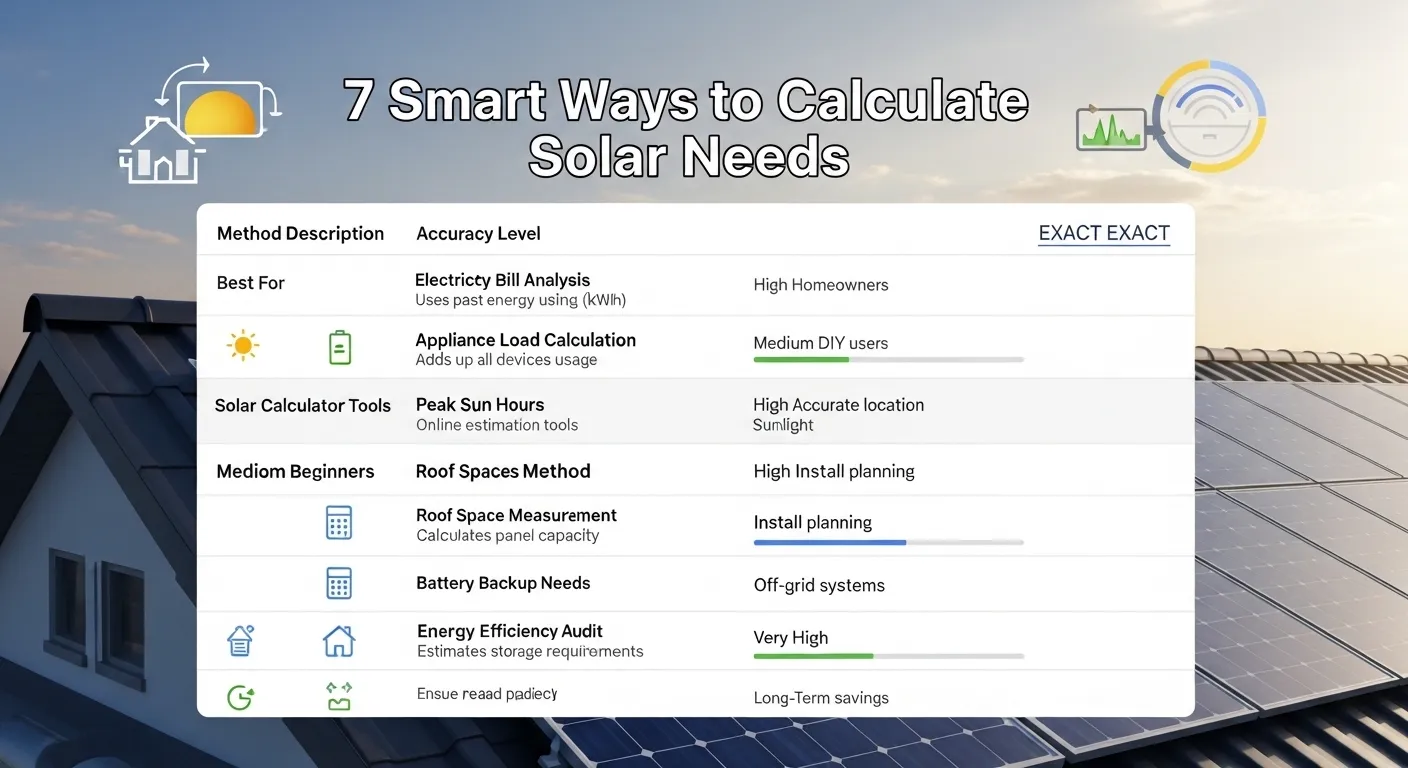
Quick Comparison Table: 7 Smart Calculation Methods
| Method | Accuracy Level | Best For | Common Mistake |
| Electricity Bill Analysis | High | Beginners | Ignoring seasonal spikes |
| Peak Sun Hours | Medium-High | DIY planners | Using wrong location data |
| Appliance Load Calculation | Very High | Off-grid users | Forgetting standby loads |
| Roof Space Estimation | Medium | Quick checks | Ignoring shading |
| Solar Calculator Tools | Medium | Fast estimates | Blindly trusting results |
| Battery Storage Planning | High | Backup systems | Oversizing battery |
| Future Energy Planning | Very High | Growing households | Ignoring EV/AC upgrades |
1. Analyze Your Electricity Bills (The Foundation Method)
What is the easiest way to calculate solar needs?
The simplest method is reviewing your last 12 months of electricity bills and calculating your average monthly kWh usage.
Look at your utility bills and find your monthly kWh consumption. Add up 12 months and divide by 12.
👉 Example:
- Annual usage: 12,000 kWh
- Monthly average: 1,000 kWh
This number is your baseline.
What works
- Gives real usage data
- Accounts for your lifestyle
- Easy to access
What fails
- People only check one bill (huge mistake)
- Seasonal usage (AC/heating) gets ignored
Pro Tip (from experience):
Always look at summer months separately. That’s when your system gets stress-tested.
2. Use Peak Sun Hours (Location Matters More Than You Think)
How do peak sun hours affect solar sizing?
Peak sun hours determine how much energy your panels can realistically produce per day in your location.
In the U.S., average peak sun hours vary:
- Arizona: 6–7 hours
- California: 5–6 hours
- New York: 3.5–4.5 hours
👉 Formula:
System Size (kW) = Daily kWh Usage ÷ Peak Sun Hours
Example:
- Daily usage: 30 kWh
- Peak sun hours: 5
- Required system: 6 kW
What works
- Accurate when paired with bill data
- Essential for system sizing
What fails
- Using national averages instead of local data
- Ignoring cloudy seasons
3. Calculate Appliance Load (Most Accurate for Serious Planners)
What is the most accurate way to calculate solar needs?
Calculating appliance-level energy consumption gives the most precise estimate, especially for off-grid or custom setups.
List your major appliances:
- HVAC
- Refrigerator
- Washing machine
- Lights
- Electronics
Then calculate:
Watts × Hours Used ÷ 1000 = kWh per day
What works
- Extremely precise
- Perfect for off-grid systems
- Helps optimize usage
What fails
- Time-consuming
- People forget phantom loads (TV standby, chargers)
Real-world mistake I’ve seen:
A homeowner forgot about their pool pump it added 20% more usage.
4. Estimate Based on Roof Space (Reality Check Method)
This is where expectations meet reality.
👉 Rule of thumb:
- 1 kW system needs ~100 sq ft
- Average home needs 5–10 kW
What works
- Quick feasibility check
- Helps visualize system size
What fails
- Ignores shading (trees, chimneys)
- Roof angle and direction matter
Expert insight:
South-facing roofs in the U.S. produce the most power. East/west setups work but need more panels.
5. Use Online Solar Calculators (But Don’t Trust Them Blindly)
Online tools can give quick estimates but they’re not gospel.
What works
- Fast and beginner-friendly
- Good starting point
What fails
- Overly optimistic projections
- Doesn’t account for real shading or inefficiencies
My take:
Use calculators for rough planning only, then verify with real data.
6. Factor in Battery Storage (Where Most People Overspend)
Do you need batteries to calculate solar needs?
Not always but if you want backup power or energy independence, battery sizing becomes critical.
👉 Key question:
Do you want to power:
- Essentials only (fridge, lights)?
- Whole house?
What works
- Increases resilience
- Useful in outage-prone areas
What fails
- Oversizing = huge cost increase
- Undersizing = useless during outages
Real-world advice:
Start with critical loads only, then scale later.
7. Plan for Future Energy Needs (The Smartest Move)
This is where most people mess up.
Think about:
- Electric vehicles
- Adding AC units
- Home expansion
- Smart home upgrades
What works
- Future-proofing saves money
- Avoids system upgrades later
What fails
- People size for today only
- End up reinstalling within 2–3 years
Pro tip:
Add 10–25% extra capacity if you expect lifestyle changes.
Buying Guide: How to Choose the Right Solar System
When calculating solar needs, you’re really deciding:
- System size (kW)
- Panel efficiency
- Battery (yes/no)
- Budget vs ROI
Key considerations:
- Roof condition (replace before installing solar)
- Local incentives/tax credits
- Utility net metering policies
Common Mistakes (I’ve Seen All of These)
Guessing instead of calculating
Ignoring seasonal usage
Oversizing batteries
Trusting online calculators blindly
Not planning for EVs or future loads
Installation Insights (What Installers Won’t Always Tell You)
- Installers may oversell system size for profit
- Cheap panels = lower efficiency long-term
- Inverter quality matters as much as panels
Real insight:
A slightly smaller, high-efficiency system often beats a large, cheap one.
Expert Opinion (From Real-World Experience)
After working with dozens of solar setups, here’s the truth:
👉 The best solar systems are not the biggest
👉 They’re the most accurately sized
If your system matches your actual energy behavior, you win:
- Lower bills
- Faster ROI
- Less frustration
Who Should NOT Go Solar (Yes, Really)
Solar isn’t for everyone.
You should reconsider if:
- Your roof gets heavy shade
- You plan to move in 2–3 years
- Your electricity bill is already very low
Internal Linking Suggestions
- Learn how to choose the best solar panels for your home
- Compare solar batteries vs no battery systems
- Explore smart home devices that reduce energy usage
- Read a guide on cleaning and maintaining solar panels
- Discover solar monitoring apps to track performance
FAQs
How many solar panels do I need for my home?
It depends on your energy usage and location. Most U.S. homes need 15–30 panels for full coverage.
Can I calculate solar needs without a professional?
Yes, using bills, peak sun hours, and appliance loads but professional verification is recommended.
Do solar panels cover 100% of electricity usage?
They can, but only if the system is properly sized and conditions are ideal.
What happens if I install too many panels?
You may overpay upfront and not fully utilize the system, reducing ROI.
How accurate are online solar calculators?
They’re useful for estimates but often miss real-world variables like shading and efficiency losses.
Conclusion
Calculating your solar needs isn’t complicated but doing it wrong is expensive.
If you follow these 7 smart methods:
- Start with real usage data
- Adjust for your location
- Plan for the future
You’ll end up with a system that actually works for your life not just on paper.
Final Thought
Before you commit to any solar system, ask yourself:
👉 “Does this feel like it’s based on real numbers or just a guess?”
Because the difference between those two decisions can cost you thousands.
👉 Complete Guide to Solar Energy & Home Efficiency
CHECK BEST LATEST SOLAR PANELS PRICES And Costs

I am Ethan Brooks is an author dedicated to exploring sustainability, technology, and forward-thinking solutions. His writing highlights simple yet powerful ways to improve everyday life while protecting the planet. He believes knowledge can drive meaningful change. Discover more at ecopowersence.com.