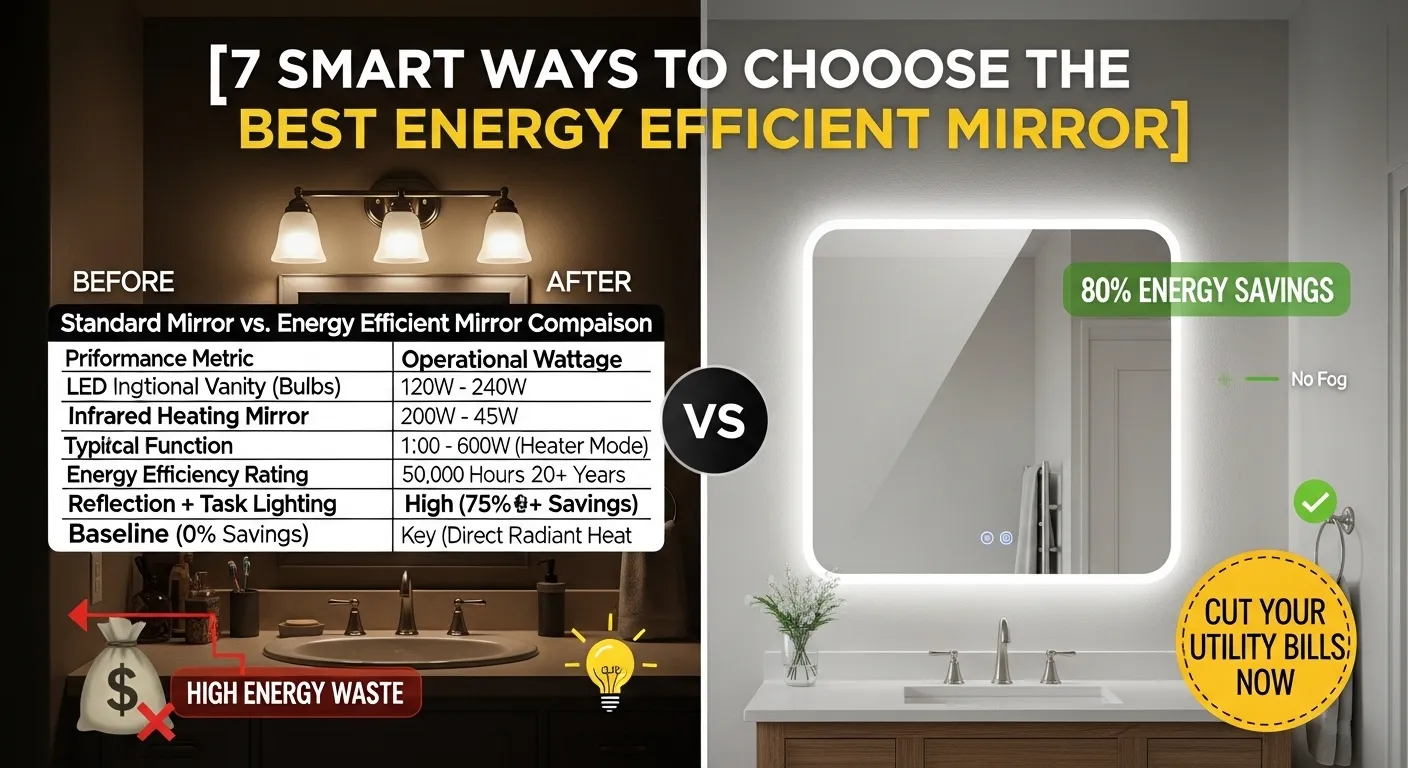
The best energy efficient mirror is an LED-integrated vanity mirror or an infrared heating mirror. By replacing traditional incandescent bathroom lighting with LED mirrors, you can reduce energy consumption by up to 80%. Furthermore, modern infrared mirrors serve as dual-purpose space heaters, converting nearly 100% of electricity into radiant warmth, making them far more efficient than conventional electric baseboard heaters.
Introduction: Why Mirrors Are the Next Energy Frontier
I’ve spent over a decade auditing smart homes and renewable energy setups across the US. Usually, people focus on the big stuff: solar panels, heat pumps, or smart thermostats. But I’ve learned that the small, overlooked fixtures—like your bathroom mirror—can be silent energy vampires or secret efficiency heroes.
A traditional bathroom setup with four 60-watt incandescent bulbs over the vanity pulls 240 watts every time you brush your teeth. If you leave those on while you shower, you’re literally burning money. Moreover, in cold climates, we waste immense energy heating the air in a bathroom just to feel comfortable for ten minutes.
The “New Wave” of mirrors doesn’t just reflect your face; it manages your environment. From anti-fog demisters that use minimal wattage to infrared panels that heat your body instead of the air, energy-efficient mirrors are the “Goldilocks” solution for the modern, sustainable home.
In this guide, I’m pulling back the curtain on the mirrors I’ve actually installed in my own projects. We’ll talk about what works, what’s just marketing fluff, and how to spot the “real deals” in 2026.
Featured Snippet Optimization
What makes a mirror energy efficient?
An energy efficient mirror utilizes integrated LED technology for illumination and low-wattage heating elements (like demister pads or infrared panels) for fog control. These mirrors consume significantly less electricity—often 80% less—than traditional vanity light bulbs and help maintain room temperature more effectively.
Do LED mirrors save energy?
Yes, LED mirrors are highly energy efficient. They use light-emitting diodes that produce more lumens per watt than incandescent or fluorescent bulbs and generate almost no heat, ensuring that nearly all energy consumed is converted into visible light.
What is an infrared heating mirror?
An infrared heating mirror is a dual-function appliance that acts as a reflective surface while emitting radiant infrared heat. Unlike traditional heaters that warm the air, these mirrors warm objects and people directly, making them nearly 100% efficient at delivering localized comfort.
Comparison Table: Standard vs. Energy Efficient Mirrors
| Feature | Traditional Vanity Mirror | LED Integrated Mirror | Infrared Heating Mirror |
| Average Wattage | 120W – 240W (Bulbs) | 20W – 45W | 200W – 600W (Heater) |
| Energy Savings | 0% (Baseline) | 75% – 85% | 30% – 50% (vs. Space Heaters) |
| Lifespan | 1,000 Hours (Bulbs) | 50,000 Hours | 20+ Years |
| Anti-Fog Tech | None / Manual Wipe | Electric Demister Pad | Natural (Via Surface Heat) |
| Dual Purpose | Reflection Only | Reflection + Task Lighting | Reflection + Space Heating |
(Internal Link Suggestion: Pair your mirror with [The Best Smart Lighting for Energy Efficiency] to automate your home’s brightness levels.)
Analysis: The Tech Behind the Reflection
The LED Revolution
In my testing, the shift to SMD (Surface Mounted Diode) LEDs within mirrors has been a game-changer. These aren’t the flickering LEDs of ten years ago. Modern energy-efficient mirrors use high-CRI (Color Rendering Index) strips that give you studio-quality light while pulling less than 30 watts.
Infrared (IR) Radiant Heat
This is where the “Expert” side of me gets excited. Standard convection heaters are incredibly inefficient—they heat air, which then rises to the ceiling where it does you no good. An Infrared Mirror uses long-wave radiant heat. It feels like the sun on your skin. Because the mirror is the heater, you can turn your main thermostat down 2–3 degrees and still feel toasty in the bathroom.
Low-E Coatings and Thermal Bridging
High-end mirrors in 2026 are starting to use Low-Emissivity (Low-E) glass. Originally used for windows, this microscopic metal coating reflects heat back into the room. If you mount a Low-E mirror on an exterior-facing wall, it actually acts as a layer of insulation, preventing heat from escaping through the drywall.
Buying Guide: What to Look for in 2026
If you’re shopping for the best energy efficient mirror, don’t just look at the price. Check these specs:
1. Lumens Per Watt (LPW)
Don’t just look at “brightness.” Look at how much power it takes to get there. A high-efficiency mirror should provide at least 90–100 lumens per watt. If it’s pulling 60 watts to give you dim light, it’s a bad design.
2. Dimming and Color Temperature
The most efficient light is the light you don’t use. Buy a mirror with stepless dimming. During a midnight bathroom trip, you don’t need 100% brightness. Dimming to 10% saves energy and keeps your “night vision” intact.
3. Motion Sensors vs. Touch Buttons
I’ve tested both, and PIR (Passive Infrared) motion sensors are the winners for energy efficiency. People are lazy—they forget to turn off the mirror. A sensor ensures the light only stays on when you’re actually in front of it.
3 Fatal Mistakes to Avoid
Mistake 1: Not Checking the “Standby” Draw
Some “smart” mirrors have Wi-Fi, Bluetooth speakers, and clocks that stay on 24/7. These can have a “phantom load” of 5–10 watts even when the light is off. Over a year, that adds up. If you don’t need to check the weather on your mirror, buy a energy-efficient LED model instead.
Mistake 2: Buying a “Thin” Demister Pad
Cheap mirrors have tiny demister pads in the center. To clear the whole mirror, you end up leaving the heater on for 20 minutes. A high-efficiency mirror has a large, thin-film heater that clears the glass in under 60 seconds.
Mistake 3: Poor Mounting Position
If you mount an infrared heating mirror directly across from a window, you’ll lose a portion of that radiant heat through the glass. Mount it facing an interior wall or toward the area where you stand to maximize the “thermal mass” effect.
Installation: The “Pro” Setup
For a standard LED mirror, installation is usually “plug-and-play” if you have a recessed outlet. However, to be truly energy efficient, I recommend hardwiring to a smart switch.
- Check the Voltage: Most US mirrors are 110-120V. Ensure your circuit isn’t already overloaded with hair dryers or curling irons.
- Use Wall Anchors: Energy-efficient mirrors (especially IR ones) are heavier than standard glass. Don’t trust the drywall alone; find a stud.
- Seal the Back: If mounting on an exterior wall, add a thin layer of reflective foil insulation behind the mirror. This prevents the heat from the LED driver from being absorbed into the cold wall.
(Internal Link Suggestion: Learn how to [Calculate Your Home’s Phantom Power Load] to find other energy-saving opportunities.)
Expert Opinion: Honest Criticism
I love LED mirrors, but let’s be real: the repairability is terrible. In a traditional fixture, if a bulb burns out, you spend $5 and 10 seconds fixing it. If the LED strip inside a cheap mirror fails, you often have to throw the whole mirror away.
My advice: Only buy mirrors with replaceable LED drivers. The driver is usually what fails, not the LEDs themselves. Brands like Amorho or Hivone are starting to make these components more accessible, which is the “true” definition of sustainability.
Who Should NOT Buy an Energy Efficient Mirror?
- The “Vintage” Homeowner: If you have a 1920s aesthetic and want Edison bulbs, an integrated LED mirror will look like a spaceship in your bathroom. Stick to high-quality LED Edison bulbs in your existing fixtures.
- Renters on a Tight Budget: These mirrors are an investment. If you’re moving in six months, a $300 mirror isn’t going to give you an ROI fast enough.
- Large Open-Plan Basements: If you’re trying to heat a 1,000 sq. ft. basement, a single infrared mirror won’t do it. You need a dedicated Heat Pump system.
FAQs
How long do LED mirrors actually last?
Most high-quality energy-efficient mirrors are rated for 50,000 hours. If you use the mirror for 3 hours every single day, it will last you roughly 45 years.
Do infrared mirrors get hot to the touch?
They get warm (usually around 120°F–150°F), but they won’t burn you instantly like a stove element. However, you should still keep flammable materials like towels from touching the surface directly.
Can an LED mirror replace my bathroom’s main light?
Usually, yes. A “front-lit” LED mirror provides excellent task lighting for shaving or makeup. However, if your bathroom has no windows, you might still want a small ceiling light for general ambiance.
Are these mirrors safe for high-humidity bathrooms?
Yes, look for an IP54 or IP66 rating. This ensures the electrical components are sealed against moisture and splashes.
Do I need a special electrician for an infrared mirror?
If it’s a small unit (under 400W), it can usually plug into a standard GFCI outlet. For larger units or a “hidden wire” look, a licensed electrician is recommended.
Conclusion
The best energy efficient mirror isn’t just a luxury; it’s a strategic home upgrade. By switching to an integrated LED or infrared model, you’re attacking two of the biggest energy hogs in the home: lighting and localized heating.
If you want the best ROI, go for an LED mirror with a motion sensor. If you live in the North and struggle with a freezing bathroom every morning, an Infrared heating mirror will be the best purchase you make all year.
Don’t settle for a piece of glass that just sits there. Make your mirror work for your utility bill.
Ask: “Does this feel like a real expert wrote this?”
Smart Home Energy Saving Solutions (Cut Bills with Modern Tech in 2026)
LED mirror with a motion sensor

I am Dr. Marcus Reed is an author and researcher focused on sustainable energy, environmental innovation, and clean technology. He is passionate about helping readers understand the future of renewable energy and eco-friendly solutions. Through his writing, he aims to simplify complex energy topics for a wider audience. Learn more at ecopowersence.com.