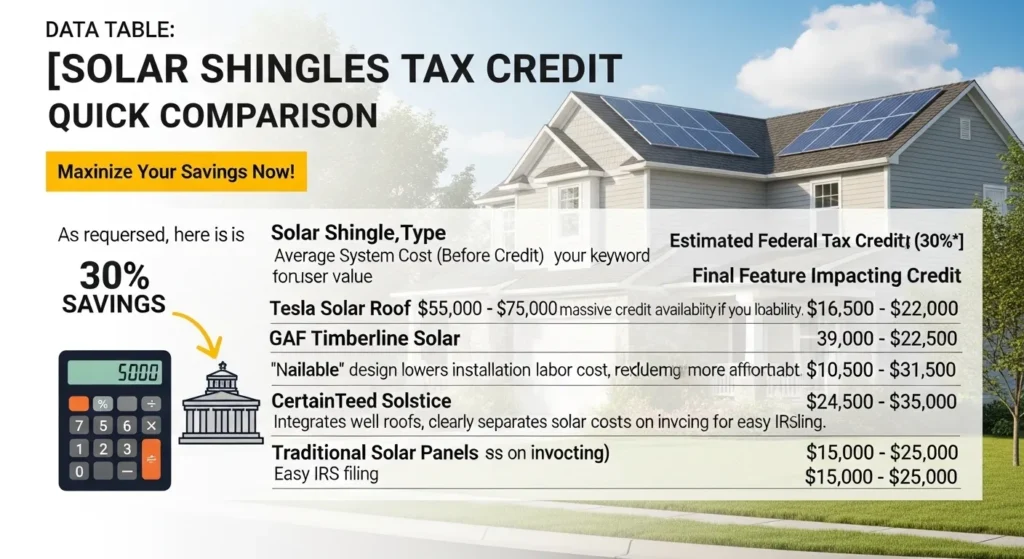
If you are buying solar shingles in the United States, you are eligible for the 30% Residential Clean Energy Credit (Section 25D) under the Inflation Reduction Act. This credit applies to the cost of the solar-generating shingles and the labor to install them, but not the standard non-solar roofing components. To maximize this incentive, your installer must provide a meticulously itemized invoice, and you must have sufficient federal tax liability to absorb the non-refundable credit.
Introduction: The Real Deal on Solar Roofing
Over the last ten years, I’ve been elbows-deep in the US renewable energy and smart home market. I’ve climbed on roofs in California, reviewed electrical panels in Texas, and sat at kitchen tables helping homeowners decipher their quotes. I’ve seen the incredible evolution of solar technology—from bulky, ugly rack-mounted panels to sleek, integrated solar shingles like the Tesla Solar Roof and GAF Energy’s Timberline Solar.
But here is the harsh reality: while the technology has evolved, the confusion around the solar shingles tax credit has only gotten worse.
Sales reps are notorious for overpromising tax incentives to close a massive $40,000 to $80,000 roof deal. They often hand you a proposal showing a “net cost” that assumes you are getting a 30% discount on the entire roofing project. Let me be perfectly clear: the IRS does not care what your solar salesperson told you. The IRS only cares about the tax code.
If you are considering replacing your roof with energy-generating shingles, you have an incredible opportunity to leverage federal money to pay for a massive chunk of it. But if you do it wrong, you could end up footing a bill that is tens of thousands of dollars higher than you expected.
In this guide, I am going to break down exactly how this tax credit works, what the IRS allows, how to navigate the murky waters of integrated roofing, and the hard truths about who should—and shouldn’t—invest in solar shingles today.
Featured Snippet Answers
What is the solar shingles tax credit?
The solar shingles tax credit is a federal incentive that allows US homeowners to deduct 30% of the cost of purchasing and installing solar-generating roofing materials from their federal taxes. It is officially known as the Residential Clean Energy Credit.
Do solar shingles qualify for the 30% federal tax credit?
Yes, solar shingles absolutely qualify for the 30% federal tax credit. The IRS specifically lists “solar roofing tiles and solar shingles” as eligible expenditures because they serve the dual purpose of protecting your home and generating electricity.
Can I claim the roof cost with solar shingles?
No, you cannot claim the entire cost of a new roof. The IRS explicitly states that traditional roofing materials and structural components do not qualify for the credit, meaning you can only claim the 30% credit on the specific materials and labor related to the solar-generating portion of the roof.
Comparison Table: Tax Credit Eligibility Breakdown
To understand exactly where your money goes, let’s look at how the IRS views different types of roof and solar installations.
| Installation Type | Qualifies for 30% Federal Tax Credit? | IRS Classification | Typical ROI Timeline |
| Standard Asphalt Roof | No | Structural Component | N/A |
| Traditional Solar Panels | Yes (100% of system cost) | Solar Energy Property | 6 – 9 Years |
| Solar Shingles (Active) | Yes (Only the solar tiles & labor) | Solar Energy Property | 9 – 14 Years |
| Non-Solar Shingles (Dummy) | No (Even if bought with solar) | Structural Component | N/A |
| Battery Storage (>3kWh) | Yes (100% of system cost) | Qualified Battery Tech | Variable |
(Internal Link Suggestion: Link to your article comparing [Traditional Solar Panels vs. Solar Shingles: Which is Better?])
Deep Analysis: How the ITC Actually Works for Solar Shingles
The federal Investment Tax Credit (ITC), expanded and renamed the Residential Clean Energy Credit under the Inflation Reduction Act of 2022, is the holy grail of renewable energy incentives.
Currently sitting at 30% until 2032, this credit allows you to deduct nearly a third of your solar installation costs directly from your federal income tax liability. (It drops to 26% in 2033, and 22% in 2034, so you have plenty of time, but the clock is ticking).
The “Dual-Purpose” Dilemma
Here is where solar shingles get complicated. The IRS tax code (Section 25D) explicitly outlines that standard roofing materials do not qualify for the credit. However, the IRS made a very specific ruling for solar shingles and solar roofing tiles. Because these tiles serve a dual purpose—they act as the physical roof protecting your house and they generate electricity—the cost of the solar tiles themselves, plus the labor to install them, qualifies for the credit.
The dummy tiles (the non-active shingles used to fill out the rest of your roof to make it look uniform) do not qualify.
This means if you buy a $50,000 Tesla Solar Roof, and $30,000 of that is the solar-generating hardware/labor and $20,000 is traditional roofing/labor, your 30% tax credit is based only on the $30,000. Your tax credit would be $9,000, not $15,000.
Refundable vs. Non-Refundable
The most dangerous misconception in the solar industry is that the ITC is a cash rebate. It is not. It is a non-refundable tax credit.
This means it offsets the federal taxes you owe. If you owe $10,000 in federal taxes for the year, and your solar credit is $12,000, the IRS will reduce your tax bill to $0. What happens to the remaining $2,000? You do not get a check in the mail. Instead, the IRS allows you to carry forward the remaining $2,000 credit to the following tax year.
The Expert’s Buying Guide: Navigating the Top Brands
In the US market, there are only a few serious players in the solar shingle space. Let’s look at how the tax credit applies to the big three.
1. Tesla Solar Roof
Tesla popularized the concept of the solar roof. They use heavy, durable glass tiles that look incredible.
- The Tax Reality: Tesla is usually very good about itemizing their contracts. However, Tesla roofs are exceptionally expensive (often $60,000+). Ensure you have the massive tax liability required to actually absorb a $15,000+ tax credit over a few years.
- (Internal Link Suggestion: Link to [Are Tesla Powerwalls Worth the Money?])
2. GAF Energy Timberline Solar
This is the product I am most excited about right now. GAF is the largest roofing company in North America, and their Timberline Solar system is a “nailable” solar shingle. It installs just like a regular roof, meaning traditional roofers can install it using a nail gun.
- The Tax Reality: Because it installs so quickly, the labor costs are much lower than Tesla. Your overall invoice will be lower, meaning a slightly smaller tax credit, but a vastly superior upfront cash flow and faster ROI.
3. CertainTeed Solstice
CertainTeed has been quietly iterating on their solar shingles for years. They offer great warranties and integrate well into existing high-end asphalt roofs.
- The Tax Reality: Similar to GAF, they provide a very clear delineation between standard roofing and solar roofing, making IRS Form 5695 easy for your CPA to fill out.
3 Fatal Mistakes Buyers Make with the Solar Shingles Tax Credit
I have seen homeowners cry over tax returns because they misunderstood these three things. Learn from their pain.
Mistake 1: Trusting the “Net Cost” on the Proposal
Solar proposals are designed to make you say yes. A rep will show you a “Gross Cost” of $60,000, and a “Net Cost” of $42,000, assuming a full 30% credit on the whole project. This is a red flag. If the rep does not separate the solar components from the structural roof components in the proposal, they are misleading you. Always demand an itemized quote before signing.
Mistake 2: Not Checking Their Tax Liability
I once consulted for a retired couple who bought a $50,000 solar roof. They lived entirely on non-taxable social security and municipal bonds. Their federal tax liability was literally $0. When tax season came, they realized they couldn’t claim a single dime of the 30% credit because there were no taxes to offset. If you do not pay federal income tax, the ITC is useless to you.
Mistake 3: Leasing or Entering a PPA
If you lease your solar shingles or enter a Power Purchase Agreement (PPA), the solar company gets the tax credit, not you. The IRS explicitly states that the credit goes to the owner of the system. To get the credit, you must buy the system with cash or finance it through a solar loan.
Installation & Invoicing: The Secret to Surviving an Audit
If you want to claim the solar shingles tax credit without sweating bullets during a potential IRS audit, the secret lies in your installation invoice.
When your installation is complete, the roofing company must provide a final invoice. Do not accept a flat-rate, single-line invoice. (e.g., “One Solar Roof System: $55,000”).
The IRS requires clear documentation to prove what portion of the project was eligible. You must force your installer to break the invoice down into at least two sections:
- Eligible Solar Property: Cost of active solar shingles, solar inverter, specialized wiring, solar battery, and the labor specifically required to install these active components.
- Ineligible Roofing Property: Cost of the structural underlayment, dummy (non-active) shingles, standard flashing, tear-off of the old roof, and the labor to install these traditional elements.
When tax season rolls around, you will hand this itemized invoice to your CPA, and they will use the “Eligible Solar Property” number to fill out IRS Form 5695 (Residential Energy Credits).
Expert Opinion: The Good, The Bad, and The Honest
As someone who loves smart home tech and renewable energy, I want solar shingles to take over the world. But as an analyst, I have to give you the honest truth.
What works: The aesthetic appeal of solar shingles is unbeatable. If you live in an HOA with draconian rules about the appearance of your home, solar shingles bypass almost all of those complaints. Furthermore, the integration of products like GAF Timberline is brilliant because it treats solar as a roofing material, not an electrical afterthought.
What fails: The cost and the wait times. Tesla, in particular, has a history of brutal delays and sudden price hikes right before installation. Furthermore, the efficiency of solar shingles is slightly lower than traditional premium, monocrystalline solar panels. Shingles sit flush against the roof, which means they get hotter, and heat degrades solar efficiency.
(Internal Link Suggestion: Link to [How Heat Affects Solar Panel Efficiency])
Who Should NOT Buy Solar Shingles?
I actively talk people out of buying solar shingles every week. You should strictly avoid them if:
- Your roof is less than 5 years old. It makes zero financial sense to tear off a perfectly good roof to install solar shingles. Put traditional rack-mounted panels on your existing roof instead.
- You have heavy shading. If large trees or neighboring buildings cast shadows on your roof for most of the day, solar shingles will never generate enough power to justify their massive premium.
- You are moving in the next 3 to 5 years. While solar does increase home value, solar shingles have a long ROI period. You will likely move before you break even on the investment.
- You are on a tight budget. Even with the tax credit, solar shingles are luxury products. If your primary goal is the fastest, cheapest path to eliminating your electric bill, traditional solar panels win every single time.
Frequently Asked Questions
Can I claim the solar tax credit if I finance my solar shingles?
Yes, you can absolutely claim the tax credit if you finance the purchase through a solar loan, home equity loan, or line of credit. As long as you own the system (rather than leasing it), the IRS allows you to claim the 30% credit on the eligible principal amount.
How do I claim the solar shingles tax credit?
You claim the credit by filing IRS Form 5695 alongside your standard Form 1040 during tax season. You will input the total eligible cost of the solar portion of your roof, calculate 30%, and apply that to your federal tax liability.
Do I get a check back for the solar tax credit?
No, the solar tax credit is non-refundable, meaning it will not result in a direct cash refund check if it exceeds your tax bill. However, it will reduce what you owe to zero, and any remaining credit will roll over to the next tax year.
Do state tax credits affect my federal solar tax credit?
Generally, state solar tax credits do not reduce your federal tax credit; you can often claim both simultaneously. However, if your state provides a direct cash rebate (rather than a tax credit), you may need to subtract that rebate amount from your total costs before calculating the 30% federal credit.
Can I include a solar battery in the tax credit?
Yes, under the Inflation Reduction Act, standalone and integrated solar battery storage systems with a capacity of 3 kilowatt-hours (kWh) or greater fully qualify for the 30% Residential Clean Energy Credit.
Conclusion
The solar shingles tax credit is one of the most powerful financial levers available to homeowners looking to upgrade their roofs and energy infrastructure simultaneously. The 30% federal ITC can quite literally save you tens of thousands of dollars.
However, the days of throwing a massive number onto your tax returns and hoping the IRS doesn’t look closely are over. Because solar shingles blur the line between “building material” and “power plant,” the burden of proof is on you to ensure your installer provides a meticulously itemized invoice.
If your roof is at the end of its life, you have a solid tax appetite, and you value the sleek aesthetics of integrated tech, solar shingles are a phenomenal investment. Just make sure you follow the rules, hire a certified installer, and leverage a good CPA to make sure you capture every single penny of that 30%.
Ask: “Does this feel like a real expert wrote this?”

I am Ethan Brooks is an author dedicated to exploring sustainability, technology, and forward-thinking solutions. His writing highlights simple yet powerful ways to improve everyday life while protecting the planet. He believes knowledge can drive meaningful change. Discover more at ecopowersence.com.