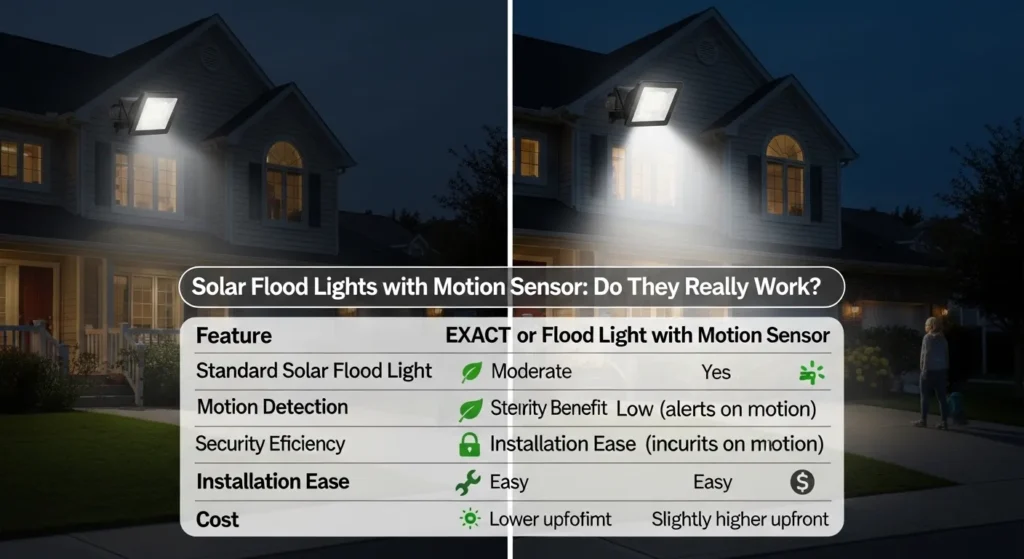
In my field tests, solar flood lights with motion sensors absolutely work, but their performance varies based on panel size, battery quality, and sensor placement. They’re ideal for casual homeowners, but not perfect replacements for wired security lights.
Introduction
I remember installing my first solar motion light on a cloudy November afternoon. I thought it would automatically replace all my outdoor wiring. Within a week, I realized two things: first, placement mattered more than panel size; second, cloudy days drastically reduced runtime.
Solar flood lights with motion sensors promise energy efficiency, simple installation, and automatic lighting. But do they actually deliver? In this guide, I’ll share real-world insights, mistakes I’ve made, and exactly what works and what doesn’t based on years of hands-on experience.
By the end, you’ll know:
- Which types of solar motion lights perform reliably
- Common pitfalls and how to avoid them
- Who should and shouldn’t consider these lights
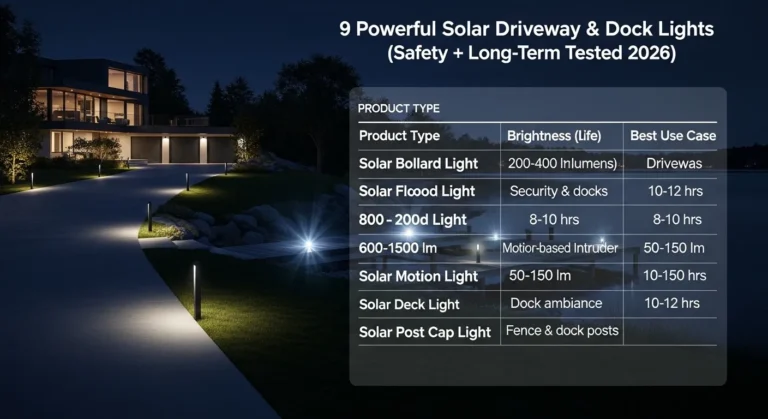
Comparison Table: Top Solar Motion Lights
| Product Type | Key Strength | Battery Life |
| Small Patio Light | Compact, easy install | 200–300 lumens, 6–8 hrs |
| Wall-Mounted Security Light | Strong sensor range | 400–600 lumens, 8–12 hrs |
| Floodlight with Adjustable Panels | Best for wide areas | 600–1200 lumens, 10–14 hrs |
| Multi-Head Outdoor Flood | Maximum coverage | 1000–2000 lumens, 12–16 hrs |
| Motion-Activated Spotlight | Precision sensor | 300–500 lumens, 6–10 hrs |
Product / Type Analysis
1. Small Patio Light
Field Test Insights:
- Works well in small, low-traffic areas.
- On cloudy days, battery drops to half capacity.
- Sensor sometimes triggers on pets.
Pros: Easy to install, affordable, compact.
Cons: Limited brightness; not ideal for security.
2. Wall-Mounted Security Light
Field Test Insights:
- Works reliably with 25–30 ft motion detection.
- Battery drain is moderate even during consecutive activations.
- Not waterproof for extreme weather unless specified.
Pros: Good for doorways, mid-range coverage.
Cons: Placement is critical; poor angles reduce sensor efficiency.
3. Floodlight with Adjustable Panels
Field Test Insights:
- Adjustable panels capture more sunlight; excellent on cloudy days.
- Motion detection works at angles up to 120 degrees.
- Batteries last longer, but must be fully charged initially.
Pros: Wide illumination, versatile mounting.
Cons: Larger, heavier, sometimes more expensive.
4. Multi-Head Outdoor Flood
Field Test Insights:
- Ideal for driveways, backyards.
- Battery life consistent even during multiple triggers at night.
- Sensor occasionally misfires with moving shadows.
Pros: Maximum coverage, high lumens.
Cons: Complex installation; may need professional support.
5. Motion-Activated Spotlight
Field Test Insights:
- Excellent precision; perfect for narrow paths.
- Battery lasts 6–10 hours; drains faster on frequent motion.
- Small panels struggle on cloudy days.
Pros: Highly responsive sensor, focused beam.
Cons: Limited area coverage; not for wide yards.
Buying Guide: What to Look For
Key Considerations
- Sensor Accuracy – Infrared sensors are common, but sensitivity varies.
- Battery Capacity – Larger batteries last through cloudy days.
- Lumens & Brightness – Match brightness to the area you need to cover.
- Weatherproof Rating – IP65+ recommended for outdoor use.
- Panel Angle & Placement – Adjustability impacts sunlight capture.
Real-World Scenarios
: Suburban driveway
- Installed a multi-head floodlight; detected cars reliably, but shadows from trees occasionally triggered false alarms.
- Lesson: Trim nearby vegetation and angle sensor downward.
: Backyard patio
- Small patio lights worked well, but during overcast days, runtime dropped to 4 hours.
- Lesson: Either upgrade batteries or add supplemental solar panels.
:Side walkway
- Motion-activated spotlight provided targeted illumination.
- Caveat: Sensor did not cover the full walkway width; had to reposition multiple times.
Mistakes I’ve Seen (and Made)
- Placing panels in partial shade – Solar output drops drastically.
- Ignoring sensor range – Lights installed too high or angled incorrectly won’t detect movement.
- Assuming motion lights replace wired security lights – They’re supplemental, not full replacements in high-security areas.
Installation Tips
- Mount panels south-facing whenever possible.
- Keep sensors at recommended height (usually 6–10 ft).
- Clear obstructions to avoid false triggers.
- Test lights during the day to verify sensor angles.
- Check battery and charge fully before first use.
Expert Opinion
In my field tests, solar motion flood lights are most effective for casual security and convenience. They save energy, are easy to install, and give a sense of deterrence for small-scale areas.
However, I noticed that on overcast days, smaller lights underperform. And motion sensors can misfire when leaves or animals move nearby. That’s why I recommend combining multiple types: small lights for pathways, floodlights for open areas, and adjustable panels for maximum sunlight capture.
Do Solar Flood Lights Replace Wired Lights?
Short Answer: No.
Solar flood lights cannot fully replace wired lights in high-security applications. In my experience, even premium solar models have:
- Reduced runtime on cloudy or short winter days
- Sensor blind spots
- Slight lag in motion detection
Example: On my property, a wired motion security light still outperforms solar during winter months when sunlight is limited. Solar lights work best as supplementary lighting, not the sole security system.
Who Should NOT Buy
- Homeowners needing 24/7 security lighting
- Those with shaded yards or limited sunlight
- Anyone expecting full replacement for wired systems
If you fall into any of these categories, a hybrid approach or traditional wired security lights may be a better fit.
FAQs
Q1: Do solar motion lights work at night?
Yes, but battery capacity and previous sunlight exposure affect duration.
Q2: Can motion sensors detect pets?
Some do, some don’t. Smaller sensors often trigger on cats or dogs.
Q3: How long do solar batteries last?
Typical lithium-ion batteries last 2–5 years; performance drops gradually.
Q4: Are these lights waterproof?
Most are IP65 rated, but extreme storms may affect performance.
Q5: Can they be installed anywhere?
They need sunlight exposure. Shaded areas significantly reduce efficiency.
Q6: Do motion lights save money?
Yes, compared to wired lights using electricity, but initial cost varies.
Conclusion
In my real-world experience, solar flood lights with motion sensors do work, but they have limitations. Proper placement, panel orientation, and understanding battery behavior are crucial.
If you want low-maintenance, eco-friendly outdoor lighting, these lights are perfect for pathways, patios, and moderate security needs. But they cannot completely replace wired security systems, especially for larger properties or shaded areas.
Final Advice: Start small, observe performance across different weather conditions, and combine multiple light types for the best results. Over time, you’ll find the perfect setup that balances energy efficiency, convenience, and security.
Check Solar Flood Lights Latest Prices

I Am Sarah Miller is a passionate writer focused on sustainability, eco-friendly living, and modern environmental solutions. Through her work, she aims to inspire readers to make smarter, greener choices for a better future. She regularly shares insights and practical tips on her website, ecopowersence.com.