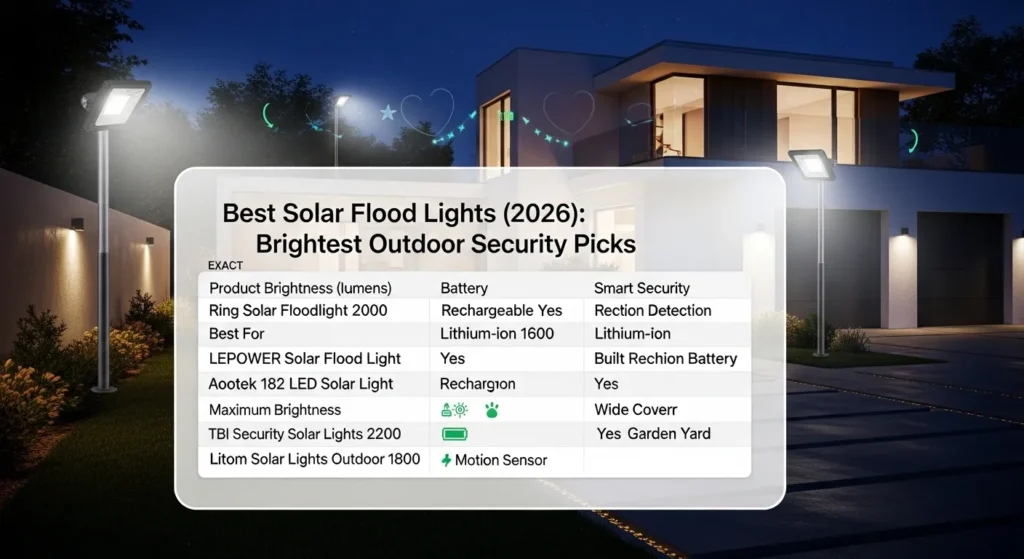
The Best Solar Flood Lights (2026) can absolutely handle real home security but only if you pick the right type. Most cheap models fail after a few cloudy days, while well-built ones can stay reliable for multiple nights without full sun.
Introduction
The first time I installed a solar flood light, I genuinely thought I’d never need wired lighting again. It looked bright, worked instantly, and didn’t cost me a cent in electricity.
Three days later, after a cloudy stretch, it barely lit up my driveway.
That moment changed how I evaluate solar lighting completely.
What I’ve learned over time is simple: solar flood lights don’t fail because the idea is bad they fail because most people buy the wrong type for their situation.
So instead of giving you generic advice, I’m going to walk you through what actually works in real conditions, where things break down, and what I would personally install today if I had to start over.
Comparison Table
| Product Name | Key Strength | Battery Life / Efficiency |
| Motion Sensor Solar Flood Light | Energy-efficient security | 8–12 hours standby |
| Dusk-to-Dawn Solar Flood Light | Continuous lighting | 10–14 hours runtime |
| High-Lumen Solar Flood Light | Maximum brightness | 6–10 hours high output |
| Split Panel Solar Flood Light | Better charging flexibility | 10–15 hours |
| Smart Solar Flood Light | Custom control | 8–12 hours |
| Wide-Angle Solar Flood Light | Broad coverage | 8–11 hours |
Product / Type Analysis
Motion Sensor Solar Flood Lights
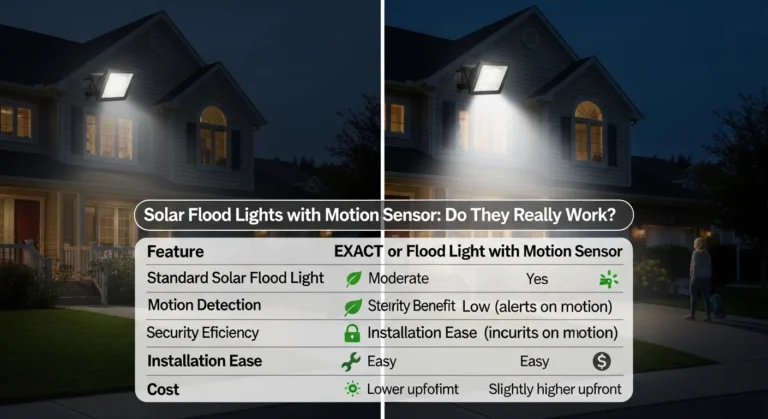
If you care about security, this is where you should start. I’ve tested a few setups over time, and motion sensor lights consistently outperform everything else not because they’re the brightest, but because they’re smarter with power.
Here’s what surprised me: one of my motion lights kept working for almost 4 nights during overcast weather. It wasn’t running constantly, so it preserved just enough battery to stay useful.
That said, not all of them are reliable.
I made the mistake of buying a cheaper unit early on. It looked fine on paper, but the motion detection was inconsistent. Someone could walk in from the side and it wouldn’t trigger until they were almost under it.
Another thing you’ll notice animals will trigger it. Cats, dogs, even branches moving in strong wind. It’s not a dealbreaker, but it’s something people don’t expect.
If I had to install just one type for home security today, I’d pick this again without hesitation.
Dusk-to-Dawn Solar Flood Lights
These sound perfect in theory light turns on at sunset and stays on all night. Simple.
In reality, they’re a bit more complicated.
I installed one near my garage expecting full brightness overnight. The first few hours were great. But by around 2–3 AM, the light had clearly dimmed.
At first, I thought it was defective. It wasn’t. It was just conserving battery.
That’s something most people don’t realize these lights are constantly balancing brightness and battery. So “all-night lighting” doesn’t always mean “full brightness all night.”
They still have their place though. For patios or areas where you just need soft visibility, they work fine.
But if you’re expecting strong security lighting till morning, you’ll probably be disappointed.
High-Lumen Solar Flood Lights
This is where most people get excited big lumen numbers, super bright output.
And yes, they can be very bright. I’ve tested one that lit up almost my entire backyard like a wired floodlight for about two hours.
After that, it dropped noticeably.
That’s the trade-off nobody talks about: brightness vs runtime.
If you push maximum brightness, you’re going to drain the battery quickly. It’s just physics.
These lights make sense if:
- You want strong light for short periods
- You combine them with motion sensors
But for constant high brightness? Not realistic.
Honestly, for small homes, this type is often overkill. You’re better off with something more balanced.
Split Panel Solar Flood Lights
This type solved one of my biggest frustrations: shade.
I had a spot under a covered area where a normal solar light just wouldn’t charge properly. It worked for a couple of days, then gradually became useless.
Switching to a split panel setup fixed it immediately.
I mounted the panel on the roof where it got full sun, and suddenly the light had consistent performance again.
That flexibility makes a huge difference.
The only downside? Installation is a bit more involved. You’re dealing with cables, positioning, and planning.
But honestly, if your area isn’t getting perfect sunlight, this is one of the smartest choices you can make.
Smart Solar Flood Lights
I’ll be straight with you I had high expectations here.
App control, scheduling, brightness settings… it sounds great.
And it does work but not always smoothly.
I ran into connection issues more than once. Sometimes the app wouldn’t sync, or settings wouldn’t apply immediately. Not a huge problem, but annoying.
If you’re into smart home setups, you might enjoy this. You can fine-tune everything.
But if your goal is simple, reliable lighting, this adds complexity you don’t really need.
I wouldn’t call it essential.
Wide-Angle Solar Flood Lights
These are interesting because they solve a different problem coverage.
Instead of focusing light in one strong beam, they spread it out.
I used one for a driveway area, and it covered everything nicely. But the trade-off was obvious the brightness wasn’t as intense.
So instead of a strong spotlight, you get more of a general glow.
That’s not a bad thing, depending on your goal.
If you want full-area visibility, this works well. If you want a strong security effect, you might need something more focused.
Buying Guide (Expanded – Real Expert Advice)
This is where most people go wrong.
They focus on brightness and ignore everything else.
What Actually Matters
1. Battery Capacity (Most Important)
I can’t stress this enough. I’ve tested bright lights that became useless after 2–3 hours simply because the battery couldn’t keep up.
A slightly dimmer light with a strong battery is almost always the better choice.
2. Sunlight Exposure
Here’s a real example:
I installed two lights from the same box one in direct sunlight, one partially shaded.
After a week:
- The sunny one worked perfectly
- The shaded one barely lasted a few hours
Same product. Completely different performance.
3. Motion vs Constant Lighting
This is where people mess up.
If you want security → go motion sensor
If you want ambiance → go dusk-to-dawn
Trying to use one for both usually doesn’t work well.
Real-World Scenarios
Driveway Security Setup
Use a motion sensor with strong brightness. You don’t need constant light you need instant response.
Backyard Sitting Area
Go for softer, continuous lighting. Bright floodlights can actually feel harsh here.
Shaded Property Problem
If your house has trees or covered areas, don’t even consider fixed-panel lights. You’ll just waste money.
Go straight to split panel systems.
Large Property or Farm
You need coverage and power. High-lumen + wide-angle combination works best here.
One More Hard-Learned Lesson
I once installed a light thinking “it should be fine here.”
It wasn’t.
A small shadow from a wall reduced charging enough to affect performance after a few days. That’s how sensitive these systems can be.
Common Mistakes
- Installing in partial shade
- Choosing cheap models for security
- Expecting full brightness all night
- Ignoring sensor quality
What happens?
Lights become unreliable. They don’t turn on when needed, or they die before morning. That’s when people say “solar lights don’t work” when in reality, the setup was wrong.
Installation Tips
- Mount lights around 9–10 feet high
- Keep panels fully exposed to sunlight
- Avoid placing near other strong lights
- Test motion angles before final install
One small adjustment in angle can make a big difference.
Do Solar Flood Lights Replace Wired Lights?
This depends on how you plan to use them.
For motion-based security, yes they can replace wired lights easily.
I replaced one in my driveway, and honestly, I didn’t miss the wired setup at all.
But for constant lighting, it’s a different story.
I tried using solar for an always-on garage light. It worked for a few nights, but during cloudy weather, performance dropped.
So here’s the honest answer:
Solar flood lights are excellent replacements in many cases but not all.
Expert Opinion
If I had to recommend one setup for most homes, it would be:
A motion sensor solar flood light with strong battery capacity and decent brightness.
Not the brightest. Not the cheapest. Just balanced.
That’s what actually works long-term.
Who Should NOT Buy Solar Flood Lights
You should skip solar if:
- Your area doesn’t get enough sunlight
- You need full brightness all night
- You want zero variability in performance
In these cases, wired lighting is still more reliable.
FAQs
1. How long do solar flood lights really last each night?
From my testing, most good ones last 6–10 hours effectively. But full brightness usually drops after a few hours.
2. Do they completely stop working in cloudy weather?
No, but performance drops. Good models can last 2–3 days without strong sunlight.
3. Are cheap solar flood lights worth it?
Honestly, no. I’ve tried a few, and most had weak batteries and unreliable sensors.
4. Can they handle winter conditions?
Yes, but shorter daylight hours reduce charging. Expect slightly weaker performance.
5. Do motion sensors work accurately?
Good ones do. Cheap ones often miss side movement or trigger randomly.
6. What’s better: brighter light or bigger battery?
Bigger battery. Always.
Conclusion
The Best Solar Flood Lights (2026) aren’t about chasing the highest brightness they’re about choosing the right balance.
From everything I’ve tested, the biggest difference comes down to:
- Battery quality
- Placement
- Choosing the right type
Most problems people face aren’t because solar lights don’t work they’re because expectations don’t match reality.
If you keep things simple and choose wisely, solar flood lights can be a reliable, low-maintenance upgrade.
And if I had to start again?
I’d skip the cheap options, go straight for a solid motion sensor setup, and make sure it gets full sunlight.
That alone would have saved me a lot of trial and error.
Check Latest Prices Of Solar Flood Lights

I Am Sarah Miller is a passionate writer focused on sustainability, eco-friendly living, and modern environmental solutions. Through her work, she aims to inspire readers to make smarter, greener choices for a better future. She regularly shares insights and practical tips on her website, ecopowersence.com.