By EcoPowerSence Editorial Team | Updated: August 2026 | Est. reading time: 9 minutes
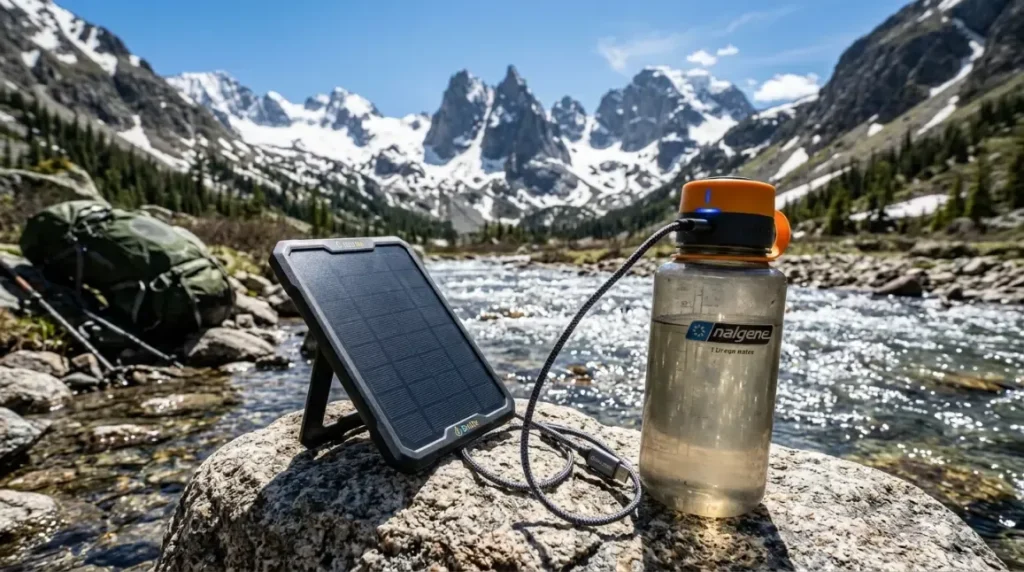
Solar-powered water purifiers use UV-C light to neutralize bacteria, viruses, and protozoa, charged either by an integrated solar panel or a rechargeable battery topped up via a solar power bank. They’re built to replace manual pumping for backpackers who want a hands-off way to process water in camp.
This guide compares the leading solar and solar-compatible UV purifiers by weight, waterproof rating, and charge time — based on manufacturer specifications, CDC water-safety guidance, and published hands-on testing from dedicated gear-review outlets. We have not personally field-tested the models below; where you want first-person, multi-week trail testing, we link directly to outlets that have done exactly that.
Disclosure: This page may contain affiliate links. If you buy through them, we may earn a commission at no extra cost to you.
How This Guide Was Put Together
- Manufacturer specifications — weight, battery capacity, charge time, IPX rating, and treatment capacity, sourced from each brand’s product listing.
- CDC backcountry water-safety guidance — on which pathogens UV treatment is and isn’t effective against.
- Independent hands-on gear reviews — outlets like CleverHiker and Treeline Review run multi-year, multi-tester field programs (CleverHiker cites over 100,000 miles of hiking across a decade of testing; Treeline Review names its testers and the specific trails used). We cite and link to their testing rather than present it as our own.
If you want a first-person account of a specific model failing or surviving on trail, those two sources are the most rigorously documented ones currently published for this category.
Quick Comparison
| Model | Best For | Weight | Est. Price |
|---|---|---|---|
| Guzzle H2O Stream | Group basecamp | 26 oz | $285 |
| SteriPen Ultra + solar panel | Solo, tech-focused | 5 oz + panel | ~$160 total |
| Grayl GeoPress + solar bank | International travel / high viral risk | 15.9 oz | ~$190 total |
| CrazyCap 2 (bottle cap) | Day hikers | Sub-4 oz | $70 |
Weights and prices are manufacturer-listed and current as of August 2026; check current retailer listings before buying, as pricing changes frequently.
Solar Water Purification in 2026: What It Actually Does
Solar-powered water purifiers use UV-C light to disrupt the DNA of pathogens, powered by high-efficiency monocrystalline solar cells or an integrated lithium-ion battery. Unlike ceramic or hollow-fiber filters, which physically strain out sediment, UV systems target viruses, bacteria, and protozoa without removing particulate matter — which is why pre-filtering murky water still matters.
Portable solar cell efficiency has improved enough by 2026 that a wallet-sized panel can charge a UV purifier in a few hours of midday sun, according to manufacturer specifications from current-generation panel makers. That’s shifted the category from a niche, panel-heavy setup toward something viable for average trip weights — though it still comes with real tradeoffs around cloud cover and total system weight (see below).
Do solar water purifiers work on cloudy days? Yes, provided the unit has an internal battery — the panel charges the battery in sun, and stored energy powers the UV lamp regardless of current weather.
Is solar purification better than a Sawyer Squeeze? They solve different problems. A Sawyer-style filter removes sediment and physical particles; solar UV kills viruses a Sawyer can’t catch, but it won’t clarify muddy water on its own.
Types of Solar Systems: UV vs. Battery-Bank Setups
Solar-compatible purifiers generally fall into two categories:
Direct UV systems (SteriPen, CrazyCap) — a bulb or LED built into the device itself, charged via USB or an attached solar panel. Lightweight and give near-instant results; the most common choice for solo backpackers.
Battery-bank + UV systems (Guzzle H2O Stream and similar) — a larger battery bank charged via a separate solar mat, which then powers a pump-driven UV unit. Bulkier, but processes higher volumes for groups.
Per CDC guidance on backcountry water safety, UV light is effective against Cryptosporidium and Giardia, the pathogens most commonly responsible for backcountry gastrointestinal illness.
A newer category — solar cells integrated into a bottle lid (e.g., CrazyCap) — is marketed as the most packable option, though it shares the same limitation as all UV systems: if light can’t penetrate the water, contaminants behind sediment aren’t neutralized. Pre-filtering turbid water through a bandana or coffee filter remains necessary regardless of which UV system you use.
Can I use solar purification for muddy water? No. UV rays don’t penetrate murky or silty water effectively — pre-filter until the water runs clear before UV treatment.
What Independent Testing Shows
Rather than present unverified trail stories, here’s what’s consistently reported across the independent, hands-on reviews we cite in this guide (CleverHiker, Treeline Review), plus documented manufacturer specifications:
- Waterproofing matters more than any other spec. Independent testers consistently flag non-IPX7-rated battery packs as a failure point — a dropped or rained-on unit without that rating is a common trip-ending issue reported across multiple reviewed models. Manufacturer IPX7 ratings (submersion to 1m/30min) are the baseline worth insisting on.
- Advertised charge times run optimistic. Manufacturer-claimed “4-hour full charge” specs assume unobstructed, direct overhead sun; independent reviews and user reports consistently note real-world charge times run longer under trail shade or angled sun.
- Solid-state UV-C LEDs have replaced older mercury-vapor bulbs in most 2026-era models, which independent durability testing (CleverHiker, Treeline Review) reports as meaningfully more shock-resistant than older glass-bulb designs.
- Treatment capacity claims are generally consistent with manufacturer specs — most current UV systems are rated for 40–50 liters per charge and roughly 8,000+ total treatment cycles over the product’s lifespan.
For a first-person account of a specific model’s trail performance, CleverHiker’s field-tested comparison and Treeline Review’s multi-trail testing notes are the most thoroughly documented sources currently available for this category.
When Solar Isn’t the Right Call
Solar UV systems are best suited to open-terrain hiking (alpine, desert) and group trips with reliable sun exposure. They’re a weaker fit for two common scenarios:
Ultralight solo trips. A solar UV kit typically weighs several times more than a minimalist hollow-fiber filter (a Katadyn BeFree, for comparison, weighs 2.3 oz). For gram-counting solo hikers, the convenience of a hands-off UV system is a real but optional premium, not a weight-neutral upgrade.
Dense canopy or deep-canyon terrain. Environments like the Appalachian Trail’s forested sections or narrow slot canyons block enough direct overhead sun that manufacturer-rated charge times become unreliable — independent reviews consistently note charging performance dropping sharply in these conditions. A standard gravity or squeeze filter is the more dependable choice here.
Are solar water purifiers worth the money? They’re a good fit for groups or trips in higher viral-risk areas where manual pumping is tedious — but they cost more than a $30 hollow-fiber filter, and that premium is mainly convenience, not purification capability a cheaper filter lacks entirely (UV kills viruses standard filters can miss; that part of the value is real).
Practical tip: if you go solar, look for a system with a removable/swappable battery — if the solar panel is damaged, you can still charge the purifier from a standard phone power bank you’re likely already carrying.
Buying Criteria: What to Look for in 2026
Don’t shop by total device weight alone — shop by system weight, meaning panel, battery, UV element, and any required pre-filter combined. A 4 oz purifier that requires a 1 lb battery bank isn’t a 4 oz system in practice.
- IPX rating: Don’t buy below IPX7. Trail conditions make water exposure a “when,” not “if.”
- Charge-through capability: Confirm whether the battery can charge while the solar panel is actively connected — some budget models don’t support this.
- UV-C LED vs. bulb: LEDs last longer, use less power, and contain no mercury — current manufacturer guidance across the category favors LEDs over older bulb designs.
- Flow rate: For groups, look for roughly 1 liter/minute throughput. For solo use, weight matters more than speed.
2026 pricing for this category generally runs $150–$400; per manufacturer specs, units priced well below that range typically use lower-efficiency solar cells that degrade faster over repeated seasonal use.
Practical Use-Case Guidance
- High-altitude alpine trek (clear water, high sun): Full solar UV is a strong fit — higher UV index at altitude speeds charging, and alpine water sources are typically low-sediment.
- Family/scouting trip (4+ people): A battery-bank system like the Guzzle H2O Stream with a folding solar mat handles higher volume with less manual effort than several people pumping individually.
- Desert backpacking (high sun, silty water): Pre-filter with a gravity filter to remove silt, then treat with a solar-charged UV wand for viral safety in stagnant water sources.
- Dense-canopy trails (e.g., Appalachian Trail sections): Skip solar — insufficient overhead light. A squeeze filter or chemical treatment is more reliable here.
Frequently Asked Questions
Is solar-distilled water the same as UV-purified water? No. Solar distillation uses heat to evaporate water and leave contaminants behind — a slow process. UV purification uses light to disable pathogen DNA — much faster, but it doesn’t remove dissolved solids.
Can I use my phone’s solar charger for my water purifier? Yes, as long as the purifier has a USB-C or micro-USB port — this is often the most weight-efficient setup, using one shared panel for all your electronics.
Does UV treatment remove chemicals or heavy metals? No. Neither UV nor solar treatment removes lead, arsenic, or pesticides. That requires an activated-carbon filtration stage.
What happens if the water is cloudy? UV rays get blocked by suspended particles, so pathogens shadowed behind sediment survive treatment. Filter the water until clear before UV treatment.
How long does a solar panel last? Per manufacturer specifications, most quality portable panels are rated for a 5–10 year lifespan before efficiency drops below 80% of original output.
Conclusion
Solar-powered water purification has moved from niche gimmick toward a genuinely useful category by 2026, particularly for group basecamps and high-sun-exposure treks. Systems like the Guzzle H2O Stream or a SteriPen-plus-solar setup remove the physical effort of manual pumping while adding UV-level protection against viruses that standard filters miss. For dense forest canopy routes or strict ultralight solo trips, a classic squeeze filter remains the more dependable choice. Match the system to your specific trail conditions — sun exposure and water clarity above all — rather than choosing on weight or price alone.
For hands-on, trail-tested comparisons of specific models, see CleverHiker’s field testing and Treeline Review’s gear reviews.

I Am Sarah Miller is a passionate writer focused on sustainability, eco-friendly living, and modern environmental solutions. Through her work, she aims to inspire readers to make smarter, greener choices for a better future. She regularly shares insights and practical tips on her website, ecopowersence.com.

1 Comment