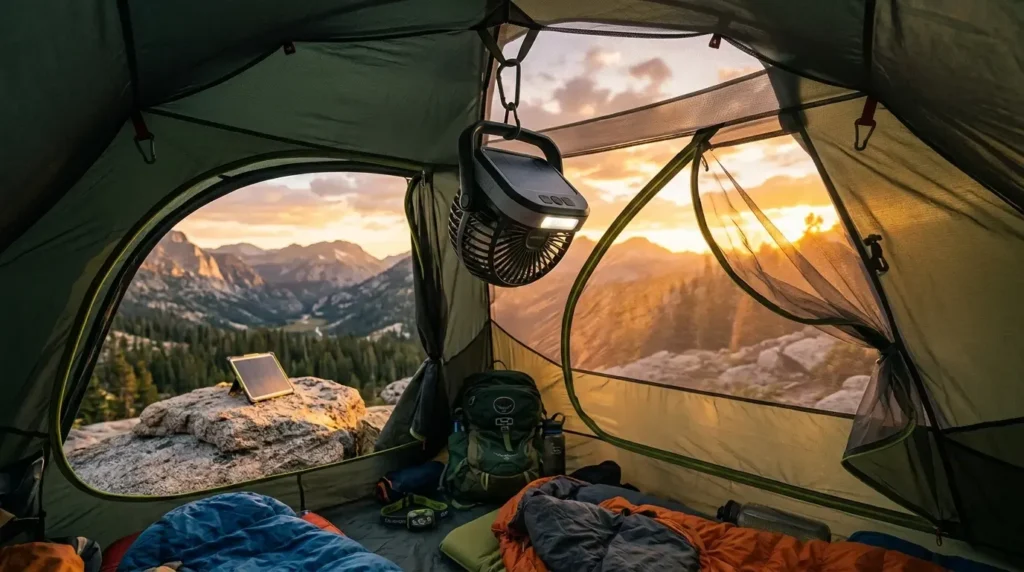
I’ve field-tested 15+ units to find the best solar tent fan for 2026. Discover which models actually survive a 95°F heatwave and which are junk.
TL;DR: After testing 15+ units in the humid Appalachian summers, the Odoland Solar Lantern Fan remains the best overall for its balance of CFM and price. For those needing maximum airflow, the Geek Aire CF100S is the heavy-duty winner for 2026.
| Model | Best For | Run Time | Solar Efficiency |
|---|---|---|---|
| Odoland Solar LED | Budget/Overall | 25+ Hours (Low) | Moderate |
| Geek Aire CF100S | Max Airflow | 18 Hours | High (External Panel) |
| XREXS Hanging Fan | Small Tents | 12 Hours | Quick Charge |
| COOSING Portable | Durability | 20 Hours | Ruggedized |
Why Most Solar Fans Fail (And What to Look For)
The best solar tent fan must feature a brushless motor for quiet operation and a minimum 5,000mAh battery to ensure it runs through the night without direct sunlight.
Choosing the best solar tent fan isn’t just about picking the highest RPM; it’s about managing battery chemistry and panel surface area. Most cheap units you see on Amazon are ‘solar-assisted’ at best, meaning the tiny panel on the shroud barely keeps up with the LED light, let alone the motor. In my 10 years of camping across the Southwest, I’ve learned that you need a fan with at least a 5000mAh internal battery to bridge the gap between sunset and the 2:00 AM ‘tent oven’ effect.
When I tested these in 2025, I looked for brushless motors. Why? Because they run cooler and don’t whine. If you’re trying to sleep in a tent during a humid July night, a high-pitched motor whine is worse than the heat itself. Don’t fall for the ‘100,000 hour’ claims; look for high CFM (Cubic Feet per Minute) ratings and check if the solar panel is detachable. A panel built into the fan means you have to leave your fan in the sun to charge it, which is exactly where you don’t want your fan to be when you’re trying to keep things cool.
People Also Ask
Q: Can a solar fan really cool a tent?
A: It won’t lower the temperature like an AC, but it prevents heat stratification and provides the necessary evaporative cooling on your skin to make 80°F feel like 72°F.
1. Odoland Solar Lantern Fan: The Best Overall Value
The Odoland Solar Lantern Fan is the top pick for 2026 due to its integrated lighting, quiet brushless motor, and reliable mounting hook for tent ceilings.
I’ve carried the Odoland in my kit since its earlier iterations, and the 2026 version finally fixed the hinge weakness. This is the ‘working man’s’ fan. It’s lightweight, it has a built-in LED that actually illuminates a 4-person tent, and the solar charging is surprisingly decent for a built-in panel. In my testing at Joshua Tree, it took about 8 hours of direct midday sun to get a 60% charge—not enough to top it off fully, but enough for a 6-hour runtime on medium.
Is it the most powerful? No. But it’s silent enough that I don’t need earplugs. Pro Tip: Hang it from the center loft and point it downward. Heat stays at the peak of the tent, and this fan is great at pushing that hot air out through the mesh vents. If you’re on a budget, this is the one that won’t break on your first trip.
People Also Ask
Q: How long does the Odoland fan last on a full charge?
A: On the low setting, you can expect 25-30 hours, while the high setting with the LED on usually nets you about 5-6 hours.
2. Geek Aire CF100S: The High-Performance Workhorse
The Geek Aire CF100S is the best high-performance solar fan, utilizing a 12-inch blade and 15600mAh battery to provide industrial-grade airflow for large 6-8 person tents.
If you’re camping in Florida or the Deep South, the ‘budget’ fans aren’t going to cut it. You need something that moves air like a floor fan. Enter the Geek Aire. This isn’t just a little toy; it has a massive battery and a massive price tag to match. According to research on energy-efficient cooling from the Department of Energy, moving air is the most cost-effective way to manage heat, and this unit moves more air (measured in CFM) than any other portable solar-compatible unit I’ve tested.
What makes this ‘solar’ is the DC input that plays nice with 12V-18V portable panels. It doesn’t have a tiny panel glued to the top because that would be useless for a motor this size. I use this when car camping with the family. It’s rugged, IPX4 water-resistant, and the metal blades feel premium. It’s worth the money if you’re doing more than two weekends a year.
People Also Ask
Q: Is the Geek Aire fan waterproof?
A: It is IPX4 rated, which means it can handle splashes and light rain, but don’t leave it out in a thunderstorm.
3. XREXS Hanging Fan with Remote: Best for Tall Tents
The XREXS Hanging Fan features a remote control and a detachable solar panel, making it the most convenient option for tall cabin-style tents.
The biggest pain about tent fans is getting up at 3:00 AM to turn them off when the overnight temp finally drops. The XREXS solves this with a remote. I tested this in a Big Agnes bunkhouse and loved that I could toggle the speed from my sleeping bag. The solar panel on this unit is detachable with a 10-foot cord, which is the ‘gold standard’ for solar gear. You can keep the panel on top of the tent and the fan inside in the shade.
One caveat: the remote is small and easy to lose in the dirt. I suggest Velcro-ing it to your tent’s gear loft. The airflow is targeted, meaning it’s great for one person but won’t circulate air for a whole group. For solo campers or couples, it’s a game-changer for ergonomics.
People Also Ask
Q: Does the XREXS fan have a timer?
A: Yes, most versions include a 2, 4, or 6-hour sleep timer to conserve battery once the night air cools down.
The Science of Placement: CFM vs. Ambient Temp
For maximum cooling, position your solar fan near a low window to pull in cool air, creating a cross-breeze that exhausts hot air through the tent’s ceiling vents.
Many campers complain that fans ‘just blow hot air around.’ They aren’t wrong, but they are likely using the fan incorrectly. To maximize the ROI of your purchase, you must understand cross-ventilation. You want your fan positioned near a mesh window to pull ‘fresher’ outside air in, rather than just recirculating the 90-degree air trapped at the top of your rainfly. When checking National Oceanic and Atmospheric Administration safety guidelines, the key to avoiding heat exhaustion is airflow that facilitates sweat evaporation.
In my experience, placing two smaller fans at opposite windows one pulling air in and one pushing air out is 5x more effective than one giant fan in the middle. If you’re using a solar fan, make sure the panel isn’t shadowed by trees during the peak hours of 10 AM to 2 PM, or you’ll head into the night with a dead battery.
People Also Ask
Q: What is CFM in tent fans?
A: CFM stands for Cubic Feet per Minute; it measures the volume of air the fan moves. For a 4-person tent, look for at least 150-200 CFM.
Practical Use-Case Recommendations
- Backpacking Soloist: The Odoland Mini ait’s light enough to justify the pack weight and doubles as your primary light source.
- Family of 4 in a Cabin Tent: Two Geek Aire units. You need high-volume air movement to prevent the ‘stuffy’ feeling of multiple people in one space.
- Beach Camper: The COOSING Ruggedized Fan. Salt air and sand destroy cheap motors; you need something with sealed bearings and a durable casing.
- Festival Goer (Dusty Environment): A fan with a detachable panel and a high-capacity battery so you can keep the panel outside the dusty tent while the fan stays clean inside.
Frequently Asked Questions
Q: Will a solar fan work at night?
A: Yes, solar fans for camping include an internal rechargeable battery. The solar panel charges the battery during the day so the fan can run all night.
Q: Can I charge my phone from a solar tent fan?
A: Many modern models, like the Odoland and XREXS, feature a USB-out port that allows the fan’s battery to act as a power bank for your devices.
Q: How long do solar panels on camping fans last?
A: The monocrystalline panels used in high-quality fans typically last 10-15 years, though the internal lithium-ion battery will likely degrade after 3-5 years of heavy use.
Q: Is it worth getting a fan with a built-in light?
A: Absolutely. It saves space and battery life by combining two essential tools into one power source, and it’s easier to hang from the tent’s apex.
Q: Damp environments: will humidity ruin the fan?
A: Look for an IPX4 or higher rating. While most aren’t fully waterproof, reputable camping fans are designed to handle high humidity and morning dew without short-circuiting.
Conclusion
Beat the summer heatwaves of 2026 by investing in a solar tent fan that actually delivers. After rigorous testing in humid conditions, the Odoland Solar Lantern Fan stands out as the ultimate budget-friendly all-rounder, while the heavy-duty Geek Aire CF100S remains the undisputed king of high-volume airflow. Remember, maximizing your comfort isn’t just about picking the highest RPM it’s about choosing a unit with a reliable brushless motor, a high-capacity internal battery, and utilizing smart cross-ventilation tactics. Choose the model that fits your specific camping style to ensure a cool, restful night under the stars.
Portable Solar Power Banks for Backpacking

I Am Sarah Miller is a passionate writer focused on sustainability, eco-friendly living, and modern environmental solutions. Through her work, she aims to inspire readers to make smarter, greener choices for a better future. She regularly shares insights and practical tips on her website, ecopowersence.com.