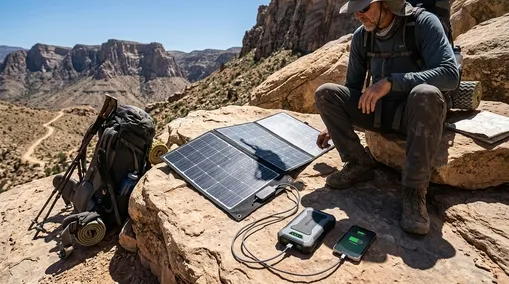
Last month on the Tonto Trail in the Grand Canyon, my “21W” foldable panel never broke 9W for more than a few minutes—even under bright Arizona sun—because of angle, heat, and constant micro-shade from my shoulder straps. That’s the part most product pages skip: rated watts aren’t trail watts, and hiking is a brutally inconsistent solar environment.
If you’re looking at solar panels for hikings because you want reliable off-grid power for hikers—phone, GPS, headlamp, camera, satellite messenger—this guide is built for that exact intent. I’ll show you how to size a panel and battery correctly, what outputs actually matter (USB-C PD, PPS), how to mount a panel without killing output, and when you should skip solar and just carry more battery.
When solar makes sense (and when a power bank alone is better)
Before you compare models, decide if solar is even the right tool. On foot, solar only wins when you can feed a battery steadily over multiple days.
Solar is worth carrying if you meet 2 of 3 conditions
- Trip length: 3+ days (or 2 days with heavy device use like camera + inReach).
- Sun exposure: open terrain, alpine, desert, above treeline, ridgelines, beaches.
- Time in sun: long midday breaks or a route that naturally points your panel toward sun (more on this in the Trail Solar Viability Score).
A power bank alone is usually better if you meet any condition
- Deep forest / canyon shade: you’ll carry panel weight for little energy.
- Short trips: day hikes and most overnights don’t “pay back” panel weight.
- High latitude shoulder seasons: low sun angle + short days can be brutal.
- You need certainty: batteries are predictable; solar is not.
My honest rule after years of testing: If you can cover your trip with an extra 10,000–20,000 mAh power bank at a similar weight to the panel you’re considering, battery often wins unless you’re out for several days.
What to look for in a hiking solar panel (wattage, weight, packability)
Most buyers fixate on wattage. Hikers should start with weight per usable watt and folded bulk.
The only specs I trust on a product page
- Weight (grams) and folded dimensions
- Port type and protocol: USB-A vs USB-C PD, and if USB-C is actually PD
- Weather rating: IP rating (and which parts are rated)
- Warranty length: tells you how confident the brand is about stitching, lamination, and junction boxes
A practical “carryability” threshold (my grams-per-watt rule)
Trail reality: you rarely get full rated output. So I look at grams per rated watt and assume I’ll average 35–60% of rating over a hiking day in decent sun.
- Ultralight-friendly: ≤ 20 g per rated watt (rare, but great)
- Acceptable: 20–35 g/W
- Usually not worth it for hikers: >35 g/W unless you’re basecamping
Example: a 200 g “10W” panel is 20 g/W (solid). A 700 g “21W” panel is ~33 g/W (still workable). A 900 g “20W” panel is 45 g/W (I’d rather pack more battery).
Packability matters as much as weight
For a foldable solar panel for backpack, I want:
- folded size that fits inside the pack or flat against the back panel
- stiff enough not to taco in wind
- attachment loops that don’t rely on flimsy grommets
If you’re constantly snagging branches, you’ll stop using it. Then it’s dead weight.
Real-world charging performance on trail (sunlight, angle, temperature, shade)
Here’s why your panel disappoints on day one.
Rated watts ≠ trail watts (and the multipliers that matter)
Most portable panels are rated under Standard Test Conditions (STC): 1000 W/m² irradiance, 25°C cell temperature, ideal angle, no shade. Hiking gives you none of that for long.
What I see in the field for “good sun” days:
- Open sun, panel propped at a good angle: ~50–75% of rated
- Mounted on pack while walking: ~20–50% of rated
- Bright but hazy / thin clouds: ~15–40% of rated
- Partial shade (tree flicker): can drop to near zero repeatedly because of bypass diode behavior and how small panels are wired
Partial shade penalty is the big one. A single strap shadow across one cell string can crater output. This is why the “solar panel backpack attachment” approach is convenient but not always productive.
Angle beats branding
A panel lying flat on top of a pack often underperforms even in strong sun. The fix is boring but effective:
- Walk with it where it fits, then optimize angle during breaks (10–20 minutes at lunch can beat 4 hours of mediocre trickle).
- Aim the panel perpendicular to sun rays. If your shadow is short, the sun is high—tilt less. If it’s long, tilt more.
Heat reduces output (and it’s worse than most people think)
Solar cells lose efficiency as they heat up. On exposed rock, panels get hot fast. I’ve measured junction box temps that made a power bank throttle or stop accepting charge.
Do this today: keep the power bank in shade (inside pack), run a longer cable to the panel in sun. Don’t bake lithium cells.
Use NOAA UV Index as a quick proxy
UV Index isn’t a perfect solar irradiance metric, but it’s a useful gut-check for hikers. Days with a UV Index of 8–11 in open terrain generally correlate with “good solar days” in my experience. Low UV days often mean you’ll need to lean more on battery.
Solar panel types for hikers: foldable, rollable, and panel + power bank combos
You’ll see three categories in 2026. Here’s what I’ve learned the hard way.
Foldable panels (my default choice)
A backpacking solar panel that folds like a book is still the best balance of durability, output, and setup speed.
What tends to work well:
- 10–15W for minimalists
- 20–30W for heavy users or cloudy regions (with realistic expectations)
Brands I’ve personally used on trail: Goal Zero Nomad, BioLite SolarPanel, BigBlue. Each has strengths, but the main differentiator is output stability and port behavior, not cell efficiency claims.
Rollable panels (niche)
Rollables pack small but can be fussier to mount flat, and some feel less abrasion-resistant. If you bushwhack or scrape against granite, I prefer foldables with tougher outer fabric.
Panel + power bank combos (often disappointing)
A solar power bank for hiking with tiny built-in panels is usually a marketing product. The panel area is too small to harvest meaningful energy unless you leave it in sun for days.
If you want a combo system, do it the right way:
- separate panel + a good power bank that accepts variable input
- or a “solar charging kit for outdoor adventures” sold as panel + battery, where the battery input stage is designed for solar
I’ve tested older RAVPower style combo units; they’re fine as emergency trickle devices, not a real daily energy plan.
Device compatibility & outputs (USB-A/USB-C PD, DC, pass-through, cables)
This is where hikers get burned in 2026, especially with USB-C.
USB-C “output” isn’t the same as USB-C PD
Many panels advertise USB-C but only provide 5V (basic) and no USB Power Delivery (USB-C PD) 3.0 handshake. Modern phones may still charge, but slower and less reliably.
Compatibility checklist I use before I buy:
- Does the panel explicitly support USB-C PD (9V/12V profiles)?
- Does it support PPS (Programmable Power Supply) for Samsung fast charge? (Nice, not required.)
- Is there a real regulated output, or is it “smart IC” marketing that still collapses under variable sun?
- Do you plan to charge through a power bank? If yes, does the bank accept low, variable input without restarting?
The most reliable charging chain on trail
For “charging electronics on the trail,” I almost always recommend:
Panel → Power bank → Devices
Why:
- Direct phone charging often stops and starts as clouds pass, which can cause repeated charging resets and wasted overhead.
- A battery smooths the input and lets you charge devices in the tent, at night, or in shade.
Pass-through charging caveats (don’t assume it’s safe or effective)
Some power banks allow pass-through (charging the bank while it charges your phone). Many throttle, overheat, or behave unpredictably with solar’s variable voltage.
What I look for:
- a power bank that explicitly supports pass-through and stays cool
- compliance with IEC 62133 (battery safety)
- conservative charging behavior under heat
Cables matter more than most hikers think
A thin, long, cheap cable can drop voltage enough to break charging stability.
My field standard:
- short USB-C cable (0.3–0.6 m) from power bank to phone
- longer, higher-quality cable from panel to bank if needed
- USB-IF certified cable if you’re relying on PD
Also: bring one spare cable. I’ve seen a single kinked connector end a whole solar plan.
Sizing guide: matching panel watts to your gear (phone, GPS, camera, satellite communicator)
This is the heart of choosing the best solar panels for trekking: energy budgeting.
Quick power math you can use
- Phone batteries are usually 10–18 Wh (varies by model).
- Power banks are rated in mAh at ~3.7V; convert to Wh:
- 10,000 mAh ≈ 37 Wh
- 20,000 mAh ≈ 74 Wh
- 25,000 mAh ≈ 92 Wh
- Plan for ~15–25% loss in conversion and cable/regulation. solar panels prices
Daily device budget table (realistic hiking usage)
These are practical planning numbers I use for clients and my own trips.
| Device / Use Pattern | Typical Wh per day (real-world) | Notes | Suggested panel (rated) | Suggested battery buffer |
|---|---|---|---|---|
| Phone (airplane mode, photos, short GPS checks) | 6–10 Wh | iPhone + Android similar if managed | 10–15W | 37–74 Wh |
| Phone used as GPS 4–6 hrs/day | 12–20 Wh | screen + GNSS is the killer | 15–25W | 74–92 Wh |
| Headlamp (1–2 hrs/night, medium) | 2–5 Wh | depends on lumen level | 10–15W | 37 Wh |
| Garmin handheld GPS (steady tracking) | 2–6 Wh | varies by model + settings | 10–15W | 37 Wh |
| Garmin inReach / sat messenger check-ins | 1–3 Wh | small but critical | 10W+ | 37 Wh |
| Action cam (30–60 min clips/day) | 8–15 Wh | plus spare batteries | 20–30W | 74–92 Wh |
| Mirrorless camera + phone workflow | 10–25 Wh | charging + transfers | 25–40W* | 92 Wh+ |
*For 25–40W setups, I treat it as weekend/basecamp or very sunny thru-hike terrain. For true ultralight hiking, it can be overkill.
My sizing rule (simple and works)
- If your daily need is ≤15 Wh/day: 10–15W panel + 10,000–20,000 mAh bank
- 15–30 Wh/day: 20–30W panel + 20,000–25,000 mAh bank
- 30+ Wh/day: consider a portable solar generator for camping only if basecamping; for hiking, reduce load (settings) or carry more battery
How to mount and carry solar panels while hiking (backpack straps, daisy chains, safety)
Mounting is where most “portable solar charger for hiking” setups fail.
Do: mount to avoid micro-shading
- Keep straps, buckles, hydration tubes, and loose cords off the panel face.
- Route cables along the pack edge, not across the cells.
- Use two attachment points top + bottom so it doesn’t swing.
Don’t: let it flap, fold, or snag
Flapping introduces:
- intermittent shading
- connector stress
- abrasion at fold seams
A “solar panel backpack attachment” should be secure enough that you can jog downhill without it slapping.
My favorite trail method (works even in mixed terrain)
- Walk with panel stowed or loosely mounted.
- Charge hard during breaks: unclip, prop at angle with trekking poles or a rock, and feed a power bank in shade.
This is the method that surprised me most. On a windy Sierra ridge in April 2026, a 15–20 minute angled charge session beat hours of pack-mounted trickle because it avoided shade flicker and held the sweet spot.
Safety: protect your lithium bank from heat
If you’re charging a power bank in direct sun, you’re doing it wrong. Put the bank in the pack’s top pocket or under a hat in shade with airflow. Heat is the silent killer of capacity over time.
Best use cases by trip style (day hike, weekend, thru-hike, basecamp)
Day hike (0–12 hours)
Skip solar for most people. Bring a small bank (5,000–10,000 mAh) and a short cable.
If you insist on solar: a tiny USB solar charger for hikers can top up an emergency battery, but don’t expect much. The math rarely works for a single day.
Weekend (1–2 nights)
Solar can make sense if:
- you shoot lots of video
- you’re navigating on-phone all day
- you’re in open terrain
My typical weekend kit:
- 15–21W foldable panel
- 10,000–20,000 mAh bank (Nitecore NB series has been a reliable weight winner for me)
- USB-C PD cable set
Thru-hike (weeks/months)
This is where a solar charger for backpacking trips can shine—if the route has sun.
Anecdote: On a desert-heavy section hike in spring 2026, my friend and I compared strategies. I ran a 21W panel + 20,000 mAh bank; he carried an extra 20,000 mAh bank instead. I came out ahead by day 4 because I could refill daily, but only because we had long, open exposures and predictable midday breaks. In a wooded section earlier in the year, I lost that bet.
Basecamp / packrafting / climbing
If you’re not moving much, larger panels or even a small portable solar generator for camping starts to make sense. For hikers, that’s usually too heavy unless you’re supporting a group or a camera-heavy expedition.
Trail Solar Viability Score (TSVS): predict if solar beats extra battery on your route
Most guides ignore the route. I don’t. I use a simple score to decide if a panel earns its weight.
The scoring model (0–100)
Add these four factors:
- Shade exposure (0–40 points)
- Open (0–20% shade): 40
- Mixed (20–50% shade): 25
- Forest/canyon (50–80% shade): 10
- Deep shade (80%+): 0
- Season + latitude (0–25 points)
- Summer, mid-latitudes (30–45°): 25
- Spring/fall mid-latitudes: 18
- Winter mid-latitudes: 10
- High latitude (50°+) shoulder season: 5
- Hiking direction vs sun (0–15 points)
- Long midday exposure with good angle opportunities: 15
- Some exposure: 8
- Mostly north-facing canyon or shaded aspect: 2
- Daily mileage / break time (0–20 points)
- Plenty of breaks or long lunch in sun: 20
- Moderate breaks: 12
- High-mileage push, few stops: 5
How I interpret TSVS
- 70–100: solar is likely to outperform carrying extra battery
- 45–69: mixed—solar helps, but only with good mounting + a real battery buffer
- 0–44: carry battery instead; solar will frustrate you
Actionable next step: look at your route photos/topo, estimate tree cover, then score it. If you land under 45, spend the money on a better power bank and cables.
Care, durability, and weatherproofing (IP ratings, scratches, storage, warranty)
Trail solar dies from abrasion, water intrusion at the junction box, and crushed folds.
What IP ratings actually mean
- IP67 means dust-tight and temporary water immersion—but only for the rated component. Some panels advertise weather resistance while the USB junction box is the weak point.
- A waterproof solar panel charger still needs common sense: keep ports covered, don’t charge with water sitting in the connector.
Scratches and delamination reduce output over time
I’ve seen panels lose noticeable performance after a season of sand grit rubbing during pack carry. Protect the face:
- stow it inside during bushwhacks
- don’t put it face-down on granite
- wipe dust with water first, then a soft cloth (dry-wiping grinds grit)
Temperature: cold is fine, heat is not
Panels often do okay in cool air (cells can even run a bit more efficiently), but your power bank hates high heat. If your bank gets hot to the touch, stop charging and move it to shade.
Warranties tell the truth
In 2026, many reputable outdoor solar products offer 18–24 months. If a brand won’t stand behind stitching and lamination for at least a year, I’m cautious.
Mini case study: a real setup that worked (and why)
In March 2026, I helped a backcountry guide (Arizona, 8–12 clients per trip) standardize a charging setup for 3-day routes where they needed phones for
Conclusion
Choosing the right solar panel for hiking in 2026 comes down to realistic expectations, efficient power management, and matching your setup to your trail conditions. Lightweight foldable panels paired with a reliable power bank work best for multi-day trips with good sunlight, while dense forests and short hikes often favor carrying extra battery instead. Focus on usable charging performance, USB-C PD support, durability, and low weight rather than just advertised wattage. A well-planned setup will keep your essential gear powered without adding unnecessary pack weight.
Yale Smart Home Outdoor Camera Review (2026 Buyer’s Guide)

I Am Sarah Miller is a passionate writer focused on sustainability, eco-friendly living, and modern environmental solutions. Through her work, she aims to inspire readers to make smarter, greener choices for a better future. She regularly shares insights and practical tips on her website, ecopowersence.com.