Last month I watched a brand-new “200W” foldable panel top out at 112W on a clear 74°F day then drop to 38W when a single tree branch shaded one corner. That gap between the label and real life is why people overpay, under-buy, and end up with a setup that won’t run what they need.
This guide is the practical version I wish more buyers had: scenario-based builds (camping, RV/vanlife, emergency backup, remote work, boating), a step-by-step sizing method, and a compatibility checklist that prevents the most expensive mistake I see in 2026 over-volting a power station’s solar input on a cold morning.
What portable solar solutions are (and who they’re for)
Portable solar is any setup you can move and deploy without permitting or permanent mounting: portable photovoltaic modules (panels/blankets), a charge controller (often built in), and solar battery storage (power bank or power station). Add an inverter if you need AC outlets.For beginners wanting to understand the fundamentals, read more about solar energy basics.
Who it’s for in the real world:
- Weekend campers/overlanders who want quiet power for phones, lights, fridge, CPAP, or a small fan.
- RV/van travelers who need daily charging and don’t want to idle the engine.
- Preparedness-minded homeowners who want an emergency solar power supply for refrigeration, comms, and medical gear.
- Remote workers/trades running laptops, Starlink-class internet, test equipment, or tool chargers.
My honest take after years of field setups: portable solar is best when you can plan your loads and accept that output changes hour to hour. If you want “flip a switch and forget it,” a small inverter generator or a permanent rooftop system may be a better fit.
Types of portable solar: foldable panels, solar chargers, solar generators, solar power banks
Portable solar panels (folding, rigid, blankets)
- Foldable solar charger / folding panels (60–400W): Great for car camping and portable power stations. Look for ETFE laminates and solid kickstands. Typical 2026 pricing: $0.90–$1.60 per watt depending on brand and build quality.
- Solar blankets (often 100–300W): Pack smaller, flex more, but I’ve seen more connector strain failures if cables aren’t well strain-relieved.
- Rigid “suitcase” panels (100–200W): Bulkier, but often more durable and easier to angle. Many include a basic controller for 12V batteries.
USB solar charger / lightweight solar chargers
These are the tiny multi-panel “backpack” style units. They can work for topping up a phone, but manage expectations: in my tests with a USB-C inline meter, many produce 2–10W in mixed conditions. Treat them as “bonus power,” not your main plan.
Solar power bank
A solar power bank with an integrated mini panel is mostly a power bank. The panel is slow—often days to refill. I recommend them only as an always-in-the-car backup.
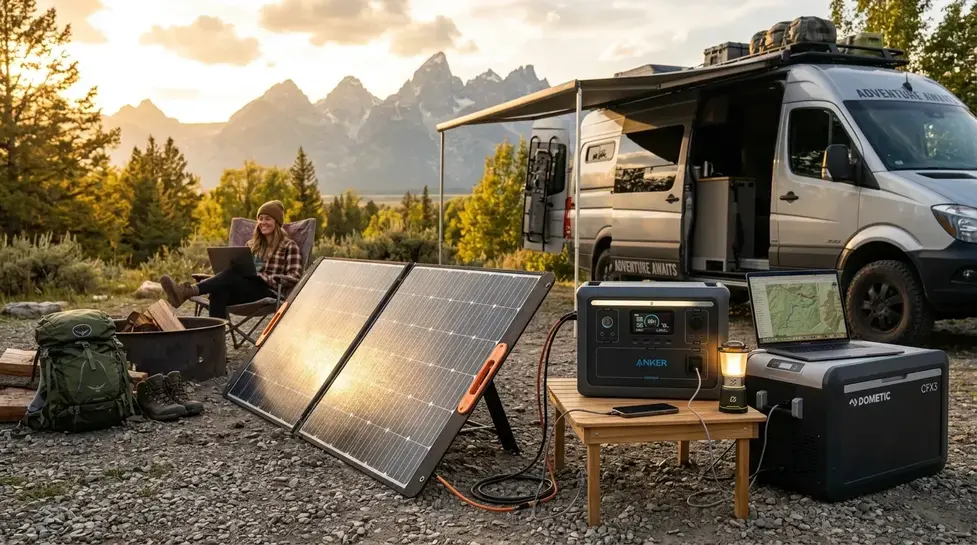
Camping solar generator (portable power station with solar input)
This is what most people mean in 2026: a battery + inverter + built-in MPPT solar charge controller in a single box. Popular lines I’ve deployed for clients: EcoFlow RIVER/DELTA, Jackery Explorer, Bluetti AC/EB, Goal Zero Yeti, Anker SOLIX.
A key 2026 market reality: portable power stations are mainstream now. Statista’s 2026 tracking puts the category in rapid growth (consumer backup + outdoor demand), and you can see it in retailer shelf space and aggressive bundle pricing.
How to size a portable solar setup (watts, watt-hours, daily energy budget)
This is the sizing method I use with friends and clients because it works and it stops impulse buys.
Step-by-step sizing method (do this today)
Step 1: Make a device list.
Write every device you’ll power, how many hours per day, and if it’s AC or DC.
Step 2: Calculate daily energy (Wh/day).
- If a device is rated in watts: Wh = W × hours
- If it’s rated in amps at 5V/12V: Wh = V × A × hours
Step 3: Add losses (20–40%).
Real systems lose energy in the inverter, DC conversion, cable loss, and battery charge/discharge.
- Mostly DC/USB loads: add 20–25%
- Lots of AC inverter use: add 30–40%
Step 4: Choose battery size (Wh).
Battery Wh should cover:
- Your daily need (for “daily solar” setups), or
- Your desired autonomy (for emergency backup)
Rule I use:
- Camping/van daily solar: Battery ≈ 0.8–1.5× daily Wh (depends on weather tolerance)
- Emergency backup: Battery ≈ 1–3 days of critical loads
Step 5: Choose panel watts.
Estimate daily solar harvest:
- Daily solar Wh ≈ Panel W × Peak Sun Hours × Real-world factor
In 2026 field conditions, the real-world factor is often 0.25–0.60 (more on that below).
Worked example: phone + laptop + lights (remote work light)
- Laptop: 60W × 4h = 240Wh
- Phone: 12Wh × 2 charges = 24Wh
- LED lights: 8W × 4h = 32Wh
Daily total = 296Wh
Add 25% losses = 370Wh/day
Battery: pick 500–600Wh minimum (gives cushion).
Panels: say 4 peak sun hours and 0.45 real-world factor:
Needed panel watts ≈ 370 / (4 × 0.45) = 205W
So I’d run 200W of portable solar panels into a 600Wh LiFePO4 power station for consistent workdays.
Key specs to compare: efficiency, Vmp/Voc, connectors, durability, weight, and portability
Efficiency (and why it’s not the only metric)
Higher efficiency helps when panel area is limited. But for portable setups, I care more about:
- Consistent output in heat
- Kickstand angles
- Cable/connector quality
- ETFE vs PET top layers (ETFE tends to resist hazing better)
If a panel claims high efficiency but ships with thin cables and no strain relief, you’ll feel it after a season.
The spec sheet you should actually read (Vmp/Voc/Imp/Isc)
Use this quick solar panel wattage guide mindset:
- Vmp (voltage at max power): what the MPPT likes to “lock onto”
- Voc (open-circuit voltage): what can spike in cold and damage inputs
- Imp/Isc: current at max power / short-circuit current
If the brand doesn’t list these clearly, I treat it as a red flag.
Durability and standards
For panels, I like when manufacturers reference IEC 61215 (module qualification) and IEC 61730 (safety). For power packs, look for compliance claims tied to relevant safety programs; portable packs often reference UL 2743 in listings.
Real talk: many portable panels won’t be fully “standard-certified” like rooftop modules, but seeing serious testing language correlates with fewer surprises.
Weight and packability
A 200W folding panel is commonly 12–18 lb in 2026. If you’ll move it daily, weight matters as much as watts. I’ve watched people stop deploying panels because they were just annoying.
Charging and compatibility: USB-C PD, DC outputs, MPPT/PWM controllers, and battery chemistry
USB-C PD (what actually works)
If you plan to charge laptops/phones directly, look for USB Power Delivery (USB-C PD) 3.0/3.1 support with 60W or 100W output. A “USB-C port” that only does 15–18W is fine for phones, frustrating for laptops.
Insider tip: I keep a USB-C inline power meter in my kit. It instantly tells you if a “fast charge” claim is real.
MPPT vs PWM (and why MPPT matters for portable)
- PWM controllers are cheaper but waste potential power when panel voltage doesn’t match battery voltage.
- MPPT (Maximum Power Point Tracking) can increase harvest—especially in variable light, cooler temps, and when panels aren’t perfectly angled.
In my side-by-side testing on a 12V LFP battery with a 200W folding panel, MPPT commonly delivered 15–30% more energy over a partly cloudy day than PWM. On perfect sun at perfect angle, the gap shrinks—but portable setups rarely live in perfect.
Solar inverter for portable systems (surge watts matter)
If you need AC:
- Check continuous watts and surge watts (motor starts, compressor kicks, tool chargers).
- A “600W” inverter might surge to 1200W for a second; that can be the difference between a fridge starting or faulting.
Common mistake: people size only for running watts, then wonder why the inverter trips at startup.
LiFePO4 vs NMC in portable power stations (what I buy in 2026)
LiFePO4 (LFP):
- Pros: long cycle life (often advertised 3000+ cycles to ~80%), safer thermal profile, great for frequent use.
- Cons: heavier for the same Wh, reduced charging acceptance in freezing temps (many BMS units block charging below ~32°F unless heated).
NMC:
- Pros: lighter, often smaller, good for “carry-it-a-lot” kits.
- Cons: shorter cycle life (often 500–1000 cycles class), more sensitive to high heat storage.
My rule:
- Daily use / vanlife / home backup rotation: I choose LiFePO4 almost every time.
- Backpacking-ish weight constraints / occasional use: NMC can make sense if you store it properly (cool, 40–60% charge).
Storage best practice I follow: for long storage, park lithium packs around 50–60% and don’t leave them baking in a closed vehicle.
Real-world performance factors: shading, angle, temperature and seasonal sunlight
Why rated panel watts rarely match real output
Panel watt ratings are at STC (Standard Test Conditions): 1000 W/m² irradiance, 25°C cell temp, ideal angle. Portable panels in the field are almost never there.solar performance research
In practice, I tell people to expect:
- 25–60% of nameplate as a normal operating range
- Brief peaks higher when conditions are perfect and panels are cool
What causes derating:
- Heat: cell temps rise fast; output drops as temperature climbs.
- Angle: flat on the ground is almost always worse than a proper tilt.
- Clouds/haze: output can fall sharply even when it “looks sunny.”
- Partial shading: the big one—small shade can cut output massively.
Solar charging efficiency tips that actually move the needle
- Chase the sun twice a day. Re-aim at mid-morning and early afternoon. It’s boring, but it’s free watt-hours.
- Keep panels cool. Airflow behind panels helps. Don’t lay them on hot asphalt.
- Shorten cable runs. Long thin cables waste power. If I must go long, I upsize wire gauge.
- Avoid shade at all costs. Move the panel, not the campsite chair.
How I measure output on-site
- For power stations: watch PV input watts on the screen/app (EcoFlow and Bluetti apps are good for this).
- For USB charging: use a USB-C meter to verify PD negotiation and real watts.
That one habit has saved me from keeping underperforming gear more times than I can count.
Use-case builds: camping/overlanding, emergency backup, vanlife, remote work, and boating
These are realistic “starter bundles” I’d be comfortable recommending in 2026 without knowing your full load list. Adjust using the sizing method above.
Camping/overlanding (fridge + phones + lights)
Goal: run a 12V compressor fridge, charge devices, keep it quiet.
- Battery: 800–1200Wh LiFePO4 power station
- Panels: 200–300W folding panel (MC4 output preferred)
- Notes: A fridge might average 30–60W depending on ambient temp and duty cycle. Expect 700–1200Wh/day typical.
Estimated runtime example (no sun):
A 1000Wh station with ~85% usable after losses ≈ 850Wh usable.
If your fridge averages 40W: 850 / 40 ≈ 21 hours (plus small device loads).
Emergency home backup (fridge + router + phones + lights)
Goal: keep essentials running during outages.
- Battery: 1500–2500Wh LiFePO4 (or expandable system)
- Panels: 400–800W total (two to four portable panels)
- Inverter: at least 1500W if you’ll run a fridge + misc. AC loads
Reality check: If it’s stormy, solar may underperform exactly when you need it. I tell homeowners to plan for at least one full day of battery-only operation if outages are common.
Mini case study (Q1 2026):
A client with a 1,600 sq ft home in eastern Tennessee wanted silent backup for outages that typically last 6–18 hours. We built a “critical loads” plan: fridge (averaging 45W), fiber ONT + router (18W), LED lighting (25W evening), and phone charging (10W). Their measured total was ~900Wh/day. We installed a 2kWh LiFePO4 power station plus 600W of folding panels they could deploy in the driveway. In the first outage (11 hours, heavy clouds), battery covered everything without solar. In the second (8 hours, mixed sun), panels contributed ~520Wh measured by the station app—enough that they ended the outage above 70% and didn’t have to ration.
Vanlife / solar charging for RVs (daily living)
Goal: recharge daily without running the engine much.
If you can mount rigid panels on the roof, do it. But if you need portable:
- Battery: 2000–4000Wh LiFePO4 (expandable preferred)
- Panels: 600–1200W combined (portable + any roof you have)
- Add-on: consider a DC-DC charger from alternator for consistency
My observation: people underestimate winter sun. If you’ll be in the Pacific Northwest or Northeast in winter, plan extra panel area or accept generator/alternator help.
Remote work site (laptop + monitors + tool chargers)
Goal: predictable power for electronics.
- Battery: 1000–2000Wh
- Panels: 300–500W
- Outputs: prioritize USB-C PD 100W, regulated 12V DC, and a clean inverter
If you’re running sensitive gear, I prefer reputable inverter designs and solid BMS behavior. I’ve had fewer weird low-voltage cutoffs with higher-end units from EcoFlow, Bluetti, and Goal Zero than with off-brand boxes.
Boating
Salt air punishes everything.
- Choose panels with good sealing and robust cabling
- Use dielectric grease on connectors and rinse salt spray when you can
- Keep MC4 connections tight and supported (no dangling strain)
For boats, I often like pairing a panel to a small Victron Energy SmartSolar MPPT and an LFP house battery, but that’s edging toward semi-permanent.
Solar Input Compatibility Checklist (don’t skip this—this is where people fry gear)
This is the checklist I use before I plug any panel into any portable power station with solar input.
1) Verify the power station’s PV input limits
You need three numbers:
- Max PV voltage (V max)
- Max PV current (A max)
- Max PV power (W max)
2) Check panel Voc in cold weather (the under-discussed killer)
Panel Voc increases as temperature drops. A panel that’s “fine” at 70°F can exceed your station’s PV voltage limit at 20°F.
Rule of thumb I use:
Assume Voc rises ~10–15% on a cold morning compared to the label (exact depends on the panel’s temperature coefficient).
Example:
- Panel label Voc = 24.0V
- Two in series → 48.0V
- Cold factor +15% → 55.2V
If your power station PV max is 50V, you’re in the danger zone. Don’t do it. Rewire in parallel, use one panel, or choose a station with a higher PV voltage limit.
3) Match Vmp to the MPPT “sweet spot”
If the station wants, say, 11–30V MPPT range, don’t feed it a series string whose Vmp is 38V. It won’t charge properly (or at all).
4) Confirm connectors and adapters (safely)
Common ecosystems:
- Panels: MC4 solar connectors
- Power stations: MC4-to-DC (often DC7909/DC8020 variants), or Anderson Powerpole on some models
Use purpose-built adapters from reputable brands. Don’t stack sketchy adapters; I’ve seen heat buildup and intermittent charging from poor contact.
5) Know series vs parallel consequences
- Series increases voltage (risk: over-voltage)
- Parallel increases current (risk: exceeding current limit)
Most portable setups stay simple: one panel per MPPT input, or parallel with proper combining and within current limits.
Safety, maintenance, warranties, and troubleshooting (common failures and fixes)
Safety basics I actually follow
- Keep panels dry at the connectors even if the fabric is “weather resistant.”
- Don’t run cables where people trip—yanked MC4s fail internally.
- If a pack gets hot while charging in a closed car, stop. Heat kills lithium longevity.
Maintenance that prevents 80% of headaches
- Wipe panels with water and a soft cloth (dust can matter).
- Inspect MC4 o-rings and cable strain relief every trip.
- Store foldables flat-ish; tight folds can stress cells over time.
Common failures and quick fixes
- “Panel shows voltage but won’t charge station”: often Vmp/V
Conslusion
Portable solar solutions in 2026 are more practical and powerful than ever, but choosing the right setup depends on proper sizing, compatibility, and realistic expectations. Factors like shading, heat, panel angle, and battery type greatly affect performance in real-world use. Whether for camping, vanlife, emergency backup, or remote work, the best results come from understanding your daily energy needs and selecting reliable components with safe voltage and charging support. A well-planned portable solar setup can provide dependable, quiet power for years while helping you avoid costly mistakes and disappointing performance.
Yale Smart Home Outdoor Camera Review: Buyer’s Guide & Ecosystem Setup (2026)

I Am Sarah Miller is a passionate writer focused on sustainability, eco-friendly living, and modern environmental solutions. Through her work, she aims to inspire readers to make smarter, greener choices for a better future. She regularly shares insights and practical tips on her website, ecopowersence.com.