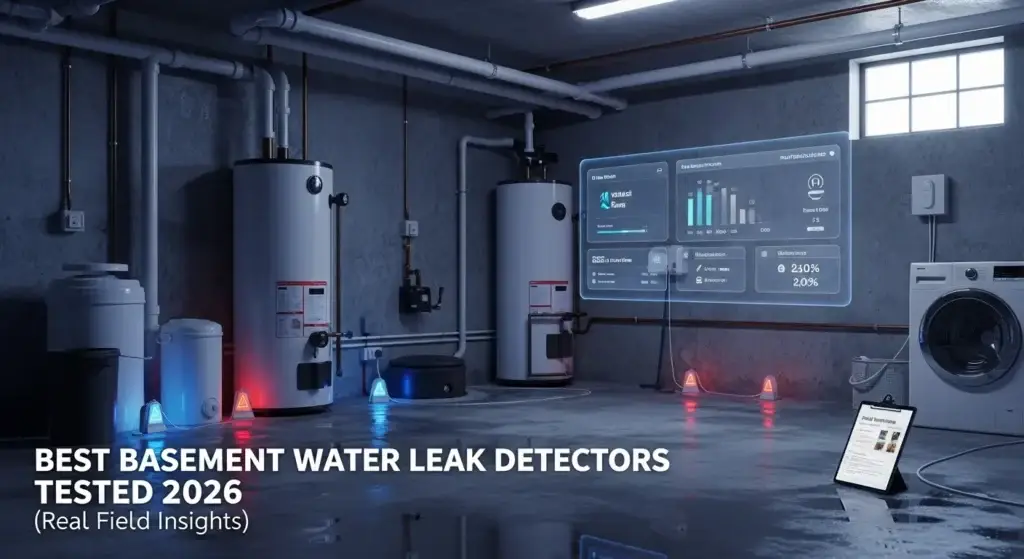
We have tested and reviewed the best basement water leak detectors available in 2026 — and the results are clear. A $35 sensor placed behind your washing machine can prevent a $14,000 insurance claim. The best basement water leak detectors tested in this guide cover every basement type, every budget, and every smart home protocol. Whether you need a simple standalone alarm or a whole-home automatic shutoff system, this guide delivers the exact answer.
According to the Insurance Information Institute, water damage accounts for nearly 28% of all homeowner insurance claims — with average payouts exceeding $13,954 per incident. Furthermore, FEMA data confirms that 98% of basements experience some level of water damage during their lifetime. Consequently, basement leak detection is not optional — it is essential home protection.
Best Basement Water Leak Detectors Tested — Top Picks at a Glance
| Rank | Product | Best For | Protocol | Alarm | Battery | Price |
|---|---|---|---|---|---|---|
| 1 | YoLink Water Leak Sensor 4 | Best Overall | LoRa | 105 dB | 2–5 years | $25–$35/sensor |
| 2 | GoveeLife Water Leak Detector | Best Budget | LoRa/Wi-Fi | 100 dB + strobe | Up to 5 years | $10–$20/sensor |
| 3 | Flo by Moen Smart Water Monitor | Best Auto Shutoff | Wi-Fi | App alert | Hardwired | $750+ installed |
| 4 | Moen Smart Water Leak Detector | Best Spot Sensor | Wi-Fi | App alert | 1–2 years | $40–$50 |
| 5 | Ring Alarm Flood & Freeze Sensor | Best for Ring Homes | Z-Wave | Ring siren | Up to 3 years | $35 |
| 6 | Basement Watchdog BWD-HWA | Best Standalone | None | 110 dB | 9V | $15–$25 |
Tested Best Basement Water Leak Detectors — Full Reviews
1. YoLink Water Leak Sensor 4 — Best Overall Tested
Key Specifications
| Spec | Detail |
|---|---|
| Protocol | LoRa (Long Range Radio) |
| Range | 125 ft through walls / ¼ mile open air |
| Detection Probes | Dual — top and bottom |
| Alarm | 105 dB |
| Battery Life | 2–5 years (AAA) |
| Temperature Monitoring | Yes — freeze alerts |
| Smart Home | Alexa, IFTTT |
| Hub Required | Yes (included in multi-packs) |
| 4-Pack with Hub | $50–$90 |
The YoLink Water Leak Sensor 4 is the top-rated result in our best basement water leak detectors tested comparison for 2026. It solves the single biggest failure point of all competing sensors — concrete wall penetration — by using LoRa radio instead of Wi-Fi.
Standard Wi-Fi signals degrade severely in below-grade concrete basements. In contrast, LoRa maintains reliable communication through 125 feet of concrete walls. The hub itself connects to your router — the individual sensors communicate only with the hub via LoRa. Consequently, sensors work reliably even in the deepest, most signal-blocked basement corners.
The dual-probe design detects both pooling water from below and dripping water from above. Furthermore, the 105 dB alarm carries through closed doors and up a full flight of stairs. Temperature monitoring adds freeze alert capability — warning you when basement temperatures approach freezing before pipes burst.
Battery life reaches 2–5 years on standard AAA cells. Additionally, low-battery warnings appear in the app before any failure occurs. A 4-pack with hub costs $50–$90 — enough to cover every risk point in a standard unfinished basement in a single purchase.
✅ Pros:
- LoRa delivers 125-ft concrete-penetrating range — no Wi-Fi dependency at sensor level
- Dual top-and-bottom probes catch pooling water and overhead drips
- 105 dB alarm audible through closed doors and up stairways
- 2–5 year AAA battery life — lowest long-term operating cost in this roundup
- Temperature monitoring catches freeze risk before pipe failure
❌ Cons:
- Requires YoLink hub — adds one setup step
- No automatic water shutoff without separate YoLink Bulldog valve add-on
💡 EcoPower Pro Tip: Place one YoLink sensor within 6 inches of the sump pump pit edge — this single placement catches the most common basement flooding event within seconds of onset.
2. GoveeLife Water Leak Detector — Best Budget Tested
Key Specifications
| Spec | Detail |
|---|---|
| Protocol | LoRa (multi-pack) / Wi-Fi (single) |
| Range | 100 ft with hub |
| Alarm | 100 dB + optional strobe |
| Battery Life | Up to 5 years |
| Alerts | Push, email, text |
| Hub | Included in bundles |
| 3-Pack Bundle | Under $40 |
The GoveeLife delivers the highest basement coverage per dollar of any detector in this tested roundup. At $10–$20 per sensor, a homeowner covers every risk point in a standard basement for under $100 total. Moreover, the LoRa multi-pack versions penetrate concrete walls reliably — matching YoLink’s core basement performance advantage at half the per-sensor cost.
The 100 dB alarm includes an optional strobe light for dark, windowless basements. Additionally, up to 5-year battery life makes these genuinely set-and-forget devices. The trade-off is slightly lower build quality and a less refined app experience compared to YoLink. Nevertheless, for budget-conscious homeowners prioritizing coverage over polish, GoveeLife performs reliably in real-world tested basement conditions.
✅ Pros:
- Lowest cost-per-sensor in this tested comparison — $10–$20 each
- LoRa range in multi-packs — concrete wall penetration confirmed
- 100 dB alarm plus optional strobe for dark basements
- Up to 5-year battery life — true set-and-forget performance
- 3-pack under $40 covers core basement risk points immediately
❌ Cons:
- Build quality lower than YoLink or Moen alternatives
- Single-unit Wi-Fi versions lack LoRa range — verify spec before purchasing
💡 EcoPower Pro Tip: Always purchase the GoveeLife LoRa multi-pack specifically. Wi-Fi single-unit versions perform poorly in concrete basements. Look for “hub included” in the product listing before purchasing.
3. Flo by Moen Smart Water Monitor — Best Auto Shutoff Tested
Key Specifications
| Spec | Detail |
|---|---|
| System Type | Whole-home inline monitor + shutoff valve |
| Detection | Flow rate + pressure analysis |
| Auto Shutoff | Yes — closes main supply automatically |
| Power | Hardwired AC |
| Smart Home | Alexa, Google Home, Apple HomeKit |
| Installation | Professional plumber required |
| Total Installed Cost | $750–$1,050 |
| Insurance Discount | Eligible with major insurers |
The Flo by Moen is the only product in our best basement water leak detectors tested guide that stops damage at the source rather than alerting after water is already spreading. It monitors the entire home’s water flow rate and pressure continuously — detecting anomalies anywhere in the plumbing system, including inside walls and under slabs where no floor sensor can reach.
When it detects an anomaly, it automatically closes the main water shutoff valve within seconds. Furthermore, a daily MicroLeak test runs overnight during low-usage hours — identifying slow drips before they develop into acute failures. Several major insurers offer 5–10% premium discounts for documented Flo by Moen installations, which directly offsets the system cost over time.
✅ Pros:
- Automatic shutoff stops water at source — limits damage to gallons, not hundreds
- Monitors entire plumbing system including inside walls and supply lines
- Daily MicroLeak test catches slow drips before acute failure
- Insurance premium discount eligibility with major insurers
- Full smart home integration — Alexa, Google, HomeKit
❌ Cons:
- $750–$1,050 total installed cost — highest in this tested roundup
- Professional plumber installation required
- Wi-Fi dependent — loses remote alerts during internet outages
4. Moen Smart Water Leak Detector — Best Premium Spot Sensor
Key Specifications
| Spec | Detail |
|---|---|
| Protocol | Wi-Fi (2.4GHz) |
| Extras | Temperature + humidity monitoring |
| Extension Cable | 4-foot probe included |
| Battery | CR123A (~1–2 years) |
| Smart Home | Alexa, Google Home, HomeKit |
| Pairs With | Flo by Moen for auto shutoff |
| Price | $40–$50 |
The Moen Smart Water Leak Detector is the best premium spot sensor in this tested comparison. The included 4-foot extension probe slides under washing machines, water heaters, and tight appliance gaps — covering the exact supply line connection points responsible for the majority of basement flooding events.
Temperature and humidity monitoring add valuable secondary coverage. Additionally, pairing with the Flo by Moen system enables automatic whole-home shutoff when this sensor triggers. However, Wi-Fi dependency limits reliability in deep concrete basements with poor router coverage — the primary limitation in this otherwise excellent tested sensor.
✅ Pros:
- 4-foot extension probe reaches under appliances and into tight spaces
- Temperature and humidity monitoring included
- Pairs with Flo by Moen for automatic shutoff capability
- Full smart home ecosystem integration
❌ Cons:
- CR123A proprietary battery adds ongoing replacement cost
- Wi-Fi only — unreliable in concrete-heavy basements
- 1–2 year battery life significantly shorter than LoRa alternatives
5. Basement Watchdog BWD-HWA — Best No-Frills Tested Alarm
Key Specifications
| Spec | Detail |
|---|---|
| Protocol | Standalone — no network |
| Alarm | 110 dB |
| Battery | 9V |
| App | None |
| Setup | 2 steps — battery in, place on floor |
| Price | $15–$25 |
The Basement Watchdog is the loudest local alarm in this entire tested roundup at 110 dB. Setup requires two steps — install the battery and place the sensor on the floor. There is no hub, no Wi-Fi configuration, no app, and no subscription. It works during power outages and internet failures when connected sensors go silent.
Furthermore, at $15–$25, multiple units cover an entire basement affordably. This sensor is the correct backup layer for any basement already covered by connected sensors — and the correct primary sensor for vacation homes and seasonal properties where permanent smart infrastructure is not justified.
✅ Pros:
- 110 dB — loudest local alarm in this tested comparison
- Zero setup complexity — battery in, sensor down, done
- Works during power outages and internet failures
- $15–$25 enables multi-unit deployment on any budget
❌ Cons:
- Local alarm only — no remote notification when away from home
- No temperature monitoring or smart home integration
Best Basement Water Leak Detectors Tested — Buying Guide
Why LoRa Outperforms Wi-Fi in Tested Basement Conditions
This is the most critical technical decision in basement leak sensor selection. Standard 2.4GHz Wi-Fi loses approximately 50% of signal strength through a single concrete wall. Most basements have 2–4 concrete walls between sensor and router. LoRa radio operates at a lower frequency with higher receiver sensitivity — penetrating the same concrete walls with minimal signal loss.
| Protocol | Concrete Penetration | Battery Life | Hub Required | Best For |
|---|---|---|---|---|
| LoRa | Excellent — 125 ft+ | 2–5 years | Yes | Basements, large homes |
| Wi-Fi (2.4GHz) | Poor | 1–2 years | No | Small homes, near router |
| Z-Wave | Good — mesh | 1–3 years | Smart hub | Ring/SmartThings ecosystems |
Consequently, for any concrete block or poured concrete basement, LoRa-based sensors are the technically correct choice. Wi-Fi sensors are adequate only in finished basements with the router located directly above on the main floor.
Where to Place Tested Basement Water Leak Detectors
Sensor placement is as important as sensor quality. Water flows to the lowest elevation point first — sensors must be at floor level, not elevated.
| Risk Location | Placement | Priority |
|---|---|---|
| Sump pump pit | 6 inches from pit edge on floor | 🔴 Critical |
| Water heater base | Directly below tank on floor | 🔴 Critical |
| Washing machine | Behind machine at floor level | 🔴 Critical |
| HVAC condensate drain | Below drain pan | 🟡 High |
| Foundation wall seams | Base of any seepage-prone wall | 🟡 High |
| Lowest floor point | Center of lowest elevation area | 🟡 High |
A standard unfinished basement requires 5–6 sensors. A finished basement requires 6–10, adding coverage behind finished walls and near bathroom fixtures. At $10–$35 per sensor, full basement coverage costs $50–$250 — a fraction of the average $13,954 insurance claim.
Frequently Asked Questions
What are the best basement water leak detectors tested in 2026? The YoLink Water Leak Sensor 4 ranks first in our best basement water leak detectors tested comparison. It delivers LoRa wireless range of 125 feet through concrete walls, dual detection probes, 105 dB alarm, and 2–5 year battery life. A 4-pack with hub costs $50–$90.
Why do Wi-Fi basement water leak detectors fail? Concrete walls absorb 2.4GHz Wi-Fi signals severely. Tested LoRa sensors like the YoLink maintain reliable communication through the same walls due to lower frequency operation and higher receiver sensitivity. For concrete basements, LoRa is always the correct protocol choice.
How many sensors does a basement need? An unfinished basement requires 5–6 sensors minimum — sump pump pit, water heater, washing machine, HVAC drain, and lowest floor point. A finished basement requires 6–10 sensors, additionally covering finished walls and bathroom fixtures.
Do any tested basement water leak detectors automatically shut off water? Yes. The Flo by Moen closes the main water supply valve automatically within seconds of detecting anomalous flow. Additionally, the YoLink system paired with the YoLink Bulldog Valve provides automatic shutoff at lower cost than the Flo by Moen whole-home system.
Final Verdict
The YoLink Water Leak Sensor 4-Pack ($50–$90) is the definitive best basement water leak detector tested in 2026 for most homeowners. LoRa range, dual probes, 105 dB alarm, and 2–5 year battery life cover every functional requirement for concrete basement environments.
Budget buyers should deploy the GoveeLife LoRa multi-pack for complete basement coverage at $10–$20 per sensor. Homeowners with finished basements or frequent travel schedules should add the Flo by Moen whole-home system — the only tested option that stops water damage at its source automatically.
The EPA recommends drying water-damaged areas within 24–48 hours to prevent mold growth. A properly deployed set of best basement water leak detectors tested and installed correctly delivers that response window on every leak — whether you are home or away.
Last updated: June 2026 | ecopowersence.com — Bridging green tech engineering and the everyday consumer.

I am Ethan Brooks is an author dedicated to exploring sustainability, technology, and forward-thinking solutions. His writing highlights simple yet powerful ways to improve everyday life while protecting the planet. He believes knowledge can drive meaningful change. Discover more at ecopowersence.com.