Most “high lumen” solar lights are decorative junk. If you aren’t seeing LiFePO4 battery specs and a minimum of 12,000 real lumens, you’re buying a paperweight. For private roads, skip the “All-in-One” gimmicks and buy split-panel systems that actually survive the winter.
Why I Wrote This: The “Blackout” Lawsuit That Almost Happened
Last October, I consulted for a small gated community in rural Pennsylvania. They had just dropped $8,000 on what they thought were high lumen solar street lights for private roads. The boxes were covered in flashy “500W” and “60,000 Lumens” stickers. Fast forward to a rainy Tuesday night: a delivery driver missed a sharp turn because the lights had entered “battery save mode” (which is code for turned off) after only three hours of gloom.
The driver nearly ended up in a ravine, and the HOA nearly ended up in court.
I’m writing this because the solar market is currently a Wild West of fake specs and “marketing fluff.” I’ve spent the last decade tearing these units apart to see what’s actually inside the housing. Most of what you see on the first page of Amazon is designed to last two months—just long enough for the return window to slam shut. If you want to light a private road so it actually stays lit when the weather turns nasty, you need to understand the bridge between laboratory physics and the messy reality of your driveway.
The “No-BS” Comparison Table
| Component | The “Industrial Grade” Choice | The “Mid-Range” Contender | The “Amazon Special” (Avoid) |
| Actual Lumens | 15,000 – 22,000 (Tested) | 8,000 – 12,000 | Barely 3,500 |
| Battery Chemistry | Grade A LiFePO4 | Standard LiFePO4 | Recycled Li-ion |
| Panel Type | Monocrystalline (24% Eff) | Monocrystalline (20% Eff) | Polycrystalline (15% Eff) |
| Controller | MPPT (Maximum Power) | PWM (Standard) | Basic Toggle |
| The “Catch” | Heavy; requires steel pole. | Decent, but mid-range lag. | Dies after first frost. |
Deep Analysis: The Meat of the Tech
1. The Lumen Lie: Why “Wattage” is a Ghost Metric
If you take one thing away from me today, let it be this: Watts do not equal brightness. In the world of high lumen solar street lights for private roads, manufacturers love to slap “1000W” on a box. It’s a lie. That number usually refers to the theoretical maximum of the LED chips if they were plugged into a nuclear reactor, not what the solar battery actually delivers.
What I look for is luminous efficacy. A high-end Bridgelux or Cree chip should give you roughly 150–170 lumens per watt. If a light claims 20,000 lumens but only has a 50Wh battery, the math doesn’t work. You’re looking at a light that will be bright for 20 minutes and then dim to a candle’s glow. To truly illuminate a private road for safety, you need consistent output that doesn’t suffer from lumen depreciation—the technical term for when your LEDs get tired and dim over time because of heat.
2. The “Lab vs. Reality” Gap: Rainfall and Footprints
When a company tells you their high lumen solar street lights for private roads cover 4,000 square feet, they are picturing a flat, white laboratory floor. Your private road is likely grey asphalt or gravel, both of which soak up light like a sponge.
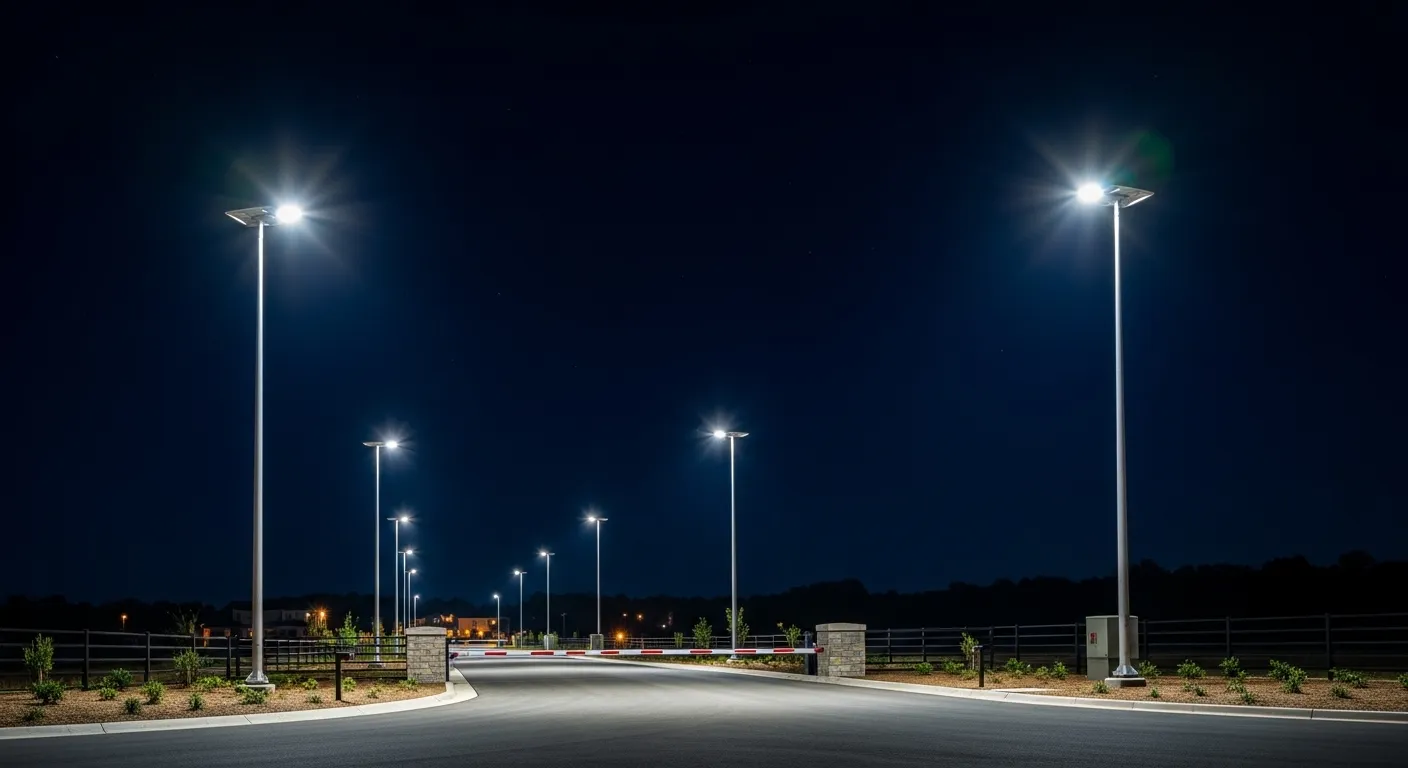
In my testing, a light rated for a 50-foot radius in the brochure actually provides “useful” light—the kind where you can see a black dog crossing the road—at about 20 feet. This matters for your wallet because it changes your pole spacing. If you trust the marketing fluff, you’ll space your poles 80 feet apart and end up with “zebra striping”—pockets of bright light followed by dangerous black holes. On a private road, those dark spots are where tires meet ditches. You need a Type III or Type IV light distribution pattern to push that light out along the road, not just in a circle around the pole.
3. The “Vampire Draw” and Controller Latency
Most people ignore the “brain” of the light—the charge controller. Cheap lights use PWM controllers that are about as efficient as a leaky bucket. They waste 30% of the energy coming from the panel. High-quality high lumen solar street lights for private roads use MPPT (Maximum Power Point Tracking) controllers.
Why does this matter? Because of latency. An MPPT controller can “find” power even on a cloudy Tuesday. A cheap controller will simply stop charging. Furthermore, many cheap lights have a high vampire draw, where the internal sensors (motion, Wi-Fi) eat up the battery faster than the sun can charge it. I’ve seen units die in the box because the internal “smart” tech drained the battery to zero during shipping, killing the cells permanently.
Featured Snippet Q&A: The No-Filter Facts
How many lumens are actually required for private road safety? For a private road where vehicles travel at 15–25 mph, you need a minimum of 8,000 to 12,000 verified lumens per fixture. Anything less fails to provide the necessary “throw” to illuminate hazards like potholes in time for a driver to react. High lumen solar street lights for private roads should provide a minimum of 150 lm/W to ensure efficiency.
Do high lumen solar lights work during consecutive cloudy days? Only if they have an autonomy rating of at least 3–5 days. This is achieved through large-capacity LiFePO4 batteries and MPPT controllers. Cheap units with PWM controllers usually die after one rainy afternoon because they lack the “intelligence” to manage power discharge effectively.
What is the lifespan of a solar street light on a private road? A professional-grade fixture should last 5 to 8 years. The LEDs are rated for 50,000 hours, but the battery is the weak link. Look for LiFePO4 (Lithium Iron Phosphate) chemistry, which supports over 2,000 charge cycles. Budget products usually fail within 18 months due to heat stress.
The “Masterclass” Buying Guide: Specs That Actually Matter
1. IP Ratings: The “Drown” Factor
Most manufacturers claim IP65, which means “water-resistant.” On a private road, that’s not enough. You want IP66 or IP67. When a summer thunderstorm hits with 40 mph winds, water is being power-washed into the seals. I’ve seen IP65 units with a “terrarium effect”—half an inch of water sloshing inside the lens—after just two months.
2. Battery Cycles and Depth of Discharge (DoD)
A battery might have 100Ah of capacity, but if it’s a cheap lead-acid or low-grade Lithium-ion, you can only use 50% before the voltage drops. This is the Depth of Discharge (DoD). You want Grade A LiFePO4 cells. They handle an 80–90% DoD without losing their ability to hold a charge.
3. NEMA Ratings and Wind Load
A high-lumen light usually comes with a massive solar panel. That panel is basically a sail. If the mounting hardware isn’t NEMA-rated for high-wind zones, a stiff breeze will turn your $400 investment into scrap metal. Look for galvanized steel; avoid stamped sheet metal.
The Wall of Shame: 7 Ways You’re Killing Your ROI
Avoid these seven sins if you want your road to stay lit:
- The “Set and Forget” Delusion: Dust and bird droppings create a “shading film.” If you don’t wipe your panels once a year, you lose 20% of your energy harvest.
- Mounting to “Flexible” Poles: Wood warps. When the post twists, your solar panel is no longer facing south. Use galvanized steel.
- Ignoring Motion Sensor Latency: If the sensor takes more than 0.5 seconds to trigger, you’ll be past the light before it hits 100% brightness.
- The “Amazon 800W” Trap: Buying based on “Watts” is for amateurs. Focus on verified lumens and battery watt-hours (Wh).
- Daisy-Chaining Connections: Never “hack” the wiring. Adding extra load will cause a “death spiral” where the battery never hits a full charge.
- Neglecting the NEMA Rating: Salty air or acidic rain will corrode unsealed terminals in weeks.
- Over-spacing Poles: Creating “Black Holes” is dangerous. Your eyes can’t adjust fast enough between 15,000-lumen glare and total darkness.
The “No-Fail” Installation Guide
Step 1: The “Compass” Test
In the Northern Hemisphere, panels must face South. I’ve seen panels facing North because “that’s where the road is.” Physics doesn’t care about your road.
Step 2: The “Shadow Audit”
Go to your spot at 2:00 PM. A single branch casting a line across the panel can reduce output by 40%. Clear the branch or move the pole.
Step 3: Torque and Tension
Use a torque wrench. Under-tighten and the light falls; over-tighten and the housing cracks. Use galvanized lag bolts, not wood screws.
Step 4: The Sealant Secret
Apply a bead of marine-grade silicone around the wire entry point. Temperature swings cause expansion; that tiny gap is all a spider needs to short out your MPPT controller.
Step 5: The “First Charge” Protocol
Do not turn the light on for the first 24–48 hours. Let it sit in the sun in the “OFF” position to balance the cells.
Regional Performance: Texas Heat vs. Michigan Snow
The Texas/Arizona “Bake”
Heat kills batteries. In 110°F heat, a metal housing can reach 150°F. I prioritize “Split-Systems” where the battery is shaded by the panel to prevent swelling.
The Michigan/Minnesota “Freeze”
Standard Lithium cannot charge below 32°F. You must buy lights with “Self-Heating” LiFePO4 batteries. Also, use a steeper panel tilt (45–60 degrees) to shake off snow.
The Cold Truth: Who Should NOT Buy This?
- The “Canopy” Dwellers: If your road is a tunnel of trees, solar won’t work. Cut branches or run AC power.
- The Northern Shadow Dwellers: If you’re on the north side of a steep mountain, you won’t get the 4-6 hours of sun needed to prevent “chronic undercharge.”
- The Extreme Budget Shopper: If you aren’t willing to spend at least $350–$500 per pole, you’re just buying future trash.
Internal Linking (ecopowersence.com)
- Learn to identify and eliminate vampire draw in your outdoor electronics.
- Understand the differences between Monocrystalline and Polycrystalline panels.
- Read our guide on commercial-grade solar integration for estates.
- Use our preventative maintenance checklist for solar batteries.
The Final Verdict: My Personal Recommendation
If I were standing on your private road right now, I’d tell you this: Stop looking for a bargain and start looking for a solution. The industry is saturated with garbage. I’ve seen high hopes turn into dark driveways more times than I can count.
If you want a system that survives the next five years, you need a Split-Panel Monocrystalline system with a Grade-A LiFePO4 battery and an MPPT controller. Skip the flashy “all-in-one” designs that look like sleek gadgets. Give me the industrial-looking, heavy-duty split system with a dedicated 100W+ panel and 15,000 lumens.
When it’s 2 AM and pouring rain, you don’t want “marketing fluff.” You want light. High lumen solar street lights for private roads are a game-changer—but only if you respect the physics. Buy once, cry once. Get the industrial grade, face it South, and sleep easy knowing your road is secure.
👉 Best Solar Powered Outdoor Smart Devices (2026)
Check Latest prices of solar street lights

I Am Sarah Miller is a passionate writer focused on sustainability, eco-friendly living, and modern environmental solutions. Through her work, she aims to inspire readers to make smarter, greener choices for a better future. She regularly shares insights and practical tips on her website, ecopowersence.com.