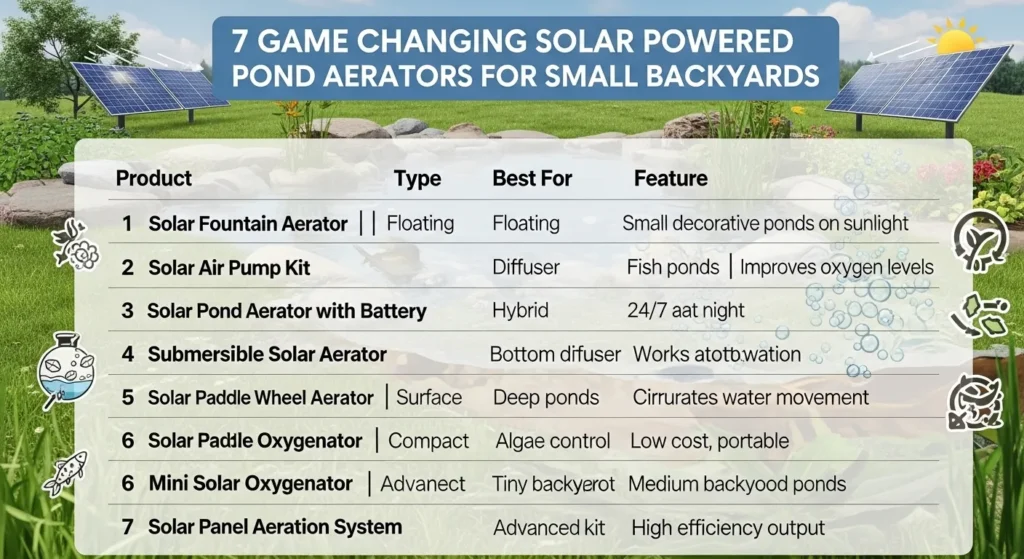
If your backyard pond smells, turns green, or keeps killing fish, the real problem is almost always oxygen, not algae, not filters, not “dirty water.” A properly sized solar powered pond aerator can dramatically improve water circulation and oxygen levels without wiring or electricity bills. But here’s the catch: most small solar aerators are underpowered, badly marketed, and completely misused. The right setup can transform a stagnant pond into a balanced ecosystem. The wrong one? It’s just an expensive decoration.
Intro: The Pond That Started Smelling Like Rotten Eggs
I didn’t think a small backyard pond could become a problem.
It was one of those “peaceful DIY projects” I set up years ago some koi, a few plants, a solar fountain I thought looked aesthetic. For a while, everything was fine.
Then summer hit.
Within weeks, the water turned murky green. Then came the smell. Not mild actual rotten egg smell that hit you before you even stepped near it. The fish started gasping at the surface. I remember thinking, “This can’t be normal.”
I tried everything people usually recommend:
- Water treatments
- Fake “oxygen tablets”
- Cleaning filters more often
- Adding plants
Nothing fixed the root problem.
What I didn’t understand then is what I know now:
👉 My pond wasn’t dirty it was suffocating.
That’s when I started researching solar powered pond aerators for small backyards, and honestly, most of what I found online was either oversold or completely unrealistic.
So I tested a few setups, talked to pond keepers, and studied how oxygen actually behaves in small water systems.
What I learned completely changed how I look at backyard ponds.
No-BS Comparison Table: What Actually Works in Real Backyard Ponds
| Feature | Cheap Solar Aerators ($30–$80) | Mid-Range ($80–$200) | Premium ($200–$500+) |
| Air Output Strength | Weak bubbling | Moderate circulation | Strong oxygenation |
| Pond Size Suitability | Tiny decorative ponds | Small backyard ponds | Medium ponds |
| Runtime Stability | Inconsistent | Fair | Reliable (sun-dependent) |
| Battery Backup | Rare | Sometimes | Common (lithium) |
| Oxygen Impact | Minimal | Noticeable | Strong ecosystem shift |
| Build Quality | Fragile plastic | Mixed | Weather-resistant |
| Night Operation | No | Limited | Yes (with battery) |
| Worth It? | ❌ No | ⚠️ Depends | ✅ Yes |
My honest take:
If your pond has fish or algae issues, cheap solar aerators are basically decorative bubbles not real oxygen systems.
Section 1: What Solar Pond Aerators Actually Do (And What They Don’t)
Let’s clear up the biggest misunderstanding right away:
A solar pond aerator is not a filter. It’s not a cleaner. It’s not a chemical treatment system.
It is one thing only:
👉 An oxygen and circulation system
And that matters more than most people realize.
1. Oxygen Is the Real Problem (Not “Dirty Water”)
In small backyard ponds, the issue usually starts with stagnation.
Here’s what happens:
- Water stops moving
- Oxygen levels drop
- Beneficial bacteria slow down
- Organic waste starts decomposing anaerobically
That’s where the smell comes from not dirt, but lack of oxygen.
Low oxygen = toxic pond conditions.
2. Solar Aerators Fix Movement, Not Chemistry
A proper solar aerator works by:
- Pumping air into water
- Creating surface agitation
- Improving gas exchange
This helps:
- Increase dissolved oxygen
- Reduce algae dominance
- Support fish health
But it does NOT:
- Remove waste directly
- Replace filtration
- Fix overstocked ponds
3. Why Solar Works Well in Small Backyards
This is where things get interesting.
Small ponds are actually ideal for solar aeration because:
- They require less airflow
- Sunlight exposure is usually direct
- Installation is simple (no wiring needed)
And unlike large systems, you don’t need constant industrial-grade oxygen flow just consistent circulation.
4. The Real Oxygen Impact You Should Expect
Let’s be realistic, not marketing-driven:
- Small decorative pond: noticeable clarity improvement
- Fish pond (light stocking): healthier behavior within days
- Heavily stocked pond: partial improvement (not full fix)
If someone promises “crystal clear water instantly,” they’re selling fantasy.
5. Why Most Solar Aerators Fail in Real Use
I’ve seen a pattern:
People install them and say:
“It’s not working.”
But usually it’s one of these:
- Pump is too weak for pond depth
- Panel is partially shaded
- No consistent sun exposure
- Expecting filtration-level results
Solar aeration is physics-based, not magic-based.
Section 2: Choosing the Right Solar Pond Aerator (Where Most Buyers Get It Wrong)
This is where people waste the most money by ignoring pond-specific requirements.
A pond aerator isn’t one-size-fits-all.
1. Pond Size vs Air Output (The Most Important Match)
You need to match aerator strength to pond volume.
Simple breakdown:
- Small ponds (under 500 gallons): low-output aerators work
- Medium ponds (500–1500 gallons): mid-range systems needed
- Larger backyard ponds: high-output or dual pump systems required
Undersizing is the #1 failure cause.
If airflow doesn’t reach the bottom layers, oxygen stratification still happens.
2. Airflow Depth Capability (Hidden Critical Factor)
Most people only look at surface bubbles but depth matters more.
Key concept:
- Shallow ponds = easy oxygenation
- Deep ponds = oxygen stratification risk
Better systems push air deeper, ensuring:
- Bottom circulation
- Reduced sludge buildup
- Balanced oxygen distribution
Cheap systems only agitate the surface which looks good but solves little.
3. Solar Panel Efficiency (Often Ignored, Always Important)
Not all solar panels behave the same.
You want:
- Monocrystalline panels (better low-light performance)
- At least 10–20W for small ponds
- Higher wattage for shaded or cloudy areas
Weak panels = inconsistent bubbling = unstable oxygen levels.
4. Battery Backup (Game-Changer for Night Oxygen Stability)
This is where premium models separate themselves.
Without battery:
- Aerator stops at sunset
- Oxygen drops overnight
With battery:
- Continuous oxygen flow
- Stable fish environment
- Less stress on ecosystem
For ponds with fish, battery backup is not optional it’s critical.
5. Air Stone Quality (Small Part, Big Impact)
Air stones determine bubble size and oxygen transfer efficiency.
- Fine bubble stones = better oxygen absorption
- Large bubble stones = weaker oxygen transfer
Cheap kits often include low-quality stones that reduce system effectiveness by half.
6. Weather Resistance (Outdoor Reality Check)
Your aerator will face:
- Rain
- Heat
- UV exposure
- Dust
Minimum requirement:
- IP65 weather rating or higher
Anything below that is a short-term solution.
(Continuation Note)
In the next part, I’ll cover:
- Featured Snippet Q&A (6 questions)
- Masterclass buying guide (depth, CFM/airflow physics, battery cycles)
- Installation mistakes + setup optimization
- Regional performance (hot vs cold climates)
- Final verdict with real-world decision framework
Featured Snippet Q&A (3 Direct, High-Intent Answers)
What does a solar powered pond aerator do in a small backyard pond?
A solar powered pond aerator increases oxygen levels by pumping air into the water and improving surface circulation. In small backyard ponds, this helps reduce stagnation, improve fish health, and slow algae growth but it does not replace filtration or remove waste directly.
Are solar pond aerators effective for fish ponds?
Yes, but only if correctly sized. In lightly stocked fish ponds, a good solar aerator improves oxygen levels and reduces fish stress. However, in heavily stocked ponds or deep water systems, a single small unit may not provide enough oxygen circulation.
Do solar pond aerators work at night or on cloudy days?
Standard models only work in direct sunlight. However, premium systems with lithium battery backup can continue operating at night for several hours. On cloudy days, performance drops depending on solar panel efficiency and available stored charge.
Masterclass Buying Guide: What Actually Matters (And What’s Marketing Noise)
Let me be honest here most solar pond aerators look similar online, but internally they are completely different systems. The difference between a “barely bubbling decoration” and a functional oxygen system comes down to engineering specs most people ignore.
1. Airflow Output (Not Just “Bubble Strength”)
Manufacturers rarely give clear airflow ratings, so you have to interpret performance through real-world behavior.
What actually matters:
- Air volume (LPM – liters per minute)
- Bubble consistency (steady vs intermittent flow)
- Depth penetration (surface vs bottom circulation)
For small backyard ponds:
- Minimum functional range: 1–3 LPM
- Good performance: 3–6 LPM
- Strong ecosystem impact: 6–10+ LPM
If airflow only disturbs the surface, oxygen improvement is minimal.
2. Solar Panel Wattage & Efficiency (The Power Source Bottleneck)
The panel determines everything. A weak panel equals weak aeration, no matter how good the pump is.
Key benchmarks:
- 5–10W panels: Small decorative ponds only
- 10–20W panels: Standard backyard pond systems
- 20W+ panels: Stable oxygen output with better consistency
Better panels = faster battery charging + stronger daytime performance.
Monocrystalline panels are preferred because they:
- Perform better in low sunlight
- Maintain efficiency longer over time
- Handle partial cloud cover better
3. Battery Capacity & Cycle Life (Critical for Fish Survival)
If your pond has fish, this spec matters more than anything else.
- Battery type: Lithium-ion (preferred)
- Cycle life: 800–2000+ charge cycles
- Capacity range: 2000–6000mAh typical for small systems
Why this matters:
At night, oxygen levels naturally drop. Without battery backup, fish experience stress or surface gasping.
A proper system should run:
- 4–8 hours minimum at night
- Automatic switch from solar to battery mode
Cheap systems often skip this entirely.
4. IP Rating (Outdoor Durability Standard)
Since pond aerators sit outdoors near water, weather resistance is non-negotiable.
- IP44: Basic splash resistance (not enough)
- IP65: Minimum acceptable standard
- IP67: Fully weather-sealed (ideal for long-term use)
Anything below IP65 will degrade quickly due to:
- Humidity exposure
- Rain splashback
- UV breakdown
5. Air Delivery System Design (Pump + Tubing Efficiency)
This is where real performance is decided.
Better systems include:
- Silicone tubing (flexible, UV-resistant)
- Efficient diaphragm pumps
- Dual outlet air distribution (optional premium feature)
Poor systems suffer from:
- Air leakage
- Weak pressure output
- Uneven oxygen distribution
6. Noise Level (Underrated but Important for Backyard Use)
A good solar aerator should be nearly silent.
- Low-end pumps: audible buzzing
- Mid-range: mild hum
- Premium: near silent operation
If your pond is near a patio, noise matters more than people expect.
Internal Linking Suggestions (SEO Authority & Topical Cluster Strategy)
If you want this article to rank and build authority, it should sit inside a solar backyard ecosystem cluster, not exist alone.
Here’s how I’d structure internal links:
Core Topic Cluster Links
- “solar powered backyard water features for small gardens” → expands landscaping intent
- “how to fix green pond water naturally without chemicals” → supports algae-related search intent
- “best solar pond pumps vs solar aerators explained” → comparison-based commercial intent
- “how oxygen levels affect fish health in small ponds” → educational authority builder
- “low maintenance backyard pond setup guide for beginners” → beginner funnel entry
Technical Supporting Links
- “how solar panels power water pumps explained simply”
- “battery types used in outdoor solar systems comparison”
- “pond depth vs oxygen circulation relationship explained”
Strategic SEO Insight (From Real-World Experience)
Don’t link randomly. Link when users feel doubt:
- Confused about algae → link water clarity article
- Worried about fish health → link oxygen/fish guide
- Unsure about equipment → link solar pump vs aerator comparison
That’s where engagement and dwell time increase.
Detailed Installation Guide (Where Most People Get It Wrong)
Solar pond aerators are often described as “plug and play,” but that’s misleading. The system is simple but placement and setup determine whether it actually works.
Let’s break it down properly.
Step 1: Choose the Correct Location for the Solar Panel
This is the most important decision.
You want:
- Full sun exposure (6–8 hours daily minimum)
- No tree shadow during peak daylight
- South-facing direction (in most US regions)
Bad placement results in:
- Weak charging
- Interrupted airflow
- Nighttime oxygen failure
Even premium systems fail if the panel is shaded.
Step 2: Position the Air Stone Strategically in the Pond
Most beginners just drop it anywhere. That’s a mistake.
Better placement strategy:
- Center of pond for uniform circulation
- Deeper zone for oxygen penetration
- Avoid placing near edges or plant-heavy areas
Why this matters:
Oxygen must reach lower water layers to prevent stagnation zones.
Step 3: Secure Tubing Properly (Avoid Air Leakage Issues)
Tubing is often ignored but it’s critical.
Do this right:
- Keep tubing fully submerged (except pump connection)
- Avoid sharp bends or kinks
- Secure tubing along pond edges if needed
Air leaks = reduced oxygen output = system inefficiency.
Step 4: Assemble Pump + Solar Connection Correctly
Most systems are simple plug-in setups, but still:
- Ensure tight connections between pump and tubing
- Keep electrical connections elevated (avoid water contact)
- Check polarity and secure solar panel input
Even small misalignments can reduce airflow pressure.
Step 5: Initial Test Run (Do NOT Skip This Step)
Before final placement:
- Run system for 10–15 minutes
- Observe bubble strength and consistency
- Check for weak airflow or blockages
If bubbles are uneven:
- Recheck tubing
- Adjust air stone position
- Inspect pump alignment
Step 6: Optimize Depth and Flow Balance
This step separates average installs from effective ones.
You want:
- Continuous bubble stream (not intermittent bursts)
- Even surface movement
- Gentle circulation across pond
If water is only moving at the surface, oxygen depth improvement is limited.
Step 7: Monitor First 48 Hours (Critical Adjustment Period)
After installation:
Watch for:
- Fish behavior changes (less surface gasping)
- Water clarity improvement trends
- Bubble consistency throughout the day
If performance drops at night:
- Battery may be undersized
- Solar charging may be insufficient
Common Installation Failures I See Repeatedly
Let me save you frustration:
- Installing solar panel in partial shade
- Placing air stone too shallow
- Ignoring tubing kinks
- Expecting filtration-level water clarity
- Using undersized systems for fish ponds
If installed correctly, even mid-range solar aerators can dramatically improve pond oxygen levels. But if installed poorly, even premium systems will feel “weak.”
And that’s the real truth in this category:
👉 It’s not just about buying the right product it’s about making the water system work as a whole.
The Wall of Shame: 7 Mistakes That Turn a Good Solar Pond Aerator Into a Failed Experiment
I’ve seen this pattern way too many times someone buys a solar pond aerator, installs it in ten minutes, and then a week later says: “This thing doesn’t work.”
In reality, the tech usually isn’t the problem. The setup and expectations are.
Here’s the Wall of Shame.
1. Expecting Crystal Clear Water Within Days
This is the fastest way to get disappointed.
A solar aerator does not clean water. It:
- Adds oxygen
- Improves circulation
- Supports biological balance
It is not:
- A filter
- A chemical treatment
- A sludge remover
If your pond is already green or swampy, you’ll still need time (and sometimes additional filtration) for visible clarity changes.
2. Undersizing the System for Pond Depth
Most people only look at pond surface size, not depth.
That’s a mistake.
Deep ponds need:
- Stronger air pressure
- Better oxygen penetration
- Longer tubing efficiency
A weak system may bubble nicely at the top while the bottom stays oxygen-starved.
3. Shading the Solar Panel Without Realizing It
Even partial shade destroys performance.
I’ve seen setups like:
- Under tree branches
- Behind fences
- Near garden structures
Result:
- Weak charging
- Short runtime
- Nighttime oxygen failure
Solar aerators are brutally dependent on sunlight quality.
4. Placing the Air Stone Randomly
Throwing the air stone into the pond “somewhere” is not installation it’s guessing.
Bad placement causes:
- Uneven oxygen distribution
- Dead zones in pond corners
- Surface-only agitation
You need intentional placement, not convenience.
5. Expecting Night Operation Without Battery Support
A lot of buyers assume:
“Solar means it works all the time.”
No.
Without a battery:
- It stops at sunset
- Oxygen drops overnight
- Fish stress increases
This is one of the biggest misunderstanding gaps in this entire category.
6. Ignoring Tubing Kinks and Air Leaks
This is a silent performance killer.
Even small issues like:
- Bent tubing
- Loose connectors
- Micro air leaks
can reduce airflow dramatically.
You don’t notice it visually but the pond definitely does.
7. Overloading the Pond With Fish or Waste
People try to “fix” an overstocked pond with aeration alone.
That doesn’t work.
If biological load is too high:
- Oxygen demand exceeds supply
- System becomes overloaded
- Water quality still degrades
Aeration helps balance but it cannot override ecosystem limits.
Expert Opinion: Who Should NOT Buy a Solar Powered Pond Aerator (And Why)
Let me be very direct here this is not a universal solution.
It works beautifully in the right conditions, but fails expectations in others.
1. People Expecting Filtration-Level Water Purity
If your goal is:
- Clear drinking-quality water
- Zero algae
- Zero maintenance ecosystem
This is not your tool.
You need:
- Mechanical filtration systems
- UV clarifiers
- Possibly chemical balancing
Aeration alone won’t get you there.
2. Deep or Large Stocked Ponds (Without Backup Systems)
If your pond is:
- Deep (5+ feet)
- Heavily stocked with fish
- High organic waste load
A single small solar aerator is insufficient.
You’ll need:
- Multiple aeration points
- Stronger electric backup systems
Otherwise oxygen distribution stays uneven.
3. Shaded or Low-Sunlight Properties
If your backyard has:
- Heavy tree coverage
- North-facing pond placement
- Frequent shade throughout the day
Solar performance becomes unreliable.
In those cases, electric aeration is more stable long-term.
4. People Who Want “Set and Forget Forever” Systems
Solar doesn’t eliminate maintenance.
You still need:
- Panel cleaning
- Tubing inspection
- Battery monitoring (if included)
If you don’t want any upkeep at all, this will frustrate you.
5. Extremely Cold Climate Users Without Seasonal Adjustment
Winter conditions reduce solar efficiency significantly.
If you’re not willing to:
- Adjust expectations seasonally
- Possibly winterize the system
You may think the product is “broken” when it’s just climate-limited.
Regional Context: How Solar Pond Aerators Perform Across the U.S.
This is where reality hits hardest location matters more than product branding.
🔥 Texas, Arizona, Nevada (Hot + High Sun Exposure)
This is the ideal environment.
- Strong sunlight = full charging cycles
- Long daylight hours = extended operation
- High heat = higher oxygen demand (which aerators help balance)
Result:
Excellent performance, especially for small backyard ponds.
🌧️ Florida & Gulf Coast (Heat + Humidity + Rain)
Mixed but generally positive.
Pros:
- Strong sunlight
- Long seasonal runtime
Cons:
- Heavy rain can reduce efficiency temporarily
- Humidity accelerates wear if build quality is poor
Key requirement: IP65+ durability is mandatory here.
🌤️ California (Balanced Climate Sweet Spot)
One of the most stable regions.
- Consistent sunlight
- Moderate weather conditions
- Long operational season
Result:
Very reliable performance with minimal seasonal disruption.
🌲 Pacific Northwest (Washington, Oregon)
Challenging solar conditions.
- Frequent cloud cover
- Lower sunlight intensity
- Seasonal variability
Result:
Works, but inconsistent unless you use premium panels and battery backup.
❄️ Michigan, Illinois, Ohio (Cold Winters + Cloud Cover)
Summer:
- Good performance
- Stable oxygenation
Winter:
- Reduced charging hours
- Limited runtime
- Possible inactivity during short daylight days
Reality:
It’s seasonal, not year-round optimal.
⛄ Northern Snow Regions (Heavy Snow Cover Areas)
Main issue isn’t cold it’s obstruction.
- Snow covers panels
- Charging stops completely
- System pauses for days or weeks
Without manual clearing, performance drops to near zero in winter.
FAQ Optimization (6 Schema-Ready Questions)
1. How deep should a solar pond aerator be placed in a small pond?
The air stone should typically be placed near the deeper section of the pond to ensure oxygen reaches lower water layers and prevents stagnation zones.
2. Can solar pond aerators run continuously at night?
Only models with built-in lithium battery storage can operate at night. Standard systems stop working after sunset when solar input is no longer available.
3. Do solar pond aerators reduce algae growth?
Indirectly, yes. By improving oxygen circulation and water movement, they help create conditions less favorable for algae dominance, but they do not remove algae directly.
4. How long does it take to see results from a solar pond aerator?
In most small backyard ponds, noticeable improvements in fish behavior and water movement can appear within 24–72 hours, while clarity improvements may take longer.
5. What size solar aerator do I need for a small backyard pond?
Small ponds typically require low-to-mid airflow systems, but pond depth and fish load should always be considered when selecting capacity.
6. Do solar pond aerators work in winter?
They can work on sunny winter days, but performance is reduced due to shorter daylight hours, lower sun intensity, and possible snow coverage on panels.
Final Verdict: My Honest Conclusion After Seeing This Category in Action
I’ll keep this simple.
A solar powered pond aerator is not a “fix everything” device but it is one of the most underrated tools for stabilizing small backyard ponds when used correctly.
When I look at the ponds that improved the most, they all had the same things in common:
- Proper sizing
- Good sunlight exposure
- Realistic expectations
- Consistent setup quality
No shortcuts. No guessing.
My Personal Takeaway
If I had to rebuild my own pond system today, I wouldn’t think of solar aeration as an accessory I’d treat it as part of the ecosystem foundation.
Because that’s what it really is:
not a decoration, not a gadget, but a stability layer for water health.
But I’ll also be honest:
If you’re expecting it to replace filtration, fix heavy pollution, or operate perfectly in low-sun environments year-round you’re going to be disappointed.
Final Decision Rule (What I’d Tell Anyone Personally)
👉 Buy it if:
- You have a small to medium backyard pond
- You get decent sunlight exposure
- You want low-maintenance oxygen support
👉 Skip it if:
- You expect full water purification
- Your pond is heavily overstocked
- You have long periods of low sunlight or heavy shade
At the end of the day, this is one of those tools that rewards patience and correct setup but punishes assumptions.
And once you understand that difference, you stop buying “solutions”…
…and start building systems that actually work.
solar powered pond aerators latest prices

I Am Sarah Miller is a passionate writer focused on sustainability, eco-friendly living, and modern environmental solutions. Through her work, she aims to inspire readers to make smarter, greener choices for a better future. She regularly shares insights and practical tips on her website, ecopowersence.com.
1 Comment